

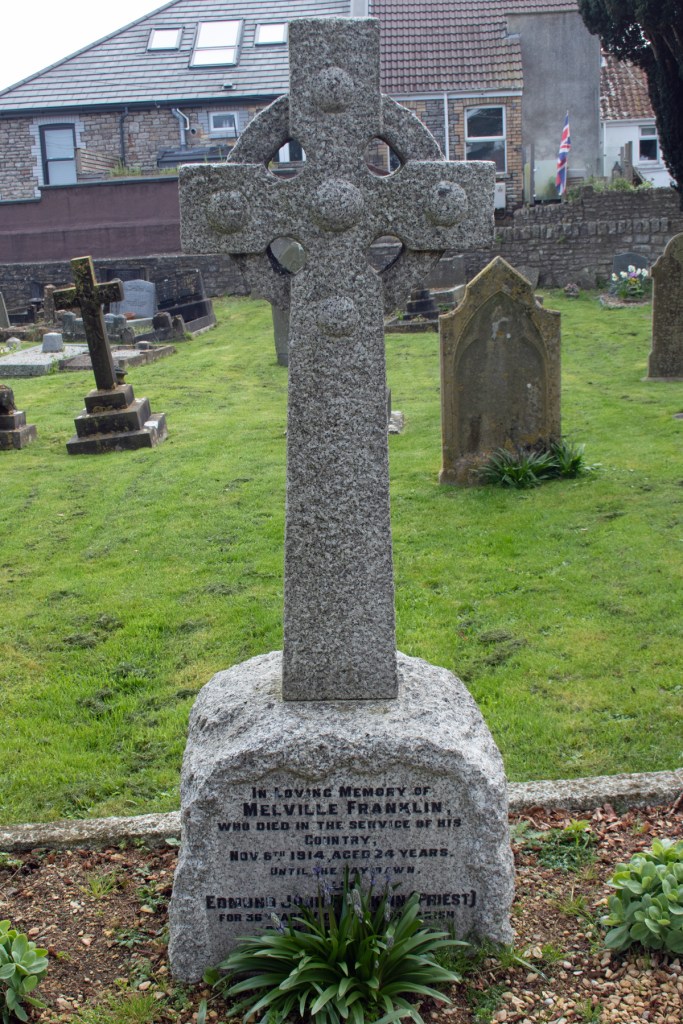
Melville Franklin was born on 25th November 1890, the youngest of seven children to Edmund and Alice Franklin. Edmund had been born in Birmingham, and had taken up holy orders. He and Alice married in the UK, but their first born, a boy called Victor, had been born in Australia, while their second child, another son called Harold, had been born a year later in Birmingham.
By the late 1880s, Reverend Franklin had taken up the post of vicar of St Nicholas’ Church in Whitchurch, near Bristol, and the family moved there. Unsurprisingly, the parish record for both Melville and his older sister Elsie, both of whom had been born in the village, shows they were baptised in the church by their father.
The Franklin children’s upbringing stood them in good stead in life. The 1901 census found that Victor and Harold had both found work as clerks – Victor for a timber merchant, and Harold for an oil cake merchant – while the following census, in 1911, recorded that another brother, Percival, was a motor expert for an insurance company. Melville, aged 20 by this point, had also found employment as a clerk, his employer being a wine merchant.
Melville wanted to expand his horizons further and, on 25th February 1911, he joined the Royal Naval Volunteer Reserve. His service records are sparse, but they confirm that he was 6ft 1ins (1.85m) tall, had fair hair, grey eyes and a fresh complexion.
Melville was formally mobilised on 22nd August 1914. At this early point in the war, there was a surplus of more than 20,000 men from the Royal Naval Volunteer Reserve, and the powers that be recognised that this was enough to form three brigades of land troops – one of Marines and two Naval.
Able Seaman Franklin was assigned to the Collingwood Battalion of the Royal Naval Division, and appears to have found himself heading to Belgium via Dunkirk by the late summer.
In the general rush to get men to the front line, more than three quarters of the troops went without even the most basic of equipment – packs, mess tins, water bottles.
The Division had no artillery, field ambulances or other support. Melville’s brigade was provided with old rifles, which they were given just three days before embarking for Europe.
Able Seaman Franklin landed in Antwerp shortly before the German invasion, and in the retreat, more than 1500 troops were captured and interned in the Netherlands. Melville, it would seem, was one of those who managed to escape back to England.
This was only to be a very temporary reprieve for Able Seaman Franklin, however. He had returned to Bristol, but had contracted enteric fever, also known as typhoid. This was to get the better of him, and he succumbed to it on 6th November 1914. He was weeks away from his 24th birthday.
Melville Franklin was laid to rest in the graveyard of St Nicholas’ Church, Whitchurch, in a funeral likely to have been presided over by his father, Edmund.
 Death and Service