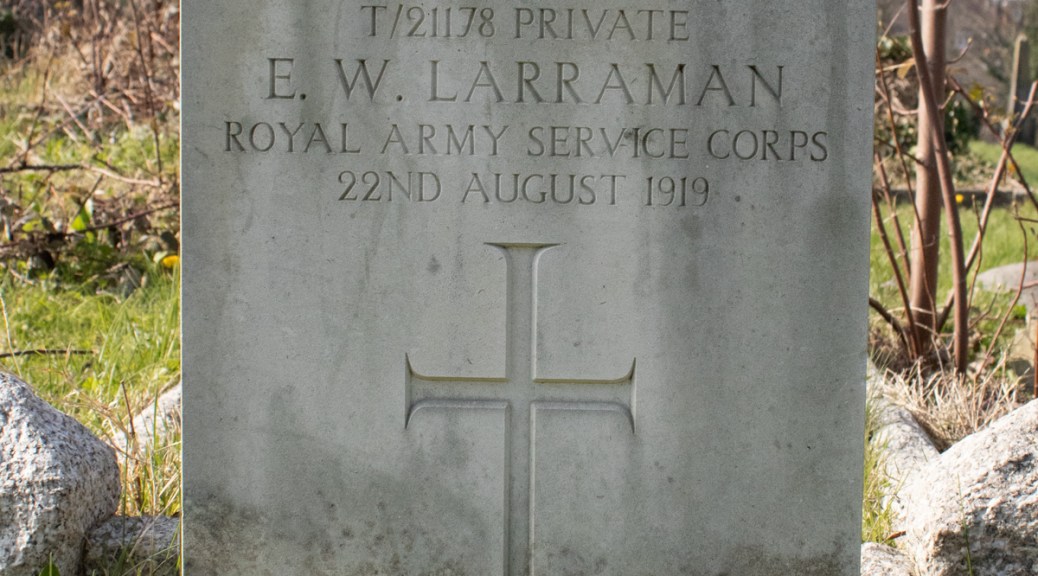
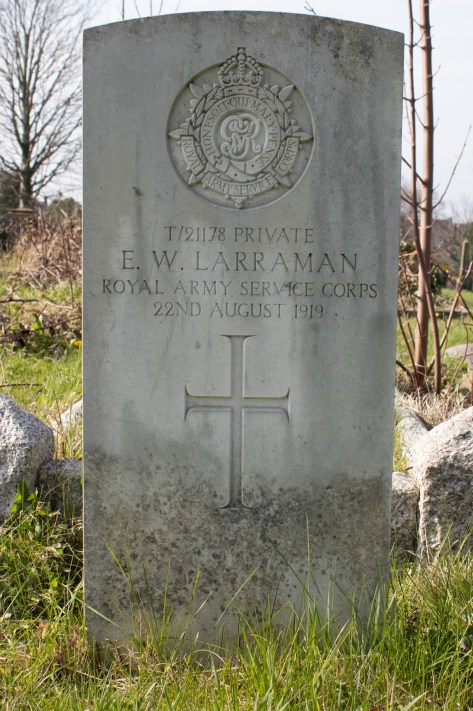
Category Archives: history

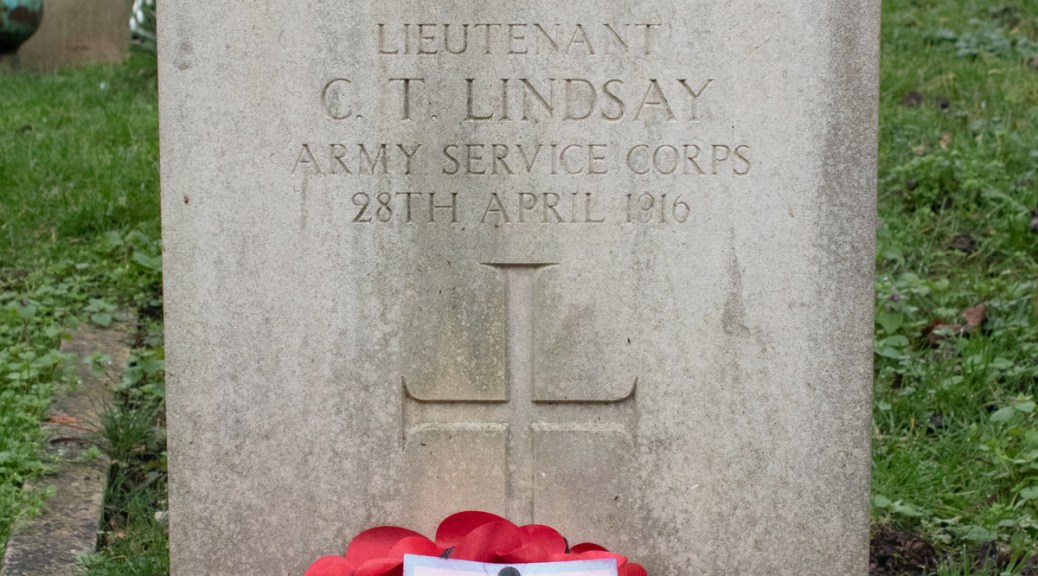
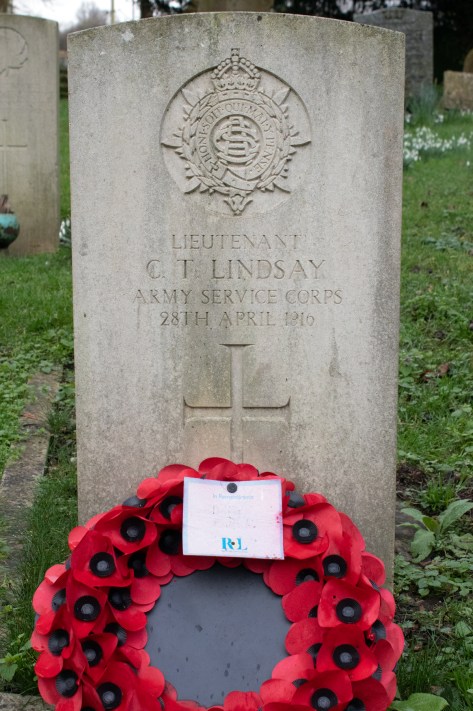
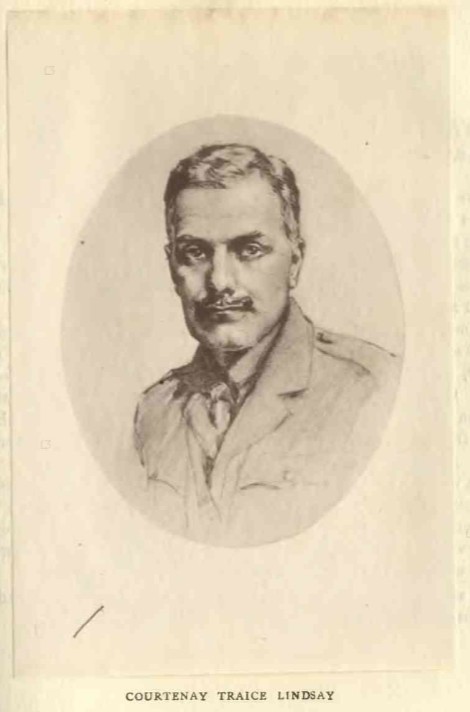
Lieutenant Courtenay Lindsay

Lieutenant Courtenay Lindsay

Courtenay Traice Lindsay was born in Belfast, Northern Ireland, on the 11th December 1874. The second of four children, he was the only son to Thomas and Ruth Lindsay. Thomas was an art teacher and examiner and, by the time of the 1881 census, he had moved the family to Rugby, Warwickshire, setting them up in the Temple Art Museum on Barby Road.

Education was important to Thomas, and it was obvious that his son’s passion was art. “He entered [Rugby] School in 1888 and left in 1892. He was afterwards Drawing Master at Seafield Park Engineering College, Hampshire, Trad Designer for textiles and pottery, and Examiner under the Board of Education in Geometrical Drawing.” [Memorials of Rugbeians Who Fell In The Great War, Volume VII]

On 10th January 1903, Courtenay married Charlotte Wetenhall. The daughter of a man of means, she was born in Stanwick, Northamptonshire, and the couple exchanged vows in her local parish church.

Courtenay’s mother died in 1905 and by the time of the 1911 census, he and Charlotte were living at 143 Beaufort Street, Chelsea, Middlesex. A five-storey Georgian building, they had let our rooms to aspiring artist Marion Forbes. Courtenay was an artist and designer himself, and he and Charlotte had an eight-month-old son, Courtenay Jr.

When war broker out, Courtenay stepped up to play his part. He gained a commission in the Army Service Corps, but did not see any service overseas. “He… was engaged on Road Transport, in the Northern Command. Hard work in the Transport Service undermined his constitution, and he died of heart failure, following on septic poisoning, on April 28th, 1916. Age 41.” [Memorials of Rugbeians Who Fell In The Great War, Volume VII]

Courtenay Traice Lindsay died at Burnham Abbey, near Maidenhead, Buckinghamshire. Interestingly, while Charlotte and their son were living four miles north in Burnham Beeches, he was laid to rest in Dorney Burial Ground, a short walk to the south of the hospital.


Lieutenant Courtenay Lindsay
(from Memorials of Rugbeians Who Fell In The Great War, Volume VII)

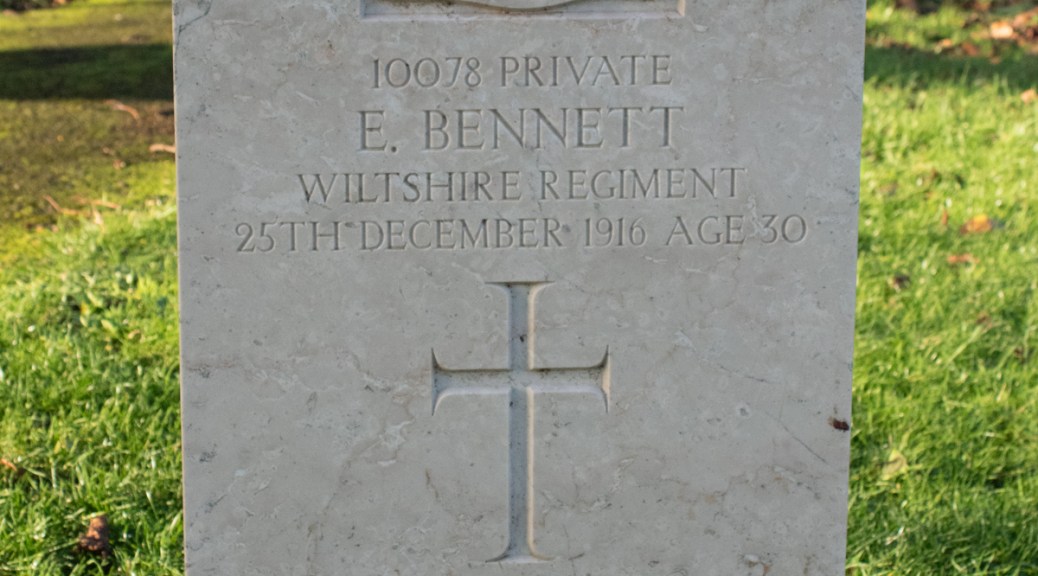
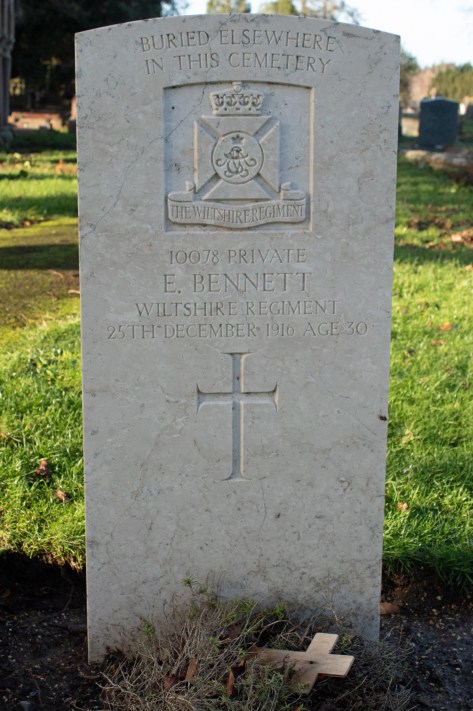
Private Ernest Bennett

Private Ernest Bennett

Ernest Bennett was born in Calne, Wiltshire, early in 1887, and was the only child to Henry and Elizabeth. Henry was a general labourer and carter for a local mill, but when he son completed his schooling, he took work as a mason’s labourer.

Alongside his paid work, Ernest also volunteered with the local militia, as a Private in the 4th Battalion of the Wiltshire Regiment. He also fell in love and, on the 6th December 1913, he married Emily Hitchens. The couple set up home in Trowbridge, and went on to have two children: Phyllis and Nelson.

When war broke out, Ernest’s time in the army proved invaluable. He was mobilised on the 1st September 1914, and assigned to the 3rd Battalion of his former regiment. Private Bennett’s medical report shows that he was 5ft 8.5ins (1.74m) tall and weighed 140lbs (63.5kg). He had fair hair, blue eyes and a fair complexion.

Details of Private Bennett’s time in the army are sparse, but it is clear that he was sent to France by the end of November. He wasn’t overseas for long, however, and was back in Britain by the first week of February 1915. The reason for Ernest’s return is unclear, but it is likely to have related to his health: on the 2nd September 1915, he was medically discharged from the army.

At this point, Ernest’s trail goes cold. He appeared to have gone back home as, on Christmas Day 1916, this is where he passed away. He was 29 years of age.

The body of Ernest Bennett was laid to rest in Trowbridge Cemetery: the exact location has been lost to time, but he is commemorated with a CWGC headstone close to some other war graves.


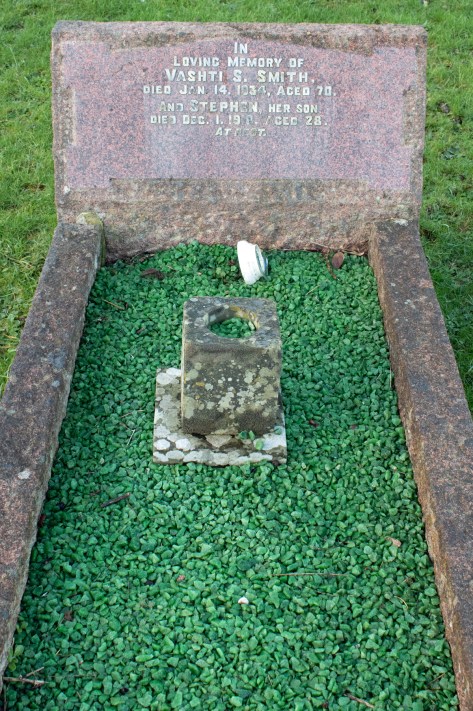
Private Stephen Smith

Private Stephen Smith

Stephen Smith was born in Hilperton Marsh, Wiltshire, in 1890. The fourth of eight children, he was the second of three sons to Thomas and Vashti Smith. Thomas was a hawker, and the family were living at 14 Islington Place when Stephen was born.

By the time of the 1901 census, the family had moved to 65 Shails Lane, slightly closer to Trowbridge town centre. Three of the family – Thomas, Vashti (who went by her middle name, Sarah), and their oldest child, Selina – were all employed in hawking. Stephen, just 12 years of age, was still at school, but his older brother, Alfred, was earning a little by collecting rags.

On 30th August 1908, Stephen married Beatrice Harding. They were both just 18 years of age at the time, and it seems to have been a love match: they went on to have three children, but their eldest, daughter Annie, was not born until 1911.

By the time of that year’s census, the young were renting a tenement at 5 Burbidge’s Yard. Just around the corner from Stephen’s Parents in Shails Lane, it was small courtyard filled with dyers, needleworkers, carpenters and hawkers.

Stephen also wanted to do his bit in the service of his King and, on the 14th June 1908, he enlisted in the 3rd Battalion of the Wiltshire Regiment. His service papers show that he was 5ft 7.5ins (1.71m) tall, and weighed 155lbs (70.3kg). He was noted as having brown hair and brown eyes.

Over the next four years, Stephen remained on home soil. He proved his mettle, and was appointed to Lance Corporal on 21st June 1911, and Corporal less than a year later. In October 1912, he extended his service for another four years. By June 1913, Stephen had been promoted again, his exemplary service resulting in him being made Sergeant.

War broke out in the summer of 1914, and Sergeant Smith found that his rank meant that he wouldn’t be able to serve with his men. At his own request, he reverted to the rank of Private and, on 11th September, he transferred to the 1st Battalion and was sent to France.

Private Smith’s unit fought at the Battle of Messines, and he was injured there. A gunshot wound to his right foot meant a medical evacuation to Britain, and he was admitted to the 2nd Western General Hospital in Manchester, Lancashire, for treatment.

Following his discharge, Stephen remained on home soil, but his health was becoming affected in unexpected ways. He had developed varicose veins in late childhood, and these developed to the point where he was not longer fit for military duty. He was discharged on 15th April 1916, and returned home to Trowbridge. The condition was declared not to be related to his service, so he did not receive any recompense for it.

By the spring of 1917, another issue had presented itself. Stephen was suffering from tuberculosis, and the prognosis was not good. “In my opinion [Private Smith] acquired the disease whilst in the service and the disease was aggravated in consequence of his military duties. He is suffering from the disease in rather an advanced stage and it does not appear to me probable that he will live for another year.” Signed Leonard Crossley MD, County Tuberculosis Officer. [Medical Report on Stephen Smith: 28th March 1917]

Ultimately, Dr Crossley’s prediction would prove correct:

The death occurred on Saturday at Lower Broad Street of Stephen Smith, aged 27, who served for some time in the Army and was discharged nearly two years ago on account of a wound in the leg. For some time past he had suffered from tuberculosis, but he was out of doors as recently as Friday. He leaves a widow and four young children.

[Wiltshire Times and Trowbridge Advertiser: Saturday 8th December 1917]

The body of Stephen Smith was laid to rest in Trowbridge Cemetery, not far from where his grieving family were still living.


While Stephen’s father disappears into history, his mother, Vashti, lived on until 1934. She was laid to rest with her son, mother and son reunited after 17 years.


Second Lieutenant Samuel Ferris

Second Lieutenant Samuel Ferris

A verdict of accidental death was returned by a Coroner’s jury at Tidworth on Thursday in the case of Second-Lieutenant Samuel Ferris, of the Cavalry Reserve. The officer was found in his room at the Barracks shot through the head, and died within the hour. Shortly before the occurrence he was in a cheerful mood, had been on parade, breakfasted, and was changing his wet clothes. Captain and Adjutant Barclay stated that he found a yard and a half from Lieutenant Ferris’s feet an automatic pistol of the latest pattern. It might, he said, easily be discharged by a person who did not intend to fire it, and who had no reason to know it was loaded. Captain Barclay expressed his opinion that the discharge of the pistol was accidental. Lieutenant Ferris, who had been to the front and was much improved in health since his return, was a son of Dr John Spencer Ferris, or Warwick Dene, Ealing.

[Wiltshire Telegraph: Saturday 10th April 1915]

Samuel Bernard Clutton Ferris was born on 1st December 1890, and was the oldest of three children to John and Mary Ferris. John was a physician and surgeon from Wiltshire, but the family were born and raised near his practice in Uxbridge, Middlesex.

Mary died in 1910, by which time Samuel had taken up studies at Cambridge. Following in his father’s line of work, he was reading natural science at the esteemed university. Outside of term time, John – now retired – Samuel, and younger sister Stella were living in an 11-roomed property at 2 Warwick Dene, Ealing, and were being supported by three servants – housemaid Mary Fisher, under housemaid Elizabeth Price, and cook Emma Lovejoy.

When war broke out, Samuel took up a commission in the 10th (Prince of Wales’s Own Royal) Hussars. Sent to France early in the conflict, it is likely that he saw action during the First Battle of Ypres, possibly at Langemarck or Gheluvelt.

Whether Second Lieutenant Ferris was wounded in France, it is unclear. He may, however, have fallen physically or mentally ill, and the wording of the newspaper report suggests this might have been the case. Either way, his condition was grave enough for him to be sent back to Britain for treatment or recuperation.

Back on home soil, Samuel was based at Tidworth, on Salisbury Plain, Wiltshire. It was here, on the 6th April 1915, that the accident that ended his life occurred. He was 24 years of age.

The body of Samuel Bernard Clutton Ferris was laid to rest in the graveyard of St Leonard’s Church in Keevil, Wiltshire. This is where Samuel’s father had been baptised, and was his paternal grandparents’ parish church. The above newspaper report noted that the funeral was well attended, but that Samuel’s father was “very ill and unable to be present.” [Wiltshire Telegraph: Saturday 10th April 1915] His sister – now Mrs Walter Spencer – attended, but his brother, John, was absent, although it is likely that he was serving his country at the time.


Samuel’s probate records note that he left an estate worth £1243 1s (around £166,000 in today’s money). Interestingly, this did not go to a family member (his father did not pass away until the spring of 1921). Instead, the beneficiary was recorded as Mr Warner Herbert Taylor Ottley. A civil servant, it is likely that he and Samuel were friends.


Private Stephen O’Leary

Private Stephen O’Leary

Stephen O’Leary was born in the autumn of 1898 in the Wiltshire village of Keevil. The second of four children, he was the eldest son to Edward and Mary O’Leary. Edward was a thatcher by trade, and the family lived on Institute Road (now Martins Road), to the south of the village.

Stephen was only 16 years of age when war broke out, but is seems that he was called upon to play his part early in 1917. He was attached to the 37th Battalion of the Training Reserve Battalion, and sent to Salisbury Plain for his instruction.

Tragically, it would seem that Private O’Leary’s time in the army was to be brief. While in camp he contracted meningitis, and was sent to the Isolation Hospital in Stratford-sub-Castle, to the north of Salisbury. He died from the condition on 21st June 1917: he was just 18 years of age.

The body of Stephen O’Leary was taken back to Keevil for burial. He was laid to rest in the village’s St Leonard’s Churchyard.


Lance Corporal Arthur Carter

Lance Corporal Arthur Carter

Arthur Frank Carter was born in the 10th July 1893 in Bratton, Wiltshire. The third of seven children, he was the oldest of four sons to Frank and Martha Carter. Frank was a farm labourer, and the family lived on Lower Street, to the north of the village centre.

When Arthur finished his schooling, he found work as a carter, probably unintentionally living up to his family’s name. When war broke out, however, he stepped up to play his part. Serving in the Wiltshire Regiment as a Private, he was attached to the 1st Battalion and, by the 19th January 1915, he found himself in France.

Full details of Private Carter’s service have been lost to time, but during his time overseas, he received a promotion to Lance Corporal. In June 1915 he was wounded, and was sent back to Britain for treatment. Admitted to hospital in London, Arthur’s injuries would prove to be too severe. He passed away on 12th June 1915, at the age of just 21 years old.

The body of Arthur Frank Carter was taken back to Wiltshire for burial. He was laid to rest in the family plot in St James’ Churchyard, Bratton.


Captain Charles Gatley

Captain Charles Gatley

A gloom was cast over Bratton and the neighbouring villages when it became known on February 28th, that Dr Gatley had passed away, after an illness of about a fortnight. Although he had only lived at Bratton since 1919, he had endeared himself to everyone with whom he came into contact.

Dr Gatley had become partner with Dr Trevor Shorland, of Westbury, in September 1919, and after working for six months with him in Westbury, went to live at Mill Vale House, Bratton. He was the only son of Dr HR Gatley and Mrs Gatley, of Kingston-on-Thames, and received his education at Marlborough College and Guy’s Hospital, London, where he was house surgeon for some time. On the outbreak of war he went as house surgeon to Mrs Hal Walker’s (not Lady Wavertree) hospital, in Regent’s Park, and a year later went to France, and was attached to the East Kents.

It was while at Cherisy in 1917, that he was very severely wounded, and the effects of the wound he received brought about his death at the early age of 31.

Dr Gatley was medical officer for the Bratton district and the Westbury Board of Guardians, and he was also a member of the Pensions Board for Wiltshire.

[Wiltshire News: Friday 11th March 1921]

Charles Alexander Robertson Gatley was born in the spring of 1889 in Norbiton, Surrey. The youngest of three children, his parents were general practitioner Henry Gatley, and his wife, Isabella.

The family moved around the area with Henry’s work and status: in 1891 they were recorded as living in a villa on Kingston Hill; by 1901 they had moved to Adelaide Road, Surbiton; and the 1911 census recorded the family residing at 12 Surbiton Road, Kingston. Interestingly, Henry is not recorded as being at home for the latter two documents and, in fact, does not appear on the census records again until 1921, when he is the Assistant Medical Officer for the Warneforld Mental Hospital in Oxfordshire.

Charles, meanwhile, was continuing his education and, according to the 1911 census, was a medical student. He and Isabella were sharing their Kingston home with his older newlywed sister and brother-in-law, Marion (or May) and Russell Fawcus. The family were supported by two servants, Edith and Sarah.

The Wiltshire News outlined Charles’ studies and career: wounded in France, he was invalided out of the Royal Army Medical Corps, and moved to the county to set up his practice. He died on 28th February 1921, at the age of 31, and was laid to rest in the village’s St James’ Churchyard.


Tragically by this point, Henry and Isabella had outlived all three of their children. Their eldest, daughter Jane, had died in 1900, aged just 16 years old. Marion – May – passed away in 1918, at the age of 30.


Private Albert Merritt

Private Albert Merritt

Albert Tom Merritt was born in the spring of 1890, the youngest of six children to John and Mary. John was a bricklayer from the village of Bratton in Wiltshire, and this is where the family were born and raised.

When he completed his schooling, Albert took up employment as a carpenter. His mother passed away in 1905, and on 15th September 1915, he married Elsie House. A labourer’s daughter from Aller Hilton, Dorset, the couple exchanged vows in her parish church, and went on to have three children: Frederick and Edward.

Albert was called up in October 1916, and was assigned to the 13th Battalion of the Devonshire Regiment. His service papers show that he was 5ft 6ins (1.67m) tall and weighed 119lbs (54kg). He was noted as having poor hearing, but declared fit for service in the regiment’s Labour Corps.

Assigned to the 447th Agricultural Company, Private Merritt remained on home soil during the conflict. He survived the war, but contracted influenza in the autumn of 1918. Sent home to recuperate, he passed away on 1st December, at the age of 28 years old.

The body of Albert Tom Merritt was laid to rest in the graveyard of St James’ Church, in his home village of Bratton.


Tragically, Elsie was pregnant when her husband died. She gave birth to a third son, Leonard, in May 1919.


The Commonwealth War Graves Commission’s records give Albert’s surname as Merrett. However, all other documents confirm the spelling as Merritt.


Private Geoffrey St Quintin

Private Geoffrey St Quintin

Geoffrey Hugh Willoughby St Quintin was born in Cromarty, Ross-shire, on 17th November 1899. The second of two children (although his older sister Doris had died two years before he was born), his parents were Geoffrey and Muriel St Quintin.

Geoffrey Sr was an estate manager and the 1901 census showed the family having eight live-in servants. Geoffrey Jr was then sent off to a private prep school in Wokingham, Berkshire.

The next census return, taken in 1911, found Geoffrey Sr was visiting his brother at Scampston Hall in North Yorkshire. Muriel, meanwhile, was staying with her cousin Eliza Willoughby, the wife of Baron Middleton. Between the two residences, there was a retinue of some 23 servants.

Geoffrey Sr died in 1913, and his son went on to attend Eton College. When war broke out he stepped up to serve his country, joining the Royal Fusiliers.

Ross-shire friends, especially in the Cromarty and Fortrose districts, will regret the death from heart failure, following pneumonia and influenza, of Geoffrey Hugh Willoughby St Quintin, son of the late Mr Geoffrey St Quintin, and of Mrs Geoffrey St Quintin, Flowerburn, Fortrose. He died in London just prior to an intended visit to Scampston, Yorks., to the home of his uncle, Mr WH St Quintin. Born at Cromarty House nineteen years ago, growing up into a young manhood of great strength and stature, he was well known and very popular in Ross-shire, where he passed the greater part of his young life. On leaving Eton College he was appointed to a cadetship in the Household Brigade, Officers’ Cadet Battalion, with the intention of joining the Guards, and was qualifying for his commission at Bushey, Herts., where he contracted his illness. He was a right gallant young gentleman, and everywhere a favourite…

A sad circumstance was the death on the day of the funeral of his devoted old nurse, Miss Johan Fraser, who was with him during his illness and contracted the influenza which carried her away.

[North Star and Farmer’s Chronicle: Saturday 21st December 1918]

Geoffrey Hugh Willoughby St Quintin was just 19 years of age when he passed away. His body was taken to Eton for burial, and he was laid to rest in the village’s St John’s Churchyard.


Boy 2nd Class John Welch

Boy 2nd Class John Welch

John Benjamin Welch was born in Eton, Berkshire, on 16th October 1899. The second of five children, his parents were Frank and Annie Welch. Frank was a house porter at Eton College, and the family lived at 4 Willow Place in the village, before moving to 8 Eton Square by the time of the 1911 census.

When he completed his schooling, John (who was known as Jack) found work in a local foundry. He sought a life of adventure, however, and, on 25th July 1916, he joined the Royal Navy. His service records show that he was just 5ft 3.5ins (1.6m) tall, with brown hair , blue eyes and a fresh complexion.

Being below the age to formally enlist, John was given the rank of Boy 2nd Class, and sent to the cruiser HMS Powerful to be trained on the job. Tragically for John, however, he contracted pneumonia, and the condition would take his life. He passed away on 14th November 1916: he was just 17 years of age.

The body of John Benjamin Welch was taken back to Berkshire for burial. He was laid to rest in the peaceful graveyard of St John’s Church, Eton.


John’s older brother, Frank, had also spent time serving his country. Enlisting in the Royal Field Artillery, and was attached to the 145th Brigade.

Gunner Welch served at Ypres and at Loos, and, by the spring of 1917, his unit was fighting in Salonika. He was wounded, and died of his injuries on 8th May that year: he was eighteen years of age.


By this point, through war and illness, Annie had lost a daughter, and three of her sons. The impact must have been unbearable: she died in the autumn of 1919, aged 43 years old.