
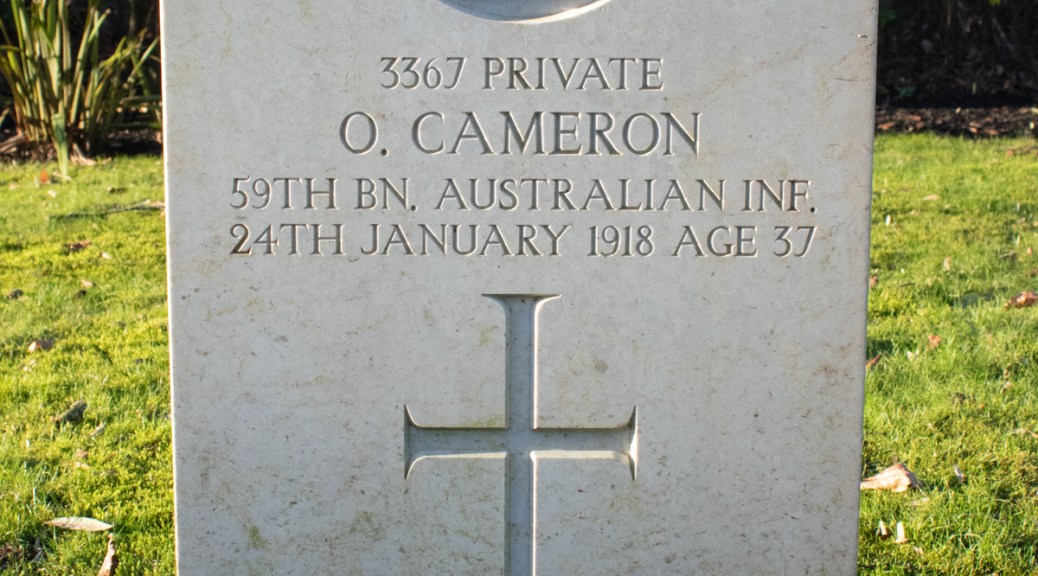
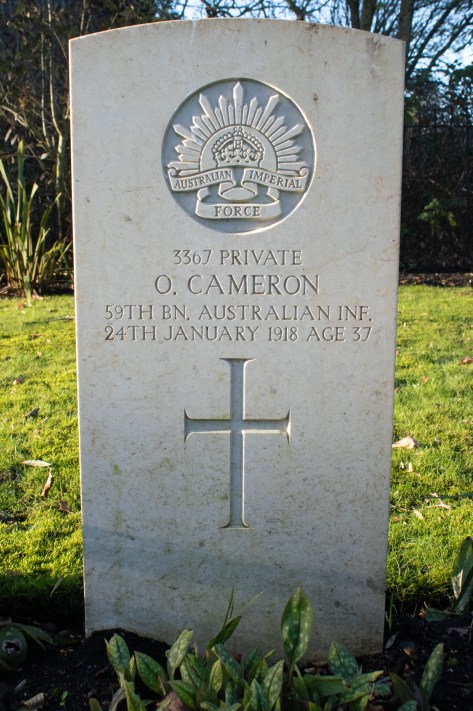
Born in Shelburne, Nova Scotia, in around 1876, the early life of Oscar Cameron is a challenge to piece together. He was one of four children to ship’s carpenter Christopher Cameron and his wife Alice.
Oscar appears to have followed his father in a sea-faring life, and his later army service records confirm that, by 1917, he was a ship’s officer. When the call came to serve the Empire, he took a discharge from his ship in Australia, and joined up.
Enlisting on 20th February 1917, Oscar’s service records show that he was 5ft 6.5ins (1.69m) tall, and weighed 128lbs (50.1kg). He had fair hair, blue eyes and a fresh complexion, with a tattoo on his right forearm and a vaccination scar on his left upper arm. His age was given as 36 years and 6 months, although he was, in fact 41 by this point.
Assigned to the 59th Battalion of the Australian Infantry, Private Cameron’s unit left from Sydney on board the HMAT A16. The two-month voyage was not uneventful: Oscar spent three days in hospital with an undeclared ailment, and also forfeited two days’ pay for being absent without leave for 34hrs during the ship’s layover in Cape Town, South Africa.
The 59th Battalion disembarked in Liverpool, Lancashire, on 16th September 1917. From there it made the journey to the ANZAC camps in Wiltshire, and this is where Oscar would have continued his training.
At the start of 1918, Private Cameron’s health was suffering again. He was admitted to the No. 3 New Zealand General Hospital in Codford, Wiltshire, suffering from nephritis. Ultimately, the condition was to prove fatal: Oscar passed away at 4:45pm on 24th January 1918, aged 40.
Thousands of miles from home, it wasn’t possible for the remains of Oscar Cameron to be taken back to Canada. Instead, he was laid to rest in the ANZAC extension to St Mary’s Churchyard in Codford, not far from the base where he had received treatment.
 Death and Service