
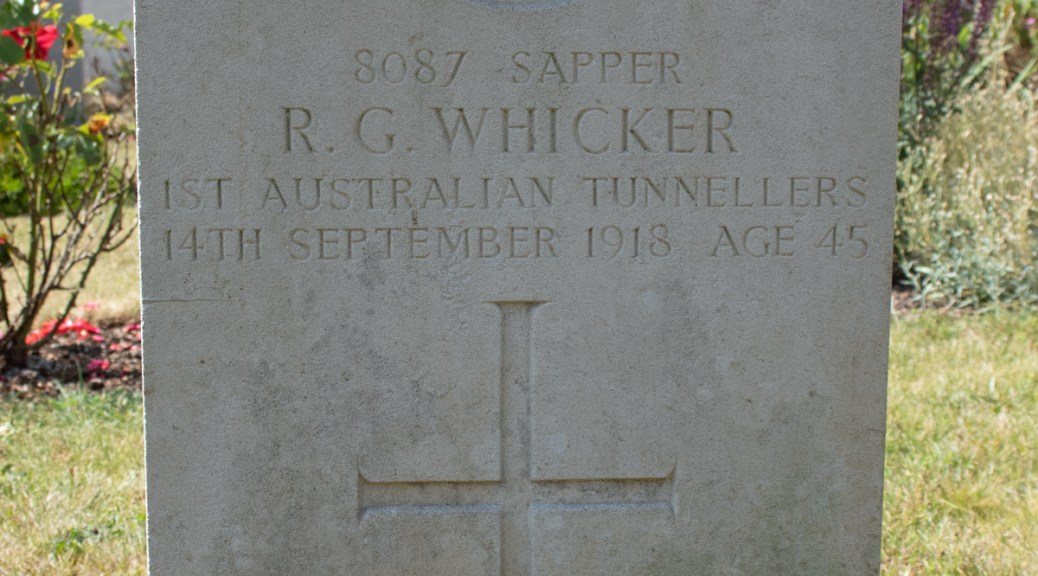
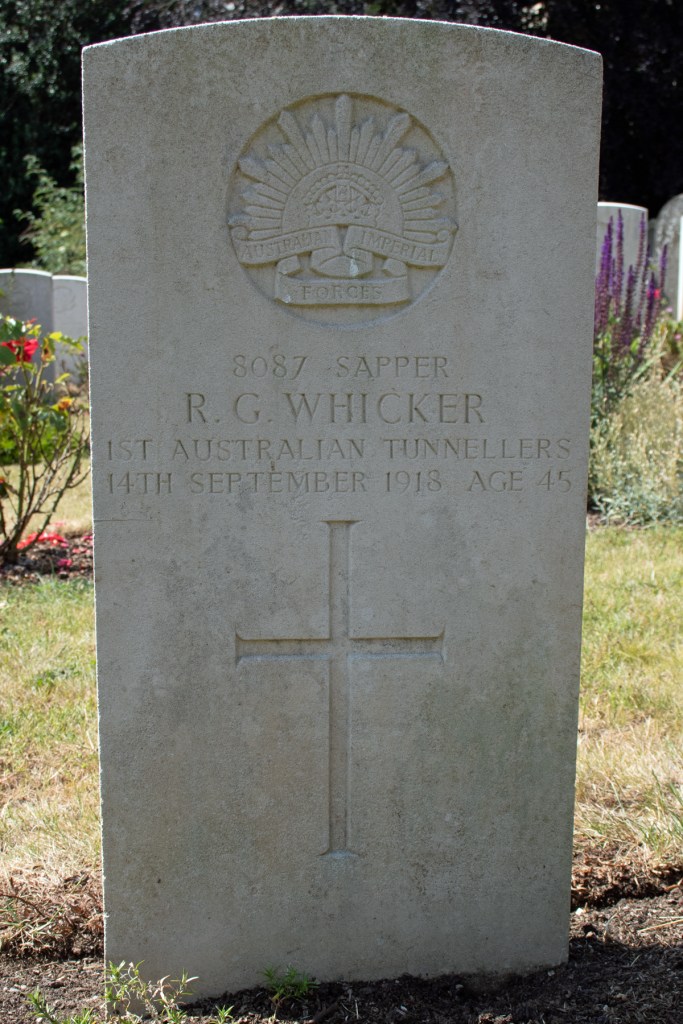
Rupert Gilchrist Whicker was born in Derby, Derbyshire, on 6th February 1873, one of eight children to Walter and Susannah Whicker. There is little information about the family’s early life, and it appears than one of both of Rupert’s parents had died by the time he was 14 years of age.
The Whicker siblings seemed to have gone their own ways at this point, emigrating to the United States and Australia, and it was to Ballarat in Victoria, Australia, that Rupert sailed in 1896. His trail goes cold for then nine years, at which point he married the Australian-born Ellen Ward. The couple would go on to have six children, eventually setting up home in Melbourne.
It is only Rupert’s military records – from when he enlisted on 21st September 1917 – that we discover more about what he had been doing. He gave his trade as miner, and the document suggests that he had tried to join up earlier in the war, but had been rejected as being under height: he was just 5ft 1.5in (1.56m) tall. Rupert’s medical also confirmed that he was 107lbs (48.5kg) in weight, and had auburn hair, hazel eyes and a fair complexion. He was noted as having a birth mark on the side of his left foot and two scars on his left cheek, between the eye and the bone.
Sapper Whicker was assigned to the 1st Battalion of the Australian Tunnellers. He left Australia on board the SS Indarra on 26th November 1917, bound for Europe. After leaving Port Said, Egypt, on 9th January 1918, Rupert’s unit landed in the south of France eleven days later. They travelled to Cherbourg by train, and finally landed in Southampton, Hampshire, on 2nd February 1918.
Rupert would remain on British soil until the beginning of April. His unit arrived in Caëstre in the middle of the month, and he then found himself on the Western Front. Sapper Whicker would serve there for the next four months, and it was only because of illness – a bout of gastritis – that he was brought back from the Front Line.
The stomach condition was severe enough to warrant Rupert’s medical evacuation to Britain for treatment, and he was admitted to Bath War Hospital in Somerset. What was initially thought to be an infection turned out to be far more serious. Sapper Whicker was diagnosed as having stomach cancer, and it has quickly taken hold. Sadly, it would prove fatal, and Rupert passed away on 14th September 1918: he was 45 years of age.
Rupert Gilchrist Whicker had died thousands of miles from his home. He was laid to rest in the military section of Bath’s Locksbrook Cemetery, not far from the hospital in which he had breathed his last.
 Death and Service