

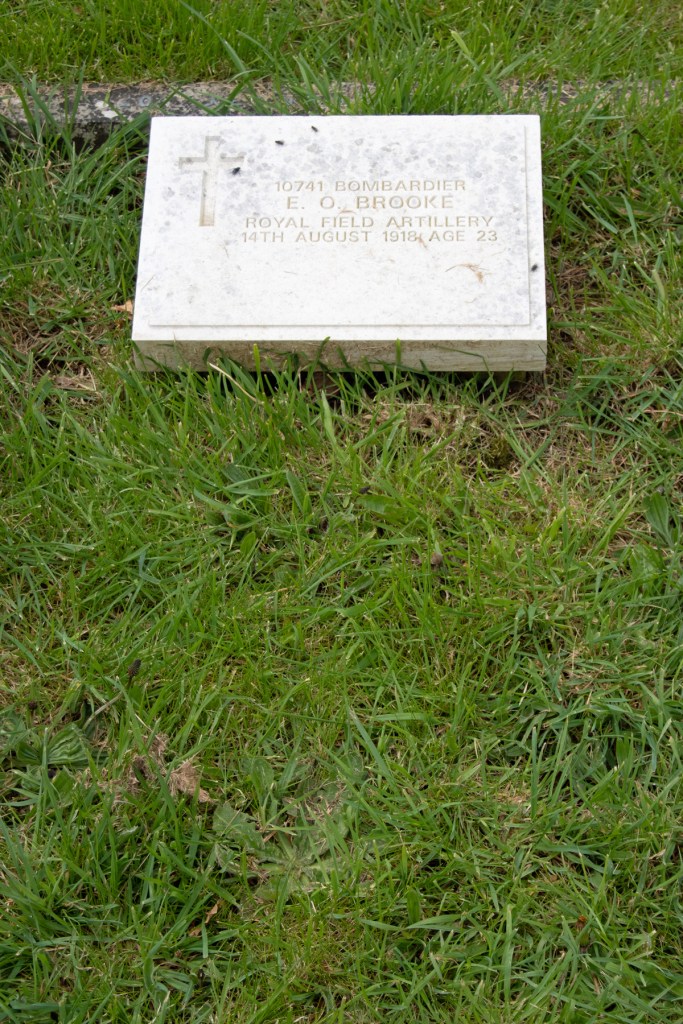
Ernest Oliver Brooke was born in 1895 in Bath, Somerset. The oldest of four children, his parents were tailor Oliver Brooke and his wife, Kate. Ernest did not follow in his father’s footsteps, however, and, by the time of the 1911 census, when the family were living in a Georgian town house in the Lyncombe area of the city, he was noted as being employed as an engine fitter.
Storm clouds were brewing over Europe by this point and, when war was declared, Ernest was one of the first to step up to play his part. He enlisted in 1st September 1914, and was assigned to the Royal Field Artillery.
Gunner Brooke’s service records show that he was 5ft 10ins (1.78m) tall and weighed 138lbs (62.6kg). He had brown hair, grey eyes and a fresh complexion.
Ernest spent ten months on the Home Front, learning and honing his skills. In July 1915 he was sent to the Mediterranean, and found himself in Gallipoli. After nearly a year in Eastern Europe, he was sent to serve on the Western Front in France.
His service records show that the now Bombardier Brooke was wounded on 10th November 1916. Little additional information about this is available, and he was certainly fit enough not to be sent back to Britain for treatment or recuperation.
Things had changed for Ernest, however, and by December 1916, he was transferred back to the UK, to serve on the Home Front once more. While serving in Gallipoli, he had contracted tuberculosis. Over the ensuing months, he had gradually lost weight and developed a distressing cough, which occasionally resulted in haemoptysis, or coughing up blood.
By the summer of 1918, Bombardier Brooke was admitted to a sanitorium. His health led to him being medically discharged from the army on 20th June, and his condition slowly deteriorating. On 14th August 1918 he finally succumbed, aged just 23 years old.
Ernest Oliver Brooke was laid to rest in the family plot in St James’ Cemetery, Bath.
 Death and Service