Category Archives: Royal Field Artillery

Farrier Serjeant William Inkpen

Farrier Serjeant William Inkpen

In the cemetery of the Dorset town of Gillingham, is a headstone dedicated to the memory of Farrier Sergeant William Inkpen of the Royal Field Artillery, who died on 13th July 1915. Despite his unusual name, it is a challenge to piece together his early life. There are a number of men by the name William Inkpen in the Dorset area, and without confirmation of his age or his parents’ details, there are too many varying records to construct a timeline.

William’s entry in the British Army Register of Soldiers’ Effects suggests that his beneficiary was his widow, Rose, but there are no documents on which they both appear.

An entry in the Southern Times and Dorset County Herald notes that Farrier Sergeant Inkpen died at the Bourton Military Hospital in Gillingham, Kent, and that he was 50 years old when he passed. There is a paper trail for a William Charles Inkpen who worked as a farrier in London and Middlesex, but Rose does not appear in them, and he was, in fact, married to Helen Wood, with four children: Charles, Elsie, Ivy and Cecil. This William was one of six children, and all of them were boys.

Ultimately, with no documentation relating to his time in the army, it is impossible to piece together William’s life for certain. Much of that life he took with him to his grave, in the Dorset cemetery.


Gunner William Taylor

Gunner William Taylor

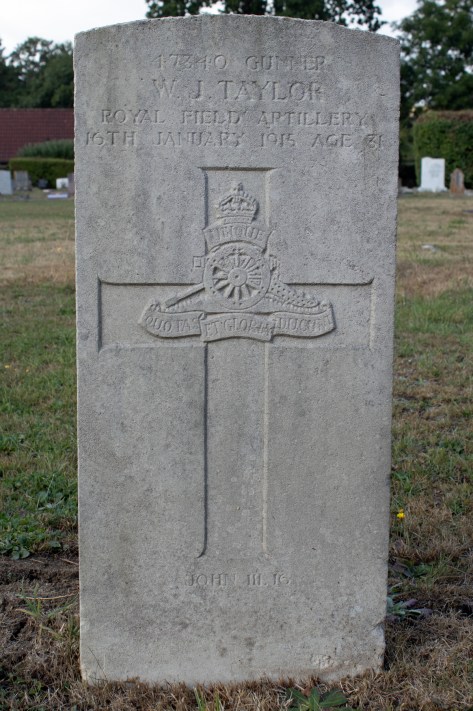
Military honours were paid to Bombardier W Taylor, of the 59th Battery, RFA, who succumbed to an attack ocf douple pneumonia in the VAD Hospital on Saturday at the age of 23. The funeral took place on Tuesday afternoon in the presence of a large gathering, including some from each battery billeted in the town, to the number of nearly 200. The service, which was a most impressive one, was conducted by the Vicar (Red. WEH Sotheby). The deceased came with a draft from Glasgow over a fortnight ago and soon got his first stripe; but it was willed that he should rise no higher, as the day after he received his first promotion he was taken to the hospital. A tribute of respect was paid to him from each battery in the shape of wreaths subscribed for by the men.

[Southern Times and Dorset County Herald: Saturday 23rd January 1915]

William John Taylor was born in St Helier, Jersey, in 1883. He was the only child to John Lebanon Taylor and his wife, Margaret. John had been born ‘at sea’ and was a writer for the Royal Arsenal. His work had taken him to the Channel Islands, and this is where he met and married Margaret in the autumn of 1882.

By the time of the 1901 census, the Taylor family had moved back to the mainland, and were living at 12 Mineral Street, Plumstead, Kent. William had finished his schooling by this point, and was employed as a commercial clerk.

William disappears from the 1911 census, while his parents had moved to a larger property at 101 Tuam Road, Plumstead. John was now listed as an army pensioner, and it was just him and Margaret living in the house.

By this point, William’s trail had gone completely cold. When war broke out he was called on to play his part, and the newspaper report, while giving an incorrect age, does outline what would seem to be his time in the army. He passed away in the Red Cross Hospital in Gillingham, Dorset, on 16th January 1915: he was 31 years of age.

John appears to have passed away by this point too, and it seems possible, that Margaret was unable to cover the cost of bringing her son back to Kent. Instead, Gunner William Taylor (his rank before the promotion to Bombardier was formally recorded) was laid to rest in Gillingham Cemetery, close to the hospital where he had died.


Gunner Robert Dobson

Gunner Robert Dobson

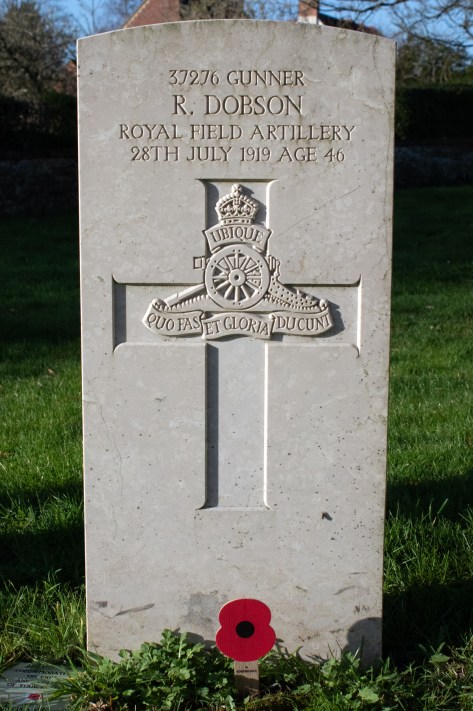
In the graveyard of St Mary’s Church in Steeple Ashton, Wiltshire, is a headstone dedicated to the memory of Gunner R Dobson of the Royal Field Artillery. The early life of Robert Dobson, however, is a challenge to unpick.

Born in Kilbride, County Wicklow, in 1873, he was the son of John Dobson and, according to his later service papers, he had three brothers: William, John Jr and Richard.

When he finished his schooling, Robert found work as a gamekeeper, but he wanted more adventure, and, on 27th April 1891, he enlisted in the Royal Artillery. Given the rank of Gunner, his papers note that he was a little over 5ft 6ins (1.68m) tall, and weighed 150lbs (68kg). A Presbyterian, he had brown hair, blue eyes and a fresh complexion.

Gunner Dobson signed up for a period of seven years, and during this time he travelled the world. From March 1893, he was based in India, but was invalided home for reasons unclear in November 1894. He would remain on home soil for the next three years, and was stood down to reserve status in April 1898.

While back on home soil, love had blossomed and, on the 14th May 1898, Robert married Mary Bull. A labourer’s daughter from Steeple Ashton, the couple wed in the parish church. Robert gave his address as the same village, and, given the proximity of the garrison town of Trowbridge, it is likely a local posting is how the couple met.

On 3rd November 1899, Gunner Dobson was called into duty once more. Attached to the 3rd Battalion of the Royal Field Artillery, his unit headed to South Africa, and he was quickly caught up in the Boer War. He would remain overseas until the spring of 1901, at which point he returned to Britain once more.

After a total of twelve years’ service, Robert was formally stood down from army service on 26th April 1903, returning to Steeple Ashton and Mary. The 1911 census – the only one of the four returns taken during his lifetime on which he appeared – found the couple living in a cottage on Common Hill, to the north of the village centre. Robert, now 38 years old, was working as a farm labourer.

When war broke out in Europe, Robert stepped up to serve his country once more. He initially re-joined his old unit, but seems to have transferred over the Labour Corps, and was attached to the 95th Company. His service records for this period have been lost, so it is unclear when or how he served.

Robert survived the conflict, but would pass away on 28th July 1919. The cause of his passing is unclear, but he was 46 years of age when he died.

The body of Robert Dobson was laid to rest in the peaceful graveyard of St Mary’s Church in Steeple Ashton.


Driver Charles Newman

Driver Charles Newman

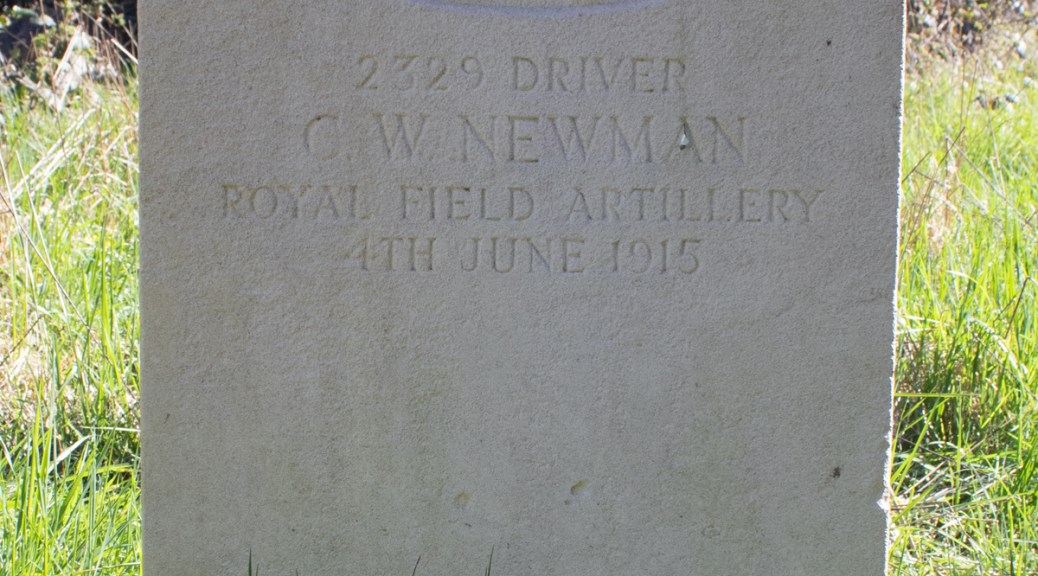
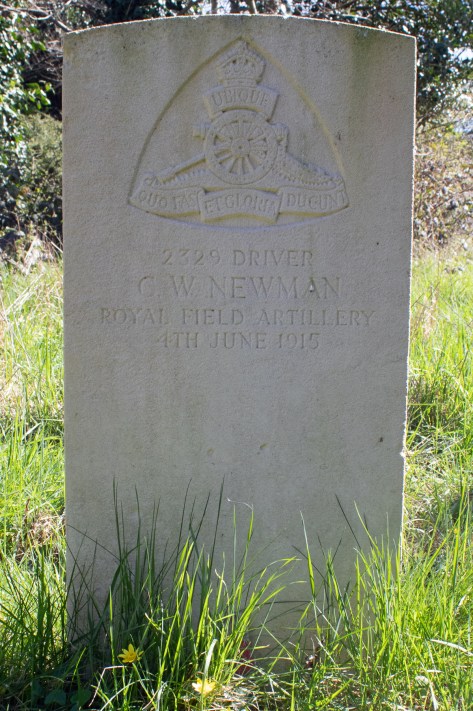
Charles William Newman was born in Worthing, West Sussex, on 16th April 1880. The younger of two children, he was the only son of John and Eliza Newman. John worked as a plasterer, and the family boarded with Mary Ann Brooker, initially on Stanhope Road, then at Campion Terrace, off Worthing High Street.

By the time of the 1901 census, John and Eliza were living in a place of their own, a terrace house at 14 Lennox Road. Charles had completed his schooling by this point, and was employed as a house painter. Eliza was working as a dressmaker, and the Newmans had a lodger, hawker Harry Fielder.

On 11th October 1903, Charles married Ellen Stilwell. Eight years her new husband’s senior, she was a shepherd’s daughter. The couple married in St Botolph’s Church, to the west of Worthing town centre. The couple would not go on to have any children, and the 1911 census found them living at 24 Lanfranc Road, a small terraced cottage, near West Worthing station.

Charles was still employed as a house painter, but had also taken up work as a member of the ground staff at Worthing Sports Ground. When war broke out, however, he stepped up to serve his country, enlisting in the Royal Field Artillery in the early months of the conflict.

When information last reached us concerning certain local members of the Home Counties Brigade of the Royal Field Artillery, they were at Slough, but recently they were transferred to Westerham, in Kent, where a fatal accident occurred to one of their number, Driver Charles William Newman… who was killed by a runaway horse.

His widow was one of the witnesses examined at the Inquest, and the evidence revealed the fact that the horse was attached to a water van which Newman himself was driving.

Newman… was expected to go home on short leave on Friday, the day of the accident, to see his wife.

[Worthing Gazette: Wednesday 9th June 1915]

Driver Charles William Newman was 35 years old when he died, on 4th June 1915. His body was taken back to Sussex for burial, and he was laid to rest in Broadwater Cemetery, a short walk from where Ellen was still living.


Driver Charles Hillier

Driver Charles Hillier

Mrs C Hillier and Family wish to thank all kind friends for their kind sympathy and for their floral tributes.

[Worthing Gazette: Wednesday 4th December 1918]

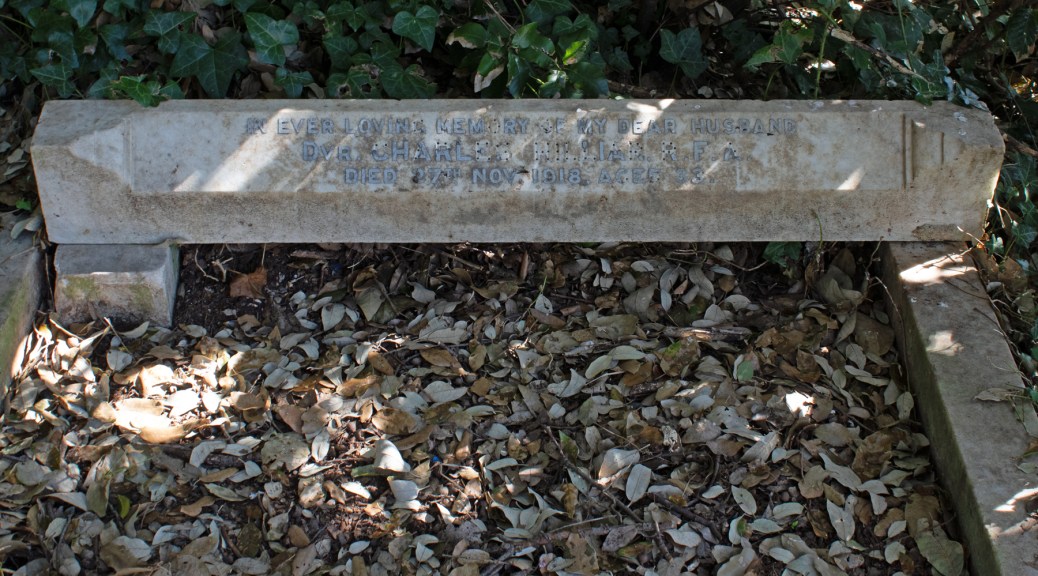
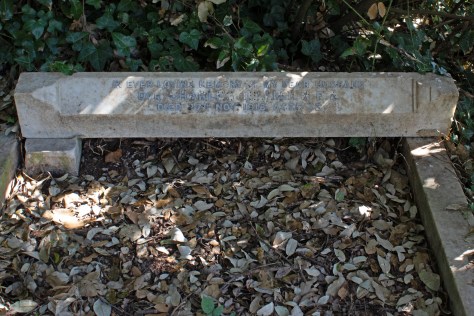
In a quiet corner of Broadwater Cemetery, Worthing, West Sussex, is the unassuming grave of Charles George Hillier. A Driver in the Royal Field Artillery, the Commonwealth War Graves Commission notes that he was 33 years old when he passed on 27th November 1918. He was the husband of Margaret Hillier, of 14 Warwick Place, Brighton Road, Worthing.

Charles’ life appears fated to unfold as a series of frustrating impasses, with details about him tantalisingly just out of reach. His service records have not survived, and there is no trace of his marriage to Margaret. He cannot be definitively identified in any census records and, without information about his parents or place of birth, tracing his life through existing documents remains impossible.

There is a 1920 record for a Margaret Hillier, widow, of Worthing, marrying engineer James Locke on 3rd July 1920. This is likely to be Charles’ widow, but again, she disappears from the records after that.

The quiet corner of the burial ground seems destined to keep its secrets, a permanent memorial to Charles George Hillier.


Driver Arthur Parsons

Driver Arthur Parsons

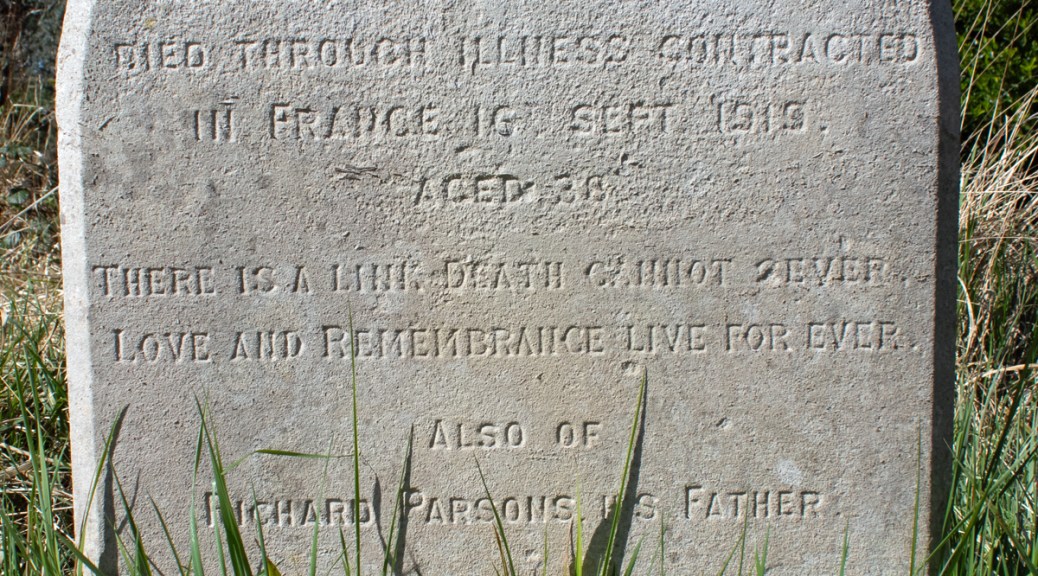
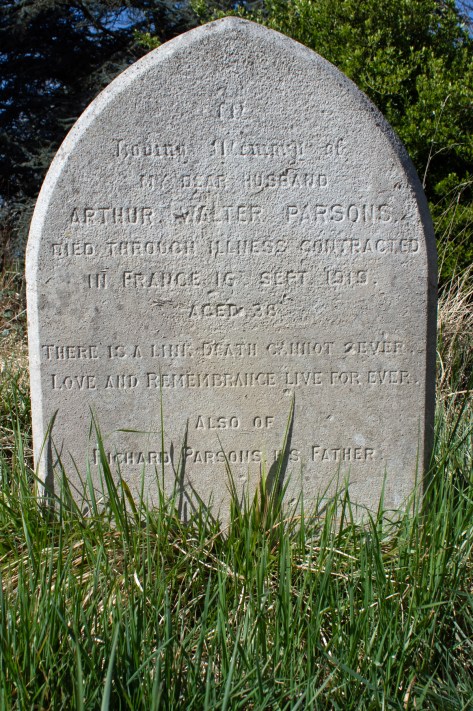
Arthur Walter Parsons was born in Broadwater, West Sussex, in the autumn of 1881. The fourth of nine children, his parents were Richard and Clara Parsons. Richard was a carter, and by the time of the 1891 census, the family had moved into Worthing, and were living at 64 Montague Street, a stone’s throw from the sea.

Richard died in 1899, and the following spring, Arthur married Emily Eagleton. She was the daughter of a domestic servant, and seems to have been born in Poplar Workhouse, Middlesex. The 1891 census found her as a boarding student at St Agatha’s Home Institute in Great Barlow, Cambridgeshire, but by the time here and Arthur exchanged vows, she too was living in Worthing. Their marriage certificate shows that Emily was three years older than her husband, and that he was working as a carter, and living at 23 Clifton Road when they married.

The next census record, taken in 1901, recorded the Parsons living at 25 St Dunstan’s Road in Tarring. Arthur was a carter, and the couple shared their home with Alice, Emily’s daughter and Arthur’s stepdaughter.

By the time of the next census, Arthur and Emily had moved closer to the town centre, and were living at 96 Station Road. Arthur was still employed as a carter – possibly connected to the railway at the end of his road – and was supporting his wife and their three children – Alice (now called Edith), Arthur and Hilda.

When war broke out, Arthur stepped up to play his part. His service papers have been lost to time, but it is clear that he enlisted in the Royal Field Artillery as a Driver, presumably because of his experience with horses. By 27th June 1915, he found himself in France. It is unclear exactly how or where Driver Parsons served, but his unit had moved to Mesopotamia by the start of 1916.

Arthur survived the war, and returned home to his family, which now included another son, Cecil, who had been born in 1915. It would seem that Driver Parsons’ health had become impacted, however, and he would be discharged from the army in 1919. That autumn, on 16th September, he would breath his last, passing away at the age of 38.

The body of Arthur Walter Parsons was laid to rest in Broadwater Cemetery, a short walk from where his grieving family still lived, in Station Road.


Emily was pregnant when her husband died: son Ronald Walter Parsons was born in December 1919. She would find love again, and married railway porter Arthur Browning in December 1929. The 1930 Register found them living at 81 Tarring Road, Worthing with her daughter Rose and son, Cecil.

The Second World War would bring Emily further tragedy. Ronald, who had never known his father, was serving in the Royal Navy, and attached to the destroyer HMS Grenville. She struck a mine off the Essex coast on 19th January, and he was killed. He was just 20 years of age.

The following year, Emily’s husband Alfred also died, passing away at home at the age of 66. Emily lived another eight years, and died in the spring of 1949, aged 69 years old.


Acting Bombardier Walter Ricketts

Acting Bombardier Walter Ricketts

Walter James Ricketts was born in the summer of 1893, the fifth of ten children to James and Elizabeth (and, tragically, the first to survive childhood). James was a farm labourer from the Herefordshire village of Dilwyn, and this is where the family were born and raised.

When he completed his schooling, Walter found work as a groom. The 1911 census recorded him as living at the Moorhampton Hotel, seven miles (11km) to the south west of his home. His employer, Edith Pearman, is recorded as a hotel keeper and farrier, and he was one of two live-in staff.

Walter married Lucy Godwin in the spring of 1918. The oldest daughter of a clerk, she had been born in Lugwardine, near Hereford. By the time the couple married, Walter had enlisted in the army, and was serving in the Royal Field Artillery.

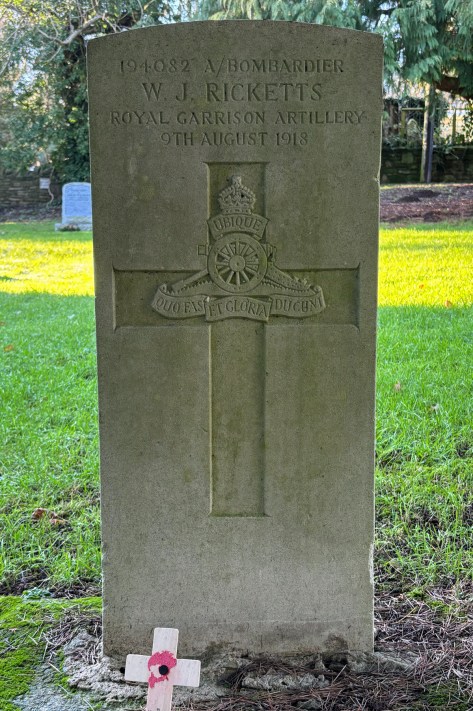
Full details of Gunner Ricketts’ service have been lost, but it is clear that he made the move to the Royal Garrison Artillery at some point. By the summer of 1918, the newly promoted Acting Bombardier was attached to the 57th Company, and based at a gun station in Dulwich, Surrey.

The only other record for Walter is his Pension Ledger card. This confirms that he died on 9th August 1918, following accidental contact with an electric current. There is no further information about the incident, but he was 25 years of age when he died.

The body of Walter James Ricketts was taken back to Herefordshire for burial. He was laid to rest in the tranquil setting of St Mary’s Churchyard in his home village, Dilwyn.


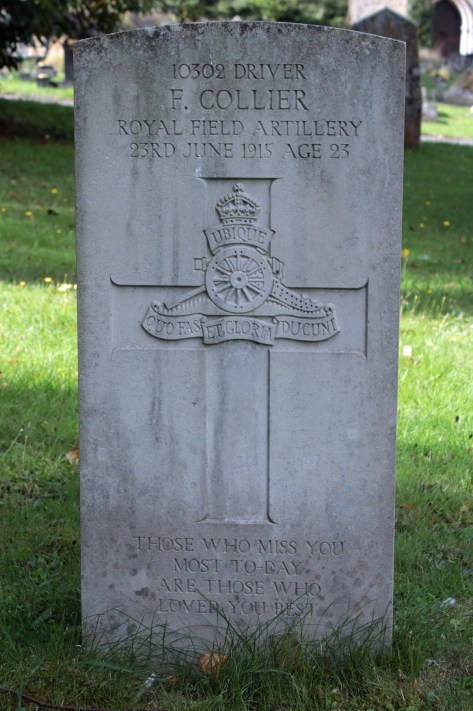
Driver Frederick Collier

Driver Frederick Collier

Frederick William Collier was born in the autumn of 1891. The oldest of four children, his parents were weavers Frederick and Annie Collier. Annie died in 1899, and her widow re-married. The 1911 census found the extended family – Frederick Sr, new wife Rose, Frederick Jr, two of his siblings and his three half-siblings – living at 30 New Prospect Buildings, Westbury, Wiltshire, their home town.

When Frederick Jr completed his schooling, he found work as a grocer’s labourer. War broke out in 1914, however, and he felt drawn to play his part. Full details of his military service have been lost to time, but it is clear that he had enlisted early in the conflict, and certainly by the start of 1915.

Driver Collier was assigned to the Royal Field Artillery, and was attached to the 59th Brigade Ammunition Column. He was sent to Surrey for training, unbeknownst to his unit, in preparation for the Gallipoli campaign. Frederick, however, was not to get his chance to be involved.

Frederick William Collier… died on Wednesday last week from injuries received while attempting to stop horses which were stampeding in his camp, the Ammunition Column, 59th Brigade, at Milford (Surrey)… Collier… was well known in Westbury, and was popular amongst his comrades, and the greatest sympathy is extended to his parents in their bereavement. The young fellow died the same day the accident happened in the hospital at Aldershot.

[Wiltshire News: Friday 2nd July 1915]

Driver Frederick William Collier succumbed to his injuries on 23rd June 1915. He was 23 years of age. His body was taken back to Wiltshire for burial, and he was laid to rest in Westbury Cemetery, not far from where his grieving parents still lived.


Bombardier Frank Sloman

Bombardier Frank Sloman

Frank Sloman was born in the autumn of 1887, and was the youngest of five children to Frank and Emma. Frank Sr was a mason from Jersey, in the Channel Islands, but it was in Tiverton, Devon, that he and Emma made their home and raised their family. The 1891 census found the family living on Castle Street, but by 1901 they had moved down the road to St Peter’s Street.

Frank Jr found work as a painter when he finished his schooling, but he sought adventure and a career. He was already a volunteer for the Devonshire Regiment, and, on 7th May 1904, he officially enlisted as a paid member of the troop. Private Sloman’s records show that he was 5th 10.5ins (1.79m) tall, and weighed 129lbs (58.5kg). He was noted as having brown hair, grey eyes and a fresh complexion.

Private Sloman spent two years on home soil. He quickly extended his contract, and this led to more opportunities. By December 1906 his unit was in India, and he would go on to spend five and a half years there.

In December 1907, Frank transferred to the Royal Garrison Artillery. He initially held the rank of Gunner, before being promoted to Bombardier in January 1912, and Corporal just three months later. In October, Frank returned to Britain, and was stood down to reserve status. He returned to Tiverton, and found work as a porter at the local station.

War was on the horizon, however, and when conflict broke out, Frank was called upon to play his part once more. Initially taking up the rank of Corporal in the Royal Field Artillery, he reverted to the role of Gunner at his own request. By this point, his unit was in France, and he would remain there for the next eight months.

On 6th May 1915, Frank returned to Britain, and was attached to 2B Reserve Brigade. He was based at the training facility in Bettisfield Park in Clwyd, and would spend the next eighteen months there. In June 1916, he was once again promoted to the rank of Bombardier.

Love was on the cards, and, on 17th June 1916, Frank married Frances Hadlow. There is little information available for her, but the couple exchanged vows at the Register Office in Windsor, Berkshire.

By the autumn of 1916, Frank’s health was becoming an issue. He contracted phthisis, or tuberculosis, and was sent to the the south coast for recuperation. His condition would ultimately render him unfit for continued military service, and Bombardier Sloman was discharged from the army on 17th December 1916.

His papers show that he had grown to 6ft 2.5ins (1.89m) in height, and, while physically unfit, he was a steady, sober and reliable man. He and Frances had taken rooms at 7 Hawley Street, Margate, Kent, but it seems that the couple soon moved back to Devon. Their new home was a small cottage at 3 Westbrook Place in Tiverton.

At this point, Frank’s trail goes cold. It is unclear whether he took up work again – or was able to do so – but his lung condition was ultimately to get the better of him. He passed away on 3rd June 1918, at the age of 30 years old.

Frank Sloman was laid to rest in Tiverton Cemetery, on the outskirts of the town in which he had grown up.


Driver Thomas Dicker

Driver Thomas Dicker

Thomas Lockyer Dicker was born at the start of 1890 in Tiverton, Devon. One of six children, his parents were Thomas and Mary Dicker. Thomas Sr was a cab driver, and the family lived at 4 Back Lane in the town.

Thomas Jr’s later life is a challenge to pin down. He doesn’t appear on the 1911 census, and his service records have been lost to time. It is clear that he had enlisted before October 1919 – and, in all likelihood, while the war was being fought. Assigned to the Royal Field Artillery, he worked as a driver, and again it is possible that he served overseas at some point.

Thomas Lockyer Dicker died at the Queen Alexandra Hospital in Cosham, Hampshire, on 12th April 1920, although the cause of his passing is unclear. He was 30 years of age. His body was taken back to Devon for burial, and he was laid to rest in Tiverton Cemetery, not far from the family home.