
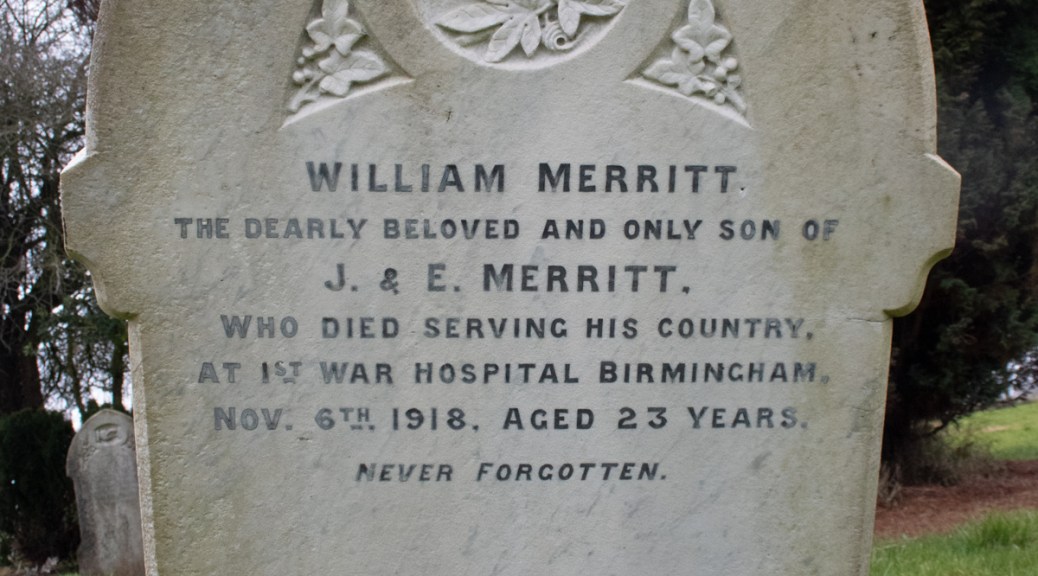
William Merritt was born in the summer of 1895 in Chippenham, Wiltshire. He was the youngest of three children to John and Elizabeth Merritt. John was a blacksmith, and he moved the family to Milborne Port, Somerset, when William was just a boy.
William found work as a shoesmith when he left school, but was one of the first to enlist when war broke out in 1914. He had his medical examination on 17th November, which confirmed that he was 5ft 5ins (1.65m) tall, had good vision and was of good physical development.
Initially assigned to the Dorset Yeomanry, Private Merritt’s trade soon found him taking on the role of Shoeing Smith for the battalion. He was obviously good at what he did, because by May 1915, he had been promoted to the rank of Corporal Shoeing Smith.
William had not enlisted in the army to make and mend shoes, however, and, in March 1916, he transferred to the Royal Garrison Artillery, back with the rank of Gunner. Rather than being sent to the Western Front, however, he found himself billeted at a camp in the West Midlands.
Little further information about Gunner Merritt’s service is available for the next couple of years. The next record for him comes on 5th November 1918, confirming his admission to the Birmingham War Hospital, as he was suffering from influenza and pneumonia. Sadly, his admittance to hospital was to prove too late: he passed away from heart failure the following day. Gunner Merritt was just 23 years of age.
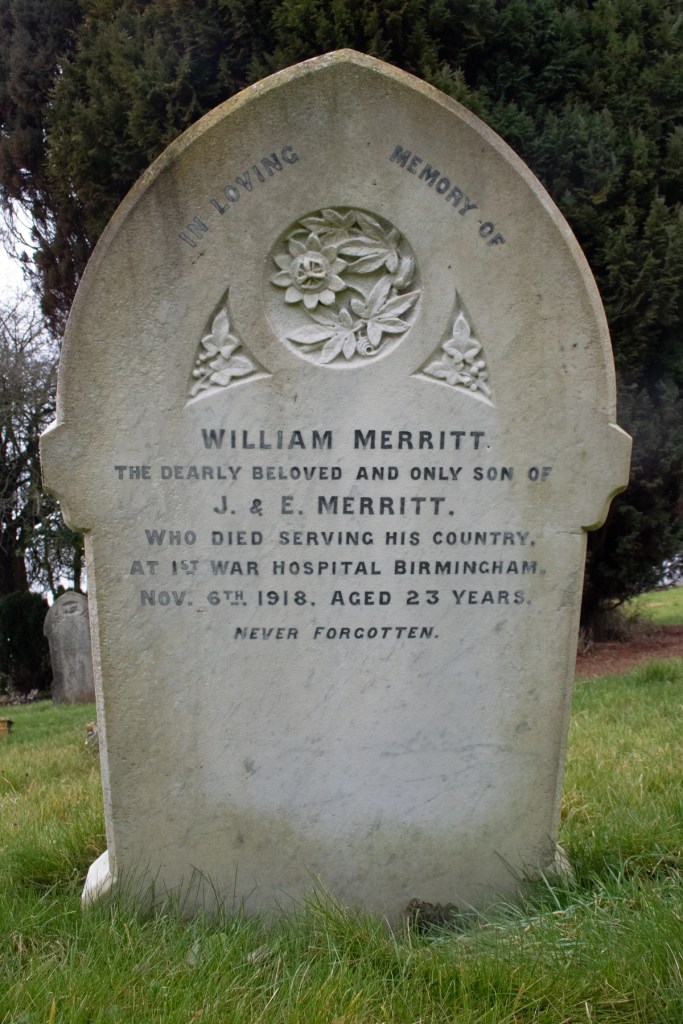
William Merritt’s body was brought back to Somerset for burial. He was laid to rest in the cemetery of the town in which he had plied his trade before the war, Milborne Port.
William’s sparse personal effects were also returned to his parents. The records note that these included: “pair [of] boots, 6 postcards, razor, comb, toothbrush, shaving soap and brush, letter, pair of socks, bell.”
Another bureaucratic error is highlighted in a letter sent from the hospital in which William passed to his regiment’s records office notes that “I have to inform you that the body was forwarded to his Wife for burial…” William was unmarried, and his body was actually returned to his mother, Elizabeth.
 Death and Service