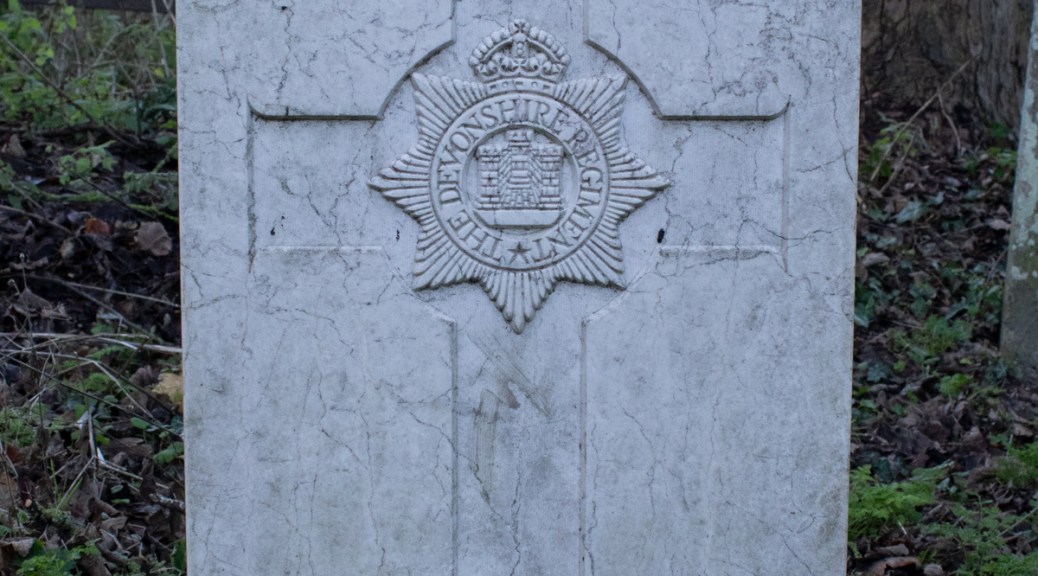
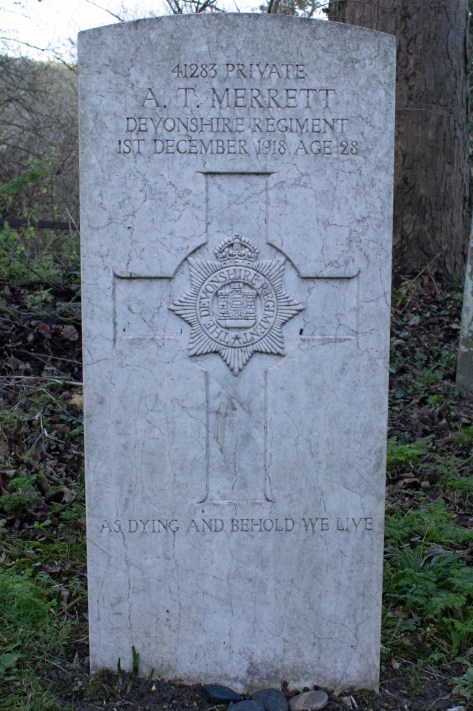
Albert Tom Merritt was born in the spring of 1890, the youngest of six children to John and Mary. John was a bricklayer from the village of Bratton in Wiltshire, and this is where the family were born and raised.
When he completed his schooling, Albert took up employment as a carpenter. His mother passed away in 1905, and on 15th September 1915, he married Elsie House. A labourer’s daughter from Aller Hilton, Dorset, the couple exchanged vows in her parish church, and went on to have three children: Frederick and Edward.
Albert was called up in October 1916, and was assigned to the 13th Battalion of the Devonshire Regiment. His service papers show that he was 5ft 6ins (1.67m) tall and weighed 119lbs (54kg). He was noted as having poor hearing, but declared fit for service in the regiment’s Labour Corps.
Assigned to the 447th Agricultural Company, Private Merritt remained on home soil during the conflict. He survived the war, but contracted influenza in the autumn of 1918. Sent home to recuperate, he passed away on 1st December, at the age of 28 years old.
The body of Albert Tom Merritt was laid to rest in the graveyard of St James’ Church, in his home village of Bratton.
Tragically, Elsie was pregnant when her husband died. She gave birth to a third son, Leonard, in May 1919.
The Commonwealth War Graves Commission’s records give Albert’s surname as Merrett. However, all other documents confirm the spelling as Merritt.
William James Maslin was born in the autumn of 1898, and was the second of four children to Mark and Emma. Mark was a hay cutter from Liddington, Wiltshire, but the family were born and raised in Edington, near Westbury.
There is little specific information about William’s life, but it is clear that when war broke out, he was keen to play his part. He enlisted in the Training Reserve Battalion, and was assigned to the 25th Battalion. Sent to Wool, near Bovington, Dorset, it wasn’t long before Private Maslin fell ill. He passed away from bronchial pneumonia on 4th April 1917: he was just 18 years of age,
The body of William James Maslin was taken back to Wiltshire for burial. He was laid to rest in the graveyard of Ss. Mary and Katherine and All Saints’ Church in his home village, Edington.
William’s older brother, Walter Frank Maslin, also served in the First World War. Born in 1891, he followed in his father’s footsteps, working as a farm labourer.
On 24th September 1911, Walter married Rose Long. The couple set up home just along the road from Mark and Emma, and wend on to have three children: Florence, Herbert and Dorothy.
Walter enlisted in the Worcestershire Regiment, and was attached to the 2nd/8th Battalion. His unit fought at Fromelles, the Ancre and Langemarck, although, as his service papers no longer exist, it isn’t clear where or how Private Maslin served.
What is clear, however, is that he was captured, and taken as a prisoner of war. Imprisoned at Hamelin Camp, not far from the German town of the same name, he was certainly there by the spring of 1918. Conditions would have been harsh, and Private Maslin succumbed to pneumonia on 6th May 1918: he was 26 years of age. His widow and family would not find out about his passing for some weeks, and a death notice was only reported in the Devizes and Wiltshire Advertiser on the 18th July.
The body of Walter Frank Maslin was laid to rest in Friedhof Ohlsdorf, Hamburg, Germany.
Arthur Frederic Thornton Phripp was born in Gillingham, Dorset, in the summer of 1894. The middle of three children, and the only son, his parents were Frederick and Kate Phripp. Frederick was a farmer, and the family lived in Slaughter Gate, to the west of the town centre.
The 1911 census recorded Frederick and Kate managing the farm, and raising their youngest child, daughter Lucy. Arthur, however, is missing, and it seems that he had taken started working for the Post Office as a boy clerk. Where he was living is unclear, but later documents suggest that he may have moved to London.
When war broke out, Arthur stepped up to play his part, joining the 1/21st (County of London) Battalion of the London Regiment, which was also known as the First Surrey Rifles. Private Phripp arrived in France on the 16th March 1915 and, over the next couple of years, fought at Loos, the Somme and Messines. He rose through the ranks, reaching Sergeant and, in the autumn of 1917, he was awarded a commission to Second Lieutenant.
Arthur returned to Britain to formally take the commission, and was transferred to the Duke of Wellington’s (West Riding) Regiment. Back on home soil, it was a chance to see family again, but tragedy was to strike.
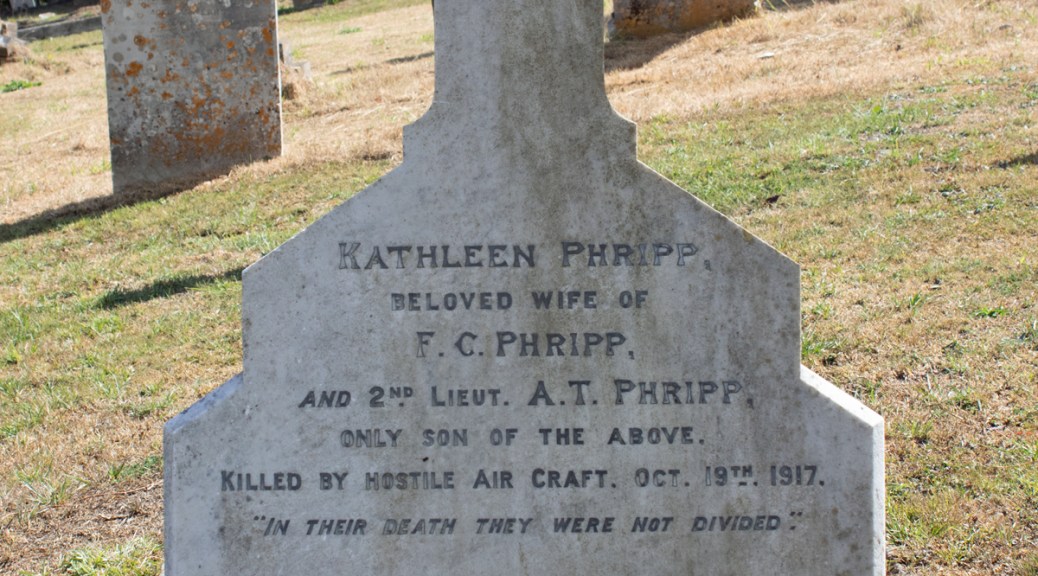
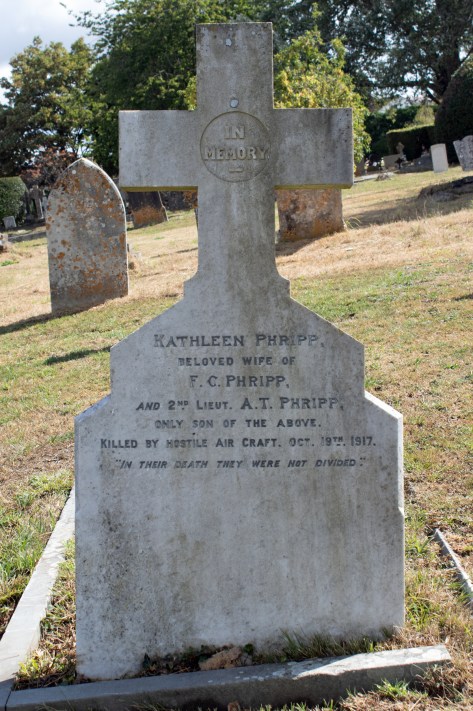
A painful sensation was created in the town when it became known that Mrs Kate Phripp, 65, of Slaughtergate Farm, and her son, Arthur TF Phripp, 23, had been killed in the Zeppelin raid on Friday.
At the inquest on seven of the victims on Monday evidence was given that Mr Phripp was stopping with some friends, and his mother went up from Gillingham on Friday to see him. Evidence given by the police showed that warning had been given in every principal thoroughfare in the district where the fatalities occurred, and the theatres had been warned. The bomb came quite unexpectedly. Besides the killed nine people were seriously injured and nine slightly injured. A great amount of glass was smashed. It was mentioned that Mrs Phripp and her son had been attending the theatre, where is was announced that the warning had been given, and that the play would continue until the guns were heard. The play was continued to the end, and the deceased left at their own risk. The Coroner observed that it was clear that some people took the optimistic view that the raid was over. If people went out into the street after a warning they did to at their own risk. A formal verdict was returned, and they commended the work of the police, special constables and ambulance workers, who, they said, had acted promptly and pluckily…
[Bridport News: Friday 26th October 1917]
The Zeppelin that raided London that night had originally been one of eleven aircraft tasked with attacking Britain’s northern industrial towns. But strong winds disrupted the operation, and one airship – L45, commanded by Kapitänleutnant Waldemar Kölle – was blown south instead.
Meanwhile, Second Lieutenant Phripp and his mother had just left His Majesty’s Theatre in the Haymarket, where they had been watching the comedy Chu Chin Chow, and were making their way across Piccadilly Circus, returning to their friend’s house.
By ill twist of fate, at that moment Kölle released a 100kg (220lb) bomb, which exploded in the road outside the Swan & Edgar department store. The resulting explosion destroyed the building’s frontage and left a crater in the road some 10ft (3m) across and 4ft (1.2m) deep. Seven people were killed: this included Kate and her son.
The bodies of Kate and Arthur Phripp were taken back to Dorset for burial. They were laid to rest together in Gillingham Cemetery, not far from where Frederick and Lucy were grieving.
[Note: My thanks go to Tony Otton for his insight into the event that led to the passing of Arthur and his mother.]
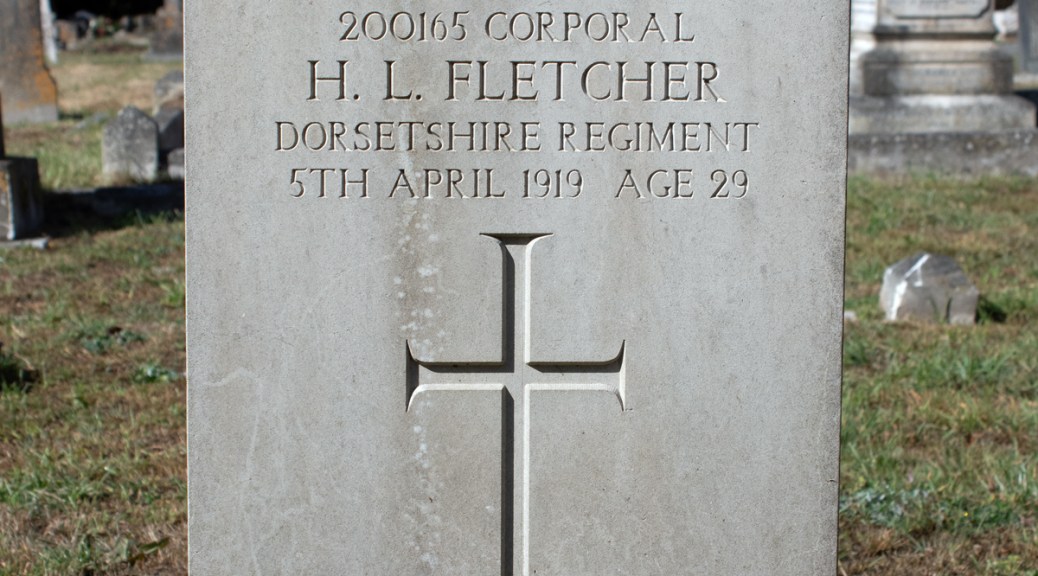
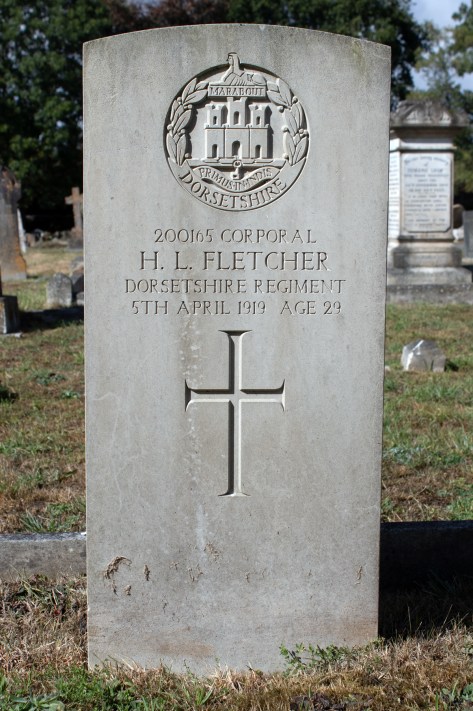
Harry Luke Fletcher was born in the spring of 1889 in the Dorset town of Gillingham. The youngest of eight children, his parents were James and Mary Fletcher. James was an agricultural labourer-turned-gardener, but when his youngest left school, he took a different path.
The 1911 census found the family living in a four-roomed cottage on Wyke Road, Gillingham. James was retired by this point, and he and Mary shared their home with their daughter Bessie, who was employed as a glover. Harry completed the household, and he was working as a printer in the local iron works.
When war broke out, Harry was called upon to play his part. His service records have been lost to time, sadly, but, it is clear that he enlisted in the Dorsetshire Regiment, and was assigned to the 1st/4th Battalion. They served in South Asia, and it is likely that Harry – who rose to the rank of Corporal – spent the war in India and Mesopotamia.
Harry survived the conflict, and returned to Britain after the Armistice, waiting to be demobbed. During this time he fell ill, and passed away on 5th April 1919. He was 29 years of age.
The body of Harry Luke Fletcher was laid to rest in Gillingham Cemetery, not far from where his family were still living.
William Arthur Coward was born in the autumn of 1878 in Gillingham, Dorset. The youngest of three children, his parents were Arthur and Sarah Coward. Arthur died around the time his son was born, and, while he was baptised William, he was known by Arthur from there on in.
Sarah was left to being up her children alone and, by the time of the 1891 census, she had taken work as a laundry woman. The family were living on Gas House Lane, and Arthur’s older brother Hubert, or Bertie, had finished school and was working as an errand boy.
When he had completed his education, Arthur took a job as an ostler for a local inn, but wanted a reliable career and, on 30th October 1897, he enlisted in the army. Joining the Dorsetshire Regiment as a Private, his service papers show the young man he was becoming. His medical record notes that, at 19 years of age, he was a little under 5ft 7ins (1.7m) tall, and weighed 127lbs (57.6kg). He had dark brown hair, brown eyes and a sallow complexion. He was also found to have a scar on the left side of his neck, and slight varicose veins.
Assigned to the 2nd Battalion, Arthur spent the first few months training on home soil. In February 1898, however, his unit was sent to the Mediterranean and, that December, he transferred to the 3rd Battalion of the Lancashire Fusiliers. Over the next three years, Private Coward was based in Malta and Crete, but things were to go awry.
Bertie had passed away in the spring of 1899 and, on 25th February 1901, Arthur was imprisoned for an unrecorded felony. Tried ten days later, he was convicted of the offence, and imprisoned for three months. On his release, on 12th June, he was formally discharged from the army, and sent back to Britain.
By the time of the 1911 census, Arthur was back home. Taking up his former job as a ostler, he is recorded as living in a four-roomed house on Cemetery Road, Gillingham, with his mother. His older sister, Emily, was also living at home, the census noting that she had been an imbecile since birth.
When war broke out in the summer of 1914, Arthur would be called upon to play his part as part of Kitchener’s Army. He joined the Army Ordnance Corps on 14th April 1916, his papers suggesting little change in stature or looks, bit noted that he now suffered from eczema.
Private Coward survived the war, but in the winter of 1918, he fell ill with influenza, and this became bronchial pneumonia. His illness led to a medical discharge from the army on 15th March 1919.
At this point, Arthur’s trail goes cold. He returned home, but his health appears to have hampered him. He passed away on 24th October 1919 in Shaftesbury, Dorset. He was 41 years of age.
The body of William Arthur Coward was laid to rest in Gillingham Cemetery, just a short walk from where his mother and sister were living.
Sarah had now lost her husband and two sons and, in her early 70s, she was looking after her disabled daughter. The 1921 census found them still living on Cemetery Road, where Sarah was undertaking home duties, Emily being unable to work. She outlived her youngest child by a decade, her daughter dying just five months later, in May 1930.
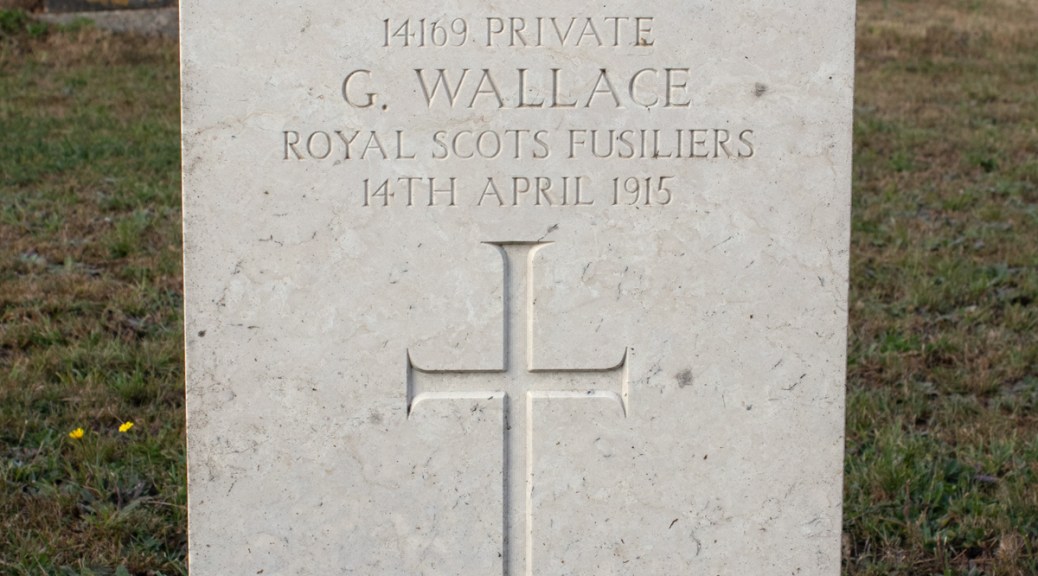
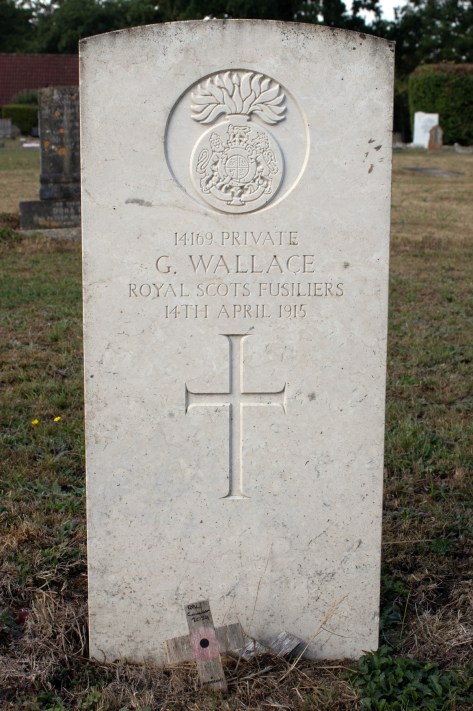
In the town cemetery of Gillingham, Dorset, is the grave of Private G Wallace of the Royal Scots Fusiliers, who died on 14th April 1915. His entry in the British Register of Soldiers’ Effects confirms his first name as George, and that he died on the town’s Leatham Red Cross Hospital. Private Wallace was recorded as being in the 8th Battalion, and his beneficiary was noted as being his father, James.
Unfortunately, beyond this, there is little concrete information about George’s early life: his regiment would suggest that he was born north of the border, but, without a year or location of birth, it is impossible to narrow down the documentation.
A newspaper report does, however, confirm how his life came to an end:
An inquest was held at the Drill Hall on Friday morning, on the body of Private George Wallace, of the Royal Scots Fusiliers, who died at the Gillingham Red Cross Hospital as a result of injuries by the kick of a horse at Codford Camp… Corporal James Doig, of the 12th Argyll and Sutherland Highlanders, said the accident occurred on the Wednesday, April 7th. The stable was only an open shed, and deceased was going up the near side of the horse when it let our and kicked Wallace in the pit of the stomach and knocked him over. He fell in towards the stall among the feet of the horse, which let out again and caught him in the head. While witness went to the horse’s head another witness Private O’Neil, hauled Wallace our. When Wallace was pulled out O’Neil took him to the field hospital, where he managed to walk with some assistance. Lieutenant WE Hopkins, RAMC, proved attending to the deceased as far as possible. There were no facilities for serious cases, and, thinking it was only a case of slight concussion, he had the deceased sent to the Gillingham Red Cross Hospital. If he had been aware it was a fracture of the skull, he should have sent the case to Salisbury Infirmary. The field hospital was only a detention ward, with no hot or cold water supply and no instruments. He cleaned the wound in the head as far as possible. Dr Huntly said he examined the deceased at the Gillingham Hospital. The skull was fractured, and everything was done for him by himself and Dr Morgan, but he died from septic inflammation. If the wound had been “sweet” it would have given him a better chance after the operation was performed. A verdict of “Accidental death” was returned.
[Southern Times and Dorset County Herald: Saturday 24th April 1915]
The body of George Wallace was laid to rest in Gillingham Cemetery, not far from the hospital in which he had died.
In the cemetery of the Dorset town of Gillingham, is a headstone dedicated to the memory of Farrier Sergeant William Inkpen of the Royal Field Artillery, who died on 13th July 1915. Despite his unusual name, it is a challenge to piece together his early life. There are a number of men by the name William Inkpen in the Dorset area, and without confirmation of his age or his parents’ details, there are too many varying records to construct a timeline.
William’s entry in the British Army Register of Soldiers’ Effects suggests that his beneficiary was his widow, Rose, but there are no documents on which they both appear.
An entry in the Southern Times and Dorset County Herald notes that Farrier Sergeant Inkpen died at the Bourton Military Hospital in Gillingham, Kent, and that he was 50 years old when he passed. There is a paper trail for a William Charles Inkpen who worked as a farrier in London and Middlesex, but Rose does not appear in them, and he was, in fact, married to Helen Wood, with four children: Charles, Elsie, Ivy and Cecil. This William was one of six children, and all of them were boys.
Ultimately, with no documentation relating to his time in the army, it is impossible to piece together William’s life for certain. Much of that life he took with him to his grave, in the Dorset cemetery.
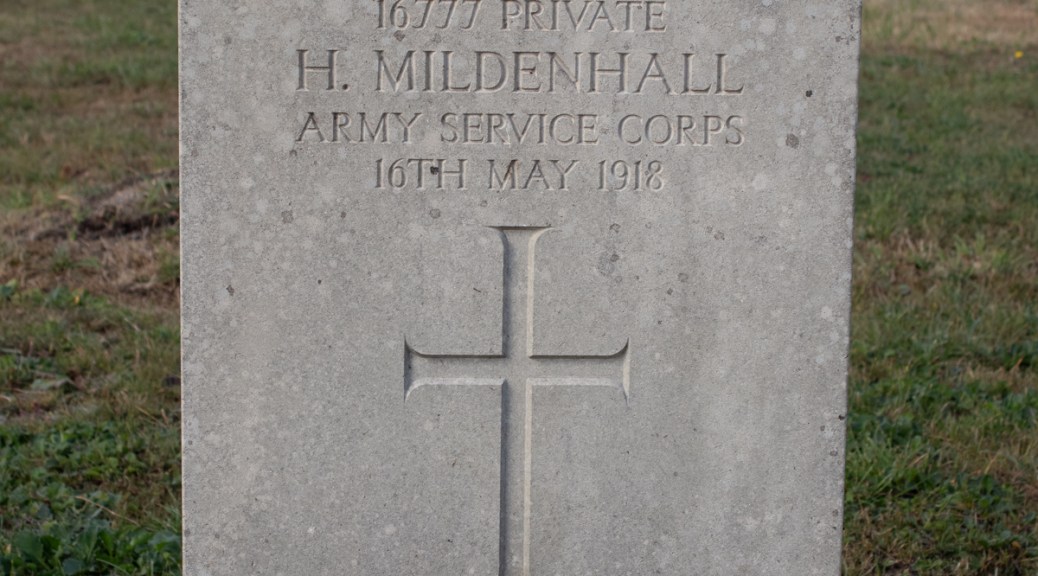
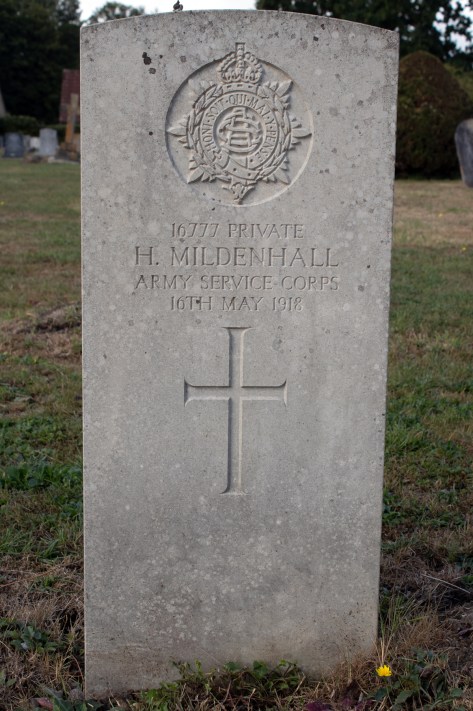
Harry Mildenhall was born in the autumn of 1873 in Eton, Buckinghamshire. The third of six children, his parents were Henry and Harriet Mildenhall. Henry was a groom, and the family lived on first on Mill Lane, before moving to Alma Road in nearby Boveney, by the time of the 1891 census.
The next census return, taken in the spring of 1901, recorded Harry as having left home. Initially apprenticed to house painter Glen Rowland, the document found him as boarding with his employer at 1 Thames View, Clewer, on the outskirts of Windsor, Berkshire.
It was not long before Harry would set out on his own. On 14th April 1906, he was living on Speedwell Street, Oxford. It was on that day that he married Annie Berridge in the parish church. Seven years her new husband’s junior, Annie was a labourer’s daughter, with a history of her own:
Annie Berridge (19), domestic servant, Peterborough, was charged with obtaining 4s. by false pretences from Martha Withers on Feb. 4th. The evidence showed that Berridge had been residing with Mrs Knighton of Wellington-street, who was known to Mrs Withers. On Monday week she visited the latter’s house at Oundle-road and stated that Mrs Knighton wanted to borrow 6s. In consequence Mrs Withers gave her 4s., but afterwards discovered that Mrs Knighton had never sent for the money. Accused pleaded guilty, electing to be dealt with summarily. The Bench gave defendant a chance to retrieve her character by dealing with her ad a first offender and binding her over to come up for judgment when called upon.
[Peterborough Standard: Saturday 16th February 1901]
But Annie was not done with the law just yet:
Annie Berridge (19), single soman, of no fixed abode, was charged with stealing from 11, City-road, a pair of shoes, value 4s. 6d., the property of Elizabeth Ryall, on the 24th. She was further charged with stealing from 7, Perseverance Cottages, Star-lane, money to the amount of 1s., the property of Ethel Norman, on the 18th. In the first care Elizabeth Ryall stated that accused asked for lodgings. She stayed one day and went out the following morning. As accused did not return witness looked round and missed a pair of shoes (produced), an old pair being left in their place. Detective-Sergeant Smith stated that he saw accused in Broadway on the 25th wearing the shoes missed by the previous witness. Accused, who cried bitterly, elected to be dealt with summarily, and pleaded guilty. The Chief Constable stated that a fortnight ago the accused was before the Bench and was then bound over to be of good behaviour. The Bench retired, and on their return into Court the Chairman stated that it appeared leniency was no good. That had been tried a fortnight previously, and a sentence of two months’ imprisonment would now be passed. The second charge was not proceeded with.
[Peterborough Standard: Saturday 2nd March 1901]
The 1902 census, taken just a month later, recorded Annie’s fate: she was imprisoned in Northampton Prison. Meeting Harry may have been what helped Annie back on the rails. After their wedding the couple took rooms at 6 Mill Street, Kidlington, Oxfordshire, and went on to have three children: Edward, Albert and Annie.
War came to Europe in the summer of 1915, and, despite his age, Harry would step up to play his part. He enlisted in the Army Service Corps on 16th September 1915, his papers confirming that he was of Church of England by faith, and was 5ft 5.5ins (1.66m) tall.
Private Mildenhall was sent to France within a fortnight of enlisting, although his exact role is unclear. He certainly remained overseas until April 1917, when he returned home for three months. He returned to the fray in July 1917, transferring to the Labour Corps.
Harry next returned to Britain in May 1918. By this point, however, he had fallen ill, and was admitted to Station Road Hospital in Gillingham, Dorset, suffering from bronchitis. Any treatment proved to be too little, too late: Private Mildenhall died from heart failure at 8:15pm on 16th May 1918, at the age of 44 years old.
The body of Harry Mildenhall was laid to rest in Gillingham Cemetery, not far from the hospital where he had breathed his last.
Of Annie there is no further record. The 1921 census records the three children boarding with separate families: Edward and Albert were living with the Bowd family at 35 Gracious Street, Whittlesey, Cambridgeshire. Annie, meanwhile, was living with Joseph and Harriett Wing, just around the corner from her brothers at 5 Whitmore Street. The census records note that the children’s father was dead, but their mother alive.
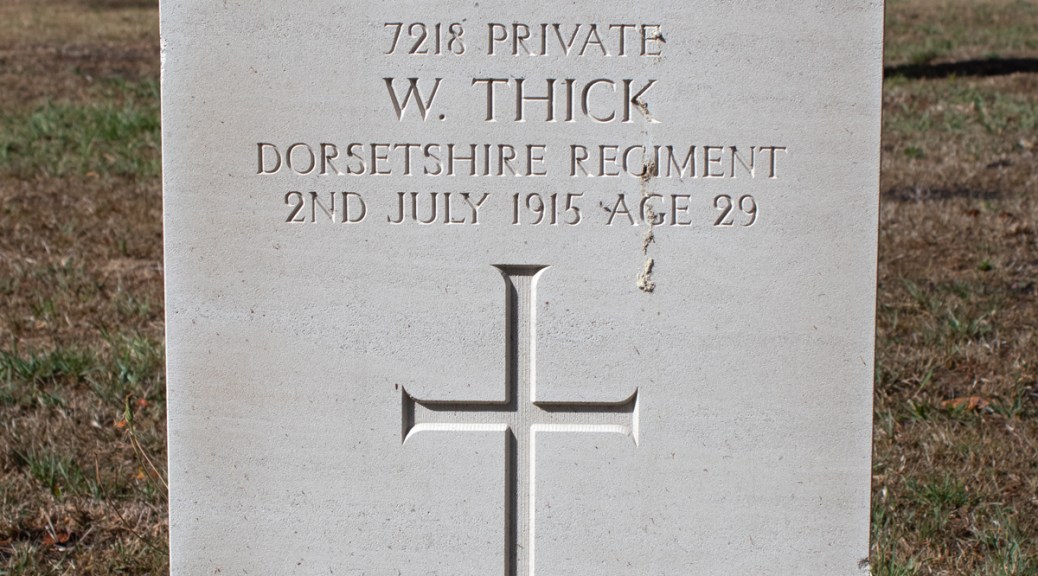
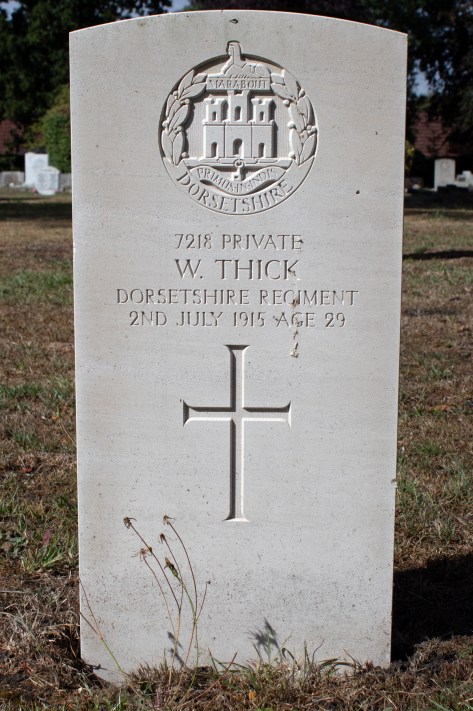
William Thick was born in Gillingham, Dorset, in the autumn of 1885, and was the oldest of four children to Henry and Emma Thick (who also went by the names Harriett and Fanny). Henry was a general labourer, and the family lived in a cottage at Culvers Corner, on the western outskirts of the town.
William initially found work as a mason, but he sought bigger and better things. Already a volunteer in the local militia, on 19th April 1904, he formally enlisted in the army. Taking the rank of Private in the Dorsetshire Regiment, he was attached to 2nd Battalion. His service papers note that he was 5ft 5ins (1.65m) tall and weighed 129lbs (58.5kg). He was recorded as having dark brown hair, hazel eyes and a fresh complexion. His medical report also notes a lateral curvature of his spine.
Private Thick spent the first two years of his service on home soil. In February 1906, however, his unit was sent to India, and he would spend the next five years in and around Poona. William completed an initial seven years’ service in April 1911: stood down to reserve status, he returned home.
In the spring of 1914, William married Eliza Belgin. There is little information available for her, but she gave birth to the couple’s only child, daughter Hettie, the following January.
By this point, war had broken out, and Private Thick was called into action once more. Attached to the 1st Battalion, he was sent to France within days of the outbreak of hostilities. Within the first six months of the conflict, William’s unit was involved in the battles of Mons, the Marne, the Aisne, Messines and Armentières, some of the fiercest fighting of the conflict.
By the summer of 1915, Private Thick was suffering from rheumatism. He was admitted to the No. 1 Canadian General Hospital in Boulogne, but was soon transferred to Britain, as he contracted pleurisy. Sent to the Norfolk War Hospital in Norwich, his condition deteriorated, and he passed away on 2nd July 1915: he was 29 years old.
The body of William Thick was taken back to Dorset for burial: he was laid to rest in Gillingham Cemetery, not far from where his family were living.
Eliza had been widowed just six months after having Hettie. The only other record for her is the Commonwealth War Graves Commission’s record that she had moved to Harold Road, Roath, South Glamorgan.
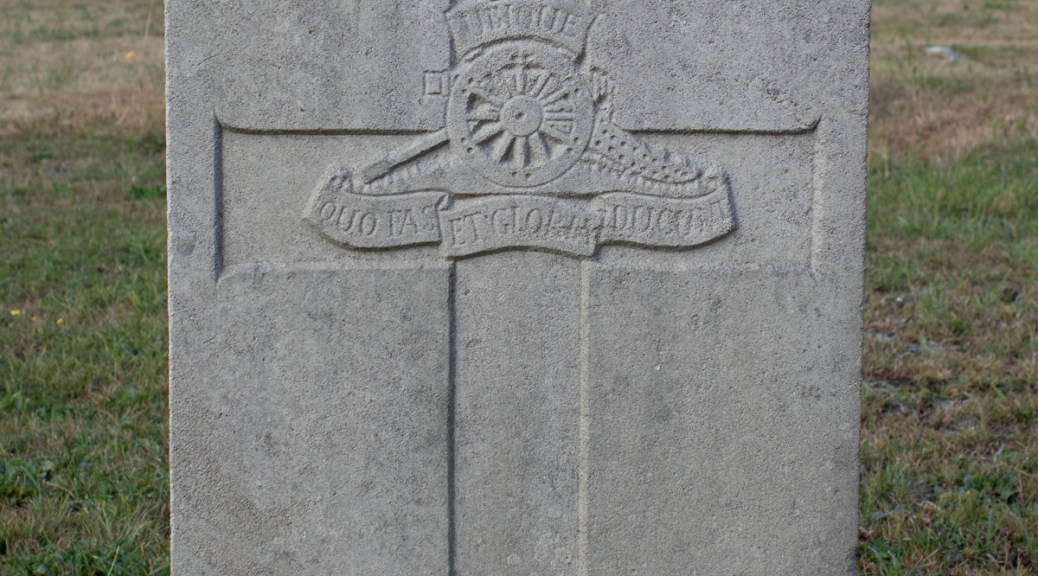
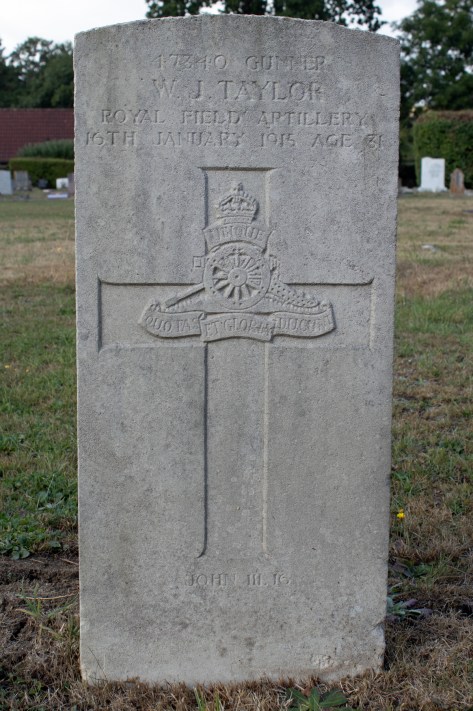
Military honours were paid to Bombardier W Taylor, of the 59th Battery, RFA, who succumbed to an attack of double pneumonia in the VAD Hospital on Saturday at the age of 23. The funeral took place on Tuesday afternoon in the presence of a large gathering, including some from each battery billeted in the town, to the number of nearly 200. The service, which was a most impressive one, was conducted by the Vicar (Red. WEH Sotheby). The deceased came with a draft from Glasgow over a fortnight ago and soon got his first stripe; but it was willed that he should rise no higher, as the day after he received his first promotion he was taken to the hospital. A tribute of respect was paid to him from each battery in the shape of wreaths subscribed for by the men.
[Southern Times and Dorset County Herald: Saturday 23rd January 1915]
William John Taylor was born in St Helier, Jersey, in 1883. He was the only child to John Lebanon Taylor and his wife, Margaret. John had been born ‘at sea’ and was a writer for the Royal Arsenal. His work had taken him to the Channel Islands, and this is where he met and married Margaret in the autumn of 1882.
By the time of the 1901 census, the Taylor family had moved back to the mainland, and were living at 12 Mineral Street, Plumstead, Kent. William had finished his schooling by this point, and was employed as a commercial clerk.
William disappears from the 1911 census, while his parents had moved to a larger property at 101 Tuam Road, Plumstead. John was now listed as an army pensioner, and it was just him and Margaret living in the house.
By this point, William’s trail had gone completely cold. When war broke out he was called on to play his part, and the newspaper report, while giving an incorrect age, does outline what would seem to be his time in the army. He passed away in the Red Cross Hospital in Gillingham, Dorset, on 16th January 1915: he was 31 years of age.
John appears to have passed away by this point too, and it seems possible, that Margaret was unable to cover the cost of bringing her son back to Kent. Instead, Gunner William Taylor (his rank before the promotion to Bombardier was formally recorded) was laid to rest in Gillingham Cemetery, close to the hospital where he had died.