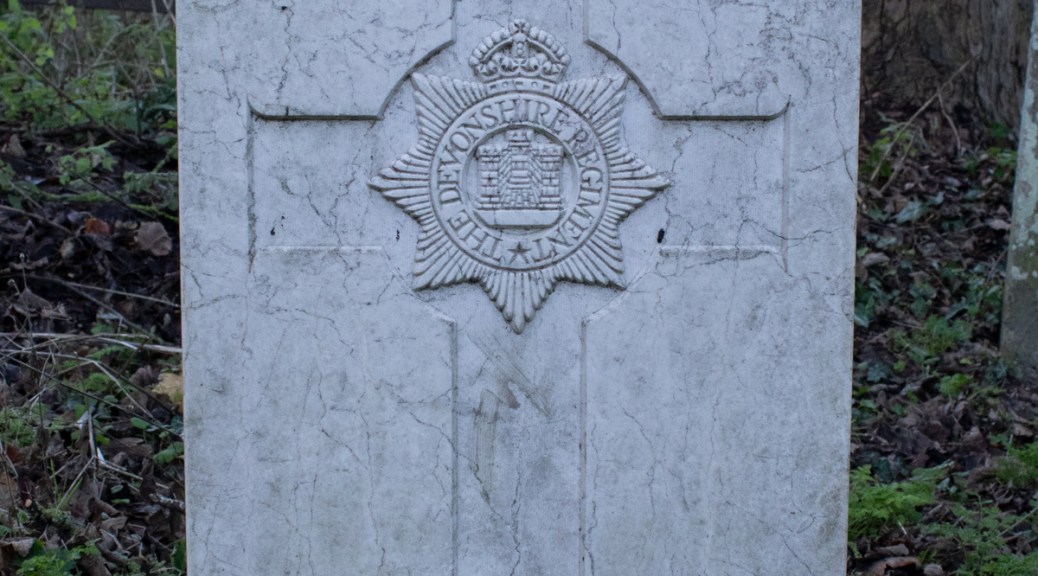
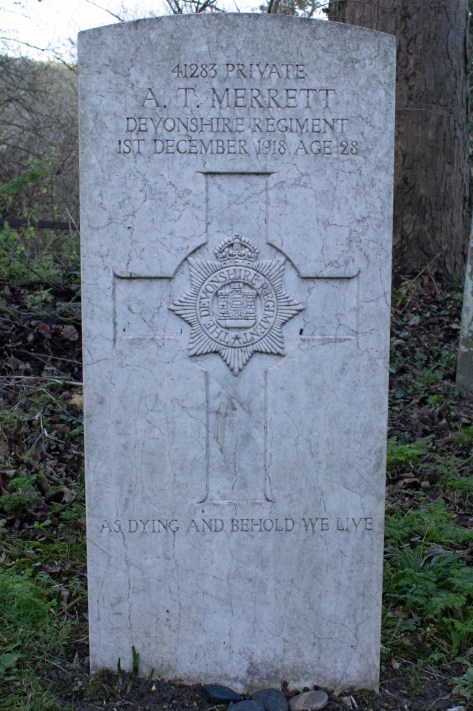
Albert Tom Merritt was born in the spring of 1890, the youngest of six children to John and Mary. John was a bricklayer from the village of Bratton in Wiltshire, and this is where the family were born and raised.
When he completed his schooling, Albert took up employment as a carpenter. His mother passed away in 1905, and on 15th September 1915, he married Elsie House. A labourer’s daughter from Aller Hilton, Dorset, the couple exchanged vows in her parish church, and went on to have three children: Frederick and Edward.
Albert was called up in October 1916, and was assigned to the 13th Battalion of the Devonshire Regiment. His service papers show that he was 5ft 6ins (1.67m) tall and weighed 119lbs (54kg). He was noted as having poor hearing, but declared fit for service in the regiment’s Labour Corps.
Assigned to the 447th Agricultural Company, Private Merritt remained on home soil during the conflict. He survived the war, but contracted influenza in the autumn of 1918. Sent home to recuperate, he passed away on 1st December, at the age of 28 years old.
The body of Albert Tom Merritt was laid to rest in the graveyard of St James’ Church, in his home village of Bratton.
Tragically, Elsie was pregnant when her husband died. She gave birth to a third son, Leonard, in May 1919.
The Commonwealth War Graves Commission’s records give Albert’s surname as Merrett. However, all other documents confirm the spelling as Merritt.
Geoffrey Hugh Willoughby St Quintin was born in Cromarty, Ross-shire, on 17th November 1899. The second of two children (although his older sister Doris had died two years before he was born), his parents were Geoffrey and Muriel St Quintin.
Geoffrey Sr was an estate manager and the 1901 census showed the family having eight live-in servants. Geoffrey Jr was then sent off to a private prep school in Wokingham, Berkshire.
The next census return, taken in 1911, found Geoffrey Sr was visiting his brother at Scampston Hall in North Yorkshire. Muriel, meanwhile, was staying with her cousin Eliza Willoughby, the wife of Baron Middleton. Between the two residences, there was a retinue of some 23 servants.
Geoffrey Sr died in 1913, and his son went on to attend Eton College. When war broke out he stepped up to serve his country, joining the Royal Fusiliers.
Ross-shire friends, especially in the Cromarty and Fortrose districts, will regret the death from heart failure, following pneumonia and influenza, of Geoffrey Hugh Willoughby St Quintin, son of the late Mr Geoffrey St Quintin, and of Mrs Geoffrey St Quintin, Flowerburn, Fortrose. He died in London just prior to an intended visit to Scampston, Yorks., to the home of his uncle, Mr WH St Quintin. Born at Cromarty House nineteen years ago, growing up into a young manhood of great strength and stature, he was well known and very popular in Ross-shire, where he passed the greater part of his young life. On leaving Eton College he was appointed to a cadetship in the Household Brigade, Officers’ Cadet Battalion, with the intention of joining the Guards, and was qualifying for his commission at Bushey, Herts., where he contracted his illness. He was a right gallant young gentleman, and everywhere a favourite…
A sad circumstance was the death on the day of the funeral of his devoted old nurse, Miss Johan Fraser, who was with him during his illness and contracted the influenza which carried her away.
[North Star and Farmer’s Chronicle: Saturday 21st December 1918]
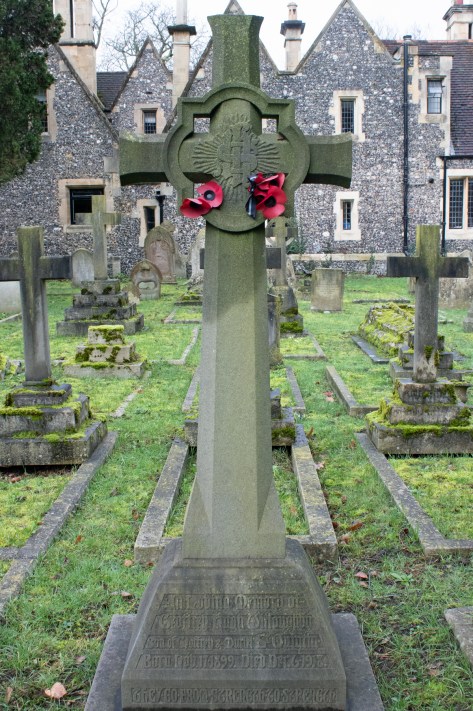
Geoffrey Hugh Willoughby St Quintin was just 19 years of age when he passed away. His body was taken to Eton for burial, and he was laid to rest in the village’s St John’s Churchyard.
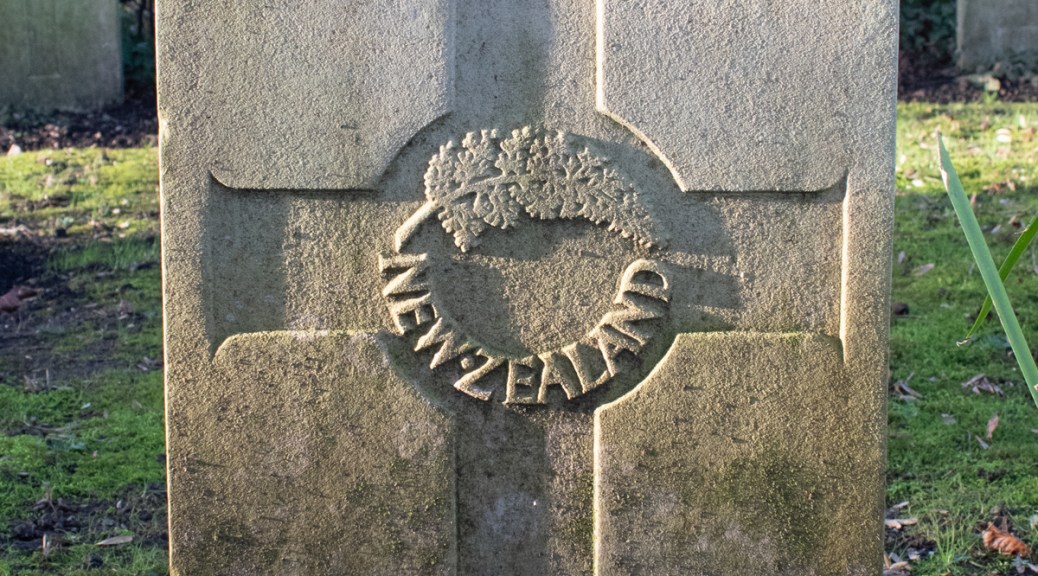
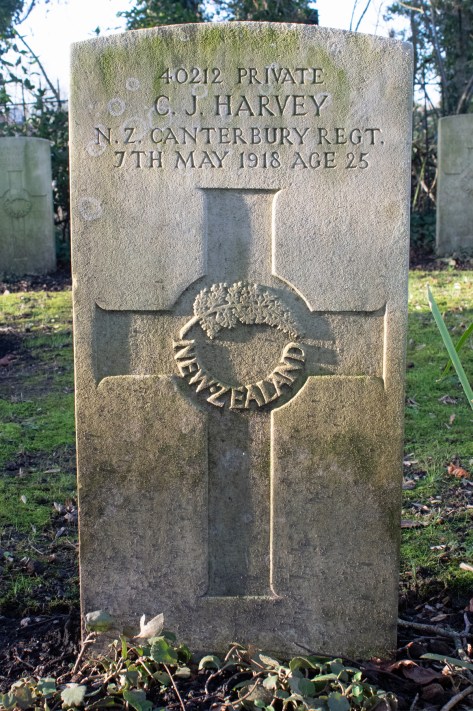
Charles John Harvey was born in Nelson, New Zealand, on 30th May 1892. Little information is available about his early life, but documents give his parents as George and Eleanora Harvey.
Charles was working as a general labourer when war broke out, and was called upon to play his part on 19th October 1916. Attached to his country’s Canterbury Regiment, his medical report showed that he was 5ft 6ins (1.68m) tall, and weighed 11st 2lbs (70.8kg). An Anglican, he was recorded as having dark brown hair, blue eyes and a dark complexion. He was noted as having no vaccination marks.
This fact that Private Harvey hadn’t been vaccinated would come back to haunt him. Sent to an army camp in Trentham, near Wellington, within a matter of weeks he was hospitalised with measles. He remained admitted until 13th December 1916, when he was discharged back to his unit.
It was not until 2nd April 1917, that Private Harvey would set sail for Britain. The journey from Wellington to Devonport would take ten weeks, and Charles was marched in to camp at Sling, Wiltshire, on 10th June that year.
Assigned to the 2nd Company of the 2nd Battalion, Private Harvey finally arrived in France on 27th August 1917. He served on the Western Front for a couple of months, before falling ill again. This time it was influenza that had incapacitated him, and he was admitted to a hospital in Le Tréport for a month while he received treatment.
Charles’ recovery was to be a slow one and, in the end, he was medically evacuated to Britain for ongoing medical support. By February 1918, he had spent time in four different hospitals and, intriguingly, had forfeited three days’ pay for going AWOL while a patient in a medical facility in Hornchurch, Essex. By the start of April 1918, Private Harvey was discharged to the ANZAC camp in Codford, Wiltshire.
His health issues were not over, however, and, on 21st April, Charles was taken in to the No. 3 New Zealand General Hospital in near the Codford camp. He was suffering from acute nephritis, and this would ultimately prove fatal. Private Harvey died on 7th May 1918: he was 25 years of age.
The body of Charles John Harvey was laid to rest in the graveyard extension of St Mary’s Church, Codford.
William Arthur Coward was born in the autumn of 1878 in Gillingham, Dorset. The youngest of three children, his parents were Arthur and Sarah Coward. Arthur died around the time his son was born, and, while he was baptised William, he was known by Arthur from there on in.
Sarah was left to being up her children alone and, by the time of the 1891 census, she had taken work as a laundry woman. The family were living on Gas House Lane, and Arthur’s older brother Hubert, or Bertie, had finished school and was working as an errand boy.
When he had completed his education, Arthur took a job as an ostler for a local inn, but wanted a reliable career and, on 30th October 1897, he enlisted in the army. Joining the Dorsetshire Regiment as a Private, his service papers show the young man he was becoming. His medical record notes that, at 19 years of age, he was a little under 5ft 7ins (1.7m) tall, and weighed 127lbs (57.6kg). He had dark brown hair, brown eyes and a sallow complexion. He was also found to have a scar on the left side of his neck, and slight varicose veins.
Assigned to the 2nd Battalion, Arthur spent the first few months training on home soil. In February 1898, however, his unit was sent to the Mediterranean and, that December, he transferred to the 3rd Battalion of the Lancashire Fusiliers. Over the next three years, Private Coward was based in Malta and Crete, but things were to go awry.
Bertie had passed away in the spring of 1899 and, on 25th February 1901, Arthur was imprisoned for an unrecorded felony. Tried ten days later, he was convicted of the offence, and imprisoned for three months. On his release, on 12th June, he was formally discharged from the army, and sent back to Britain.
By the time of the 1911 census, Arthur was back home. Taking up his former job as a ostler, he is recorded as living in a four-roomed house on Cemetery Road, Gillingham, with his mother. His older sister, Emily, was also living at home, the census noting that she had been an imbecile since birth.
When war broke out in the summer of 1914, Arthur would be called upon to play his part as part of Kitchener’s Army. He joined the Army Ordnance Corps on 14th April 1916, his papers suggesting little change in stature or looks, bit noted that he now suffered from eczema.
Private Coward survived the war, but in the winter of 1918, he fell ill with influenza, and this became bronchial pneumonia. His illness led to a medical discharge from the army on 15th March 1919.
At this point, Arthur’s trail goes cold. He returned home, but his health appears to have hampered him. He passed away on 24th October 1919 in Shaftesbury, Dorset. He was 41 years of age.
The body of William Arthur Coward was laid to rest in Gillingham Cemetery, just a short walk from where his mother and sister were living.
Sarah had now lost her husband and two sons and, in her early 70s, she was looking after her disabled daughter. The 1921 census found them still living on Cemetery Road, where Sarah was undertaking home duties, Emily being unable to work. She outlived her youngest child by a decade, her daughter dying just five months later, in May 1930.
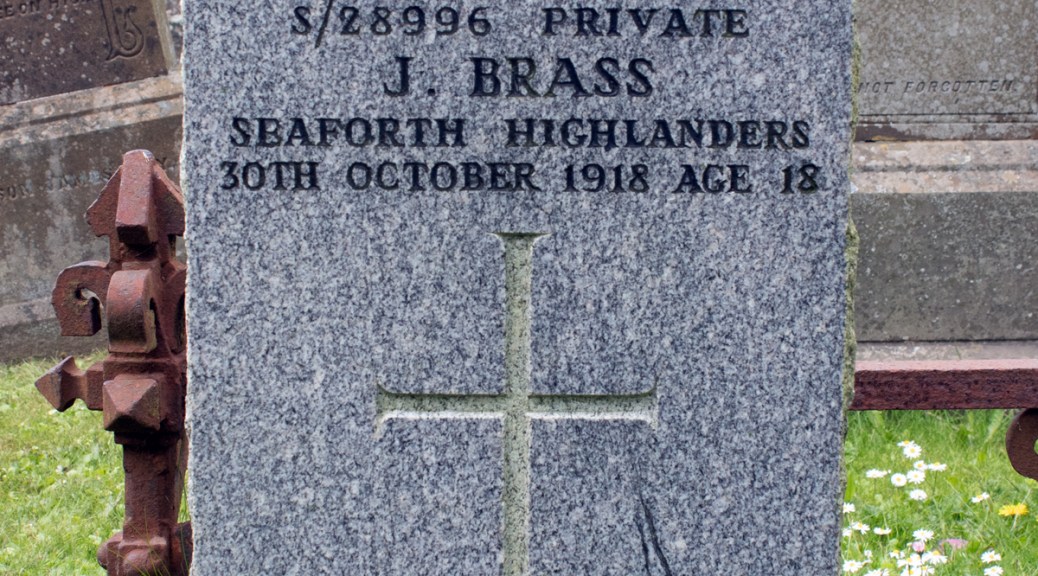
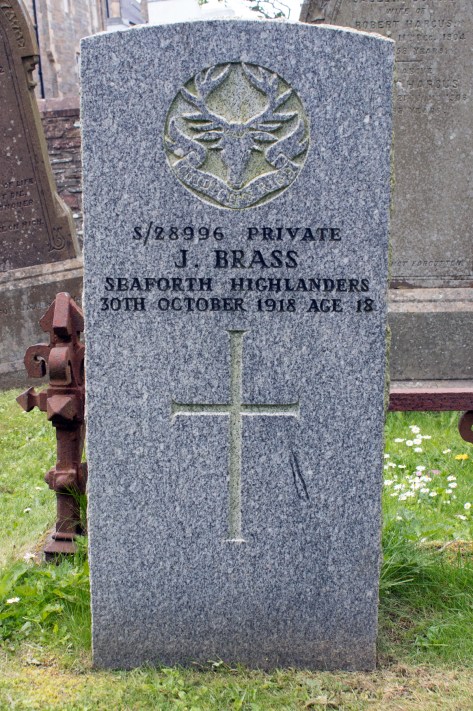
John Harcus Brass was born in Kirkwall on the Orkney mainland in May 1900. He was the oldest child to Thomas and Margaret Brass. Thomas was a grocer, and the family lived at 3 Union Street, to the south of the town centre.
There is little information about John’s early life. Better known as Jackie, he was too young to enlist when war broke out, but joined up as soon as he came of age. He was assigned to the Seaforth Highlanders and, as a Private, was attached to the 4th Battalion.
Jackie was sent south for training, and was billeted in Glencorse, to the south of Edinburgh. Sadly, Private Brass’ war was not to be a lengthy one. He was admitted to the 2nd Scottish General Hospital in Edinburgh, suffering from influenza. The condition was to get the better of him, and he passed away on 30th October 1918. He was just 18 years of age.
The body of John Harcus Brass was taken back to Orkney for burial. He was laid to rest in the graveyard of St Magnus’ Cathedral, in his home town of Kirkwall.
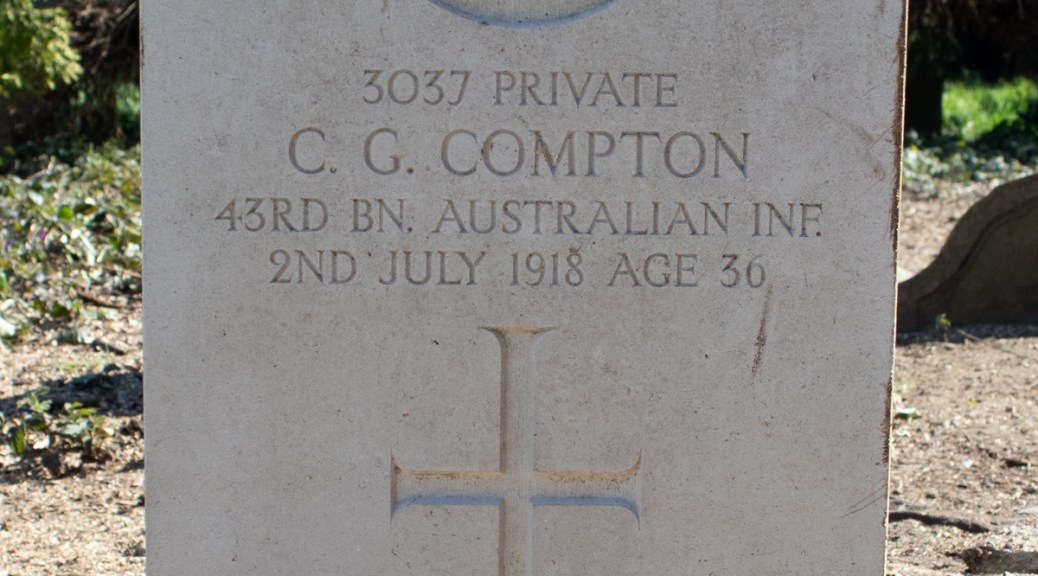
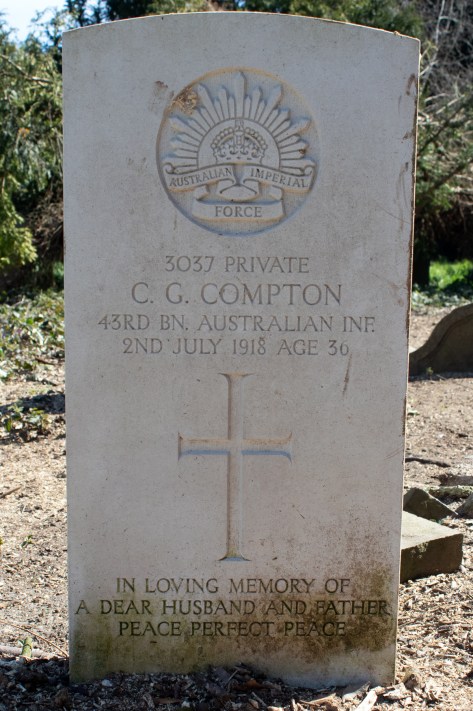
Charles George Compton was born in the Broadwater area of Worthing, West Sussex in 1882. One of five children, his parents were Charles and Eliza Compton. Charles Sr was a shoe maker, but when he finished his schooling, his son found work as a bricklayer.
There is little detailed information about Charles’ early life, but in 1901 he married a woman called Lilian. They went on to have three children, and, by the time of the 1911 census, they had set up home at 47 Newland Road, Worthing.
Charles sought to make a better life for his family, and, on 31st January 1913, he boarded the SS Osterley, bound for Australia. He set up home at 1 Orange Lane, in Norwood, a suburb of Adelaide, and, at some point soon afterwards, Lilian and the children joined him.
War was declared in the summer of 1914, and the Empire was called on to play its part. On 28th March 1917, Charles enlisted, becoming a Private in the Australian Infantry. His service papers show that he was 5ft 6ins (1.68m) tall, and weighed 154lbs (69.9kg). He was noted as having brown hair, hazel eyes and a medium complexion. He had two tattoos: one on his left forearm and another on his left hand.
After a few months’ training, Private Compton’s unit boarded the HMAT A30 from Adelaide, to make the journey back to Britain. His unit – the 10th Training Battalion – disembarked in Plymouth on 25th August 1917, and made its way to Larkhill Camp on the edge of Salisbury Plain, Wiltshire.
Over the next few months, Private Compton undertook further training, and would be transferred to the 43rd Battalion of the Australian Infantry. On 30th May 1918 he was admitted to Hurdcott Hospital, near Fovant, Wiltshire, suffering from influenza. The condition would eventually prove fatal: Charles passed away on 2nd July, at the age of 36 years old.
There was another Military funeral locally on Saturday.
The deceased soldier in this case was Private Charles George Compton, and the place of interment was the Cemetery at Broadwater. Private Compton, a member of an old Worthing family… was a member of the Australian Force…
The deceased worked for the Corporation before leaving Worthing for Australia, where his wife and two children are now living.
[Worthing Gazette: Wednesday 10th July 1918]
Charles George Compton was laid to rest in Broadwater Cemetery, not far from where his family were still living.
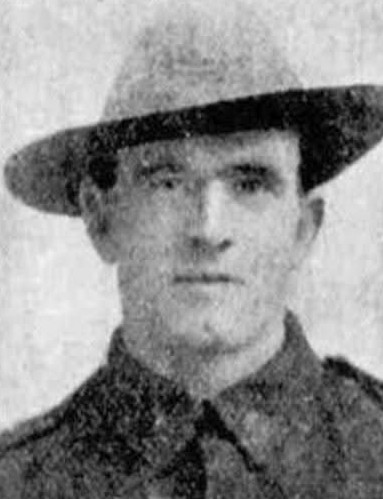
Private Charles Compton (from findagrave.com)
Lilian was now thousands of miles from home and family. Grieving the loss of her husband, the communication from the Army on his passing would provide her with some comfort:
Thanking you for all your kindness in sending my husband things on to me. You don’t know how greatefull I feel when I received letters saying how kind the nurses all were to him through his illness. All I wishes I could have been their, but it was not to be. I now close thanking you all.
[Letter to battalion: 14th January 1919]
Lilian would move to Lincoln Street, Adelaide: her new home she would name Worthing after her home town.
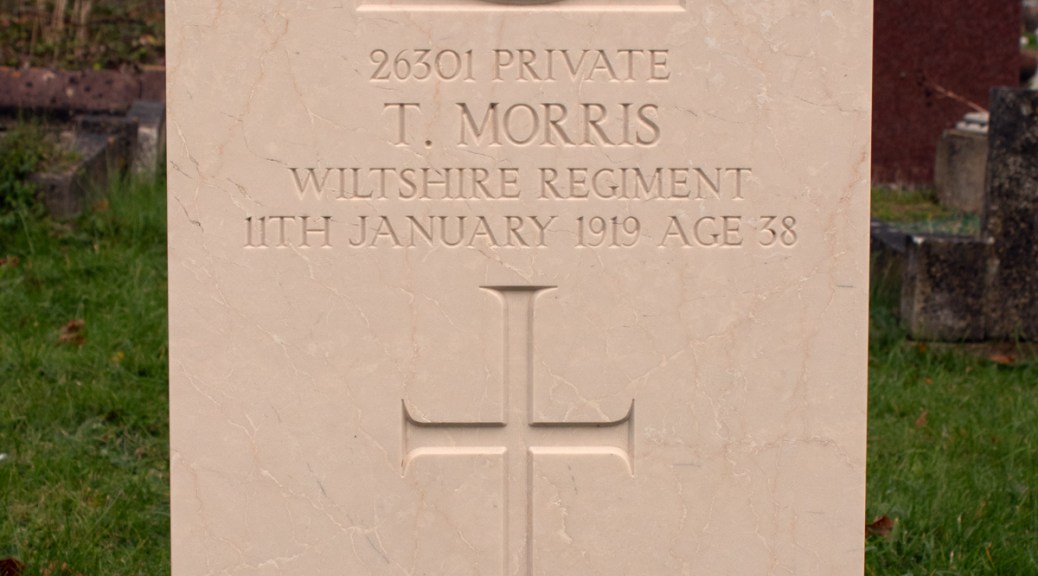
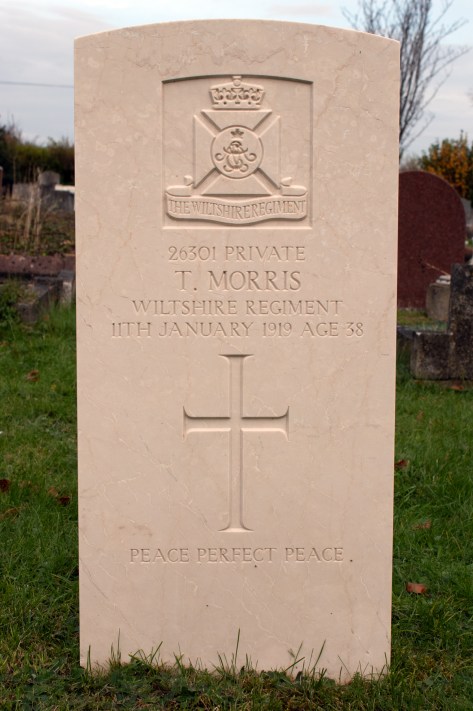
Thomas Morris was born on 12th November 1880 in Bradford on Avon, Wiltshire. One of thirteen children, his parents were Henry and Eliza Morris. Henry was a chimney sweep, and this is a trade that Thomas would also go into, unsurprisingly, from a very young age. The family lived to the north of the town centre, initially at 57 Newtown, before moving round the corner to 5 Wine Street.
By the turn of the century, love was beckoning for Thomas. On 29th March 1903, he wed Annie Britten, a labourer’s daughter, who also lived on Wine Street. The marriage certificate noted that Thomas had changed jobs, and was employed as a labourer.
The 1911 census return shows the family home that had been set up. Henry and Eliza were still at Wine Street, although now at No. 44. Thomas and Annie were also living there, crammed into the four-roomed cottage with their four children as well. Henry was still working as a chimney sweep, while Thomas had found employment as maltster’s labourer.
Annie would go on to have six children in all, and when war broke out, she was left to raise the family with the help of her father-in-law (Eliza having passed in May 1914). Thomas enlisted in the Wiltshire Regiment early on in the conflict and, according to later reports, had seen a lot of service on the Western Front. He survived the conflict, however, and returned to a base in the garrison town of Trowbridge, Wiltshire.
At the start of 1919, Private Morris came home on leave, but while there, he fell ill. He was admitted to the military hospital in Sutton Veny, also in Wiltshire, but succumbed to the influenza he had contracted. He passed away on 11th January 1919, aged the age of 38 years old.
The body of Thomas Morris was taken back to Bradford on Avon to be buried. He was laid to rest in the town’s cemetery.
Annie was now a widow with children to raise. Henry had also passed away in 1918, and so she remarried, wedding William Bishop in December 1919. The couple went on to have a child of their own, Phyllis, in March 1921.
Annie would live a peaceful life, passing away in Trowbridge in 1943, at the age of 60.
Edward Joseph Hollis was born in the village of Cogges, Oxfordshire, in the spring of 1876. The youngest of four children, his parents were Joseph and Rebecca Hollis. Joseph was a blacksmith, who died shortly before Edward’s birth, leaving a son who would never know his father.
Rebecca had children to raise, and did so while continuing her job as a gloveress. The 1881 census found the family living on Oxford Road, with her widowed father, cowman James, also residing at the house.
Edward remained living with his mother through to the 1901 census, records suggesting that they stayed living in the same property. By this point, Rebecca had give up her work making gloves, and was listed as a charwoman. Her son, however, had found employment as a gardener’s assistant.
Rebecca died in 1902, at the age of 60 years old. Soon after, her son moved to Wiltshire, having found work as a labourer in Trowbridge. On 20th January 1907, he married local woman Rose Banks in the parish church. A cloth worker, she was nine years her new husband’s junior. The couple set up home at 9 Court Street, to the south of the town centre, and went on to have three children, daughters Elsie, Margaret and Bessie.
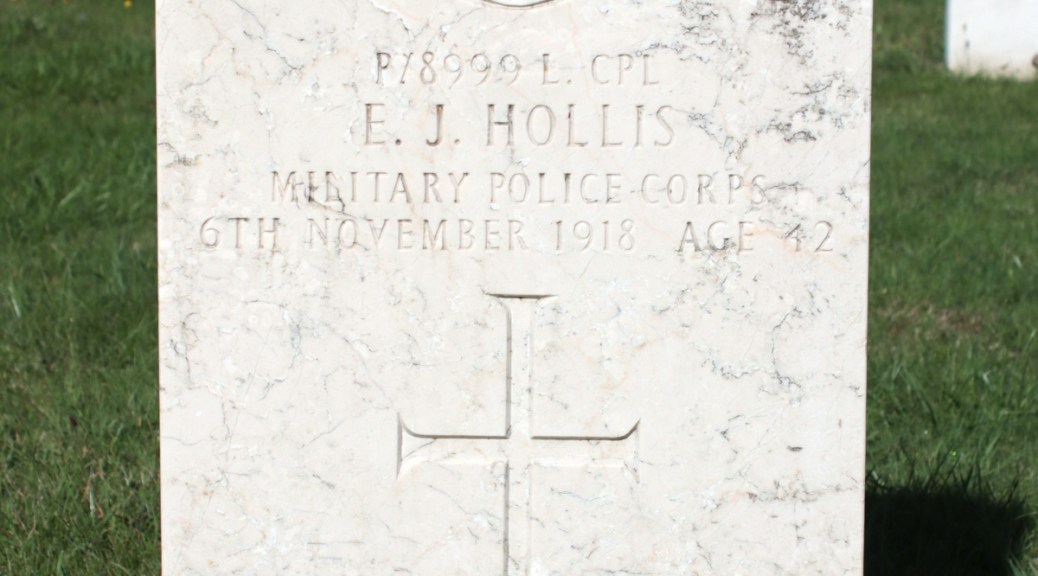
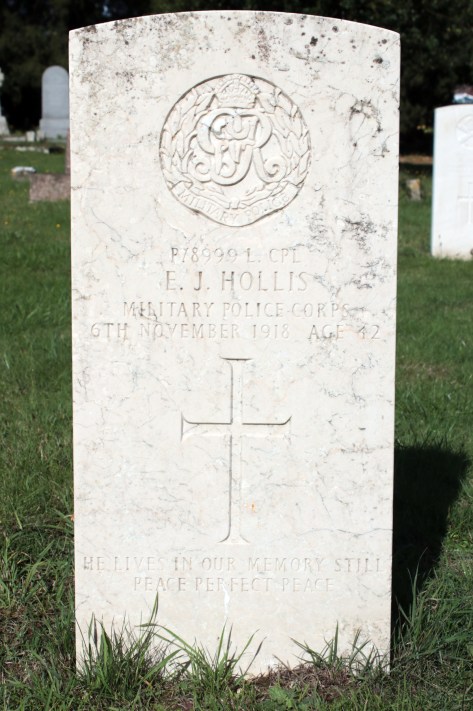
War broke out in the summer of 1914, and Edward stepped up to play his part. There is little information about his time in the military, but it is clear that he had enlisted by the summer of 1918. He saw the war out as a Lance Corporal in the Military Police Corps, and was based at Chiseldon Camp, near Swindon, Wiltshire.
While there, Edward’s health was becoming impacted. He was admitted to the camp hospital with a combination of influenza and bronchial pneumonia, but his heart gave out. He died on 6th November 1918, at the age of 42 years old.
The body of Edward Joseph Hollis was taken back to Trowbridge for burial. He was laid to rest in the town’s cemetery.
Like her mother-in-law before her, Rebecca was now a widow, with young children to raise. She took the risk of emigrating, and moved the family to Ontario, Canada. Here she met farmer James Morgan, and the couple married on 5th July 1920. She died in 1918, also aged 42.
Her and Edward’s legacy were their children. All three married and had families in Canada.
James Rees Cole was born in the spring of 1881, and was the oldest of four children to Thomas and Jane. Thomas was a groom from Pembrokeshire, Wales, and, at the time of James’ birth, he and Jane were living in the village of Chancery, to the south of Aberystwyth, Ceredigion, Wales.
The 1901 census recorded that the Cole family had relocated to England and had set up home at 15 Woolley Street, Bradford on Avon, Wiltshire. Thomas was employed as a domestic coachman, while James, now 19 years old, was an ironmonger’s assistant.
By 1911, James was boarding with widow Sarah Goodman in the Devon village of Withycombe Raleigh, now a suburb of Exmouth. His was engaged by this point, and just a couple of months later, on 5th July, he married his sweetheart, Bessie Livings, in Christ Church, Bradford on Avon. The couple went on to have two children, Irene and Dennis.
When war was declared, James stepped up to play his part. He enlisted in December 1915, by which point he and Bessie had moved to Reading, Berkshire. His service papers show that he was 5ft 9ins (1.75m) tall, and weighed 135lbs (61.2kg). He had blue eyes, brown hair and a fresh complexion.
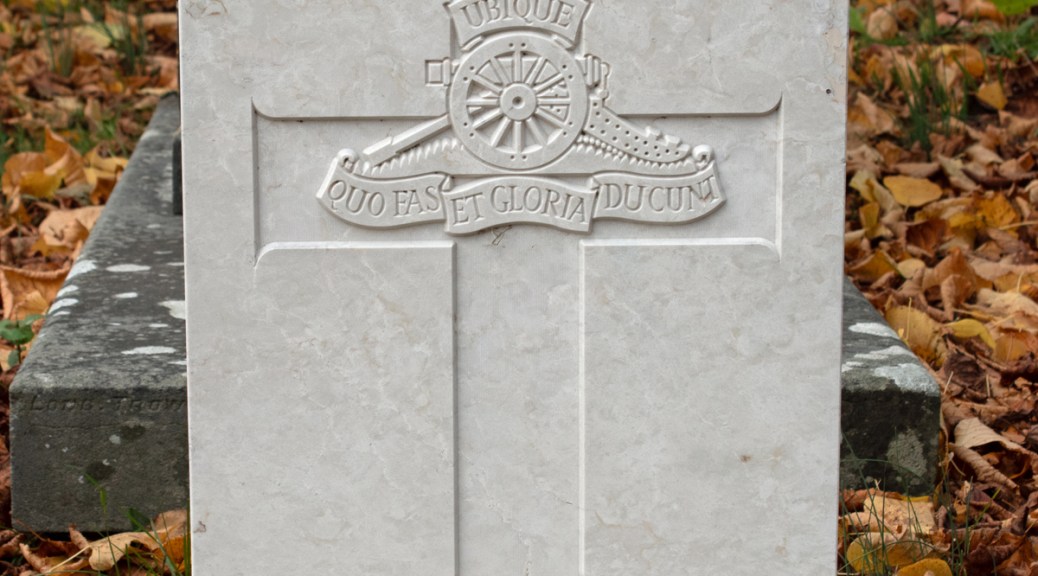
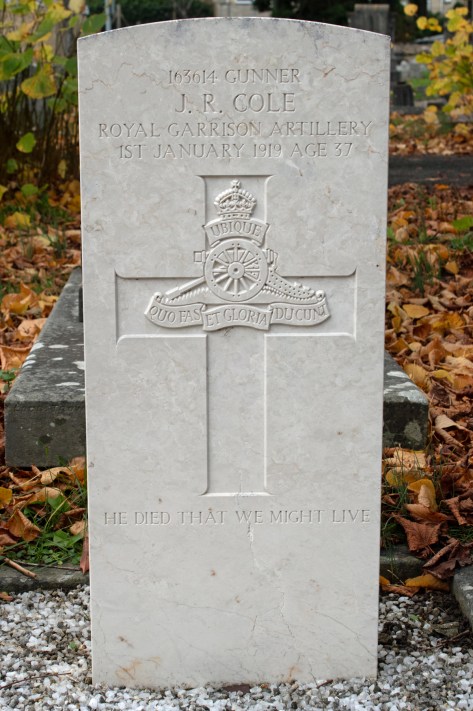
Assigned to the Royal Garrison Artillery, Gunner Cole was not formally mobilised until June 1917. Initially sent to Plymouth, Devon, by the following spring, he had moved to Fareham, ahead of his unit being sent to France. James would spend the next six months in France, before being medically evacuated back to Britain.
Gunner Cole had crushed the metatarsals in his left foot, although his medical notes are difficult to read, it is clear that he was inconsiderable pain. He was admitted to the war hospital in Reading, Berkshire, and remained there for a couple of weeks. When he was discharged, he was transferred to the 2nd Siege Artillery Reserve Brigade in Catterick, North Yorkshire, while he recuperated.
James would only be out of hospital for a matter of weeks. He contracted influenza and was admitted to the camp hospital, but the condition would prove too severe. He passed away on 1st January 1919, at the age of 37 years old.
The body of James Rees Cole was taken back to Wiltshire for burial. He was laid to rest in the graveyard of Christ Church, Bradford on Avon, not far from where his widow and children were living.
The early life of Charles Henry Waller is a challenge to piece together, and it is easier to work backwards.
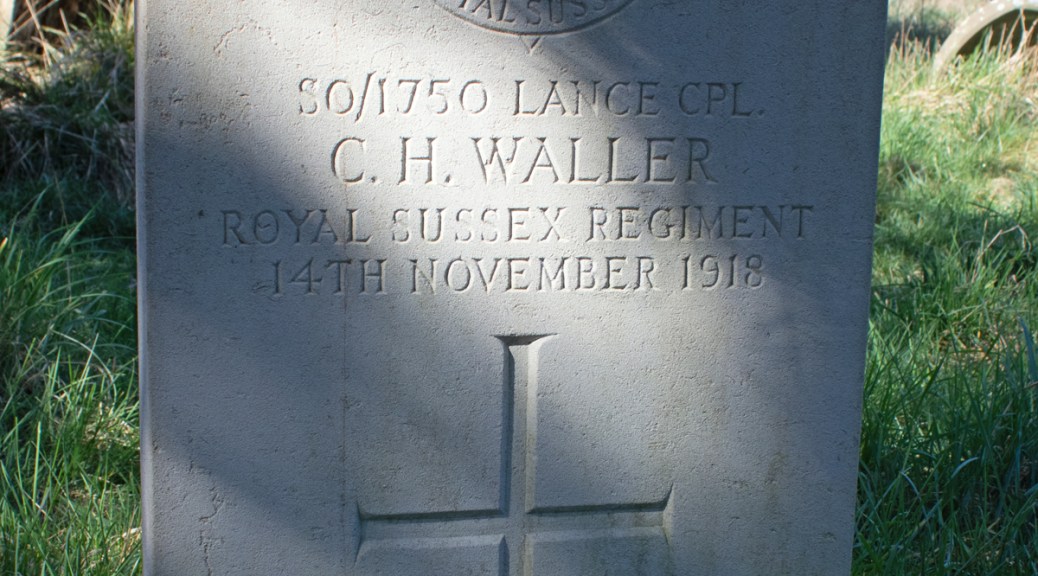
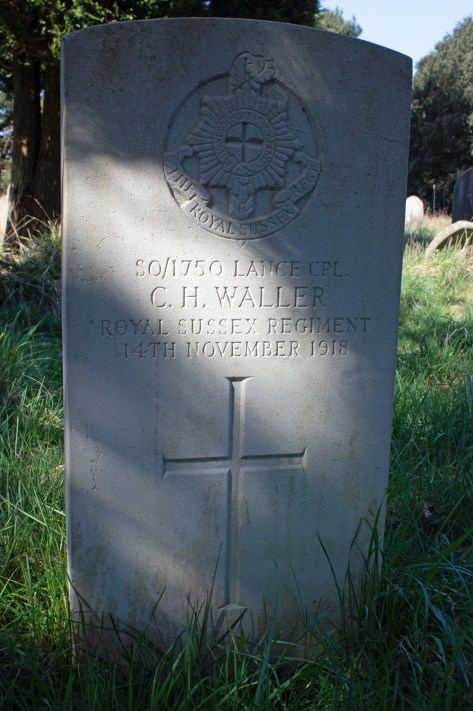
A Lance Corporal in the Royal Sussex Regiment, Charles died from influenza in the 2nd Eastern General Hospital, Brighton, Sussex, on 14th November 1918. His entry in the British Army Register of Soldiers’ Effects show that he had enlisted before the spring of that year, and gave his beneficiary as Elsie.
Lance Corporal Waller’s Dependents’ Pension card expanded on this, giving her details as Mrs Elsie Smith, of 91 High Street, Worthing. The card, however, states that the pension was refused, as she had attained the age of 16.
Intriguingly, while it has not been possible to trace Charles in the 1911 census, Elsie does appear. She is recorded as living with her husband, carter Arthur Smith, and son, three-year-old James. The three are also recorded in the 1921 census, with another child, Arthur. The family, who were living at 35 Lyndhurst Road, Worthing, by this point, had a boarder, George Frederic Waller – possibly a relation of Charles.
As to Charles himself, his life looks to remain a mystery. There are records for people with the same name in the area, but without an age it isn’t possible to definitively identify him. When he passed away, he was laid to rest in Broadwater Cemetery, Worthing, not far from Elsie and her family.