
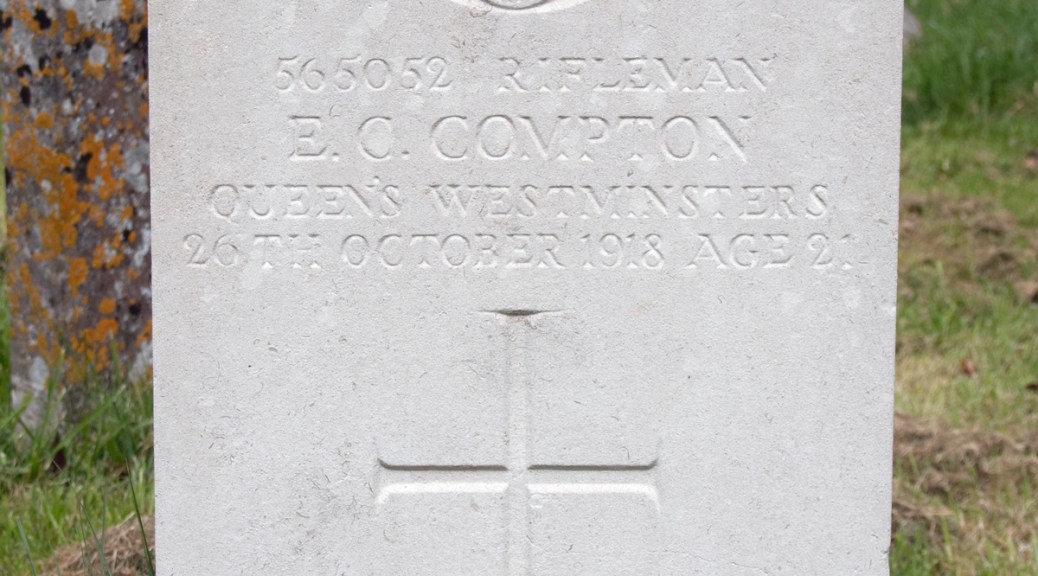
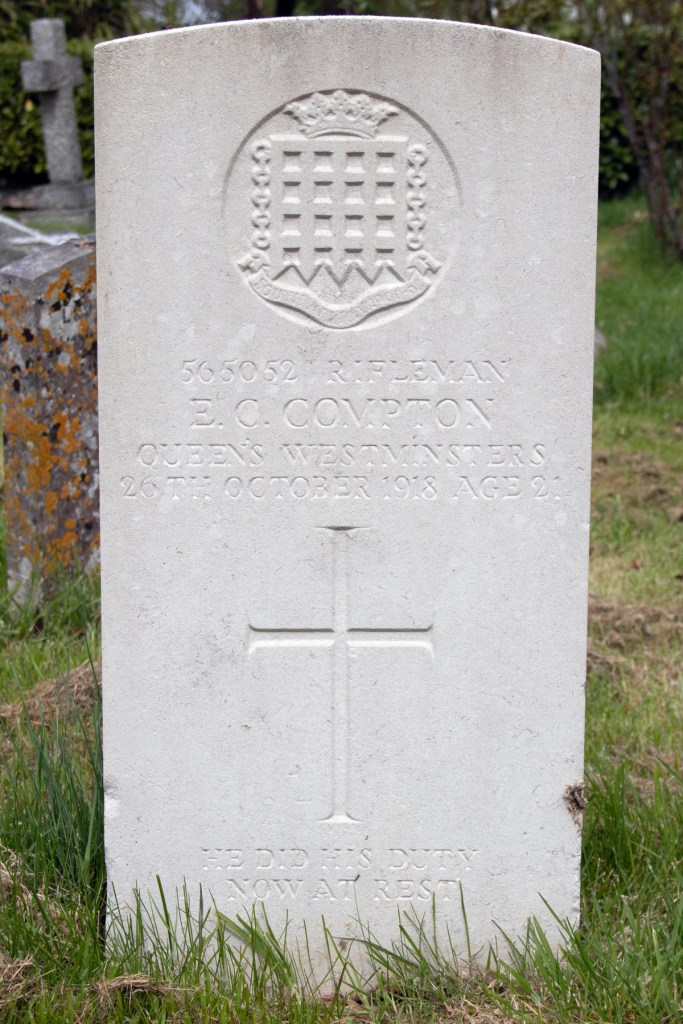
Edward Charles Compton was born in Islington, Middlesex on 4th July 1897, the only child to Charles and Ada Compton. Charles was an agent for the Prudential Insurance company, and the family lived on Devonshire Road, with Charles’ aunt, Mary.
When he finished his schooling, on 7th July 1911, Edward found work as a clerk for the North African Mission. When war came to European shores, he was eager to serve his King and Country. He enlisted on 10th September 1914, and was assigned to the 11th (Reserve) Battalion of the London Regiment.
Rifleman Compton’s service records confirm that he was 5ft 8ins (1.73m) tall, with good vision and physical development. He wasn’t formally mobilised until the summer of 1916 and, after training, he was transferred to the 16th (County of London) Battalion, also known as the Queen’s Westminster Rifles. He was sent to France on 19th December 1916.
Edward would have been involved in the German retreat to the Hindenburg Line in the spring of 1917, and the First and Third Battles of the Scarpe in April and May. At the end of July he returned to Britain and, while the reason for this is unclear, it seems that his health was suffering.
On 24th September 1917, Rifleman Compton was medically discharged from the army, after three years and fifteen days’ service. The cause for this isn’t documented, but there is no evidence that he was wounded, so it is likely to have been an illness of some description.
Edward returned to Islington and on 20th October 1918, he married Emily Backholer. She was a farmer’s daughter from Paignton, Devon, and was registered as living there when the couple’s banns were read during October.
Tragically, Edward and Emily’s marriage was not to be a long one: he died in Kelston, near Bath, Somerset, on 26th October 1918, less than a week after his wedding. He was just 21 years of age.
Edward Charles Compton was laid to rest in the graveyard of St Nicholas’ Church in Kelston, Somerset.
 Death and Service