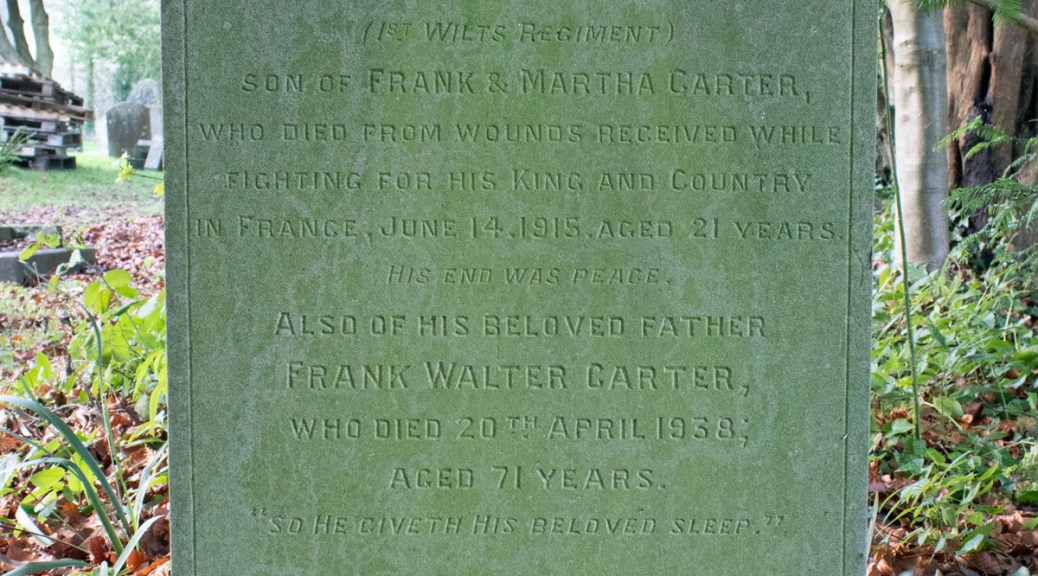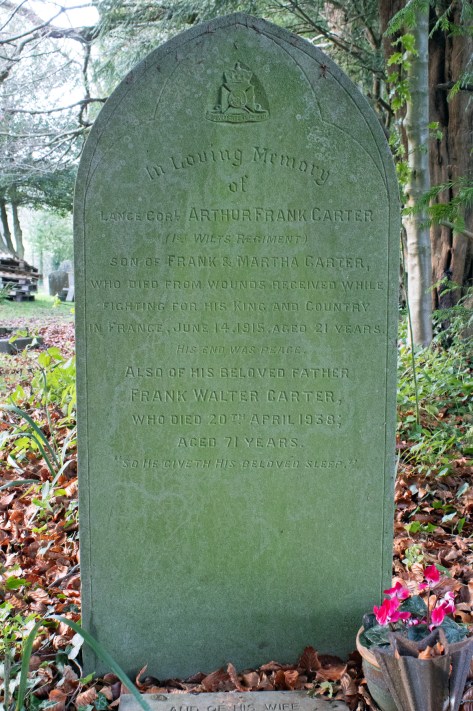
Arthur Frank Carter was born in the 10th July 1893 in Bratton, Wiltshire. The third of seven children, he was the oldest of four sons to Frank and Martha Carter. Frank was a farm labourer, and the family lived on Lower Street, to the north of the village centre.
When Arthur finished his schooling, he found work as a carter, probably unintentionally living up to his family’s name. When war broke out, however, he stepped up to play his part. Serving in the Wiltshire Regiment as a Private, he was attached to the 1st Battalion and, by the 19th January 1915, he found himself in France.
Full details of Private Carter’s service have been lost to time, but during his time overseas, he received a promotion to Lance Corporal. In June 1915 he was wounded, and was sent back to Britain for treatment. Admitted to hospital in London, Arthur’s injuries would prove to be too severe. He passed away on 12th June 1915, at the age of just 21 years old.
The body of Arthur Frank Carter was taken back to Wiltshire for burial. He was laid to rest in the family plot in St James’ Churchyard, Bratton.
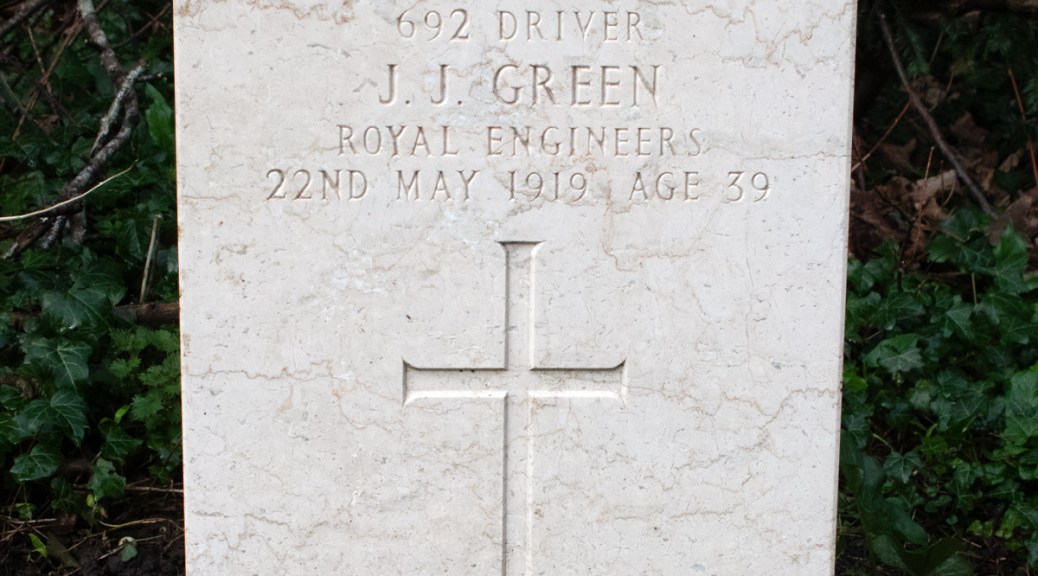
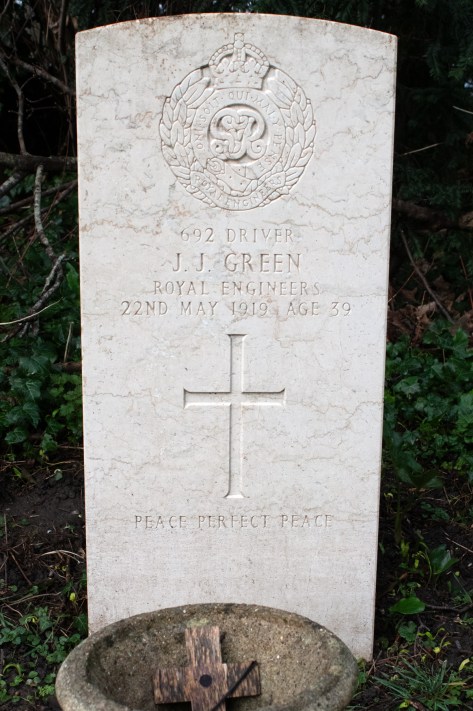
The life of John James Green is a challenge to piece together. Born in Chatham, Kent, in the spring of 1880, he was the older of two children to David and Frances Green. David was a Sapper in the Royal Engineers, but when he died in 1883, his widow was left with two young children to raise.
Frances moved the family back to Eton, Berkshire, where she had been born. She married again, to groom Robert Edwards, and the couple went on to have a child of their own, John’s half-brother, Robert.
When John completed his schooling, he followed in his father’s footsteps. He joined the Royal Engineers, and went on to be a Driver for the regiment.
The 1901 census recorded him as being a patient in the Connaught Hospital, attached the North Camp in Aldershot, Hampshire. While not confirming John’s condition, it does note that he was married, although there does not appear to be any other record confirming this.
On 29th October 1903, however, John did get married. His new bride was Alice Morton, and the couple exchanged vows in St Mary Magdalene Church in Southwark, London.
Sadly, Alice seems to have died young, and in December 1905, John wed for a second time, to grocer’s daughter Ellen Mansey. Now based back in Aldershot, the two married in Holy Trinity Church, and went on to have five children: John, Ernest, May, Charles and Alice.
The 1911 census found the Green family in rooms at 25 Lyson’s Road. A small terraced cottage, they shared it with the Scotts – married couple John and Edith, and their baby, William.
At this point, John’s trail goes cold. War broke out, and it is certain that he served in some capacity, but how and where is unclear. Driver Green survived the conflict, but passed away in Aldershot on 22nd May 1919: he was 39 years of age.
The body of John James Green was taken back to Berkshire for burial. He was laid to rest in the graveyard of St John’s Church in Eton, where his mother was still living.
It appears that Ellen may also have passed away by this point, as John’s pension was split equally between their five children. Tragically, his pension card notes Ernest and Charles’ guardian as the Sister in charge of St Augustine’s Home for Boys in Clewes, Berkshire. May and Alice were being looked after by Miss J Angerous of Pembroke Gardens, Windsor; while oldest son John Jr was in the care of Mrs B Evans Baldwin’s End, Eton College.
Arthur Frederic Thornton Phripp was born in Gillingham, Dorset, in the summer of 1894. The middle of three children, and the only son, his parents were Frederick and Kate Phripp. Frederick was a farmer, and the family lived in Slaughter Gate, to the west of the town centre.
The 1911 census recorded Frederick and Kate managing the farm, and raising their youngest child, daughter Lucy. Arthur, however, is missing, and it seems that he had taken started working for the Post Office as a boy clerk. Where he was living is unclear, but later documents suggest that he may have moved to London.
When war broke out, Arthur stepped up to play his part, joining the 1/21st (County of London) Battalion of the London Regiment, which was also known as the First Surrey Rifles. Private Phripp arrived in France on the 16th March 1915 and, over the next couple of years, fought at Loos, the Somme and Messines. He rose through the ranks, reaching Sergeant and, in the autumn of 1917, he was awarded a commission to Second Lieutenant.
Arthur returned to Britain to formally take the commission, and was transferred to the Duke of Wellington’s (West Riding) Regiment. Back on home soil, it was a chance to see family again, but tragedy was to strike.
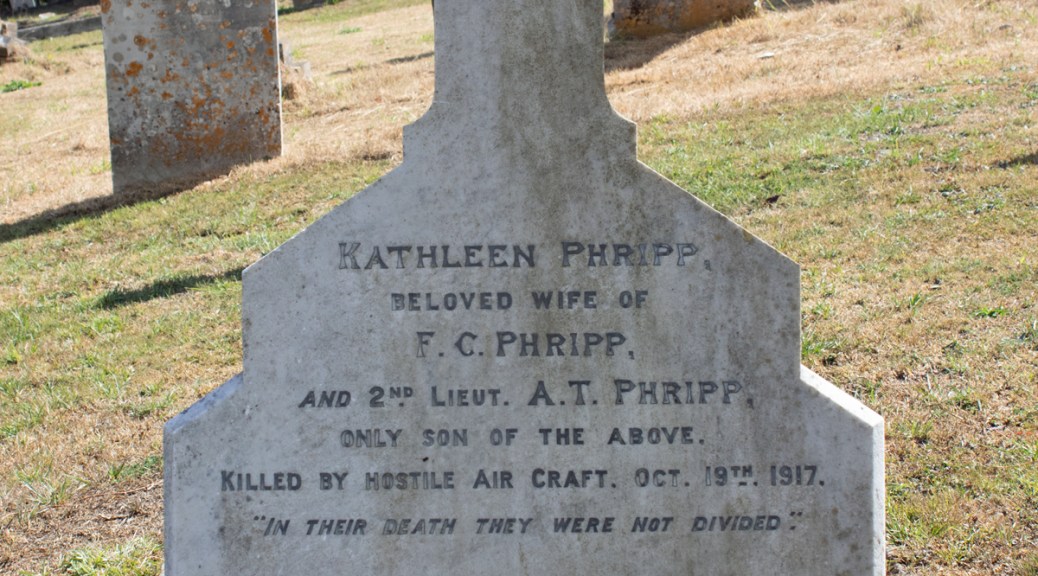
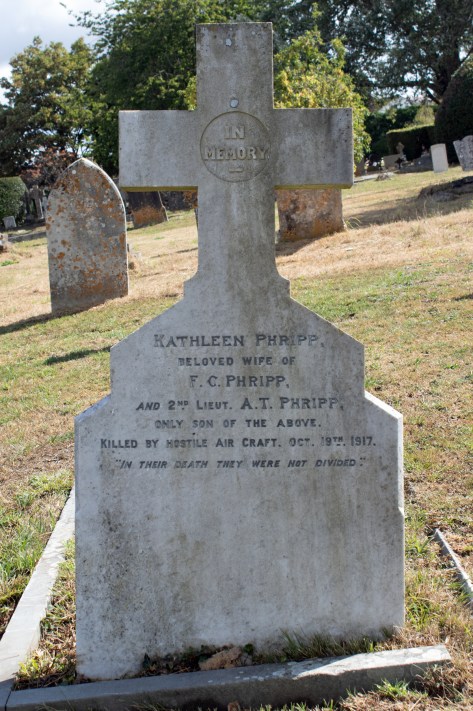
A painful sensation was created in the town when it became known that Mrs Kate Phripp, 65, of Slaughtergate Farm, and her son, Arthur TF Phripp, 23, had been killed in the Zeppelin raid on Friday.
At the inquest on seven of the victims on Monday evidence was given that Mr Phripp was stopping with some friends, and his mother went up from Gillingham on Friday to see him. Evidence given by the police showed that warning had been given in every principal thoroughfare in the district where the fatalities occurred, and the theatres had been warned. The bomb came quite unexpectedly. Besides the killed nine people were seriously injured and nine slightly injured. A great amount of glass was smashed. It was mentioned that Mrs Phripp and her son had been attending the theatre, where is was announced that the warning had been given, and that the play would continue until the guns were heard. The play was continued to the end, and the deceased left at their own risk. The Coroner observed that it was clear that some people took the optimistic view that the raid was over. If people went out into the street after a warning they did to at their own risk. A formal verdict was returned, and they commended the work of the police, special constables and ambulance workers, who, they said, had acted promptly and pluckily…
[Bridport News: Friday 26th October 1917]
The Zeppelin that raided London that night had originally been one of eleven aircraft tasked with attacking Britain’s northern industrial towns. But strong winds disrupted the operation, and one airship – L45, commanded by Kapitänleutnant Waldemar Kölle – was blown south instead.
Meanwhile, Second Lieutenant Phripp and his mother had just left His Majesty’s Theatre in the Haymarket, where they had been watching the comedy Chu Chin Chow, and were making their way across Piccadilly Circus, returning to their friend’s house.
By ill twist of fate, at that moment Kölle released a 100kg (220lb) bomb, which exploded in the road outside the Swan & Edgar department store. The resulting explosion destroyed the building’s frontage and left a crater in the road some 10ft (3m) across and 4ft (1.2m) deep. Seven people were killed: this included Kate and her son.
The bodies of Kate and Arthur Phripp were taken back to Dorset for burial. They were laid to rest together in Gillingham Cemetery, not far from where Frederick and Lucy were grieving.
[Note: My thanks go to Tony Otton for his insight into the event that led to the passing of Arthur and his mother.]
It is with deep regret we record the death of Mr G Aubrey Manaton, son of Mr and Mrs William Manaton, of Braunton, who had just passed away at his home in Braunton. Mr Manaton was a young journalist of brilliant prospects, his scholarly attainments and aptitude for the profession being such that he made rapid steps for one so young. Having served his articles on a Barnstaple weekly newspaper, he went to London and joined the staff of one of the Newsagencies, and subsequently that of “The Times.” For a short while he was a war correspondent for the latter paper in France, and during that period made most able contributions to the paper, notably among them being a graphic account of the sinking of a large warship off the French coast, of which he was an eye witness in the early days of the war. He served for a short time with the Inns of Court Officers’ Training Corps, from which he was invalided on account of ill-health. Besides being naturally gifted in his literary capacity, Mr Manaton had a wealth of charm of personality and character, and his death, at the early age of 26, is deeply regretted, especially among his intimate friends, of whom he had a great many. He was unmarried. In their bereavement, the parents, whose eldest son was killed in the war some time since, will have a measure of sympathy both full and sincere. One of deceased’s brothers, Lieut. Arthur Manaton, is serving in France with the Yorks and Lancs Regt.
[Western Times: Tuesday 30th July 1918]
George Aubrey Manaton was born on 9th June 1892 in Braunton, Devon. The second of five children, his parents were William and Sarah Manaton. William was a tailor and outfitter, and the family lived in a nine-roomed house – Hillside – on Church Street, to the north of the town centre.
George was working as a journalist by the time of the 1911 census. When war broke out, his work took him to France, but by the summer of 1915, he felt he could no longer remain a mere observer. Back in London, on 17th June, he enlisted in the army, and was assigned to the Inns of Court Officers’ Training Corps.
Private Manaton was sent to Berkhamsted, Hertfordshire, for his training. His time in the military, however, was to be a short one, and he was discharged for being unlikely to become an efficient soldier on medical grounds on 26th November 1915.
At this point, George’s trail goes cold. His older brother, Fred, a Private in the 9th (Service) Battalion of the West Yorkshire Regiment, had survived Gallipoli, but was killed during the Battle of the Somme in September 1916. He was laid to rest in Puchevillers British Cemetery in Picardie.
George Aubrey Manaton passed away on 25th July 1918: he had turned 26 just a few weeks before. He was laid to rest in the Methodist Chapelyard of his home town, Braunton.
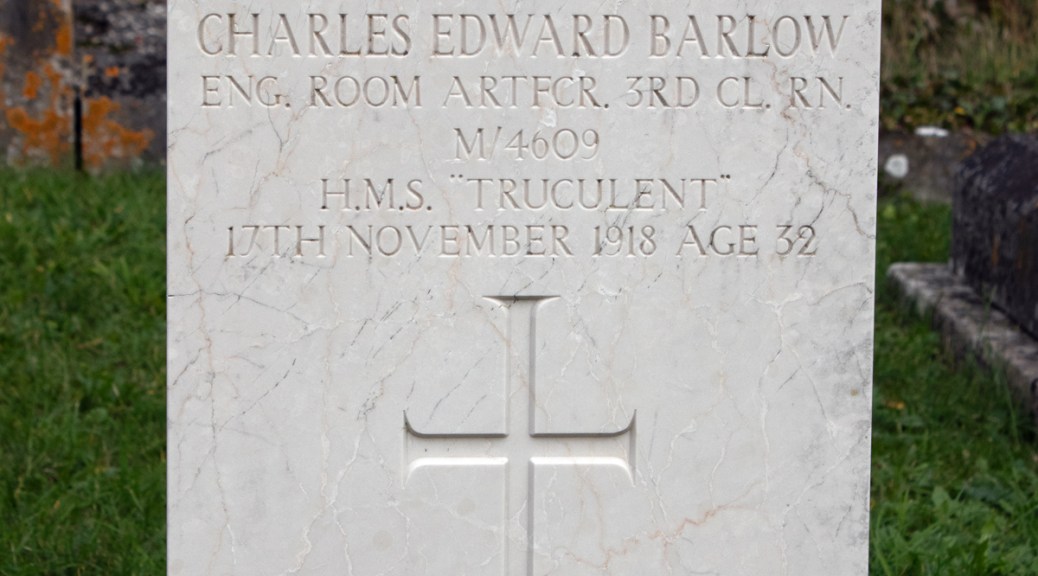
Charles Edward Barlow was born on 3rd January 1886, and was the second of eight children to John and Agnes. John was a Serjeant Major in the Royal Fusiliers, and his work meant the family moved a lot. Charles and his older brother were born in Dublin, Ireland, while Agnes gave birth to his younger siblings in Essex, Ireland, Hampshire and London.
John died in the late 1890s, and the 1901 census found Agnes and four of the children – including Charles – living at 18 Ethel Road, a small terraced cottage in the centre of Portsmouth, Hampshire. Agnes was listed as a shirt maker, while Charles was apprenticed to a boiler maker.
The apprenticeship obviously stood Charles in good stead, and he later found employment as the local dockyard, HMS Victory. The 1911 census recorded mother and son living at 124 Ernest Road, in the Buckland area of Portsmouth. Slightly further from where Charles was working, this was, however, a larger property.
A new opportunity presented itself in the spring of 1912, when Charles formally enrolled in the Royal Navy. His engineering background served him well, and he took the rank of Engine Room Artificer 4th Class. Initial training was provided at Portsmouth Dockyard, and he then moved to the neighbouring bases HMS Fisgard that autumn, and HMS Dryad in February 1913.
After a two month posting on board the torpedo gunboat HMS Harrier, Charles would return to shore in the summer of 1914. On 1st January 1915, however, he was assigned to the depot ship HMS Dido, and she would remain his home for nearly four years. During this time, he was promoted to Engine Room Artificer 3rd Class.
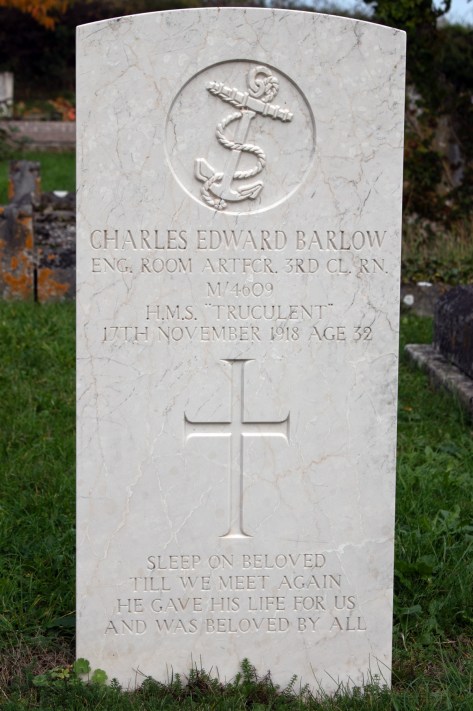
In the autumn of 1918, with the war in its final weeks, Charles fell ill. He was disembarked and admitted to the War Hospital in Bath, suffering from pneumonia. The condition would prove his undoing, and he passed away on 17th November: he was 32 years of age.
The body of Charles Edward Barlow was taken to Bradford on Avon for burial, possibly due to a familial connection in the area, and he was laid to rest in the town’s cemetery.
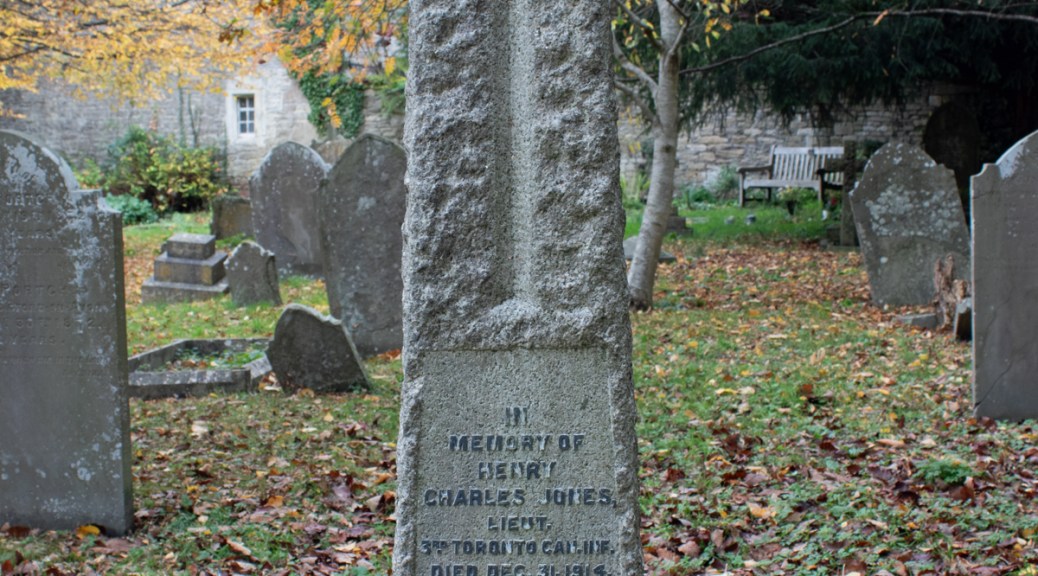
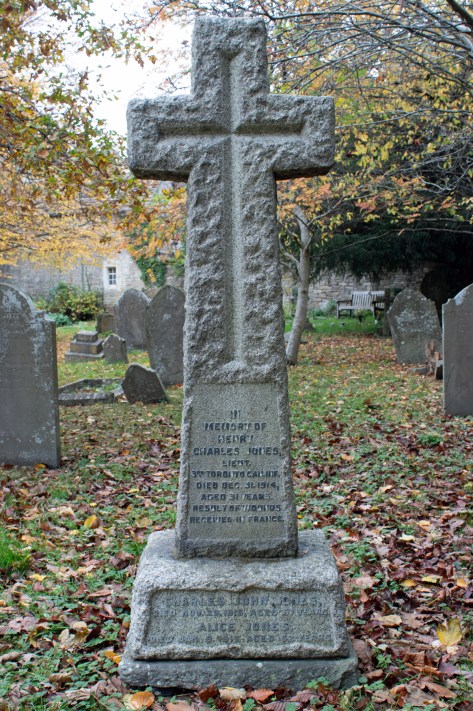
Lieut. H C Jones, of the 3rd Battalion Toronto Infantry, sone of Mr C J Jones, solicitor of Bradford-on-Avon, died on Friday morning in a London nursing home, as the result of wounds received in France about six weeks ago. Lieut. Jones, who was about 30 years of age, served his apprenticeship at Messrs. Stothert and Pitt’s, Bath, and afterwards went to Canada. He returned to England with the first Canadian contingent, as a sergeant in the Mechanical Transport. He received his commission in the Toronto Infantry last summer. Six weeks ago he was dangerously wounded in the jaw by shrapnel, while serving in France, and was taken to the Duchess of Westminster’s Hospital at La Touquet. There he was operated on by Dr Fraser, of Bath. He was later taken to a nursing home in London, where he underwent several operations. Death, however, took place yesterday morning, as stated above. Lieut. Jones’s only other brother is Second Lieut. B Jones of the… Wiltshires, and is serving in France. His eldest sister is also in France, serving as a military nurse.
[North Wilts Guardian: Friday 7th January 1916]
Henry Charles Jones was born on 22nd November 1884 in Bradford-on-Avon, Wiltshire. The oldest of four children, his parents were Charles and Alice Jones. As the newspaper report suggested, Charles was a solicitor and, by the time of the 1891 census, the family were living in some comfort at 3 Woolley Street, near the town centre. Alice was supported by a domestic servant and two live-in nurses for the children.
The status quo remained until Henry moved to Bath to serve a the engineering company in Bath. From here, as the North Wilts Guardian suggests, he emigrated to Canada, although the exact dates for the move are unclear. He had certainly relocated to Valcartier, Quebec, by the summer of 1914, and was employed as a chauffeur.
On 23rd September that year, with war declared in Europe, Henry joined the Canadian Infantry. His service papers show that he was 5ft 8.5ins (1.74m) tall, with dark brown hair, grey eyes and a fair complexion. He was noted as having two vaccination scars on his left arm, an appendectomy scar on his left side, a scar over his left knee and a mole on the back of his neck.
By the summer of 1915, Lieutenant Jones was in France when he fell ill. He was admitted to the 3rd London 85th Field Ambulance on 26th August, suffering from diarrhoea, and remained there for three days.
It was on 17th November 1915, that Henry was wounded. Where he was based at the time is unclear, but his unit – the 3rd Battalion (Toronto Regiment) were ensconced on the Western Front that autumn. The newspaper report outlined the progress his treatment took from there. He contracted septic pneumonia and it is to this that Lieutenant Jones seems to have succumbed. He died on 31st December 1915, at the age of 31 years old.
The body of Henry Charles Jones was taken back to Wiltshire for burial. He was laid to rest in the graveyard of Christ Church, Bradford on Avon.
Their son’s death seems to have taken its toll on Henry’s parents. Charles died a year later, at the age of 67: Alice died just two months later, at the age of 62.
Henry’s headstone incorrectly gives the date of his death as 31st December 1914.
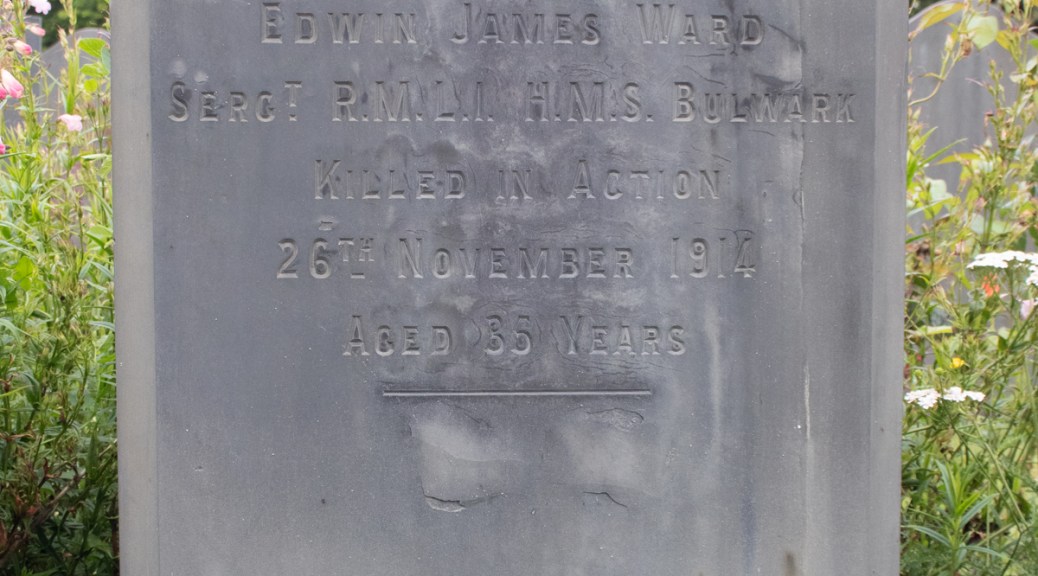
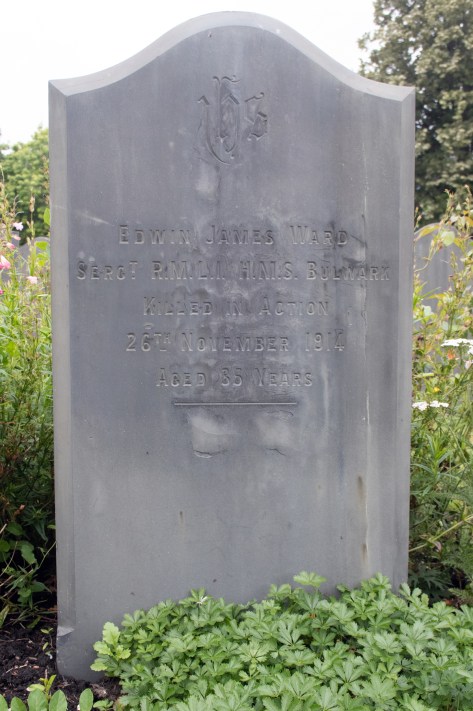
Edwin James Ward was born at the start on 3rd December 1879 in London. The oldest of four children, his parents were William and Emma Ward. William, who was a printer, had also been born in London, and the family lived initially in rooms on Trafalgar Street, Walworth, then Hardaker Street in Shoreditch.
There are tantalising gaps in Edwin’s life, and it is a challenge to piece together what happened to him after the 1891 census. He disappears from the records for nearly two decades, and is it likely that he had enlisted in the Royal Marine Light Infantry, and spent time overseas.
On 21st August 1908, Edwin married a woman called Kate. There is no further information available about her, although the couple went on to have a daughter, Kitty, who was born in Portsmouth on 13th November 1911.
Edwin’s trail goes cold again at this point. He appears to have risen through the ranks with the Royal Marines and, by the summer of 1914, was a Sergeant. He was assigned to the battleship HMS Bulwark, and was on board on the 26th November 1914, when she was moored close to Sheerness, Kent. That morning, an explosion ripped through the ship, sinking it and killing more than 740 people. Sergeant Ward was amongst them: he was 34 years of age.
The body of Edwin James Ward was laid to rest in a marked grave in the naval section of Woodlands Cemetery, Gillingham, Kent.
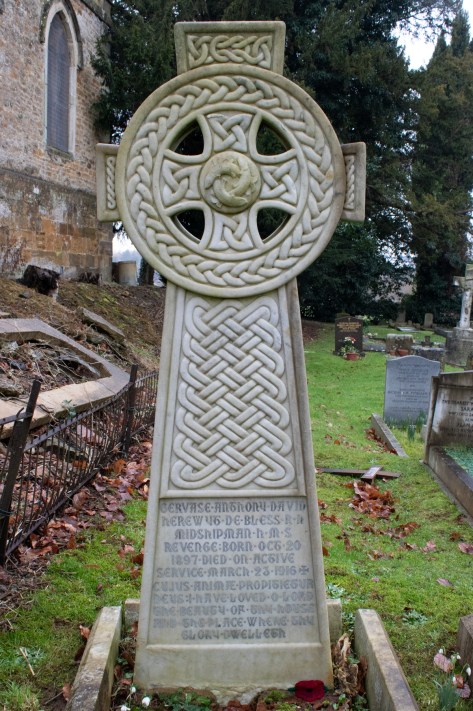
Gervase Anthony David Herewyt de Bless was born on 20th October 1897 in Westminster, Middlesex. One of two children, he was the surviving son of barrister Alfred de Bless and his wife Maud, born Maud Cary-Elwes. Both were renowned families – Maud’s brother going on to become the Bishop of Northampton. The family do not appear in the 1901 census, but by 1911 Gervase’s parents were living at 156 St James’ Court, with French lady’s maid Henriette Forestier.
Alfred died not long after the census was taken. Gervase, meanwhile, was installed as a boarder at Downside College, Somerset. One of 168 students, he was taught by twelve schoolmasters and a handful of Roman Catholic priests from the local abbey.
An exceptionally clever boy of very active minds and many interests, during his time in the School he distinguished himself in all branches of study, winning the Gregorian Medal in 1912. He passed the Higher Certificate three times, twice gaining distinction in French and twice in Roman History. For three years he played in the Junior Cricket Eleven, which he captained in 1912. From 1908 to 1912 he sang in the choir as a treble, and he took a leading part with much success in “The Gondoliers,” and in “HMS Pinafore.” In 1914 he was Editor of The Raven, and he was on the committee of the Petre Library. In this year also he was awarded the Higher Certificate Latin Prose Prize given by St Gregory’s Society. On leaving Downside he spent two terms at Cambridge under the tuition of Mgr Barnes. Sensitive and somewhat retiring, and with health far from robust, he faced the situation created by the war with splendid courage, and obtained a cadetship in the Royal Navy. A skilful angler, fishing had ever been his favourite recreation, and on this pleasant pastime he wrote some charming verses which were afterwards collected in a little booklet.
[Baliol College War Memorial Book]
Gervase was given the rank of Midshipman in February 1916, and was assigned to the battleship HMS Revenge the following month. Before his posting he had suffered a bout of influenza, and had a relapse within days of boarding. He died from a combination of influenza and diabetes on 23rd March 1916, just two days after joining Revenge. He was just 18 years of age.
…rites of the Church… were administered to him by Dom Jerome Tunnicliffe, of St Mary’s, Liverpool, a monk of Downside.
[Baliol College War Memorial Book]
The body of Gervase Anthony David Herewyt de Bless was taken to Northamptonshire for burial. He was laid to rest in the ground of St Andrew’s Church, Great Billing, the last resting place of the Cary-Elwes family and de Bless families.
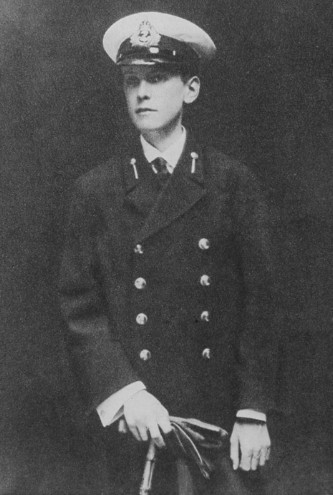
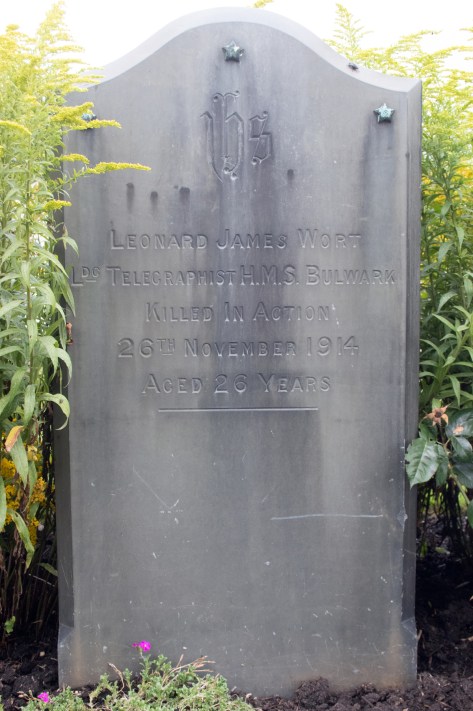
Leonard James Wort was born in the Wiltshire village of Woodfalls, on 28th September 1888. He was the second of eleven children – and the oldest son – to James and Annie Wort.
James was a sawyer, but Leonard sought a better life for himself. Initially finding work as a blacksmith’s mate when he completed his schooling, but took up a career in the Royal Navy at the start of 1907. Employed as a Stoker 2nd Class, documents show that he was 5ft 6.5ins (1.69m) tall, and that he had brown hair, hazel eyes and a fresh complexion. He was also noted as having scars on the thumb and finger of his left hand.
Leonard was sent to the training ship HMS Nelson for his initial induction. He remained there for four months, before being given his first sea-faring appointment, on board the cruiser HMS Spartiate. Over the next seven years, he would serve on nine ships in total, but his service took an unexpected route.
In February 1908, Leonard was promoted to Stoker 1st Class, and the next expected progression would have been to Leading Stoker. However, year later, while serving on HMS Hindustan, he took a different route, and became a Telegraphist. He appears to have enjoyed this role, and been more than capable of carrying it out: his annual reviews noted his superior ability on more than one occasion.
Over the next few years, Leonard spent time at HMS Victory – the Royal Naval Dockyard in Portsmouth, Hampshire – presumably to receive the training needed to undertake his role. At the start of 1911, he was promoted again, taking the rank of Leading Telegraphist.
Away from the sea, love was blossoming. Leonard had met Florence Bysouth, a casemaker’s daughter from Bankway, Hertfordshire. The couple exchanged their vows in Bromley, Kent, but had set up home in Poplar, East London.
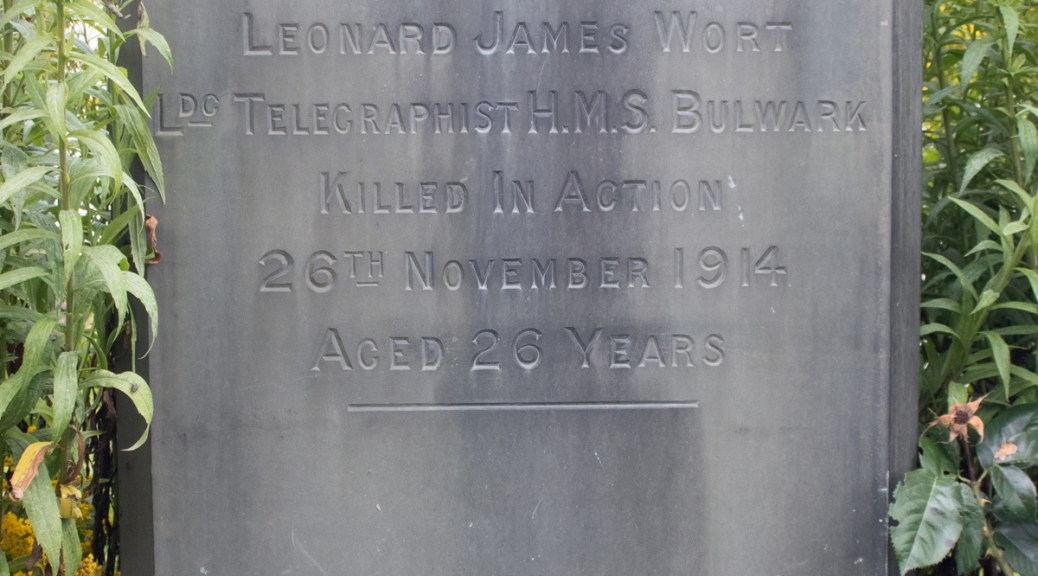
In November 1912, Leading Telegraphist Wort was assigned to the pre-dreadnaught battleship HMS Bulwark. Part of the Channel Fleet, she was tasked with patrolling the southern coasts of Britain. On 26th November 1914, Bulwark was moored in the River Medway, close to Sheerness, and was being stocked with shells and ammunition. That morning, some of the cordite charges overheated, detonating the shells stored nearby. The resulting explosion ripped through the battleship, and more than 740 crew were killed. The body of Leading Telegraphist Wort was recovered: he was 26 years of age.
Those who were killed in the explosion were laid to rest during a mass funeral in Woodlands Cemetery, Gillingham, Kent. As his body had been identified, Leonard James Wort was laid to rest in a marked grave.
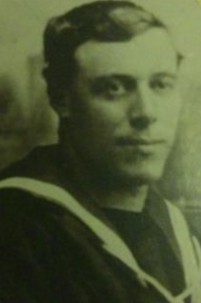
Leading Telegraphist Leonard Wort (from findagrave.com)
Leonard was not the only one of the Wort sons to sacrifice his life during the First World War. His younger brother, Alfred, also enlisted in the Royal Navy, giving up his role as footman and valet to serve as an Officer’s Steward.
Alfred’s service records show that he was attached to HMS Vivid – the Royal Naval Dockyard in Devonport – when, on 4th April 1918, he drowned. He was 26 years of age, and left a widow and son.
John Edward Major was born on 1st April 1881 in Gorleston, Suffolk. One of seven children, his parents were William and Elizabeth Major. William was a fisherman and the family lived on the town’s High Street.
Things changed for the Major family, however, and the 1891 census found them living in Barking, Essex. William was now employed as a general labourer, and the family had set up home at 16 Rosa Terrace.
John was drawn to his coastal past and, according to the next census, he was a ship’s mate on the fishing boat Cygnet. Based out of London, the return was taken in Lowestoft, so it is safe to assume that she plied the Essex and Suffolk coasts.
Love was blossoming for John at this point and, on 9th September 1906, he married Ann Davy. She was a coal porter’s daughter from Barking, and the couple married in the town’s St Margaret’s Church. They would go on to set up home in Cleethorpes, Lincolnshire, and have five children: Blanche, Amelia, Annie, Elizabeth and John Jr.
Over the next few years John’s trail goes cold. When war broke out, he was called upon to play his part, and joined the Royal Naval Reserve as a Trimmer. By the summer of 1917 he was attached to the SS Gransha, based out of the Royal Naval Dockyard in Chatham, Kent.
The next record for Trimmer Major relates to his passing. His pension ledger notes that, on 11th September 1917, he fell overboard from Gransha and was drowned. Sadly, there is no other information available about the incident, but John was 37 years of age.
The body of John Edward Major was laid to rest in the naval section of Woodlands Cemetery, Gillingham, Kent, not far form the naval base that he had come to call home.
Tragically, John’s entry on the Pension Ledger confirms that his and Ann’s youngest child – John Jr – died on Christmas Eve 1917, three months after his father.