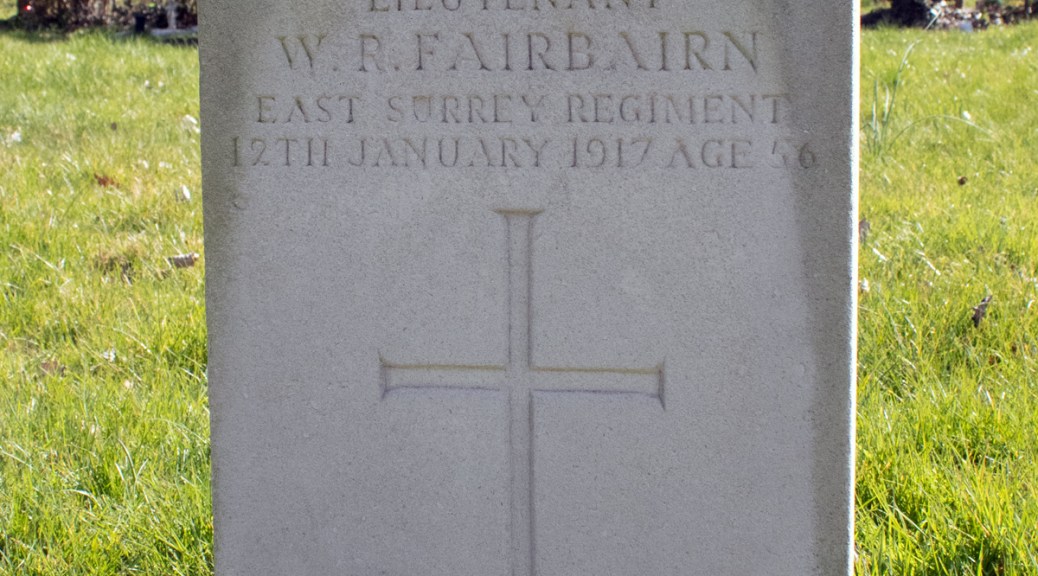
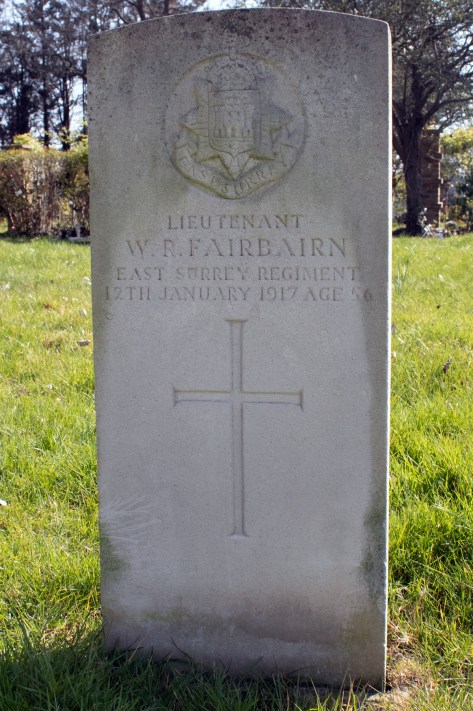
In the sprawling Streatham Park Cemetery, Surrey, is a headstone dedicated to Lieutenant WR Fairbairn of the East Surrey Regiment, who died on 12th January 1917, at the age of 56.
There is frustratingly little information available about Lieutenant Fairbairn. The Commonwealth War Graves Commission records confirm his widow as Mrs F Fairbairn, of 35 Egerton Road, Bexhill-on-Sea, Sussex, but this was a boarding house and the couple were not resident there at the time of the 1911 census.
Without a confirmed first name, or place of birth, it isn’t possible to track down baptism or parental records, and Lieutenant Fairbairn’s name does not appear in contemporary newspaper reports.
As a commissioned officer, standard military records do not exist, and with no service number available, his time with the East Surrey Regiment is a mystery.
One document gives a tiny insight into Lieutenant Fairbairn’s life: the Hospital Registers for 1914-1919 confirms that he was admitted to the Queen Alexandra Military Hospital on Millbank, Westminster, on 12th December 1916. While the document doesn’t confirm his first name, it does show that he had been in the army for some 41 years, which might explain his absence from any census records. Now attached to the 21st Training Reserve, he was suffering from chronic bronchitis and nephritis.
Lieutenant Fairbairn was discharged from hospital on 6th January 1917, and for the next six days his trail goes cold. Whether he was sent to Streatham to recuperate, or whether he was based there with his wife is unclear.
Either way, Lieutenant WR Fairbairn passed away on 12th January 1917, ad the age of 56 years old. He was buried in Streatham Park Cemetery, taking the details of much of his life with him.
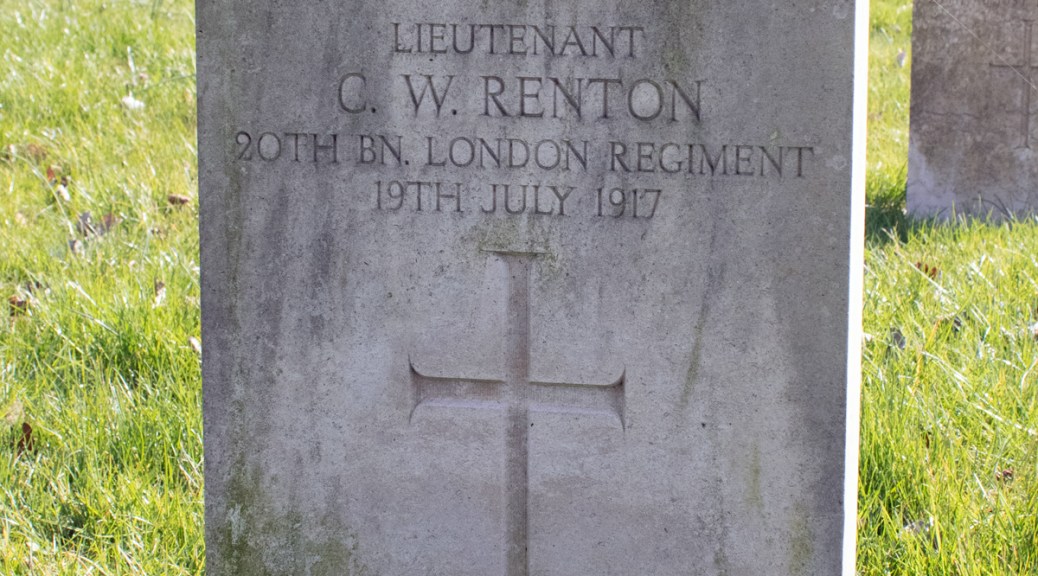
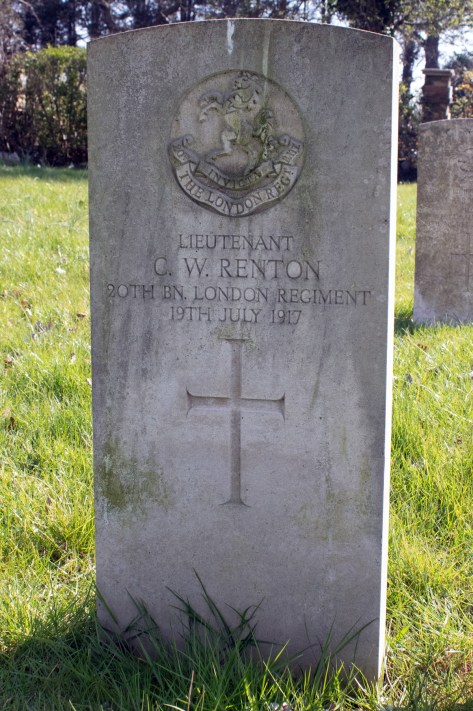
Cyril William Renton was born in Brixton, Surrey, on 27th November 1872. The older of two children, hie parents were Edward and Emily Renton. Edward was an engraver and artist and, when Emily died shortly after Cyril’s younger brother was born, he married again, to Harriett Predier: the couple went on to have two children, Cyril’s half-brother and half-sister.
By the time of the 1891 census, Edward had moved the family to Hampstead, Middlesex. Setting up home in the illustrious South Hill, their home – a Georgian semi-detached villa backing onto Hampstead Heath – served as a fine setting for the now art dealer head of the household.
When Cyril completed his schooling, he found work as a stockbroker. On 22nd December 1894, he married Mary Nettleton at St Paul’s Church in Kentish Town. Mary was the daughter of a solicitor’s clerk, and Cyril’s new father-in-law seems to have helped his career.
The 1901 census found the young couple living at 33 Tivoli Road in Hornsey, Middlesex. Their eldest child, Lionel, had been born four years before, and Mary’s father and brother were also living with them. Cyril was now recorded as being an articled clerk for a firm of solicitors.
Second son Esmonde was born in 1897, and Cyril’s career continued its upward journey. By 1911 the Rentons had moved to 46 Glasslyn Road in Crouch End, and had taken on two servants to support the family. Cyril was now a full-blown solicitor and counted an estate agent’s clerk, a cement company secretary, a master stevedore and a human hair merchant amongst his neighbours.
[He] practised as a solicitor as the Police Court. For several years he represented the National Society for the Prevention of Cruelty to Children. He was at one time the vice-president of the Highgate Thirty Club, and in 1914-15 became the president.
[Hornsey & Finsbury Park Journal: Friday 3rd August 1917]
While obviously good at his job, Cyril wanted more:
At a time when he seemed very likely to make a big name for himself in the various courts he attended, he decided to dispose of his practice and to study for the bar. In the Michaelmas law examination of 1913 he successfully passed in all the subjects and the “final,” and was thereupon duly “called.” He was getting on extremely well in the higher branch of his profession when war broke out…
[Hampstead & Highgate Express: Saturday 28th July 1917]
Cyril felt a call to serve his country, and so stepped up to enlist.
[He] joined the Inns of Court OTC, and went into training. When he obtained his commission je joined a battalion of the London Regiment, and, having been through a course at Hythe, he became a musketry instructor and was engaged in that capacity for many months. At last the authorities yielded to his repeated applications to be sent on active service, and he went to France. There he had six months’ fighting, and only returned after he had been wounded.
[Hampstead & Highgate Express: Saturday 28th July 1917]
Attached to the 20th (Country of London) Battalion (Blackheath and Woolwich), Lieutenant Renton’s older son, Lionel, was also fighting, and was attached to the 16th Service Battalion – also known as the Public Schools Battalion – of the Middlesex Regiment.
It is unclear whether Cyril returned to the fray, and by the spring of 1917, having recovered from injuries, he fell ill. His health seems to have been impacted by his injuries, and he passed away from his condition on 19th July: he was 44 years of age.
The body of Cyril William Renton was taken to Streatham, Surrey, for burial: the reasons are unclear, but it is likely that this is where his mother and father (who had died in 1904) had been buried. Private Lionel Renton was recuperating from injuries, and was able to attend the funeral with Mary and Esmonde.
Courtenay Traice Lindsay was born in Belfast, Northern Ireland, on the 11th December 1874. The second of four children, he was the only son to Thomas and Ruth Lindsay. Thomas was an art teacher and examiner and, by the time of the 1881 census, he had moved the family to Rugby, Warwickshire, setting them up in the Temple Art Museum on Barby Road.
Education was important to Thomas, and it was obvious that his son’s passion was art. “He entered [Rugby] School in 1888 and left in 1892. He was afterwards Drawing Master at Seafield Park Engineering College, Hampshire, Trad Designer for textiles and pottery, and Examiner under the Board of Education in Geometrical Drawing.” [Memorials of Rugbeians Who Fell In The Great War, Volume VII]
On 10th January 1903, Courtenay married Charlotte Wetenhall. The daughter of a man of means, she was born in Stanwick, Northamptonshire, and the couple exchanged vows in her local parish church.
Courtenay’s mother died in 1905 and by the time of the 1911 census, he and Charlotte were living at 143 Beaufort Street, Chelsea, Middlesex. A five-storey Georgian building, they had let our rooms to aspiring artist Marion Forbes. Courtenay was an artist and designer himself, and he and Charlotte had an eight-month-old son, Courtenay Jr.
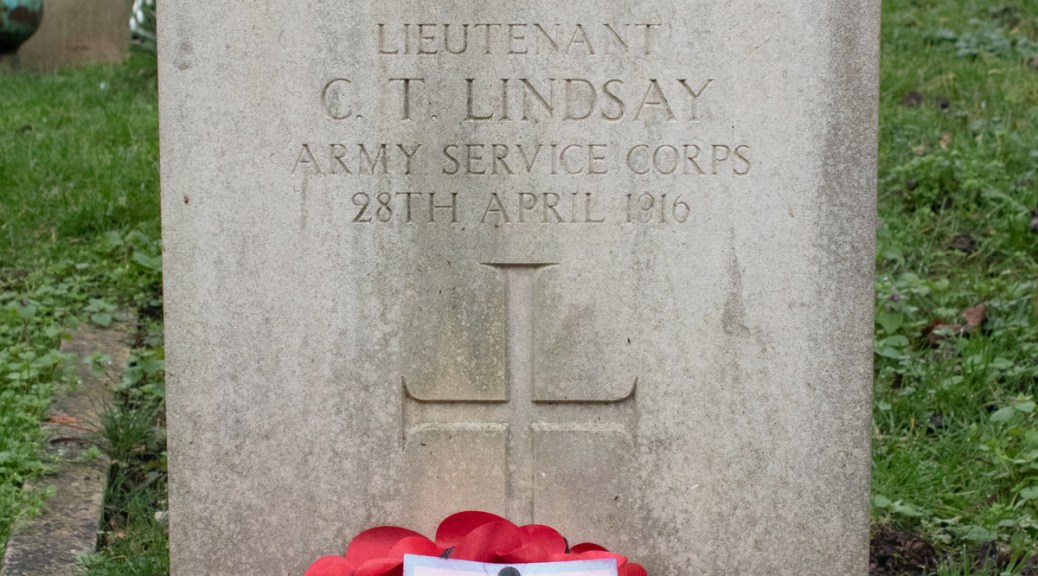
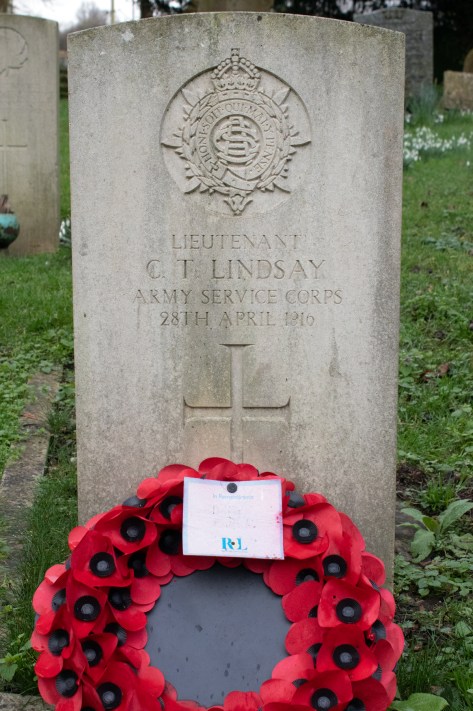
When war broker out, Courtenay stepped up to play his part. He gained a commission in the Army Service Corps, but did not see any service overseas. “He… was engaged on Road Transport, in the Northern Command. Hard work in the Transport Service undermined his constitution, and he died of heart failure, following on septic poisoning, on April 28th, 1916. Age 41.” [Memorials of Rugbeians Who Fell In The Great War, Volume VII]
Courtenay Traice Lindsay died at Burnham Abbey, near Maidenhead, Buckinghamshire. Interestingly, while Charlotte and their son were living four miles north in Burnham Beeches, he was laid to rest in Dorney Burial Ground, a short walk to the south of the hospital.
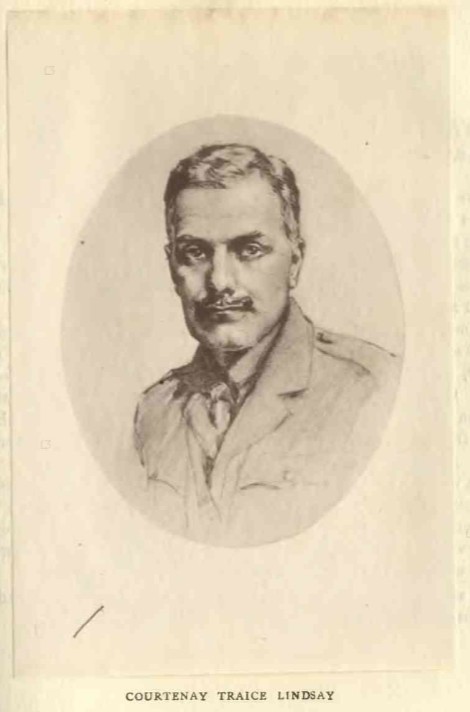
Lieutenant Courtenay Lindsay (from Memorials of Rugbeians Who Fell In The Great War, Volume VII)
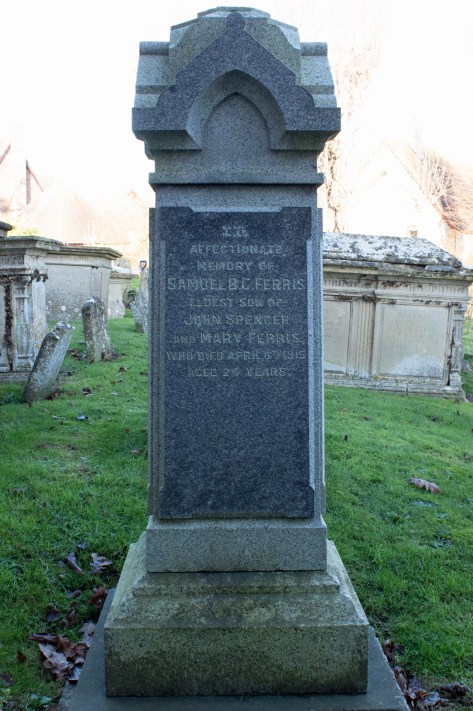
A verdict of accidental death was returned by a Coroner’s jury at Tidworth on Thursday in the case of Second-Lieutenant Samuel Ferris, of the Cavalry Reserve. The officer was found in his room at the Barracks shot through the head, and died within the hour. Shortly before the occurrence he was in a cheerful mood, had been on parade, breakfasted, and was changing his wet clothes. Captain and Adjutant Barclay stated that he found a yard and a half from Lieutenant Ferris’s feet an automatic pistol of the latest pattern. It might, he said, easily be discharged by a person who did not intend to fire it, and who had no reason to know it was loaded. Captain Barclay expressed his opinion that the discharge of the pistol was accidental. Lieutenant Ferris, who had been to the front and was much improved in health since his return, was a son of Dr John Spencer Ferris, or Warwick Dene, Ealing.
[Wiltshire Telegraph: Saturday 10th April 1915]
Samuel Bernard Clutton Ferris was born on 1st December 1890, and was the oldest of three children to John and Mary Ferris. John was a physician and surgeon from Wiltshire, but the family were born and raised near his practice in Uxbridge, Middlesex.
Mary died in 1910, by which time Samuel had taken up studies at Cambridge. Following in his father’s line of work, he was reading natural science at the esteemed university. Outside of term time, John – now retired – Samuel, and younger sister Stella were living in an 11-roomed property at 2 Warwick Dene, Ealing, and were being supported by three servants – housemaid Mary Fisher, under housemaid Elizabeth Price, and cook Emma Lovejoy.
When war broke out, Samuel took up a commission in the 10th (Prince of Wales’s Own Royal) Hussars. Sent to France early in the conflict, it is likely that he saw action during the First Battle of Ypres, possibly at Langemarck or Gheluvelt.
Whether Second Lieutenant Ferris was wounded in France, it is unclear. He may, however, have fallen physically or mentally ill, and the wording of the newspaper report suggests this might have been the case. Either way, his condition was grave enough for him to be sent back to Britain for treatment or recuperation.
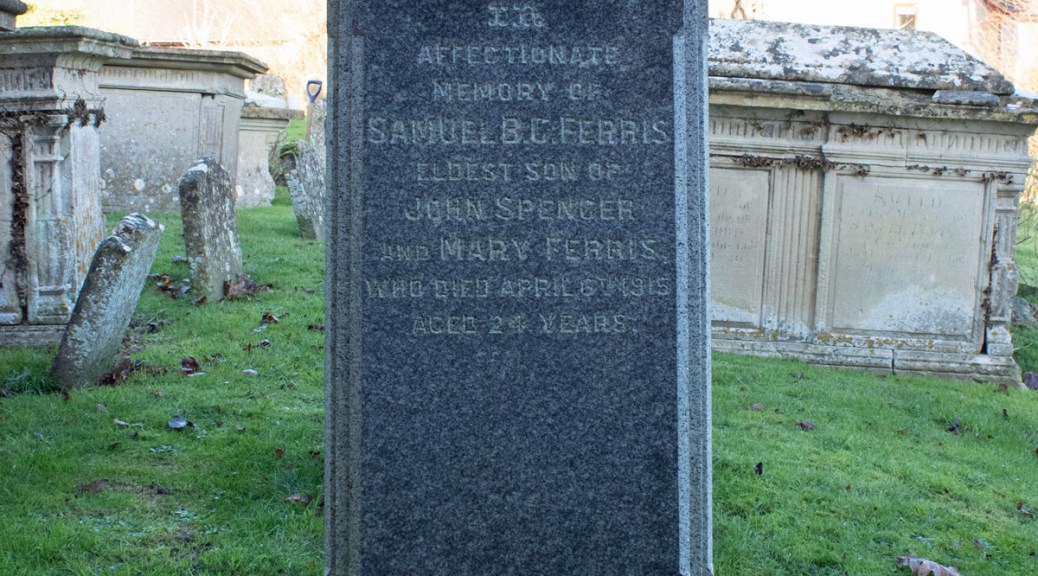
Back on home soil, Samuel was based at Tidworth, on Salisbury Plain, Wiltshire. It was here, on the 6th April 1915, that the accident that ended his life occurred. He was 24 years of age.
The body of Samuel Bernard Clutton Ferris was laid to rest in the graveyard of St Leonard’s Church in Keevil, Wiltshire. This is where Samuel’s father had been baptised, and was his paternal grandparents’ parish church. The above newspaper report noted that the funeral was well attended, but that Samuel’s father was “very ill and unable to be present.”[Wiltshire Telegraph: Saturday 10th April 1915] His sister – now Mrs Walter Spencer – attended, but his brother, John, was absent, although it is likely that he was serving his country at the time.
Samuel’s probate records note that he left an estate worth £1243 1s (around £166,000 in today’s money). Interestingly, this did not go to a family member (his father did not pass away until the spring of 1921). Instead, the beneficiary was recorded as Mr Warner Herbert Taylor Ottley. A civil servant, it is likely that he and Samuel were friends.
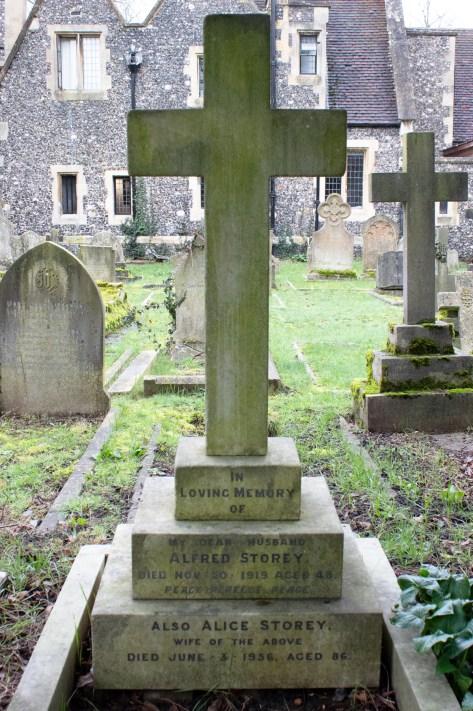
Alfred Story was born in the summer of 1876 in Poplar, Middlesex. The youngest of three children, his parents were Benjamin and Margaret. Benjamin was an engine fitter from North Shields, Tyne and Wear, but he and Margaret had moved to London by the time their eldest was born in 1863.
Margaret died in the 1880s, and, when Alfred left school, he found work as a draper’s assistant. He did not carry out this trade for long, however, and took up a career in the Royal Army Medical Corps. His First World War service papers suggest that he remained in the army for twelve years, gaining the Kedive’s Star for service in the Sudan in 1898, and the Queen’s Medal with five clasps and the King’s Medal with two clasps for his time in South Africa.
By the time of the 1911 census Alfred was living at 1 Belle Vue, Eton, Berkshire, and that he was a house porter at Eton College. He was recorded as having married Alice in 1905 (although a later document suggests they did not exchange vows until 26th October 1916), and the couple were living there with their daughter, May, who was three years old. While no formal marriage certificate is available, it would seem that Alice was a widow when they got together: also living at 1 Belle Vue were her children, William Mallaband (who was 15) and Violet Mallaband (13).
The next record for Alfred is his service papers for the First World War. He enlisted on 26th February 1917, and was assigned back to his former regiment as a Private. His medical confirms that he was 5ft 8ins (1.72m), and that he weighed 160lbs (72.6kg). He was recorded as having brown hair, blue eyes and a fresh complexion.
Private Storey carried out his duties on home soil, and was attached to 18th Company. He survived the conflict, and rose to the rank of Corporal, then Acting Sergeant. When he was stood down on 16th February 1919, we readily volunteered to extend his service for a further twelve months. On 20th November that year, he collapsed and died from a cerebral haemorrhage. He was 39 years of age.
The body of Alfred Storey was taken back to Berkshire for burial. He was laid to rest in the peaceful graveyard of St John’s Church, Eton. He was reunited with Alice when she died in 1956: husband and wife buried together after 37 years.
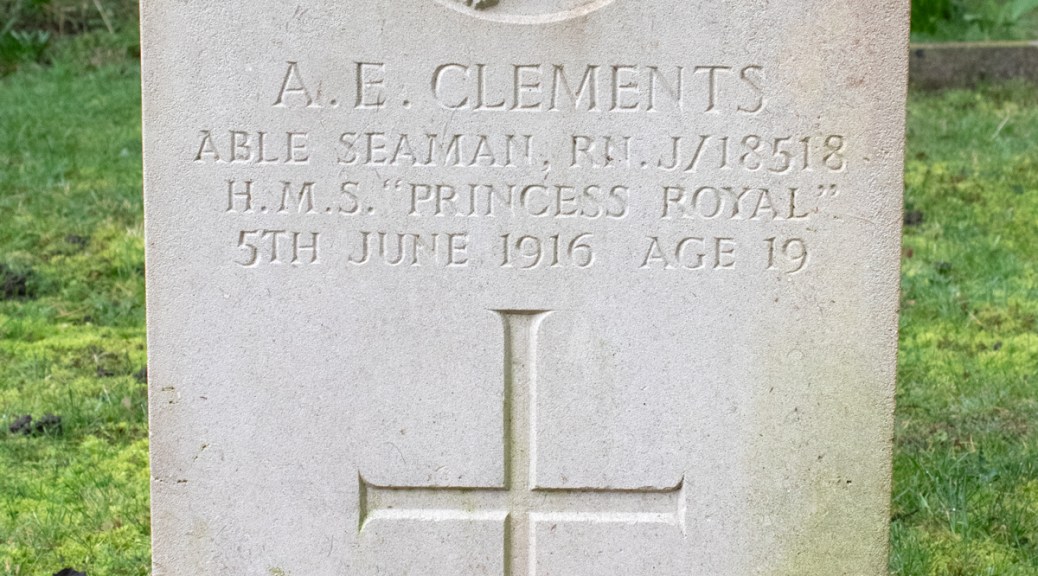
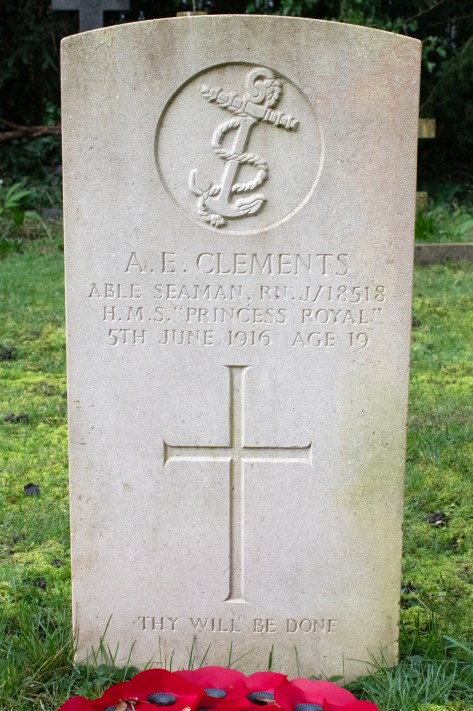
In spite of unpropitious weather, an exceedingly large number of people of all classes paid a last tribute to Able-Seaman Albert Edward Clements, at Eton, on Saturday last. The deceased, whose home was at 3, Tangier-lane, Eton, was on HMS Princess Royal, which took part in the naval fight in the North Sea, and he as severely injured by burns. He was taken on board HM Hospital Ship Plassy, but died on 31st May, and his remains were brought home on Thursday evening last week from Scotland. Clements as a boy showed an affection for the sea, and when old enough joined the merchant service and made several voyages. Five years ago from the day he was laid to rest he joined the Navy, and was at first on HMS Warspite and afterwards on the ship on which he received his mortal wounds. He was a loyal and devoted son, and after the death of his father three years ago was of great assistance to his mother. His father was for 29 years in the Royal service at Frogmore and consequently served under three Sovereigns – Queen Victoria, King Edward and King George. His elder brother, Charles George, was in the Oxford and Bucks LI, and was killed at Loos a year ago. The Admiralty, through pressure, was not able to send a representative, but his mother had received from that department a letter expressing its sympathy and appreciation of his services. A letter of sympathy has also been received from the King.
[Windsor and Eton Express: Saturday 17th June 1916]
The early life of Albert Edward Clements is a challenge to piece together. Born in 30th October 1896 in Marylebone, details of his parents are unclear and, by the time of the 1901 census, he seems to have been adopted by his paternal grandparents, George and Louisa. By this point the family were living at 4 Sunbury Road, Eton, the household being made up of Albert, his grandparents, and his four uncles and aunts.
At 45 years of age, George was a gardener’s labourer, but, as the newspaper report suggests, Albert had a hankering for the sea. He served on merchant vessels, but enlisted in the Royal Navy on 12th June 1912. Sent to HMS Ganges – the training base near Ipswich, Suffolk – he was given the Rank of Boy 2nd Class, as he was too young to formally join up.
By January 1913, Albert was assigned to the dreadnought battleship HMS St Vincent. Within four months he had moved to the heavy cruiser-turned-aircraft carrier HMS Vindictive. By the end of the year, however, Boy Clements received his main move, to HMS Princess Royal.
Albert was formally inducted in the Royal Navy on 28th May 1914, and was given the rank of Ordinary Seaman. His service records notes that he was 5ft 5ins (1.65m) tall, with dark brown hair, blue eyes and a fresh complexion. He was also recorded as having a birth mark on the back of his left arm.
Princess Royal would remain Albert’s home for more than three years and, on 1st April 1915, he received a promotion to Able Seaman. His ship would be involved in some of the Royal Navy’s fiercest skirmishes, including Heligoland Bight and Dogger Bank, but it was during the Battle of Jutland, on the night of the 31st May 1916, that Albert was injured and died of his wounds. He was just 19 years of age.
The hospital ship Plessy brought the body of Albert Edward Clements back to shore, and he was taken home to Berkshire for burial. He was laid to rest in the cemetery of St John’s Church in Eton.
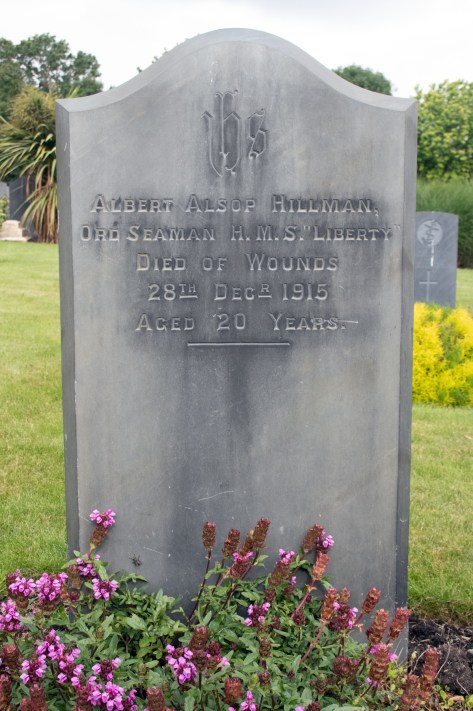
Albert Alsop Hillman was born in Islington, Middlesex, on 22nd September 1895. He was the second of five children to Alfred and Harriet Hillman. Alfred was a builder’s labourer from Hoxton, and, at the time of the 1901 census, the family had rooms at 36 Affleck Street, not far from King’s Cross Station.
The next ten years showed a downturn in the family’s fortunes. They had moved to rooms at 19 Chapel Street, but Alfred was no longer bringing in a wage, and was recorded as being an invalid. In fact, unusually, none of the household of seven – including Albert and his older brother, Alfred Jr, both of whom were of age to have left school – were recorded in any trade, and it is not clear what, if any, money was coming in.
This changed in 1913, when Albert joined the Royal Navy. He had been earning money as a van guard, but a life at sea offered a career and a regular wage. Sent to HMS Vivid, the Royal Naval Dockyard in Devonport, Devon, he spent the next five months learning the skills he would need as a seaman. Being below the age to formally enlist, however, he was given the rank of Boy 2nd Class.
On 15th November 1913, Boy Hillman was given his first assignment, on board the battleship HMS Venerable. She would remain his home for the next few months, during which time he was promoted to Boy 1st Class.
Albert was formally enlisted in the Royal Navy on 18th February 1914, and was given the rank of Ordinary Seaman. His service papers show that he was 5ft 7ins (1.7m) tall, with brown hair, hazel eyes and a fresh complexion. His papers also note that he had a scar on his right cheek, and a number of tattoos on his left forearm.
After a short spell at Chatham Dockyard in Kent – also known as HMS Pembroke – Albert was given his second assignment, aboard the destroyer HMS Liberty. In August 1914, she was involved in the Battle of Heligoland Bight and, in a skirmish with the German 5th Flotilla. She was hit by the enemy cruiser Mainz, which landed a direct hit on the bridge, killing the ship’s commander, Nigel Barttelot, and a number of other crew. Albert was wounded, and the ship made its slow way back to port.
When Liberty reached Pembroke once more, Albert was admitted to the Royal Naval Hospital in Chatham, and would remain there for the next more than a year.
The death has taken place in the RN Hospital, Chatham, of Able Seaman Albert Hillman, who sustained terrible injuries whilst serving in HM destroyer Liberty in the sea fight in the Bight of Heligoland on August 28th, 1914. For sixteen months the young fellow – he was only 19 years of age – suffered, but he bore his pain unflinchingly and without a murmur, winning the admiration of the medical and nursing staff. It will be remembered that Lieut.-Com. Nigel Barttelot and six members of the crew of the Liberty were killed in the action, one died from wounds, and eleven others were wounded.
[Sheerness Guardian and East Kent Advertiser: Saturday 15th January 1916]
The newspaper report includes a couple of errors – Albert held the rank of Ordinary Seaman, and was 20 years of age when he died – and has a stoic and heroic sense of how the injured man bore his wounds with grace and calm.
The body of Albert Alsop Hillman was laid to rest in the naval section of Woodlands Cemetery, Gillingham, not far from the Kent hospital in which he had been tended for so long.
Thomas Roland Wilson was born on 2nd December 1871 in Hythe, Kent. His parents were Thomas and Sarah, but there is little information available about his early life.
The 1881 census recorded Thomas as living with his uncle and aunt in Deptford, Kent. Ten years later, he was living with his parents in Finchley, Middlesex. Thomas Sr was living on his own means, while his son, now 20 years of age, was a mercantile mariner.
On 18th November 1895, Thomas Jr was awarded a certificate of competency as being able to be a master of his own vessel. Five years later, he married Charlotte Chichester. She was the daughter of a master mariner, and the couple appeared to settle in her home town of Braunton, Devon.
When war broke out, Thomas was assigned to the Royal Naval Reserve. Details of his time during the conflict are hazy, but, by 1917, he was in charge of HMS Yacht Vagrant. Built in Jarrow, she had been hired by the Admiralty at the start of the war to act as an anti-submarine vessel, with Captain Wilson leading the crew.
Little further information is available about Thomas’ life, and while the Commonwealth War Graves Commission and his headstone give his rank as Lieutenant Commander, other documents note he was a Captain.
The next available record for him relates to his passing:
The regretted death has occurred of Capt. Wilson, in his 47th year, at Fern Lea, Braunton, the residence of his mother-in-law, Mrs Chichester.
[North Devon Journal: Thursday 18th October 1917]
No cause of death is evident, but Thomas Roland Wilson passed away on 17th October 1917. He was laid to rest in the graveyard of St Brannock’s Church in Braunton, Devon.
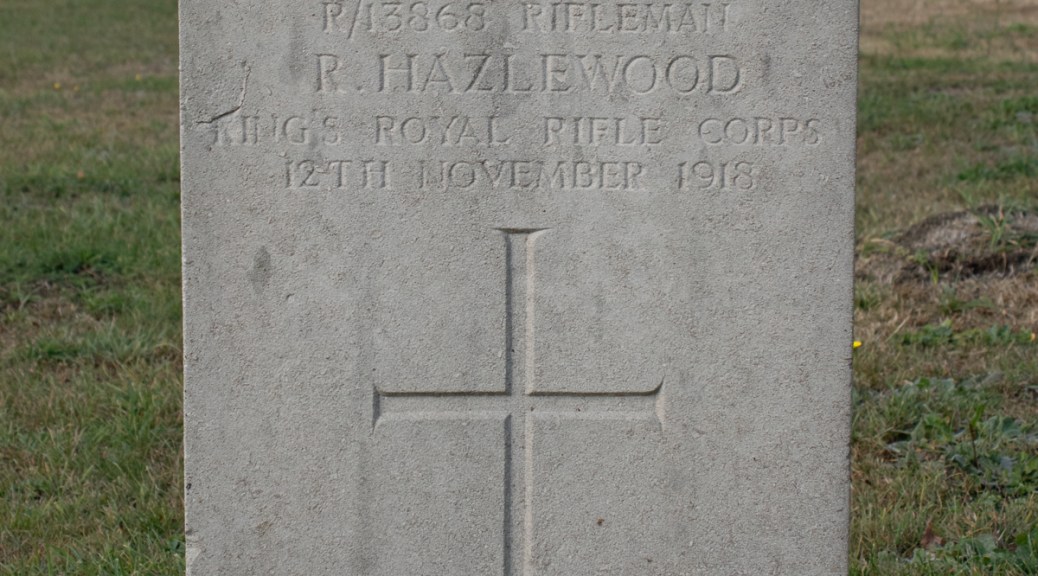
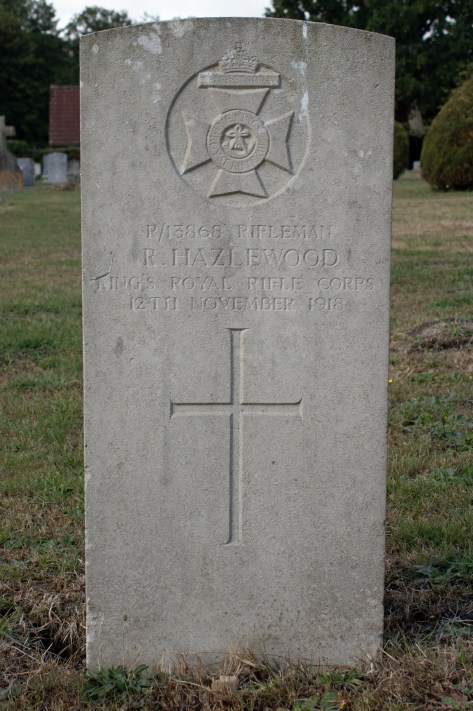
Richard Hazlewood was born in the spring of 1892 in Kentish Town, Middlesex. One of at least seven children, his parents were railway engine driver George Hazlewood and his wife, Sarah.
There is frustratingly little documentation for Richard’s early life. The family do not appear on the 1901 or 1911 census records, and it is only when he enlists on 5th June 1915, that his name appears on paperwork once more.
Richard was working as a cook when he joined up, and gave this up to join the King’s Royal Rifle Corps. His service record notes that he was a little over 5ft 9ins (1.76m) tall, and had brown hair, blue eyes and a fresh complexion.
Rifleman Hazlewood was attached to the 12th Battalion, and, after his initial training, he was sent to France. He would spend the next three years overseas, his unit being caught up in the fighting at the Somme and Ypres. In February 1917, he spent a few days in hospital, suffering from scabies in his right foot.
In the autumn of 1918, Richard came down with pneumonia. He was medically evacuated to Britain for treatment, and was admitted to the Station Road Hospital in Gillingham, Dorset. His condition would prove fatal: Rifleman Hazlewood passed away on 12th November – a day after the Armistice was signed. He was 26 years of age.
George had died in 1911, and it seems likely that Sarah, who was now living at the St Pancras Almshouses, Kentish Town, was unable to cover the cost of bringing her son back to Middlesex. Richard Hazlewood was instead laid to rest in Gillingham Cemetery, not far form the Dorset hospital in which he had died.
William John Payne was born on the 29th November 1896. The second youngest of ten children, his parents were Alfred and Alice. Alfred was a cab driver from St John’s Wood, Middlesex, but the family were born and raised in Paddington. The 1901 census recorded them lodging in a shared house at 100 Woodchester Street, but by 1911, they had taken two rooms around the corner at 89 Cirencester Street. Both were within easy reach of both Paddington Station and the Grand Union Canal.
When he completed his schooling, William found work as a van guard, possibly for the railway. On 19th July 1915, with war raging across Europe, he stepped up to serve his country, and enlisted in the Royal Navy. His papers show that he was 5ft 5ins (1.65m) tall, with light brown hair, grey eyes and a fresh complexion. He was recorded as having a scar on the back of his right hand, and tattoos on both forearms.
Stoker 2nd Class Payne was sent to HMS Pembroke, the Royal Naval Dockyard in Chatham, Kent, for his training. On 13th October 1915, he was given his first posting, on board the depot ship HMS Tyne. Based in the Firth of Forth, she provided support to the naval fleet patrolling the area.
Tyne remained William’s home for the next year, and, during this time, he was promoted to Stoker 1st Class. After a short spell back in Chatham in September 1916, William was reassigned to HMS Wallington. She was a shore base on the River Humber, and from here he would have had short postings on local patrols in the area.
By the spring of 1917, however, Stoker Payne was back at Pembroke. The dockyard was a busy and overcrowded place at this point in the war: the sinking of HMS Vanguard in July led to its replacement crew being stuck at the base while awaiting new assignments. In addition to this, an outbreak of spotted fever meant that sailors’ bunks had to be spaced out in an attempt to slow the spread of the disease. As a result, William found himself billeted in temporary accommodation in the dockyard’s Drill Hall.
On the night of the 3rd September 1917, the German Air Force carried out a daring raid on North Kent. Chatham was in the line of fire, and two bombs landed squarely on the Drill Hall. The glass roof shattered, raining shards down on the sleeping men beneath. Stoker 1st Class Payne was one of the dozens killed in the explosions: he was 20 years of age.
The body of William John Payne was taken back to London for burial. He was laid to rest in Paddington Cemetery, just a short walk from where his family were still living.
William was not the only one of his siblings to be killed during the war. His older brother Walter enlisted in the opening weeks of the conflict and, as a Private, he was attached to the 2nd Battalion of the King’s Royal Rifle Corps.
Private Payne quickly found himself on the Western Front, his unit fighting at Ypres in 1914, and Loos the following year. In April 1916 he was badly wounded, and admitted to a hospital near Béthune. His wounds would prove too severe, however, and he succumbed to them on 4th April: he was 25 years of age.
The body of Private Walter Payne was laid to rest in Béthune Town Cemetery.
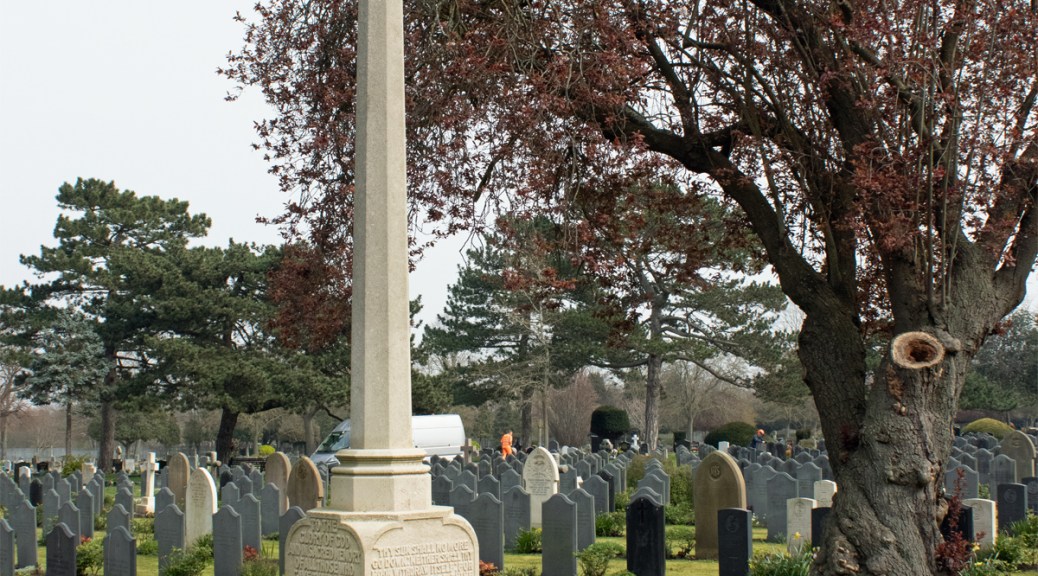
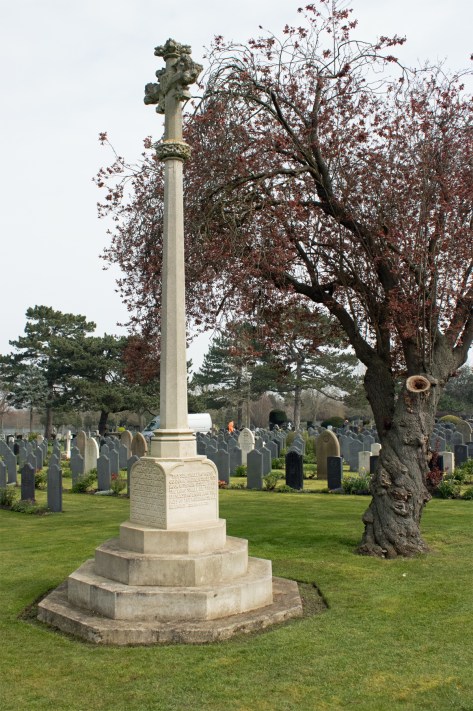
[Note: the photo above is of the memorial to the Chatham Air Raid victims, close to the mass grave for those whose bodies were not identified, in Woodlands Cemetery, Gillingham, Kent.]