

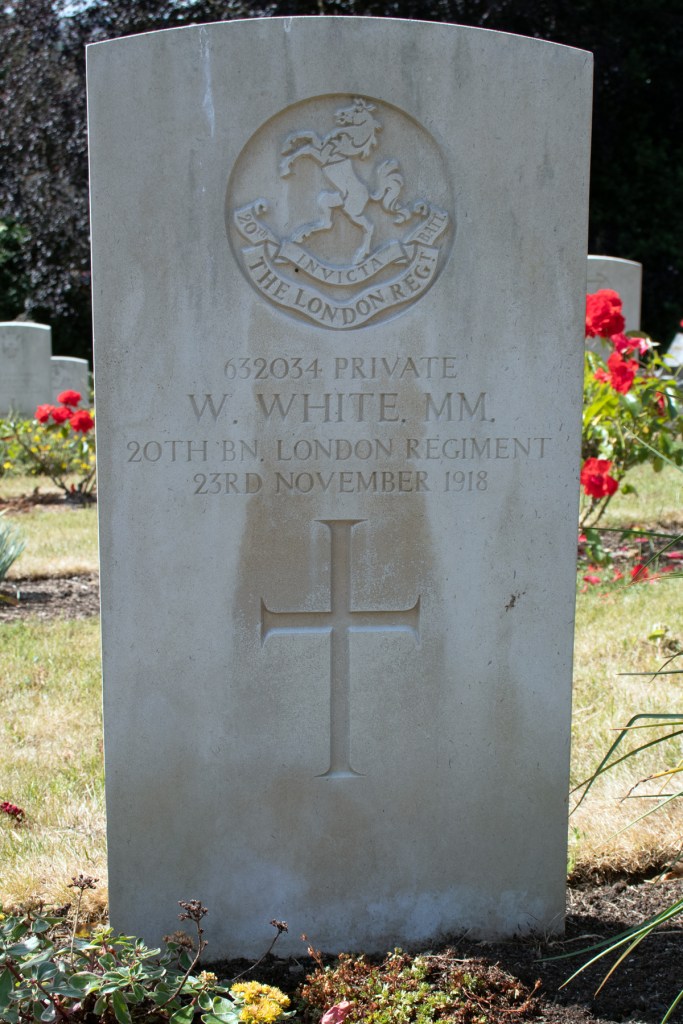
William White was born in the autumn of 1892 in Gravesend, Kent. He was the second of eleven children to Joseph and Eleanor – or Ellen – White. Joseph was a general labourer who, by the time of the 1911 census, was employed in the local docks.
The same census recorded the family of eleven people living in four rooms at 2 Robert Street, Gravesend. In addition to Joseph, both William and his older brother, Joseph Jr, were employed as assistants for a local butcher, while the next youngest of the siblings, Edward, was working as a bootmaker’s errand boy.
When war was declared, William stepped up to play his part. Full service details have been lost to time, but it seems that he had enlisted by the spring of 1918 at the latest. He joined the London Regiment, and was assigned to the 20th (City of London) Battalion. Private White’s unit spent the duration of the conflict on the Western Front, fighting at Loos, the Somme and Messines amongst other areas.
By the end of the war, William had been awarded the Military Medal for his bravery, although it is unclear when and for what he receive it.
The next confirmed record for Private White was his admission to hospital in Somerset, as he was suffering from pneumonia. He was sent to the Bath War Hospital, but it is unclear whether he had been on home soil when he fell ill, or if he had been medically transferred there from across the English Channel.
William White’s condition was to prove fatal. He passed away in hospital on 23rd November 1918, at the age of 26 years old. His body was laid to rest in the military section of Locksbrook Cemetery in Bath, not far from the hospital where he had breathed his last.
 Death and Service