
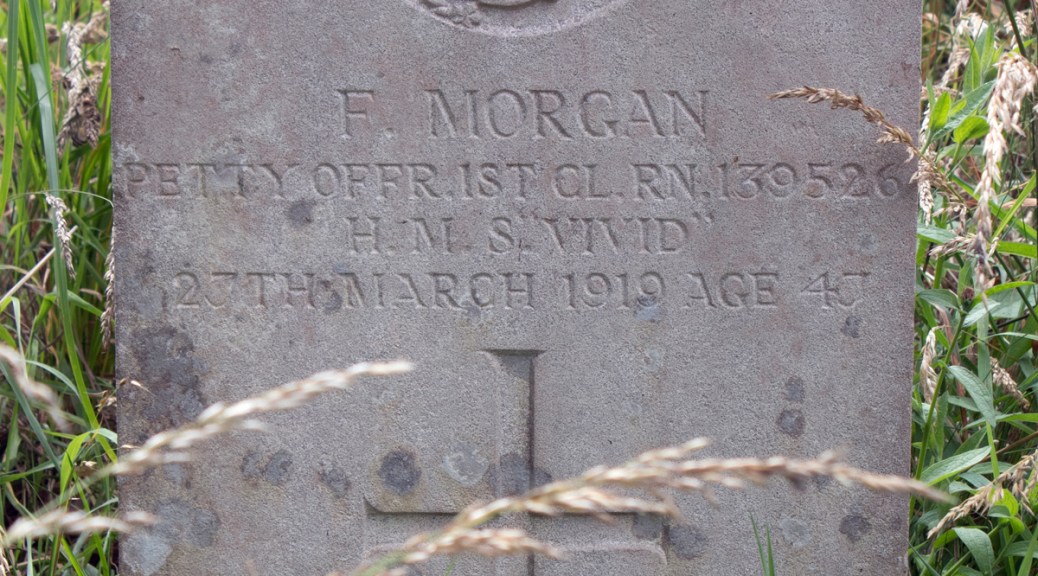

Frederick Morgan was born on 15th July 1871, the oldest of four children to Samuel and Selina. Samuel was a miner from Bristol, Gloucestershire, but it was in the Staffordshire town of Tipton that he and local girl Selina married and raised their family. The 1881 census found the Morgans living at 17 Brewery Street, to the south of the town centre.
Frederick was not destined to follow in his father’s footsteps, however, and had his sights set on a life at sea, rather than in the depths of a coal mine. On 23rd November 1896 he joined the Royal Navy, and was sent to HMS Impregnable, the training base in Devonport, Devon, for his induction.
Being too young to formally enlist, Frederick was given the rank of Boy 2nd Class. Over the next three years, he learnt the tools of his trade, and served at three further bases: HMS Lion, HMS Penelope and HMS Raleigh. During this time, he was promoted to Boy 1st Class and, on 15th July 1889, when he turned 18, he was formally inducted into the Royal Navy.
Ordinary Seaman Morgan’s service records show that he was just 5ft 2.5ins (1.59m) tall. He had light brown hair, blue eyes and a fair complexion. He also had a tattoo by this point, of a dancing sailor on the inside of his right arm.
Frederick remained at HMS Raleigh for the next couple of years, and was promoted to Able Seaman on 1st July 1891. From the autumn, however, his sea-going life really took hold. Over the next ten years, he served on five ships, and was to be based at HMS Vivid, the Royal Naval Dockyard in Devonport, in between voyages. His dedication to the service was recognised – his annual reviews regularly noted his character as very good, and he rose through the ranks to Leading Seaman in May 1898, Petty Officer 2nd Class that October, and Petty Officer 1st Class in January 1901.
Away from work, Frederick’s love life was blossoming. In the autumn of 1893 he married Zipporah Elizabeth Beatrice Griffiths. Better known as Beatrice, she was the daughter of waterman Thomas Griffiths and his wife, Zipporah. The family came from Dartmouth, and this is likely where the young couple got to know each other. They married in St Clement’s Church, Dartmouth, and went on to have two children, George and Kathleen.
On 15th July 1901, Petty Officer Morgan’s initial contract with the Royal Navy came to an end. He renewed it straight away, and would spend the next decade sailing the world. Again Frederick was based at HMS Vivid in between voyages. On 11th July 1911, after 21 years in service, he was formally stood down to reserve status, and he returned to shore.
Frederick’s trail goes cold over the next couple of years, but when war broke out, he was called into service once more. Petty Officer Morgan would serve on the depot ships HMS Leander and Cyclops, which served out of Scapa Flow. He also spent time at HMS Gunner, the naval base to the north of Edinburgh. By March 1919, with the Armistice signed, he found himself based back in Devon.
At the Royal Naval Hospital, Plymouth, on Saturday, an inquest was held relative to the death of Fredk Morgan, 47, a naval pensioner, who died suddenly in the train on Thursday last.
Wm. Griffiths, inspector, GWR, at Millbay, said that PO Morgan was removed from the 6.20 train from Saltash on Thursday, apparently in a fit. He was laid on a seat, and a doctor who was about to travel on another train pronounced life extinct.
Charles Evans Jenkins, surgeon-lieutenant at the Naval Hospital said death was due to fatty degeneration of the heart.
The Coroner, who expressed his sympathy with the widow, declared that death was due to natural causes.
[Western Times: Tuesday 1st April 1919]
Frederick Morgan died of a heart attack on 27th Match 1919. He was laid to rest in the graveyard of St Clement’s Churchyard, Dartmouth, where he and Beatrice had been married.
 Death and Service