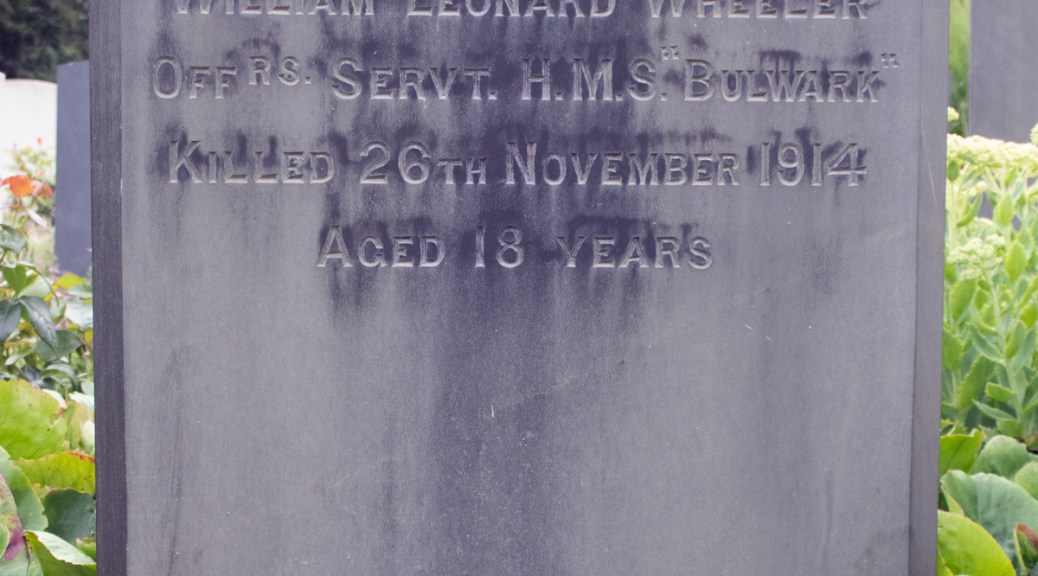
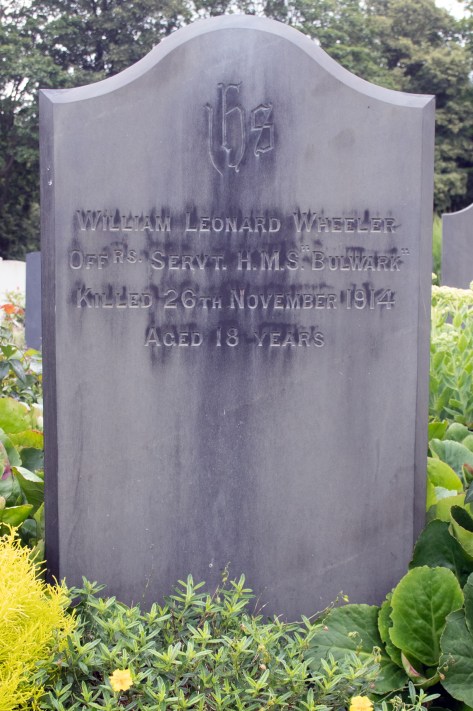
William Leonard Wheeler was born in Epsom, Surrey, on 8th September 1896. He was the fourth of six children to John and Mary Wheeler. John was a carman in a brickyard, and the family lived in Nonsuch Cottage on Leith Road.
When William finished his schooling, he took work as a gardener. He sought bigger and better things, however, and, on 12th September 1912, he joined the Royal Navy. Too young to formally enlist, he was given the rank of Boy 2nd Class, and sent to HMS Impregnable, the training ship, to start learning the skills he would need.
Impregnable would remain Boy Wheeler’s home for the next nine months, during which time he was promoted to Boy 1st Class. On 18th June 1913, he was give his first posting, on board the cruiser HMS Gibraltar. In November 1913, William was reassigned, and took up a post on board the battleship HMS Bulwark.
William came of age in September 1914, and fully enlisted in the Royal Navy. Given the rank of Ordinary Seaman, his service papers show that he was 5ft 1in (1.55m) tall, and had light brown hair, grey eyes and a fresh complexion.
Bulwark was part of the Channel Fleet, tasked with patrolling and defending Britain’s southern coast. On 26th November 1914, she was moored in the River Medway, close to Sheerness, and was being resupplied with shells and ammunition. That morning, a handful of the cordite charges overheated, detonating the shells stored nearby. The explosion ripped through the vessel, and more than 740 crew – including 18-year-old William – were killed.
Ordinary Seaman Wheeler’s body would be recovered from the wreckage until 8th July 1915. He was laid to rest in the naval section Woodlands Cemetery, Gillingham, Kent, a short distance from the the Royal Naval Dockyard in Chatham.
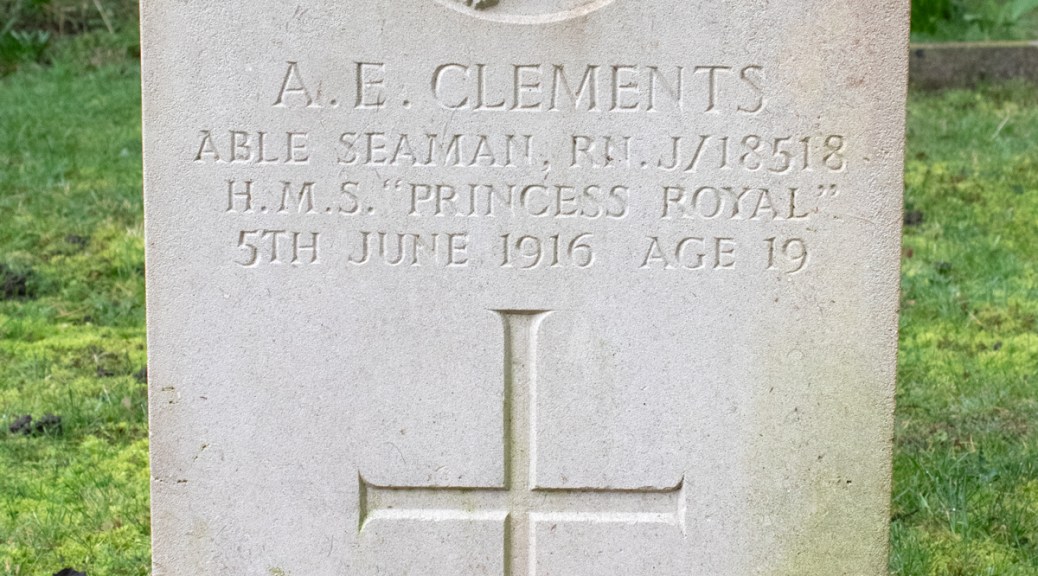
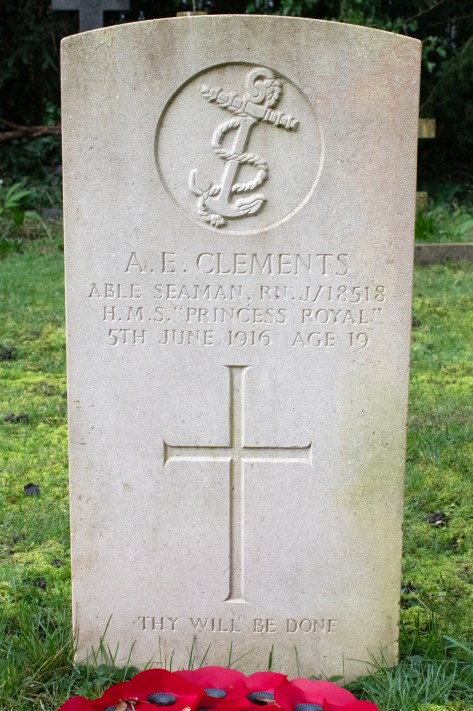
In spite of unpropitious weather, an exceedingly large number of people of all classes paid a last tribute to Able-Seaman Albert Edward Clements, at Eton, on Saturday last. The deceased, whose home was at 3, Tangier-lane, Eton, was on HMS Princess Royal, which took part in the naval fight in the North Sea, and he as severely injured by burns. He was taken on board HM Hospital Ship Plassy, but died on 31st May, and his remains were brought home on Thursday evening last week from Scotland. Clements as a boy showed an affection for the sea, and when old enough joined the merchant service and made several voyages. Five years ago from the day he was laid to rest he joined the Navy, and was at first on HMS Warspite and afterwards on the ship on which he received his mortal wounds. He was a loyal and devoted son, and after the death of his father three years ago was of great assistance to his mother. His father was for 29 years in the Royal service at Frogmore and consequently served under three Sovereigns – Queen Victoria, King Edward and King George. His elder brother, Charles George, was in the Oxford and Bucks LI, and was killed at Loos a year ago. The Admiralty, through pressure, was not able to send a representative, but his mother had received from that department a letter expressing its sympathy and appreciation of his services. A letter of sympathy has also been received from the King.
[Windsor and Eton Express: Saturday 17th June 1916]
The early life of Albert Edward Clements is a challenge to piece together. Born in 30th October 1896 in Marylebone, details of his parents are unclear and, by the time of the 1901 census, he seems to have been adopted by his paternal grandparents, George and Louisa. By this point the family were living at 4 Sunbury Road, Eton, the household being made up of Albert, his grandparents, and his four uncles and aunts.
At 45 years of age, George was a gardener’s labourer, but, as the newspaper report suggests, Albert had a hankering for the sea. He served on merchant vessels, but enlisted in the Royal Navy on 12th June 1912. Sent to HMS Ganges – the training base near Ipswich, Suffolk – he was given the Rank of Boy 2nd Class, as he was too young to formally join up.
By January 1913, Albert was assigned to the dreadnought battleship HMS St Vincent. Within four months he had moved to the heavy cruiser-turned-aircraft carrier HMS Vindictive. By the end of the year, however, Boy Clements received his main move, to HMS Princess Royal.
Albert was formally inducted in the Royal Navy on 28th May 1914, and was given the rank of Ordinary Seaman. His service records notes that he was 5ft 5ins (1.65m) tall, with dark brown hair, blue eyes and a fresh complexion. He was also recorded as having a birth mark on the back of his left arm.
Princess Royal would remain Albert’s home for more than three years and, on 1st April 1915, he received a promotion to Able Seaman. His ship would be involved in some of the Royal Navy’s fiercest skirmishes, including Heligoland Bight and Dogger Bank, but it was during the Battle of Jutland, on the night of the 31st May 1916, that Albert was injured and died of his wounds. He was just 19 years of age.
The hospital ship Plessy brought the body of Albert Edward Clements back to shore, and he was taken home to Berkshire for burial. He was laid to rest in the cemetery of St John’s Church in Eton.
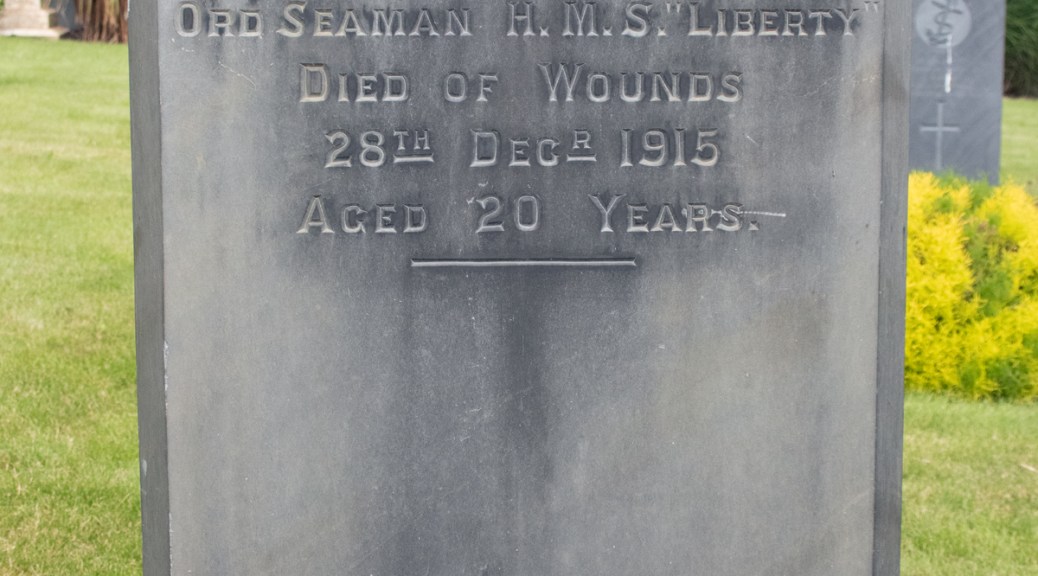
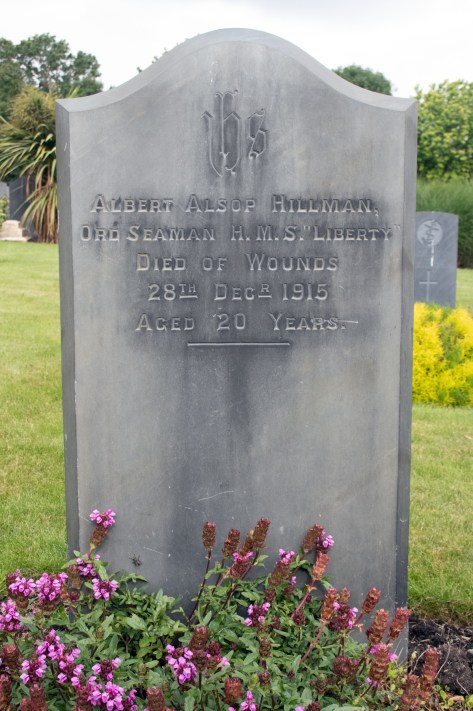
Albert Alsop Hillman was born in Islington, Middlesex, on 22nd September 1895. He was the second of five children to Alfred and Harriet Hillman. Alfred was a builder’s labourer from Hoxton, and, at the time of the 1901 census, the family had rooms at 36 Affleck Street, not far from King’s Cross Station.
The next ten years showed a downturn in the family’s fortunes. They had moved to rooms at 19 Chapel Street, but Alfred was no longer bringing in a wage, and was recorded as being an invalid. In fact, unusually, none of the household of seven – including Albert and his older brother, Alfred Jr, both of whom were of age to have left school – were recorded in any trade, and it is not clear what, if any, money was coming in.
This changed in 1913, when Albert joined the Royal Navy. He had been earning money as a van guard, but a life at sea offered a career and a regular wage. Sent to HMS Vivid, the Royal Naval Dockyard in Devonport, Devon, he spent the next five months learning the skills he would need as a seaman. Being below the age to formally enlist, however, he was given the rank of Boy 2nd Class.
On 15th November 1913, Boy Hillman was given his first assignment, on board the battleship HMS Venerable. She would remain his home for the next few months, during which time he was promoted to Boy 1st Class.
Albert was formally enlisted in the Royal Navy on 18th February 1914, and was given the rank of Ordinary Seaman. His service papers show that he was 5ft 7ins (1.7m) tall, with brown hair, hazel eyes and a fresh complexion. His papers also note that he had a scar on his right cheek, and a number of tattoos on his left forearm.
After a short spell at Chatham Dockyard in Kent – also known as HMS Pembroke – Albert was given his second assignment, aboard the destroyer HMS Liberty. In August 1914, she was involved in the Battle of Heligoland Bight and, in a skirmish with the German 5th Flotilla. She was hit by the enemy cruiser Mainz, which landed a direct hit on the bridge, killing the ship’s commander, Nigel Barttelot, and a number of other crew. Albert was wounded, and the ship made its slow way back to port.
When Liberty reached Pembroke once more, Albert was admitted to the Royal Naval Hospital in Chatham, and would remain there for the next more than a year.
The death has taken place in the RN Hospital, Chatham, of Able Seaman Albert Hillman, who sustained terrible injuries whilst serving in HM destroyer Liberty in the sea fight in the Bight of Heligoland on August 28th, 1914. For sixteen months the young fellow – he was only 19 years of age – suffered, but he bore his pain unflinchingly and without a murmur, winning the admiration of the medical and nursing staff. It will be remembered that Lieut.-Com. Nigel Barttelot and six members of the crew of the Liberty were killed in the action, one died from wounds, and eleven others were wounded.
[Sheerness Guardian and East Kent Advertiser: Saturday 15th January 1916]
The newspaper report includes a couple of errors – Albert held the rank of Ordinary Seaman, and was 20 years of age when he died – and has a stoic and heroic sense of how the injured man bore his wounds with grace and calm.
The body of Albert Alsop Hillman was laid to rest in the naval section of Woodlands Cemetery, Gillingham, not far from the Kent hospital in which he had been tended for so long.
The funeral of Mr Williams… of South-street, took place on Saturday, the interment being made by the Vicar of Braunton (Rev. JH Prince) in the St Brannock’s Churchyard. There were many manifestations of sympathy, and blinds were drawn all along the route to the Churchyard. The Vicar, in the course of a sympathetic and short address to the bereaved relatives, related a touching incident at an interview he had had with the deceased a few days before his death. The Vicar asked him if he would not rather die peacefully at home than out with his comrades, who were keeping the silent vigil on the seas and in conflict with the enemy. The dying sailor replied in the negative, and said he would sooner be with his comrades, fighting for his King and Country. This, said the Vicar, struck the key-note of Mr Williams’ unselfish life, and by his death they had lost an upright and steady inhabitant.
[North Devon Journal: Thursday 22nd March 1917/
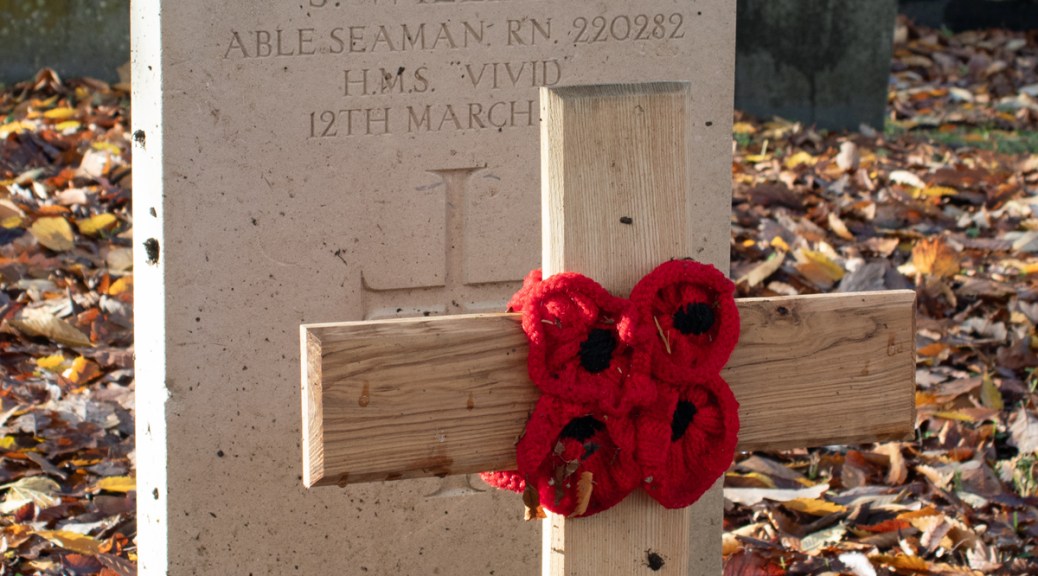
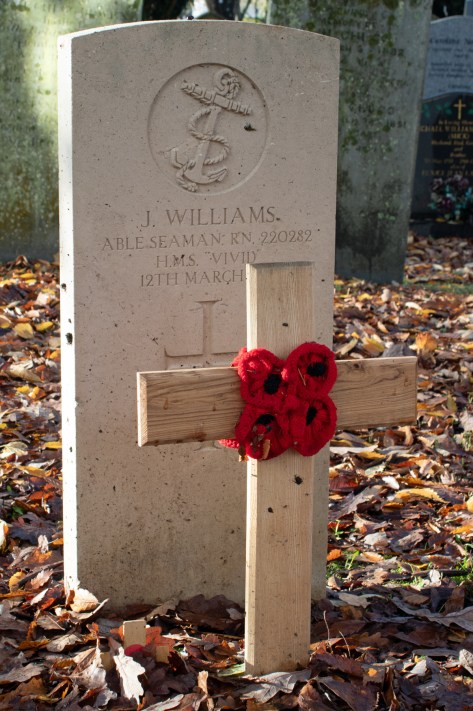
John Williams was born on 4th May 1886 in St Agnes, Cornwall. Details of his early life are a challenge to confirm, but the newspaper report goes on to name two of his brothers as Alfred and Cecil, and one of his sisters as Olive. Piecing this information together with census documents, it seems likely that his parents were William and Elizabeth (his pension record gives Mrs B Williams, which may be Bessie).
The 1891 census records the family as living in St Agnes. William is missing, although it is possible that he was away at sea when the return was taken. John does not appear on the 1901 census, but his trail can be picked up again a year later, when he enlisted in the Royal Navy.
John was working as a butcher when he chose a seafaring career path, and he was sent to HMS Impregnable, the training ship moored at Devonport, Devon, for his induction. He was below the age to formally join up, and so was given the rank of Boy 2nd Class.
Over the next two years, John learnt the tools of his trade. He was trained at three Devon bases – Impregnable, HMS Lion and HMS Vivid – and was promoted to Boy 1st Class in February 1903. On 4th May 1904 he came of age, and officially enlisted in the Royal Navy, given the rank of Ordinary Seaman. His service records note that he was just 5ft 1in (1.55m) tall, and had dark brown hair, grey eyes and a fresh complexion.
Ordinary Seaman Williams was on his first formal posting by this point, and was serving on board the gunboat HMS Harrier. By November 1904, however, he was transferred, and became part of the crew of the armoured cruiser, HMS Suffolk. She remained his home for the next eighteen months, during which he was promoted again, to Able Seaman.
Over the next decade, John would serve on a further six ships, returning to HMS Vivid in between assignments. The work, particularly after the outbreak of war, was taking a strain on his health, however, and, on 3rd May 1916, he was medically discharged from duty, suffering from tuberculosis.
By this point, John’s mother had moved to Devon and was living in the village of Braunton. Following his discharge, he returned to live with Elizabeth – Bessie – and remained there until his death some nine months later. John died on 12 March 1917, aged 29.
The body of John Williams was laid to rest in St Brannock’s Churchyard, Braunton.
William Edward Sullivan was born in Newport, Monmouthshire, on the 9th November 1898. He was one of seven children to John and Mary Sullivan. John was an iron dresser at a local foundry, but also worked as a grocer. The 1901 census found the family living at 15 Church Street, to the south of the town centre, but by 1911 they had moved to a larger property, 2 Scard Street.
When William finished his schooling, he took up work as a clerk. War broke out in the summer of 1914, and he would be called upon to play his part. On the 18th September 1916, he enlisted in the Royal Navy, taking the rank of Ordinary Seaman. His service papers show that he was 5ft 6.5ins (1.69m) tall, and that he had light brown hair, brown eyes and a fair complexion.
Ordinary Seaman Sullivan was sent to HMS Victory, the Royal Naval Dockyard in Portsmouth, Hampshire, for his training. By the end of May 1917, however, he had been transferred to HMS Pembroke, which was also known as Chatham Dockyard.
The base was a busy and overcrowded place by this point in the war, with a number of factors leading to temporary accommodation being set up in the dockyard’s Drill Hall. This is where William, who appears to have been waiting for his first formal posting, was billeted.
On the 3rd September 1917, the German air force carried out a daring night time raid on the North Kent coast. Chatham was in the firing line, and two bombs scored direct hits on the Drill Hall. Its glass roof shattered, raining shards down on the sleeping men. Dozens were killed in the explosions, and tens more, including Ordinary Seaman Sullivan, were wounded.
William was taken to the Royal Naval Hospital in Chatham for treatment, but his wounds would prove to be too severe. He passed away on the 4th September 1917, aged just 18 years old.
The body of William Edward Sullivan was taken back to Wales for burial. He was laid to rest in St Woolos’ Cemetery, a short walk from where his family still lived.
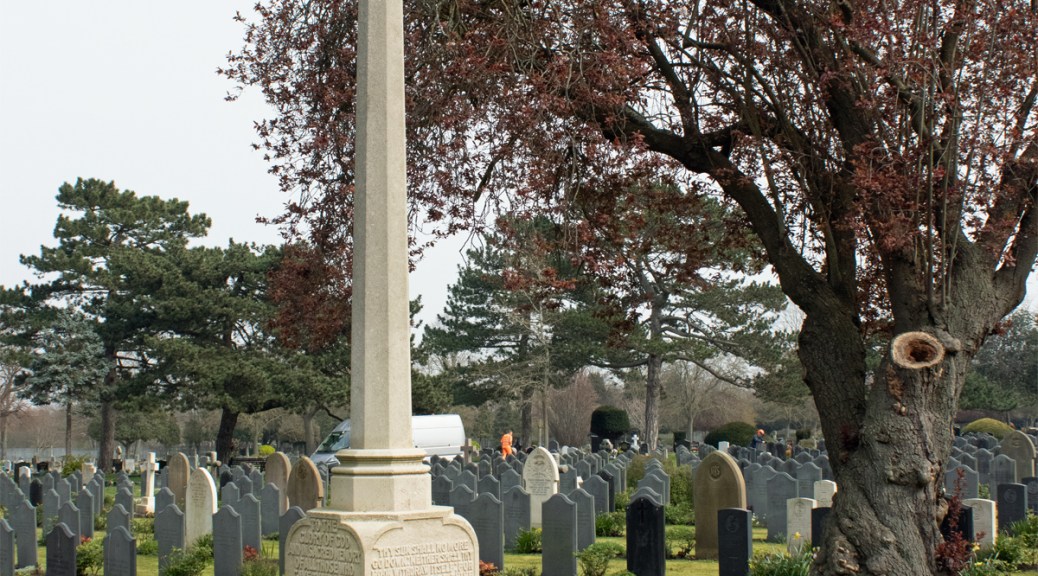
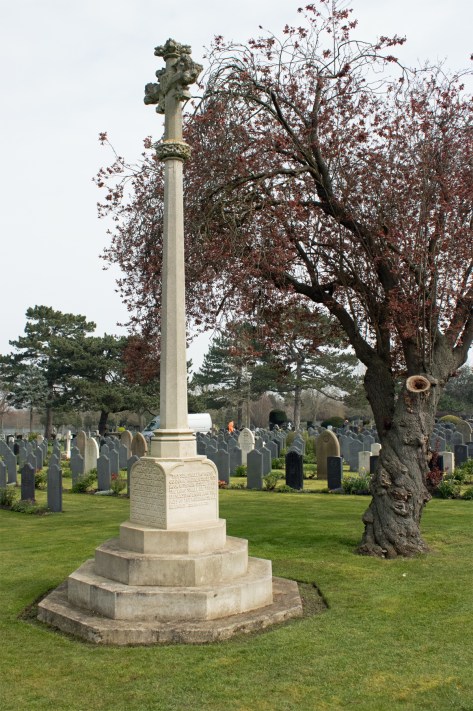
[Note: the photo above is of the memorial to the Chatham Air Raid victims, close to the mass grave for those whose bodies were not identified, in Woodlands Cemetery, Gillingham, Kent.]
Percy Walter Nicholls was born in West Ham, Essex, on 10th July 1898. One of seven children, he was the fourth son to Ernest and Selina Nicholls. Ernest was a carman for the local iron works, and the family lived close to the factory, in rooms at 28 Rocher Road.
The 1911 census recorded that the growing family had moved to 185 North Woolwich Road. Three of the family were employed by the iron works: Ernest and his oldest son Ernest Jr as carmen, while second son George was an iron worker. Percy, just twelve years of age, was still at school, and the document noted that his older brother, Charles, was unable to work as he had been epileptic since birth.
Percy chose a different route for himself when he left school, taking up work as a farm hand. He was after bigger and better things, however, and, on 17th June 1914 he joined the Royal Navy. Too young to formally enlist at that point, he was given the rank of Boy 2nd Class, and sent to HMS Ganges, the training base near Ipswich, Suffolk, for his induction.
It appears that Percy impressed his superiors: he was promoted to Boy 1st Class in January 1915, and was given a posting on board HMS Centurion, a dreadnought battleship, on the 20th March. She would remain his home for the next two years, during which time he came of age.
Now able to formally enlist, Percy was given the rank of Ordinary Seaman, his papers showing the young man he had become. He was noted as being just under 5ft 3ins (1.59m) tall, and had dark brown hair, dark brown eyes and a fresh complexion. He was also recorded as having a scar on his right eyebrow.
Centurion patrolled the waters around Scotland, and took part in the Battle of Jutland at the end of May 1916. Percy was proving to be a steady worker and, on 22nd February 1917, he was promoted to Able Seaman. His time on board the battleship was coming to a close, however, and, on 1st September 1917, he disembarked at HMS Pembroke, the Royal Naval Dockyard in Chatham, Kent.
The base was a busy and overcrowded place at that point in the war. The sinking of the Vanguard left its replacement crew shore-bound while they awaited their next assignments, and an outbreak of meningitis meant that temporary accommodation was needed to space out the men, and, with luck, slow the spread of infection. Able Seaman Nicholls found himself billeted in the dockyard’s Drill Hall.
On the night of the 3rd September 1917, the German air force carried out a daring raid on the North Kent Coast. Dozens of bombs were dropped on Chatham, two of which landed unplanned direct hits on the Drill Hall. The glass roof shattered showering the sleeping men below with deadly shards. Able Seaman Nicholls was badly injured, and taken to the Royal Naval Hospital in the town.
Percy’s wounds would ultimately prove fatal. He died from his injuries on 8th September 1917: he was just 19 years of age.
The body of Percy Walter Nicholls was taken back to Essex for burial. He was laid to rest in the East London Cemetery, Plaistow, a couple of miles from where his family were now living, on Ellesmere Road, West Silvertown.
[Note: the photo above is of the memorial to the Chatham Air Raid victims, close to the mass grave for those whose bodies were not identified, in Woodlands Cemetery, Gillingham, Kent.]
William Dowsey Magog was born on 23rd March 1898 in Sunderland, County Durham. He was the only child to William and Mary Magog. William Sr was a railway fireman who died when Mary was three months pregnant. He would never know his son, but William was named in his father’s honour.
With a baby to raise, Mary needed support and married for a second time in 1900. Her new husband was Thomas Gardner, who was employed as a chain testing labourer. The extended family set up home on Thomas Street, initially at No. 7, then moving to No. 19 by the time of the 1911 census. By this point, William had three half-siblings, Mary Jr, Elizabeth and Robert.
William followed his stepfather into factory work, taking a job as a moulder. However, he had his sights set on bigger and better things, and on 31st August 1913, he joined the Royal Navy. Too young for formally enlist at this stage, he was given the rank of Boy 2nd Class, and sent to HMS Ganges, the training base near Ipswich, Suffolk.
Boy Magog seemed to impress his seniors, and within nine months had been promoted to Boy 1st Class. He was given his first assignment, on board the cruiser HMS Grafton, in June 1914. That summer, as war broke out, he was sent to HMS Pembroke, the Royal Naval Dockyard in Chatham, Kent.
At the end of October 1914, William was transferred to the battleship HMS Dominion, and she would remain his home for the next three years. During this time, he came of age, and formally joined the Royal Navy. His service papers show that the he stood just 5ft 1/2in (1.54m) tall, and had brown hair, brown eyes and a fresh complexion.
The now Ordinary Seaman Magog was dedicated to his role, although his annual reviews noted a very good (or average) character and a satisfactory (again average) ability. He rose through the ranks, however, becoming an Able Seaman in April 1917.
During this time, Dominion patrolled the North Sea as part of the Third Battle Squadron. She was not involved in many of the major skirmishes of the First World War, although she did take part in the protection of Scarborough during the German raids of 1914, and the Battle of Dogger Bank just a few months later.
By the summer of 1917, Able Seaman Magog had returned to Chatham to await his next assignment. The dockyard was a particularly busy and overcrowded place by this point in the conflict: the sinking of HMS Vanguard had left its replacement crew with nowhere to go, and an outbreak of meningitis had meant that additional accommodation was needed to provide space in the cramped barracks. It was because of this that William found himself billeted in temporary barracks in the dockyard’s Drill Hall.
On the night of the 3rd September 1917, the German air force carried out an audacious night raid on the north Kent coast. The Drill Hall was hit by two bombs, shattering its glass roof, and killing dozens of men who were sleeping below. Able Seaman Magog was badly wounded, and was taken to the Royal Naval Hospital in Chatham. Tragically, his injuries would prove too severe, and he passed away two days after the bombing. He was just 19 years of age.
The body of William Dowsey Magog was taken back to County Durham for burial. He was laid to rest in Sunderland’s Ryhope Road Cemetery, just a few minutes’ walk from where Mary and the family were living.
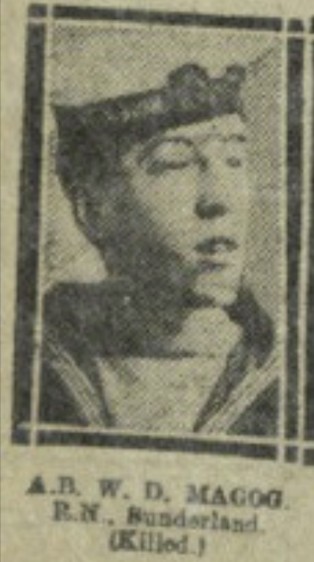
Able Seaman William Magog (from findagrave.com)
[Note: the photo above is of the memorial to the Chatham Air Raid victims, close to the mass grave for those whose bodies were not identified, in Woodlands Cemetery, Gillingham, Kent.]
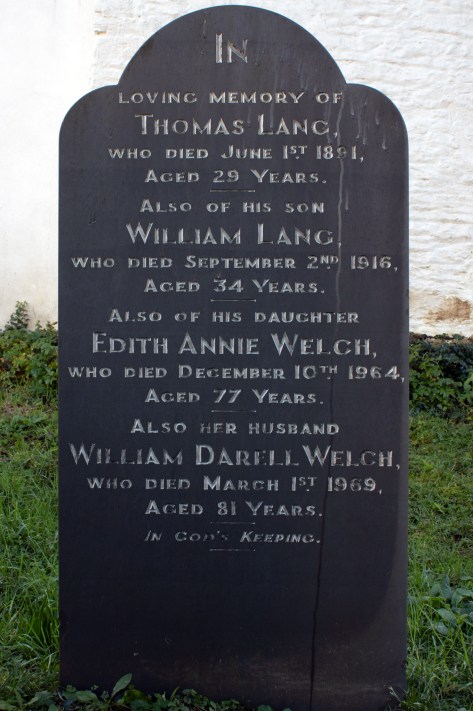
William John Lang was born on 22nd August 1882, and was one of six children to Thomas and Elizabeth Lang. Thomas was a general labourer from the Devon village of Georgeham, and this is where the family were born and raised.
William initially followed his father into labouring work, but after Thomas died in 1891, he decided he wanted bigger and better things. On 28th February 1899 he joined the Royal Navy. Under the age to formally enlist, he was given the rank of Boy 2nd Class, and sent to HMS Impregnable, the school ship based in Devonport, for his training.
It seemed that William impressed his teachers. By the end of November he had been promoted to Boy 1st Class, and in the spring of 1900, he was given his first assignment, on board the frigate HMS Agincourt. In August he was transferred to the battleship HMS Camperdown, and he was within days of arriving that he came of age.
William was now formally inducted into the Royal Navy, and given the rank of Ordinary Seaman. His service papers show that he was a little over 5ft 5ins (1.65m) tall, with light brown hair, blue eyes and a fair complexion.
Ordinary Seaman Lang signed up for a period of 12 years, and during that time, he would serve on eight vessels, returning to what would become his shore base – HMS Vivid in Devonport – between assignments. In January 1903 he was promoted to Able Seaman but, while his annual reviews consistently noted a very good character, as time went on, his ability varied from good to moderate.
Able Seaman Lang’s contract came to an end in August 1912, and he immediately re-enlisted. In November 1913 he was assigned to the battleship HMS Colossus, and she would remain his home for the next three years. The posting seemed to suit William well, and his annual reviews reflected this, with superiorability being noted at the end of 1914.
By the start of 1916, William’s health was beginning to be affected and, he returned to HMS Vivid. He had contracted tuberculosis, and this led to his ultimate discharge from naval service on 22nd March.
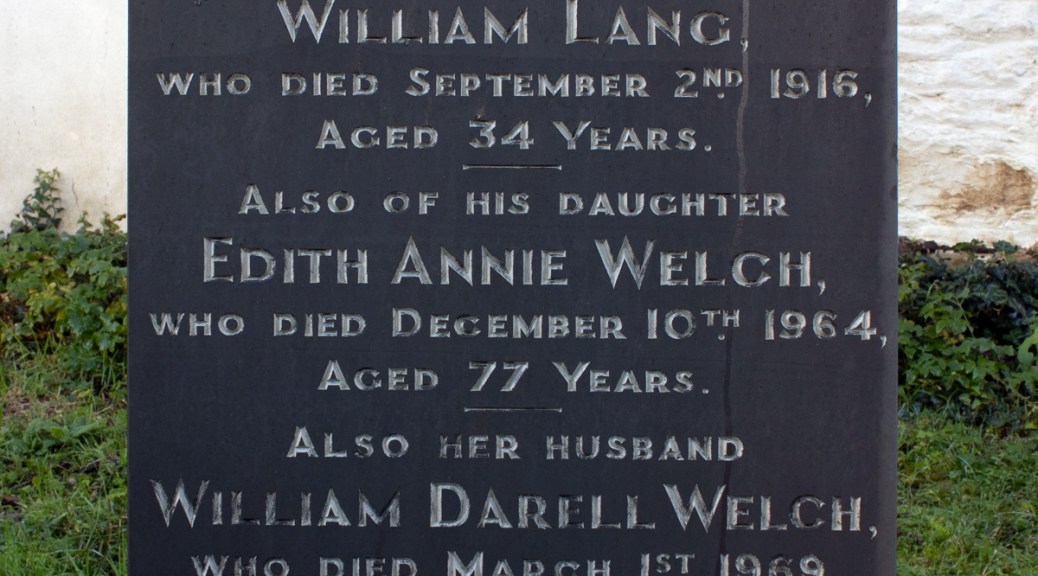
At this point his trail goes cold, but it is likely that he returned home. Elizabeth had remarried by this point, and she and her husband, Thomas Physick, were living on a farm in Georgeham. William’s lung condition would get the better of him, and he passed away on 2nd September 1916. He had not long turned 34 years of age.
The body of William John Lang was laid to rest in the family plot in St George’s Churchyard, Georgeham: father and son reunited after 15 years.
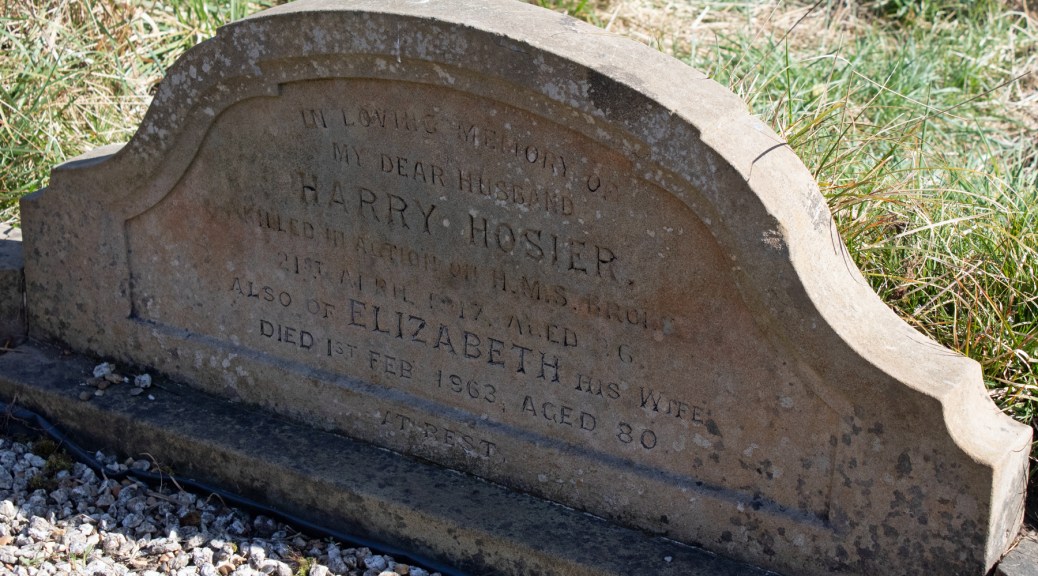
Henry – or Harry – Hosier was born on 22nd September 1880 at 2 Wenban Terrace, Worthing, West Sussex. The fourth of ten children, his parents were Charles and Elizabeth. Charles was a jack of all trades, working as a carman for the railway in 1881, and a gardener by 1891. That census recorded that the family had moved to 1 Ham Road, in East Worthing, and that Charles was the only person bringing money into the household.
When Harry completed his schooling, he found work as a coachman. On 3rd November 1900 he married Elizabeth Jenkins at Christ Church in Worthing town centre. Elizabeth was living in nearby Broadwater when the couple exchanged vows. Her father is unknown and the surname she went by was her mother Charlotte’s first husband’s name, although he died eighteen months before she was born. Charlotte married a second time, to a Stephen Lillywhite, and, for a while her daughter was listed with his surname. By the time she married Harry, however, Elizabeth had reverted to Jenkins.
Harry and Elizabeth initially moved in with Charlotte and Stephen. By the time of the 1911 census, however, they had set up their own home on Broadwater Street, to the north of Worthing town centre. The couple would go on to have seven children, although two would pass away in infancy.
Harry was working as a cab driver by this point but, when war broke out, he would be called upon to play his part. He enlisted on 26th June 1916, joining the Royal Navy as an Ordinary Seaman. His service papers show that he was 5ft 3.5ins (1.61m) tall, with dark brown hair, brown eyes and a dark complexion. His is also noted as having a number of tattoos on his arms.
Ordinary Seaman Hosier was initially sent to HMS Victory, the Royal Naval Dockyard in Portsmouth, Hampshire, for his training. In August 1916, however, he was assigned to the destroyer HMS Broke. Fresh from the Battle of Jutland, she was part of the 4th Destroyer Flotilla, charged with protecting the English Channel.
On the 20th and 21st April 1917, Broke took part in the Battle of Dover Strait against six German torpedo boats. In the confusion of the skirmish, Broke rammed the enemy ship SMS G42, and the two vessels became locked together. For a while the crews fought in hand-to-hand combat, before the British ship managed to break free. Soon afterwards the German boat sank. Badly damaged, HMS Broke had to be towed back to Dover: 21 of the crew – including Ordinary Seaman Hosier – were killed, and a further 36 were wounded. Harry was 36 years of age.
The body of Harry Hosier was taken back to Sussex for burial, his funeral at Broadwater Cemetery, making the local newspapers:
A fallen hero of the naval fight off Dover last week was buried in Worthing yesterday with full service honours. Worthing people welcomed the opportunity to show honour to a townsman who had laid down his life in one of the most brilliant naval exploits of the war, and the occasion was unique in that the funeral was the first to take place locally during the war of a naval man killed in action. Seaman Harry Hosier was serving on the destroyer leader “Broke,” so valiantly commanded by Commander Edward Evans, CB, when he met his end. He died the death of a Briton after nobly doing his duty. The coffin was conveyed from Dover to Worthing for the funeral at the request of the deceased’s relatives. Scenes of the most impressive character were witnessed, the route of the procession being thronged from one end to the other, and several thousand people assembled at the cemetery…
The Red. EJ Elliott (Rector) officiated, and from the pulpit gave a stirring address. He said “In the course of the 700 years’ history of this church, I don’t suppose there has ever been a service quite like the present one – the funeral of a Broadwater man killed in action. Forty or more Broadwater men have already made the supreme sacrifice, and we are glad this afternoon to be able in a special way to honour these noble men. In all probability Henry Hosier will be the last in this war who will be called upon to die whose funeral will take place at home. In doing honour to whim whose mortal remains are with us this afternoon – the remains of a gallant bluejacket belonging to HMS Broke – we do honour to our two score other parishioners who at the call of duty, joined up, and are now sleeping their last sleep.
“They heard their Motherland calling to them for the help of their sons and at once, with enthusiasm and alacrity, they responded. They loved their loves as we do, but they loved something more – they had a deeper love for their country and for the safety of their homes and hearth. They died, let us remember, for us, in order that we at home might be spared the agony and the martyrdom of the Belgians and the Serbians. They died in order that we might remain safe and comfortable in the home land and not be called upon the endure the nameless agony and also the atrocities perpetrated by the Huns. We leave the soul of Henry Hosier and of our 40 other Broadwater heroes in God’s hands…”
[Sussex Daily News: Friday 27th April 1917]
Two of Harry’s siblings – Christopher and Ernest – had added to the tally of Broadwater’s forty.
Ernest Hosier was born in 1895, and was the ninth of Charles and Elizabeth’s children. He found work as an errand boy when he left school, but managed to associate himself with the wrong group of friends.
Ernest Hosier, 14, errand boy, on bail, and Frederick Clark, 21, rag and bone collector, were indicted for offences against Fanny Newman and Alice Smith, girls between 13 and 16 years of age, at Worthing, between December 1st, 1909, and March 11th, 1910.
Clark pleaded guilty and Hosier not guilty. The latter gave an absolute denial to the charge, and suggested that the girls had associated him with the charge in revenge because he would have nothing to do with them…
After hearing the evidence, the jury found Hosier not guilty, and his Lordship said he was discharged without any imputation whatever upon his character. Clark was sentenced to six months’ hard labour, his Lordship remarking that girls of the character of those in this case were a terror and a real temptation to men.
[Hastings and Bexhill Independent: Thursday 30th June 1910]
Soon after the court hearing, Ernest joined the Royal Navy, the 1911 census recording him as a boarder at the Training Establishment in Shotly, near Ipswich, Suffolk. After serving on a number of vessels, he came of age, and formally enlisted as an Ordinary Seaman on 16th October 1912. Within a year he had been promoted to Able Seaman and in the summer of 1914, he was assigned to the battlecruiser HMS Invincible.
Able Seaman Hosier was on board during the Battle of Heligoland Bight in August 1914, and the Battle of the Falklands that November. In May 1916 Invincible was involved in the Battle of Jutland, and Ernest was one of the 1,000 crew who were killed when she was was hit by a number of German salvoes and sank. Able Seaman Hosier was 21 years of age, and is commemorated on Portsmouth Naval Memorial.
Christopher Hosier was born in 1887, and was working as a cellarman when war broke out. He enlisted in the Royal Sussex Regiment, and was assigned to the 7th Battalion.
In the autumn of 1917, Private Hosier’s unit was caught up on the Western Front, as Arras and Cambrai. It was here, on 20th November 1917, that he was killed, although his body was not recovered. He was 29 years of age, and is commemorated on the Cambrai Memorial.
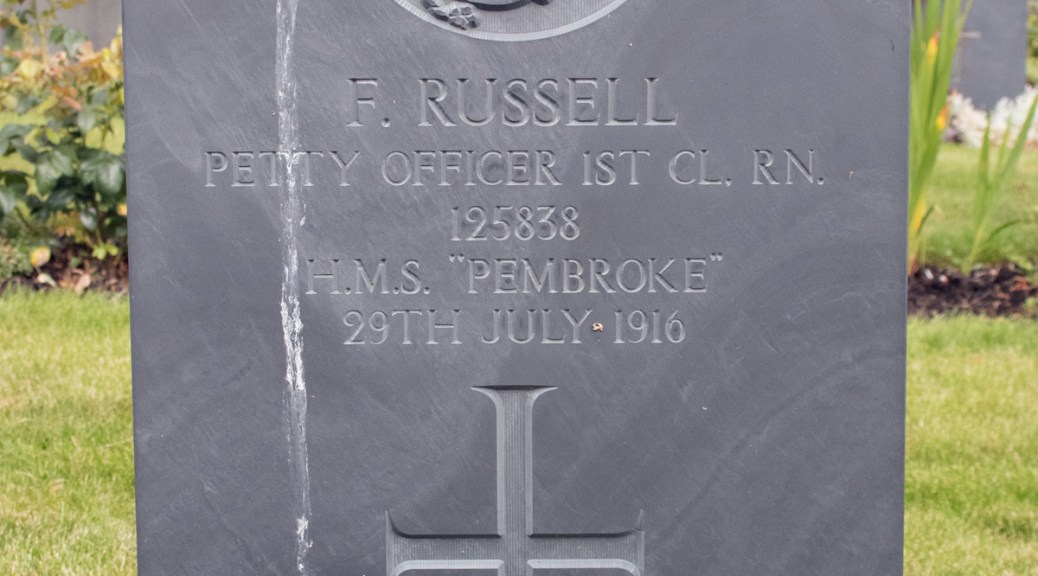
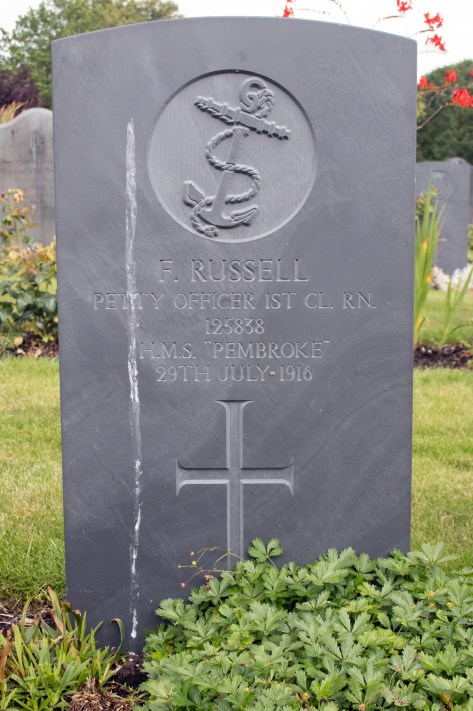
Frederick Russell was born in Woolwich, Kent, on 8th August 1868, and was the younger of two children to Elizabeth Russell. Of Frederick’s father there is no trace, and it is likely that he passed away soon after his son’s birth. Only Elizabeth’s name appears on her son’s baptism record, the ceremony carried out at St Nicholas’ Church, Plumstead, Kent, on 1st August 1869.
The 1871 census found Elizabeth and her children – Caroline and Frederick – living in rooms at 1 Armstrong Place, Plumstead. She was employed as a hat trimmer, and the document confirms that she had been born in Matlock, Derbyshire.
Money must have incredibly tight, and by the 1881 census, Frederick was one of 115 students at the South Metropolitan Schools Branch in Herne Bay, Kent. The former Pier Hotel on the seafront, this had been set up as a convalescent home for pauper children from the Woolwich area.
The next record for Frederick shows the start what would become a thirty year naval career. He enlisted as a Boy 2nd Class on 10th January 1884, and was assigned to the Royal Navy’s school ship, HMS Impregnable. She would remain his home for the next eighteen months, and he was promoted to Boy 1st Class during his time on board.
In August 1885, Boy Russell was given his first sea-going assignment, on the battleship HMS Ajax. The following spring, he transferred to the corvette HMS Comus, and she would become his home for the next six years. During this time, he came of age, and was formally inducted into the Royal Navy as an Ordinary Seaman. His papers show that he was 5ft 1in (1.55m) tall, with brown hair, grey eyes and a fresh complexion. They also note an abscess scar under his jaw and a dog bite on his right arm.
Frederick was a determined young man, and his commitment to the navy paid off. Over the ten years of his contract, he would serve on three ships after Comus, and was promoted three times – to Able Seaman in April 1888, Leading Seaman in 1894 and Petty Officer 2nd Class on 1st January 1895.
In August 1896, Frederick’s contract with the navy came to an end, but he immediately re-enlisted. Over the next decade he added a further six vessels to the list of those he had served on, and had been promoted again, to Petty Officer 1st Class, taking the rank in August 1897. As time wore on, more and more of his service was spent on shore, and he spent the last two years of his second contract based at HMS Pembroke, the Royal Naval Dockyard in Chatham, Kent.
Petty Officer Russell’s contract came to an end in August 1906 and his trail goes cold for a few years. An entry on the 1911 census suggests that he may have found work as a servant in the St Aloysius School on Hornsey Lane, Upper Holloway, Middlesex.
Frederick had also met someone by this point, and on 7th January 1911, he was due to marry Elizabeth Stone at Holy Trinity Church on Haverstock Hill. The nuptials did not take place, however, the vicar noting that the entry was cancelled, ‘the parties not having presented themselves at the time appointed.’ The couple were still very much together, however, and went on to have four children: Frederick, Gladys, Ernest and George.
When war broke out, Frederick was called back into service in his previous role of Petty Officer 1st Class. Over the course of two years, he spent six months on board the battleship HMS Duncan. The rest of the time he served at his former base HMS Pembroke, and is seems likely that this was so that he was closer to his family.
By the summer of 1916, Frederick’s health was starting to fail. He contracted pneumonia, and the condition would get the better of him. He passed away on 29th July 1916, a few days short of his 48th birthday.
The body of Frederick Russell was laid to rest in the military section of Woodlands Cemetery, Gillingham, Kent, not far from the base he had called home for a lot of his navy career.