

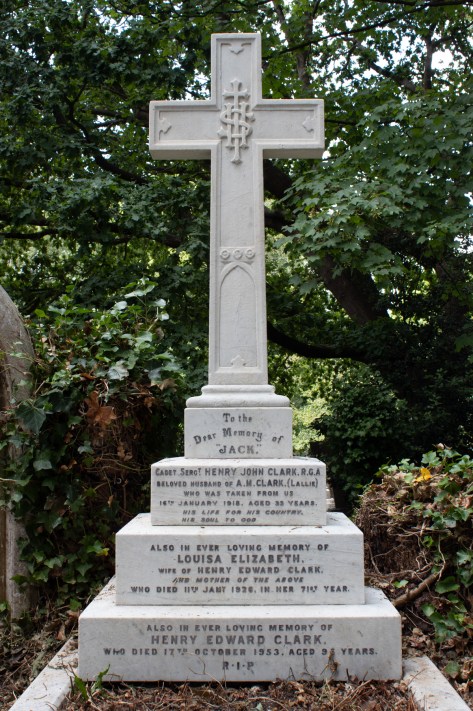
Henry John Clark was born on 17th January 1885 in Tufnell Park, Middlesex. The oldest of five children, his parents were wire worker and brass finisher Henry Clark and his wife, Louisa.
The 1891 census found the family living at 51 Cromwell Avenue, Highgate, Middlesex, and this would certainly remain Henry Sr and Louisa’s house for the next ten to fifteen years at least. Henry Jr – who was better known as Jack – is missing from the 1901 census, but by the next document, taken in 1911, he had moved back in with the family.
By this point the Clarks were living in a thirteen-room house on Shepherd’s Hill, Highgate. Henry Sr was now listed as an employer, manufacturing fenders, fire guards and metal good generally, with Jack and his brother, Cyril, also working in the business. The family were supported by two servants, with Henry Sr’s niece and another boarder living with them. Tragically, the census records that Louisa had had five children, although only Jack and Cyril were still alive.
The family business, according to De Ruvigny’s Roll of Honour, Messrs. J Clark, Ltd, of High Street, Bloomsbury, and Jack was one of the directors. The publication also notes that, in his spare time, Jack was “a prominent and active member of the Kit Marlowe Dramatic Club, and the Vaudeville Dramatic Club, and was a popular member of the Highgate Special Constabulary, which body he joined as soon as it was formed.”
On 19th June 1912,Jack married Alice King. Born in Finsbury Park, she was the daughter of a wine and spirit valuer and merchant. The couple exchanged vows at St George’s Church, Hanover Square, London, and would go on to have a child, John, in 1916.
When war broke out, Jack was called upon to play his part. He enlisted on 4th December 1916, joining the Royal Garrison Artillery as a Gunner. His service papers note that he was just over 6ft 2ins (1.89m) tall, and weighed 159lbs (72.1kg).
Gunner Clark served with the British Expeditionary Force from March 1917, returning to home soil just three months later. He had obviously impressed his superiors, as he was sent to the No. 2 RGA Officers’ Cadet School in Uckfield, Sussex, to be trained as a Sergeant.
While here, however, Jack came down with pneumonia, and was admitted to the No. 2 Eastern General Hospital in Brighton. The condition was to get the better of him, sadly, and he passed away on 16th January 1918, the day after his 33rd birthday.
Henry John “Jack” Clark was taken back to Middlesex for burial. He was laid to rest in the majestic Highgate Cemetery, a short walk from his grieving family.

(from De Ruvigny’s Roll of Honour)
 Death and Service