

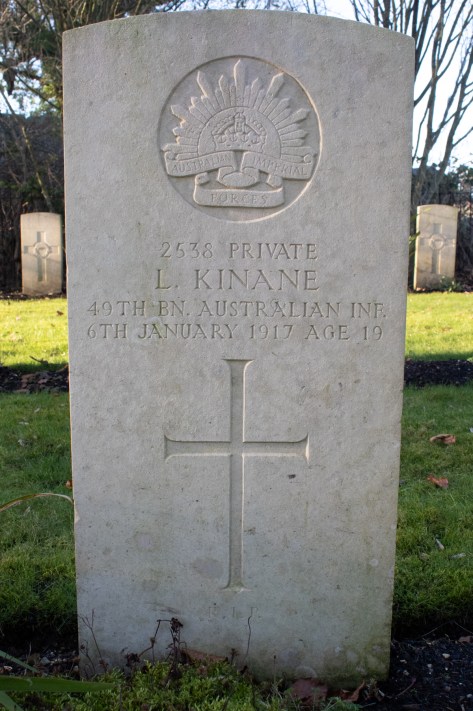
Lawrence Kinane was born in Tipperary, Ireland, in 1896. One of eight children, his parents were Daniel and Catherine Kinane. Daniel was a farmer and, when Catherine died when Lawrence was just 10 years old, he was left to raise the support the family on his own.
At this point, the family’s trail goes cold, and it later picked up in an unexpected way. Daniel and some of the children seem to have emigrated to the United States, and he died in Brooklyn in March 1914. Lawrence, meanwhile, seems to have gone further, seeking a new life in Australia. A cousin, Mary Mulcahey, was living with her husband in Warwick, Queensland, and, by the time war broke out, he had moved to Brisbane.
Lawrence was working as a labourer when, on 10th June 1916, he enlisted in the Australian Imperial Force. His service papers show that he was 5ft 11ins (1.8m) tall and weighed 147lbs (66.7kg). A Roman Catholic, he had dark brown hair, grey eyes and a medium complexion. Under Distinctive Marks, he was recorded as having a large patch of scars on his left side, about 7ins (18cm) above his buttock.
Private Kinane’s unit – the 49th Battalion of the Australian Infantry – set sail from Brisbane on the 19th September 1916. His ship – the SS Seang Choon – would take ten weeks to reach its destination – Devonport, Devon, and Lawrence finally arrived at the ANZAC base in Codford, Wiltshire in mid-December.
The lengthy sea voyage had taken its toll on a lot of the soldiers being transported, and Private Kinane was not to be immune. Within weeks of arriving, he came down with pneumonia, and was admitted to the No. 3 New Zealand General Hospital in nearby Sutton Veny on 31st December. Lawrence’s condition worsened, and he finally succumbed to it on 6th January 1917. He was just 20 years of age.
Thousands of miles from Australia, and with no family close by, the body of Lawrence Kinane was instead laid to rest in the graveyard of St Mary’s Church in Codford, not far from the base that had been his home for just a few short weeks.

(from findagrave.com)
 Death and Service