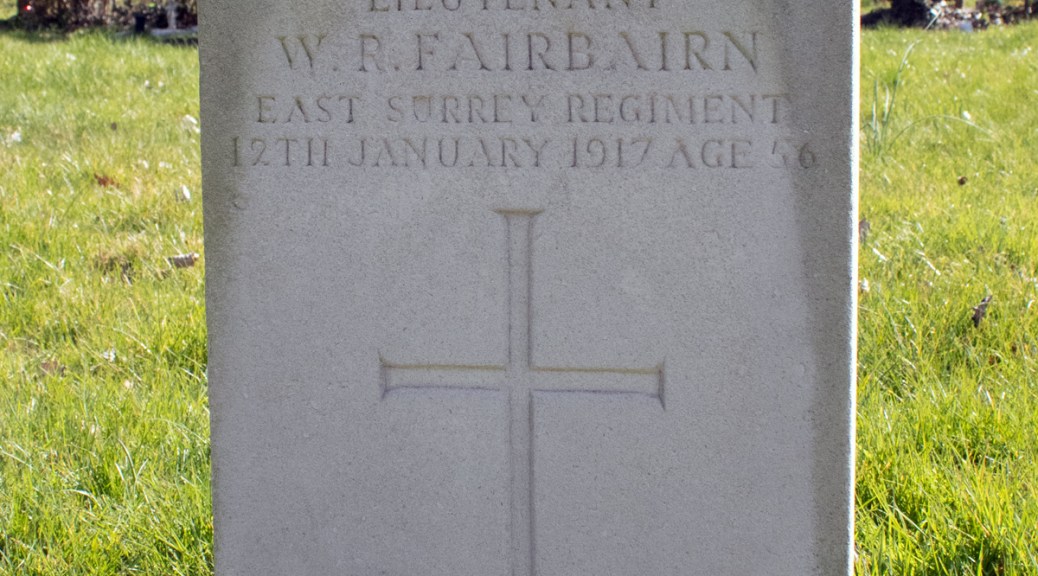
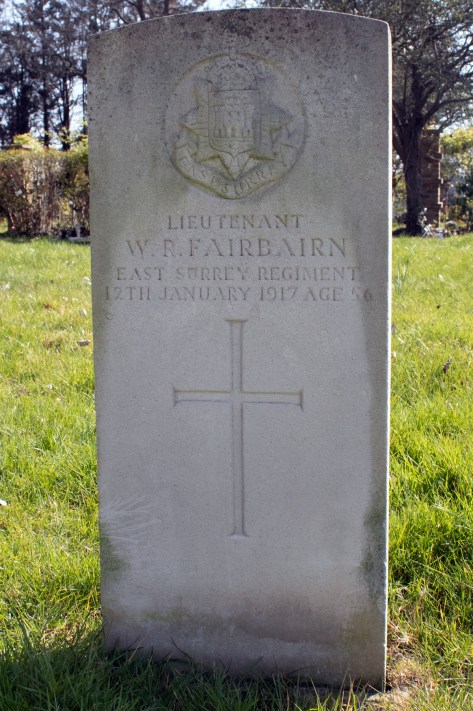
In the sprawling Streatham Park Cemetery, Surrey, is a headstone dedicated to Lieutenant WR Fairbairn of the East Surrey Regiment, who died on 12th January 1917, at the age of 56.
There is frustratingly little information available about Lieutenant Fairbairn. The Commonwealth War Graves Commission records confirm his widow as Mrs F Fairbairn, of 35 Egerton Road, Bexhill-on-Sea, Sussex, but this was a boarding house and the couple were not resident there at the time of the 1911 census.
Without a confirmed first name, or place of birth, it isn’t possible to track down baptism or parental records, and Lieutenant Fairbairn’s name does not appear in contemporary newspaper reports.
As a commissioned officer, standard military records do not exist, and with no service number available, his time with the East Surrey Regiment is a mystery.
One document gives a tiny insight into Lieutenant Fairbairn’s life: the Hospital Registers for 1914-1919 confirms that he was admitted to the Queen Alexandra Military Hospital on Millbank, Westminster, on 12th December 1916. While the document doesn’t confirm his first name, it does show that he had been in the army for some 41 years, which might explain his absence from any census records. Now attached to the 21st Training Reserve, he was suffering from chronic bronchitis and nephritis.
Lieutenant Fairbairn was discharged from hospital on 6th January 1917, and for the next six days his trail goes cold. Whether he was sent to Streatham to recuperate, or whether he was based there with his wife is unclear.
Either way, Lieutenant WR Fairbairn passed away on 12th January 1917, ad the age of 56 years old. He was buried in Streatham Park Cemetery, taking the details of much of his life with him.
Within a few weeks of following his youngest brother Fred to the grave, Sergt. Alexander Hurst has himself passed away, after a shirt but severe illness, in his 55th year. Born at the Grammar School, Cavendish, on Michaelmas Day, 1862 (being the day on which his father, the late Mr Robert Hurst, commenced his duties as headmaster there) he early closely associated himself with the social life of the village. A keen sportsman, he achieved considerable success on the cricket field, being a stead batsman, and a bowler with plenty of “spin.” He also devoted much time and study to campanology, an ort of which he was a skilful exponent, and composed several peals. On leaving Cavendish in 1884, he was the recipient of a handsome testimonial from the parishioners in recognition of the good work he had done in the village… At Long Melford he was for many hears a member of the Volunteer force, in which he attained the rank of Sergt. He was an excellent rifle shot, and on several occasions he the satisfaction of figuring in the prize list at Bisley. On the football field he was a particularly neat half-back, and was a member of the winning County Senior Cup team in the season 1887-88. As a musician Sergt. Hurst showed considerable ability, being gifted with a critical ear, and possessing a baritone voice of sympathetic timbre. For many years he officiated as organist at Bulmer Parish Church. For the past twelve years or so Sergt. Hurst had resided in London, where he was in the employ of Sir Herbert Marshall & Rose as expert piano tuner. Shortly after the outbreak of war, notwithstanding his 50 odd years, he offered himself for service and joined the County of London Battalion with the rank of Sergeant. He devoted himself to his military duties with utmost zeal, and it seems more than probable that his anxiety to serve his country to the best of his ability hastened his end.
[Suffolk and Essex Free Press: Wednesday 7th March 1917]
Alexander Burnett Hurst was the middle of seven children – all boys – to Robert and Margaret Hurst. By the time of the 1881 census, he was teaching at Cavendish Grammar School, Suffolk, which was a small educational establishment with a dozen boarding students.
The next census followed the family’s move to Long Melford, and by this time Alexander was working as a pianoforte tuner, while his older brother Bernard was employed as an organist.
On 30th October 1899, Alexander married Maude Thurston. The daughter of a chemist from Ipswich, Suffolk, the couple married in her local parish church, St Lawrence’s. The couple’s wedding certificate recorded the groom as an organ builder.
By 1901, the newlyweds had set up home in Long Melford, taking a cottage two doors up from the historic Bull Hotel, and next door to Bernard and his family. Alexander was now working as a music teacher, although it seems likely that he had his fingers in many melodic pies by this point.
Alexander and Maude would go on to have three children – daughters Geraldine and Evelyn, and son Kenneth. The 1911 census suggests that the family had moved south by 1907, as this is where young Kenneth was born. The document recorded them in rooms at 134 Kennington Park Road, sharing the building with teachers, actresses and music hall artists.
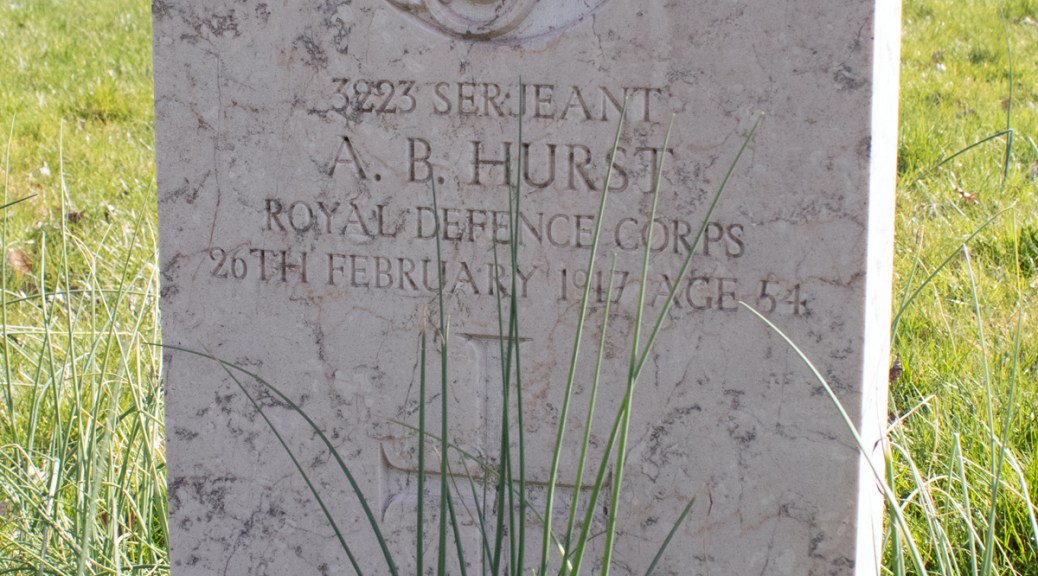
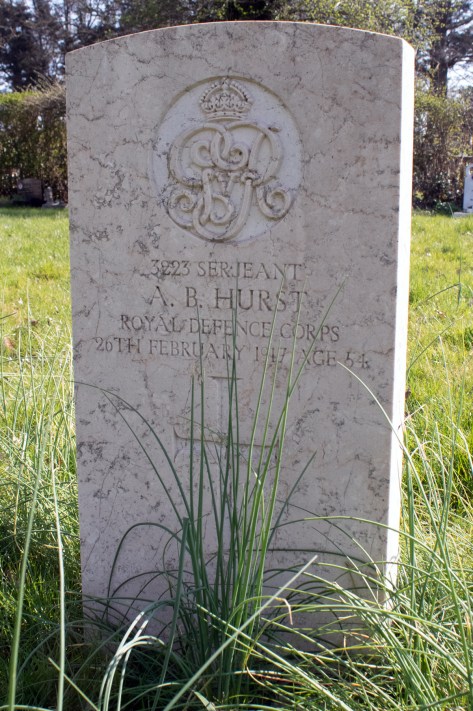
Little information remained about Alexander’s military service. While the newspaper report suggests he was assigned to the London Regiment, other documents confirm he was a member of the Royal Defence Corps. The unit was specifically set up for older service personnel and, attached to No. 1 Protection Company, Serjeant Hurst was based in London.
Alexander Burnett Hurst died from pneumonia on 26th February 1917: he was 54 years of age. He was laid to rest in Streatham Park Cemetery, a short distance from where his widow and family were living.
Maude remained living on Kennington Park Road. By the time of the 1921 census she shared her home with her two daughters – the eldest of whom was working as a clerk and typist for the Shell Motor Oil Company – and her widowed mother, Mary Thurston.
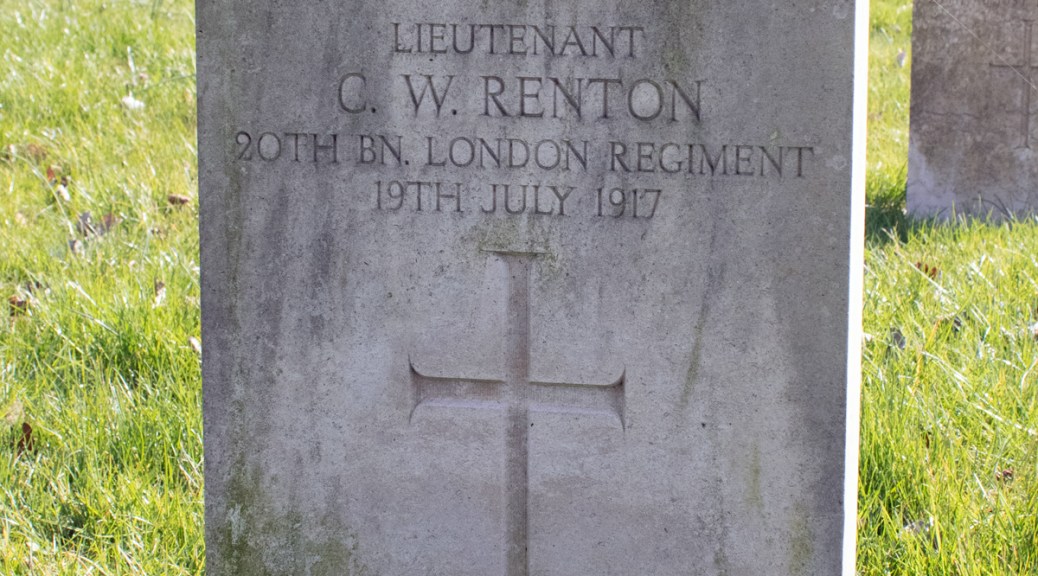
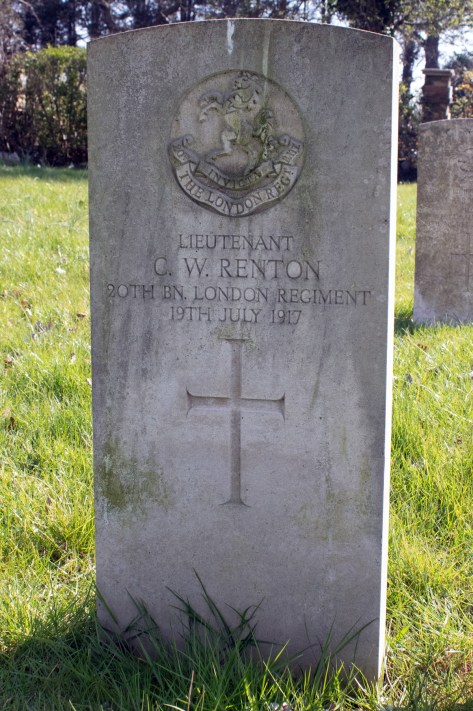
Cyril William Renton was born in Brixton, Surrey, on 27th November 1872. The older of two children, hie parents were Edward and Emily Renton. Edward was an engraver and artist and, when Emily died shortly after Cyril’s younger brother was born, he married again, to Harriett Predier: the couple went on to have two children, Cyril’s half-brother and half-sister.
By the time of the 1891 census, Edward had moved the family to Hampstead, Middlesex. Setting up home in the illustrious South Hill, their home – a Georgian semi-detached villa backing onto Hampstead Heath – served as a fine setting for the now art dealer head of the household.
When Cyril completed his schooling, he found work as a stockbroker. On 22nd December 1894, he married Mary Nettleton at St Paul’s Church in Kentish Town. Mary was the daughter of a solicitor’s clerk, and Cyril’s new father-in-law seems to have helped his career.
The 1901 census found the young couple living at 33 Tivoli Road in Hornsey, Middlesex. Their eldest child, Lionel, had been born four years before, and Mary’s father and brother were also living with them. Cyril was now recorded as being an articled clerk for a firm of solicitors.
Second son Esmonde was born in 1897, and Cyril’s career continued its upward journey. By 1911 the Rentons had moved to 46 Glasslyn Road in Crouch End, and had taken on two servants to support the family. Cyril was now a full-blown solicitor and counted an estate agent’s clerk, a cement company secretary, a master stevedore and a human hair merchant amongst his neighbours.
[He] practised as a solicitor as the Police Court. For several years he represented the National Society for the Prevention of Cruelty to Children. He was at one time the vice-president of the Highgate Thirty Club, and in 1914-15 became the president.
[Hornsey & Finsbury Park Journal: Friday 3rd August 1917]
While obviously good at his job, Cyril wanted more:
At a time when he seemed very likely to make a big name for himself in the various courts he attended, he decided to dispose of his practice and to study for the bar. In the Michaelmas law examination of 1913 he successfully passed in all the subjects and the “final,” and was thereupon duly “called.” He was getting on extremely well in the higher branch of his profession when war broke out…
[Hampstead & Highgate Express: Saturday 28th July 1917]
Cyril felt a call to serve his country, and so stepped up to enlist.
[He] joined the Inns of Court OTC, and went into training. When he obtained his commission je joined a battalion of the London Regiment, and, having been through a course at Hythe, he became a musketry instructor and was engaged in that capacity for many months. At last the authorities yielded to his repeated applications to be sent on active service, and he went to France. There he had six months’ fighting, and only returned after he had been wounded.
[Hampstead & Highgate Express: Saturday 28th July 1917]
Attached to the 20th (Country of London) Battalion (Blackheath and Woolwich), Lieutenant Renton’s older son, Lionel, was also fighting, and was attached to the 16th Service Battalion – also known as the Public Schools Battalion – of the Middlesex Regiment.
It is unclear whether Cyril returned to the fray, and by the spring of 1917, having recovered from injuries, he fell ill. His health seems to have been impacted by his injuries, and he passed away from his condition on 19th July: he was 44 years of age.
The body of Cyril William Renton was taken to Streatham, Surrey, for burial: the reasons are unclear, but it is likely that this is where his mother and father (who had died in 1904) had been buried. Private Lionel Renton was recuperating from injuries, and was able to attend the funeral with Mary and Esmonde.
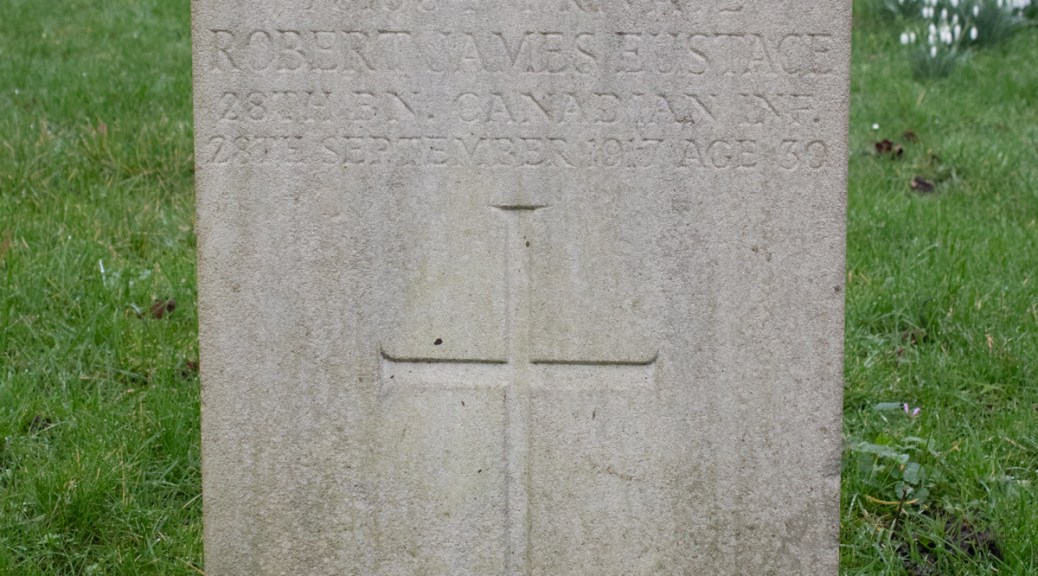
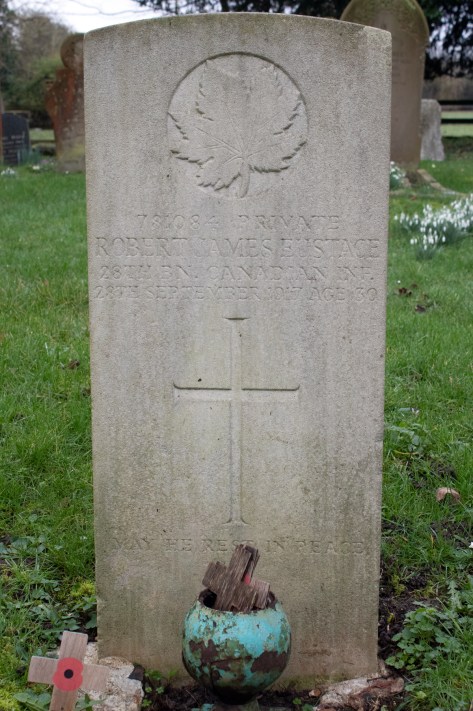
Robert James Eustace was born in the summer of 1887 in the Oxfordshire village of Shirburn. The oldest of three children, he was the only son to James and Elizabeth (or Eliza) Eustace. James was a shepherd, and by the time of the 1901 census, he had taken up work on a farm near Slough, Berkshire. The document found the family living at 4 Wellington Place, on Grove Road, to the north of the town.
Eliza died in the years after that census was taken, and by the time of the next one, recorded in 1911, James and Robert had moved to 2 Pioneer Place in nearby Cippenham. Robert was employed as a carman, but it is clear that he sought more and he took the risk of emigrating for a better life.
Robert – who now took to calling himself James – moved to Gull Lake, Saskatchwean, where he took up work as a farmer. It is unclear when he left Britain, but when war broke out, he was called upon to come back.
James enlisted in Moosejaw on the 30th November 1915. His service papers show that he was 5ft 5ins (1.64m) tall, and had dark brown hair, blue eyes and a medium complexion.
After initial training, Private Eustace’s unit – the 28th Battalion of the Canadian Infantry – left for Europe. Departing from Halifax on the 15th August 1916, James arrived in Liverpool nine days later. Further training took place, and he arrived in France on 5th December.
Private Eustace fought in some of the key battles of that part of the conflict, including at Ancre Heights, and Arras. But it was at Hill 60 that James came unstuck, and he was badly wounded in the buttock and leg.
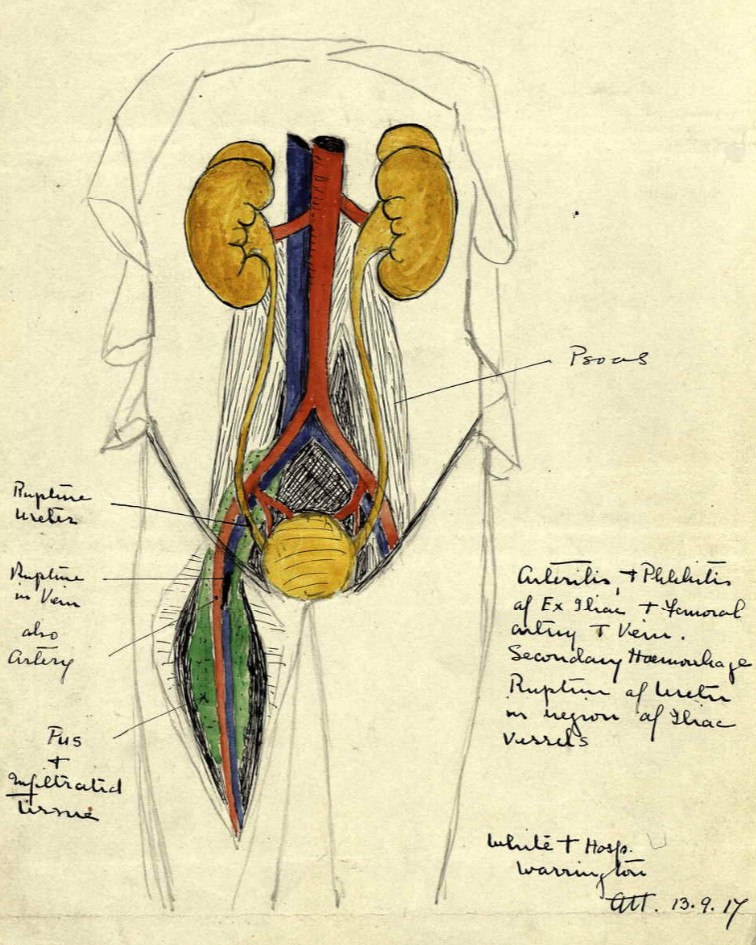
Initially treated on site, Private Eustace was medically evacuated to Britain for treatment. Admitted to the Lord Derby War Hospital in Warrington, Cheshire, on 26th August 1917, his wounds required surgery. James was also recorded as having an abscess in the psoas muscle in his lower back. During the operation, this was drained and cleaned. His service papers included a diagram of the operation from his surgeon.
James remained in hospital for a month, and during that time, he developed toxaemia. The combination of his injury, the abscess and the blood poisoning would ultimately prove fatal: Private Eustace passed away on 28th September 1917. He was 30 years of age.
The body of Robert James Eustace was taken back south for burial. James, shill a shepherd, was now living at Dorney Court Farm, not far from Slough, and it was in the village’s burial ground that he laid his son to rest.
Stephen Smith was born in Hilperton Marsh, Wiltshire, in 1890. The fourth of eight children, he was the second of three sons to Thomas and Vashti Smith. Thomas was a hawker, and the family were living at 14 Islington Place when Stephen was born.
By the time of the 1901 census, the family had moved to 65 Shails Lane, slightly closer to Trowbridge town centre. Three of the family – Thomas, Vashti (who went by her middle name, Sarah), and their oldest child, Selina – were all employed in hawking. Stephen, just 12 years of age, was still at school, but his older brother, Alfred, was earning a little by collecting rags.
On 30th August 1908, Stephen married Beatrice Harding. They were both just 18 years of age at the time, and it seems to have been a love match: they went on to have three children, but their eldest, daughter Annie, was not born until 1911.
By the time of that year’s census, the young were renting a tenement at 5 Burbidge’s Yard. Just around the corner from Stephen’s Parents in Shails Lane, it was small courtyard filled with dyers, needleworkers, carpenters and hawkers.
Stephen also wanted to do his bit in the service of his King and, on the 14th June 1908, he enlisted in the 3rd Battalion of the Wiltshire Regiment. His service papers show that he was 5ft 7.5ins (1.71m) tall, and weighed 155lbs (70.3kg). He was noted as having brown hair and brown eyes.
Over the next four years, Stephen remained on home soil. He proved his mettle, and was appointed to Lance Corporal on 21st June 1911, and Corporal less than a year later. In October 1912, he extended his service for another four years. By June 1913, Stephen had been promoted again, his exemplary service resulting in him being made Sergeant.
War broke out in the summer of 1914, and Sergeant Smith found that his rank meant that he wouldn’t be able to serve with his men. At his own request, he reverted to the rank of Private and, on 11th September, he transferred to the 1st Battalion and was sent to France.
Private Smith’s unit fought at the Battle of Messines, and he was injured there. A gunshot wound to his right foot meant a medical evacuation to Britain, and he was admitted to the 2nd Western General Hospital in Manchester, Lancashire, for treatment.
Following his discharge, Stephen remained on home soil, but his health was becoming affected in unexpected ways. He had developed varicose veins in late childhood, and these developed to the point where he was not longer fit for military duty. He was discharged on 15th April 1916, and returned home to Trowbridge. The condition was declared not to be related to his service, so he did not receive any recompense for it.
By the spring of 1917, another issue had presented itself. Stephen was suffering from tuberculosis, and the prognosis was not good. “In my opinion [Private Smith] acquired the disease whilst in the service and the disease was aggravated in consequence of his military duties. He is suffering from the disease in rather an advanced stage and it does not appear to me probable that he will live for another year.” Signed Leonard Crossley MD, County Tuberculosis Officer. [Medical Report on Stephen Smith: 28th March 1917]
Ultimately, Dr Crossley’s prediction would prove correct:
The death occurred on Saturday at Lower Broad Street of Stephen Smith, aged 27, who served for some time in the Army and was discharged nearly two years ago on account of a wound in the leg. For some time past he had suffered from tuberculosis, but he was out of doors as recently as Friday. He leaves a widow and four young children.
[Wiltshire Times and Trowbridge Advertiser: Saturday 8th December 1917]
The body of Stephen Smith was laid to rest in Trowbridge Cemetery, not far from where his grieving family were still living.
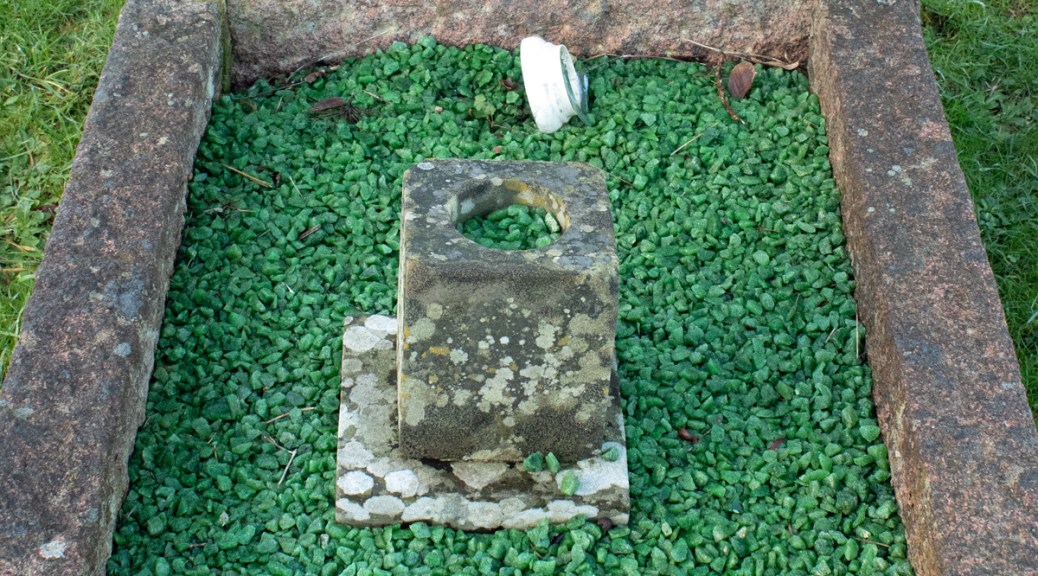
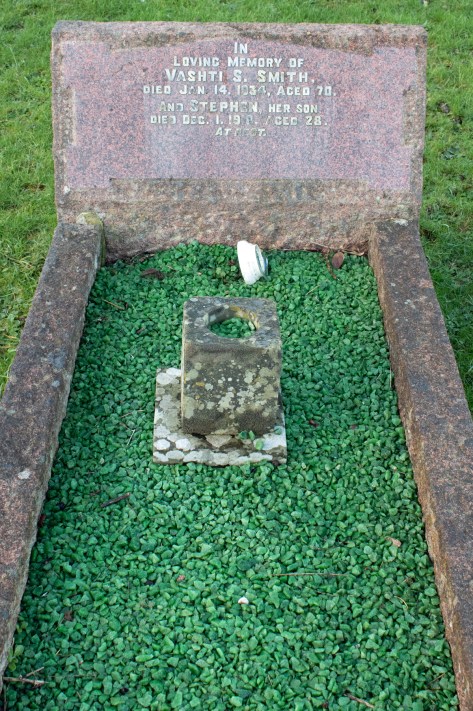
While Stephen’s father disappears into history, his mother, Vashti, lived on until 1934. She was laid to rest with her son, mother and son reunited after 17 years.
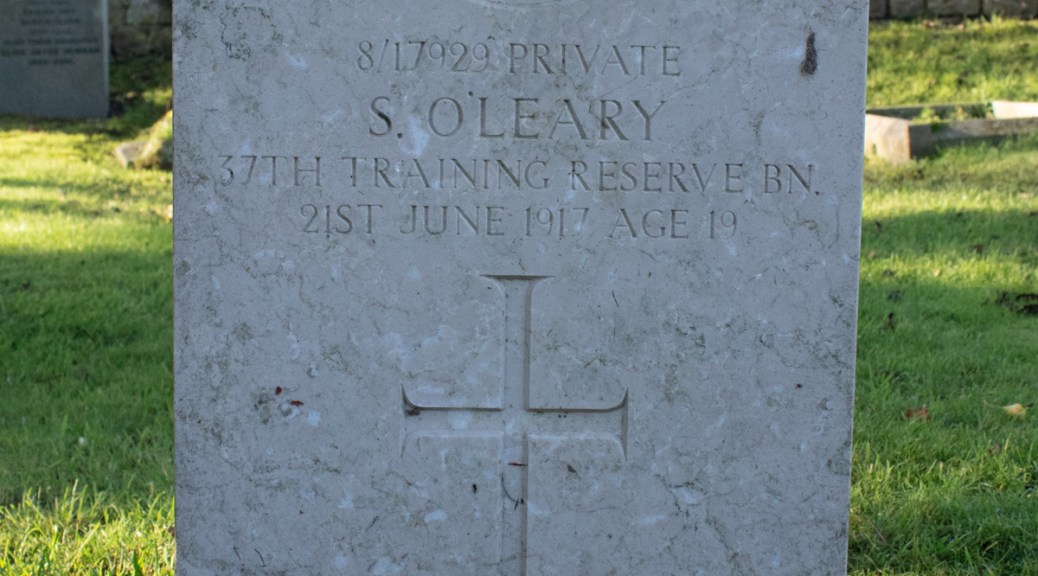
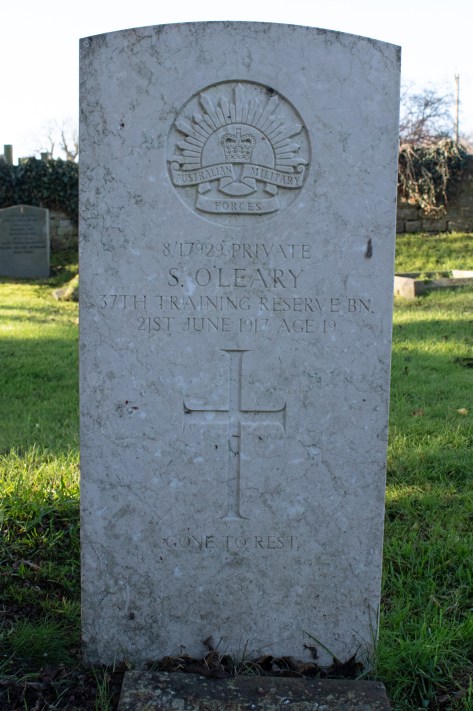
Stephen O’Leary was born in the autumn of 1898 in the Wiltshire village of Keevil. The second of four children, he was the eldest son to Edward and Mary O’Leary. Edward was a thatcher by trade, and the family lived on Institute Road (now Martins Road), to the south of the village.
Stephen was only 16 years of age when war broke out, but is seems that he was called upon to play his part early in 1917. He was attached to the 37th Battalion of the Training Reserve Battalion, and sent to Salisbury Plain for his instruction.
Tragically, it would seem that Private O’Leary’s time in the army was to be brief. While in camp he contracted meningitis, and was sent to the Isolation Hospital in Stratford-sub-Castle, to the north of Salisbury. He died from the condition on 21st June 1917: he was just 18 years of age.
The body of Stephen O’Leary was taken back to Keevil for burial. He was laid to rest in the village’s St Leonard’s Churchyard.
William James Maslin was born in the autumn of 1898, and was the second of four children to Mark and Emma. Mark was a hay cutter from Liddington, Wiltshire, but the family were born and raised in Edington, near Westbury.
There is little specific information about William’s life, but it is clear that when war broke out, he was keen to play his part. He enlisted in the Training Reserve Battalion, and was assigned to the 25th Battalion. Sent to Wool, near Bovington, Dorset, it wasn’t long before Private Maslin fell ill. He passed away from bronchial pneumonia on 4th April 1917: he was just 18 years of age,
The body of William James Maslin was taken back to Wiltshire for burial. He was laid to rest in the graveyard of Ss. Mary and Katherine and All Saints’ Church in his home village, Edington.
William’s older brother, Walter Frank Maslin, also served in the First World War. Born in 1891, he followed in his father’s footsteps, working as a farm labourer.
On 24th September 1911, Walter married Rose Long. The couple set up home just along the road from Mark and Emma, and wend on to have three children: Florence, Herbert and Dorothy.
Walter enlisted in the Worcestershire Regiment, and was attached to the 2nd/8th Battalion. His unit fought at Fromelles, the Ancre and Langemarck, although, as his service papers no longer exist, it isn’t clear where or how Private Maslin served.
What is clear, however, is that he was captured, and taken as a prisoner of war. Imprisoned at Hamelin Camp, not far from the German town of the same name, he was certainly there by the spring of 1918. Conditions would have been harsh, and Private Maslin succumbed to pneumonia on 6th May 1918: he was 26 years of age. His widow and family would not find out about his passing for some weeks, and a death notice was only reported in the Devizes and Wiltshire Advertiser on the 18th July.
The body of Walter Frank Maslin was laid to rest in Friedhof Ohlsdorf, Hamburg, Germany.
Thomas Roland Wilson was born on 2nd December 1871 in Hythe, Kent. His parents were Thomas and Sarah, but there is little information available about his early life.
The 1881 census recorded Thomas as living with his uncle and aunt in Deptford, Kent. Ten years later, he was living with his parents in Finchley, Middlesex. Thomas Sr was living on his own means, while his son, now 20 years of age, was a mercantile mariner.
On 18th November 1895, Thomas Jr was awarded a certificate of competency as being able to be a master of his own vessel. Five years later, he married Charlotte Chichester. She was the daughter of a master mariner, and the couple appeared to settle in her home town of Braunton, Devon.
When war broke out, Thomas was assigned to the Royal Naval Reserve. Details of his time during the conflict are hazy, but, by 1917, he was in charge of HMS Yacht Vagrant. Built in Jarrow, she had been hired by the Admiralty at the start of the war to act as an anti-submarine vessel, with Captain Wilson leading the crew.
Little further information is available about Thomas’ life, and while the Commonwealth War Graves Commission and his headstone give his rank as Lieutenant Commander, other documents note he was a Captain.
The next available record for him relates to his passing:
The regretted death has occurred of Capt. Wilson, in his 47th year, at Fern Lea, Braunton, the residence of his mother-in-law, Mrs Chichester.
[North Devon Journal: Thursday 18th October 1917]
No cause of death is evident, but Thomas Roland Wilson passed away on 17th October 1917. He was laid to rest in the graveyard of St Brannock’s Church in Braunton, Devon.
The funeral of Mr Williams… of South-street, took place on Saturday, the interment being made by the Vicar of Braunton (Rev. JH Prince) in the St Brannock’s Churchyard. There were many manifestations of sympathy, and blinds were drawn all along the route to the Churchyard. The Vicar, in the course of a sympathetic and short address to the bereaved relatives, related a touching incident at an interview he had had with the deceased a few days before his death. The Vicar asked him if he would not rather die peacefully at home than out with his comrades, who were keeping the silent vigil on the seas and in conflict with the enemy. The dying sailor replied in the negative, and said he would sooner be with his comrades, fighting for his King and Country. This, said the Vicar, struck the key-note of Mr Williams’ unselfish life, and by his death they had lost an upright and steady inhabitant.
[North Devon Journal: Thursday 22nd March 1917/
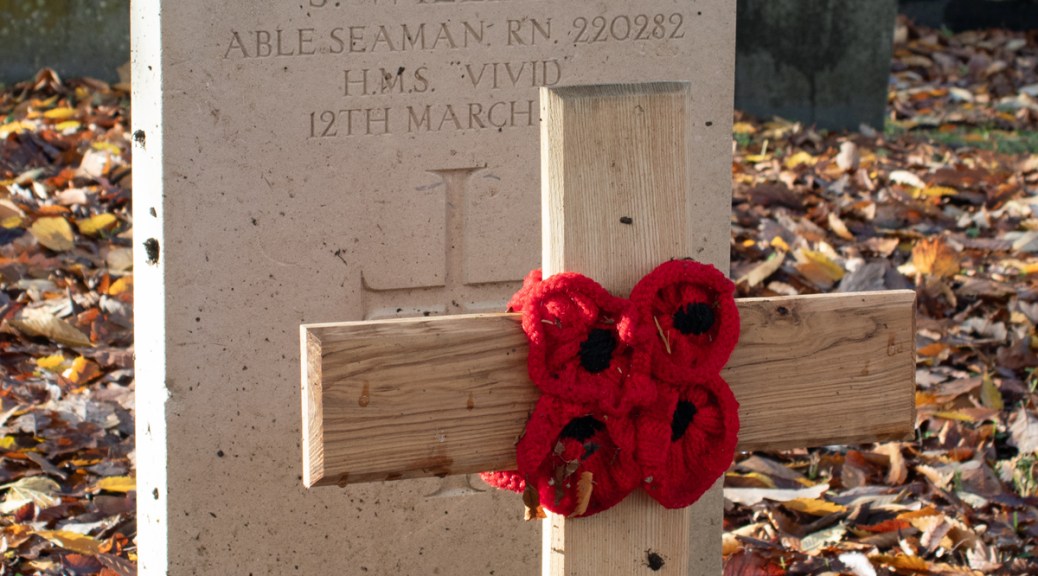
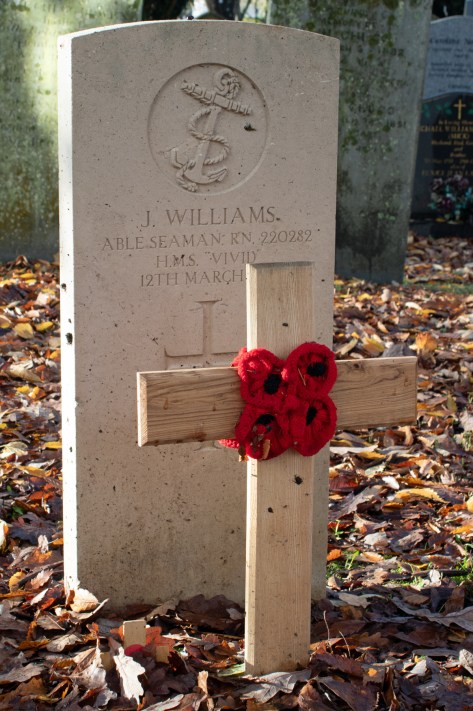
John Williams was born on 4th May 1886 in St Agnes, Cornwall. Details of his early life are a challenge to confirm, but the newspaper report goes on to name two of his brothers as Alfred and Cecil, and one of his sisters as Olive. Piecing this information together with census documents, it seems likely that his parents were William and Elizabeth (his pension record gives Mrs B Williams, which may be Bessie).
The 1891 census records the family as living in St Agnes. William is missing, although it is possible that he was away at sea when the return was taken. John does not appear on the 1901 census, but his trail can be picked up again a year later, when he enlisted in the Royal Navy.
John was working as a butcher when he chose a seafaring career path, and he was sent to HMS Impregnable, the training ship moored at Devonport, Devon, for his induction. He was below the age to formally join up, and so was given the rank of Boy 2nd Class.
Over the next two years, John learnt the tools of his trade. He was trained at three Devon bases – Impregnable, HMS Lion and HMS Vivid – and was promoted to Boy 1st Class in February 1903. On 4th May 1904 he came of age, and officially enlisted in the Royal Navy, given the rank of Ordinary Seaman. His service records note that he was just 5ft 1in (1.55m) tall, and had dark brown hair, grey eyes and a fresh complexion.
Ordinary Seaman Williams was on his first formal posting by this point, and was serving on board the gunboat HMS Harrier. By November 1904, however, he was transferred, and became part of the crew of the armoured cruiser, HMS Suffolk. She remained his home for the next eighteen months, during which he was promoted again, to Able Seaman.
Over the next decade, John would serve on a further six ships, returning to HMS Vivid in between assignments. The work, particularly after the outbreak of war, was taking a strain on his health, however, and, on 3rd May 1916, he was medically discharged from duty, suffering from tuberculosis.
By this point, John’s mother had moved to Devon and was living in the village of Braunton. Following his discharge, he returned to live with Elizabeth – Bessie – and remained there until his death some nine months later. John died on 12 March 1917, aged 29.
The body of John Williams was laid to rest in St Brannock’s Churchyard, Braunton.
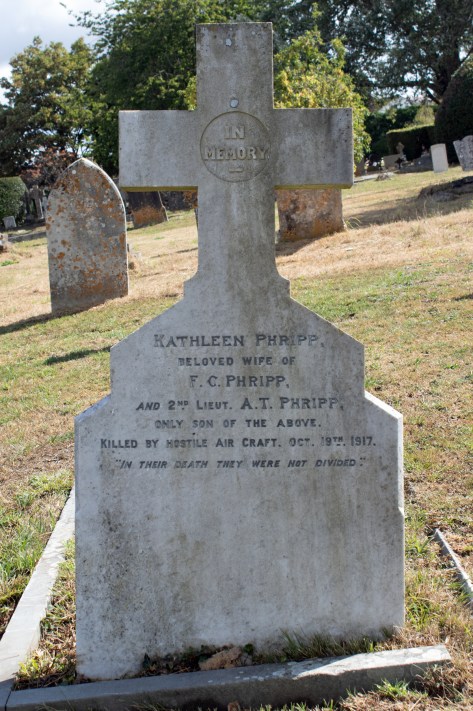
Arthur Frederic Thornton Phripp was born in Gillingham, Dorset, in the summer of 1894. The middle of three children, and the only son, his parents were Frederick and Kate Phripp. Frederick was a farmer, and the family lived in Slaughter Gate, to the west of the town centre.
The 1911 census recorded Frederick and Kate managing the farm, and raising their youngest child, daughter Lucy. Arthur, however, is missing, and it seems that he had taken started working for the Post Office as a boy clerk. Where he was living is unclear, but later documents suggest that he may have moved to London.
When war broke out, Arthur stepped up to play his part, joining the 1/21st (County of London) Battalion of the London Regiment, which was also known as the First Surrey Rifles. Private Phripp arrived in France on the 16th March 1915 and, over the next couple of years, fought at Loos, the Somme and Messines. He rose through the ranks, reaching Sergeant and, in the autumn of 1917, he was awarded a commission to Second Lieutenant.
Arthur returned to Britain to formally take the commission, and was transferred to the Duke of Wellington’s (West Riding) Regiment. Back on home soil, it was a chance to see family again, but tragedy was to strike.
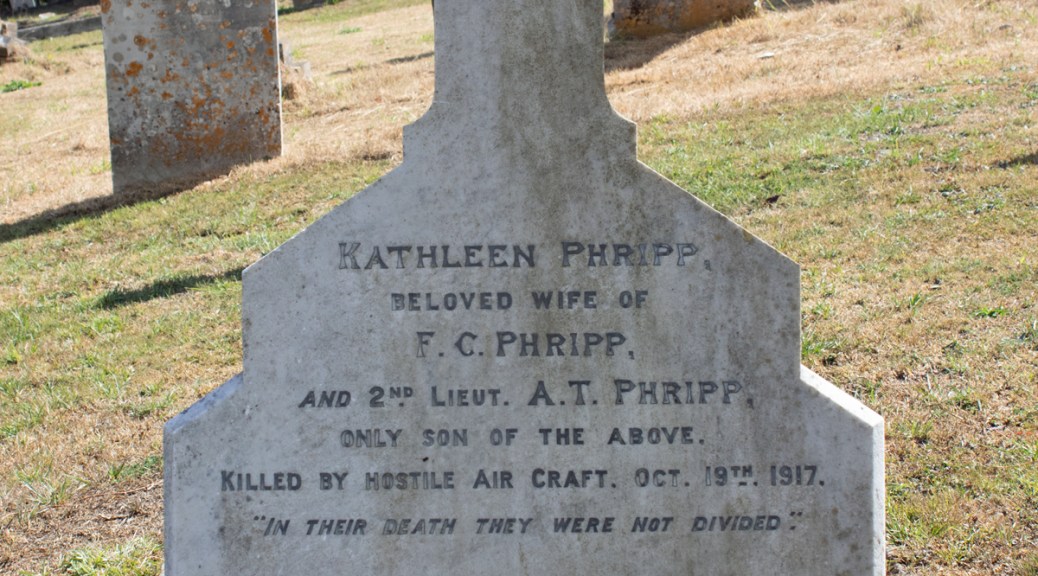
A painful sensation was created in the town when it became known that Mrs Kate Phripp, 65, of Slaughtergate Farm, and her son, Arthur TF Phripp, 23, had been killed in the Zeppelin raid on Friday.
At the inquest on seven of the victims on Monday evidence was given that Mr Phripp was stopping with some friends, and his mother went up from Gillingham on Friday to see him. Evidence given by the police showed that warning had been given in every principal thoroughfare in the district where the fatalities occurred, and the theatres had been warned. The bomb came quite unexpectedly. Besides the killed nine people were seriously injured and nine slightly injured. A great amount of glass was smashed. It was mentioned that Mrs Phripp and her son had been attending the theatre, where is was announced that the warning had been given, and that the play would continue until the guns were heard. The play was continued to the end, and the deceased left at their own risk. The Coroner observed that it was clear that some people took the optimistic view that the raid was over. If people went out into the street after a warning they did to at their own risk. A formal verdict was returned, and they commended the work of the police, special constables and ambulance workers, who, they said, had acted promptly and pluckily…
[Bridport News: Friday 26th October 1917]
The Zeppelin that raided London that night had originally been one of eleven aircraft tasked with attacking Britain’s northern industrial towns. But strong winds disrupted the operation, and one airship – L45, commanded by Kapitänleutnant Waldemar Kölle – was blown south instead.
Meanwhile, Second Lieutenant Phripp and his mother had just left His Majesty’s Theatre in the Haymarket, where they had been watching the comedy Chu Chin Chow, and were making their way across Piccadilly Circus, returning to their friend’s house.
By ill twist of fate, at that moment Kölle released a 100kg (220lb) bomb, which exploded in the road outside the Swan & Edgar department store. The resulting explosion destroyed the building’s frontage and left a crater in the road some 10ft (3m) across and 4ft (1.2m) deep. Seven people were killed: this included Kate and her son.
The bodies of Kate and Arthur Phripp were taken back to Dorset for burial. They were laid to rest together in Gillingham Cemetery, not far from where Frederick and Lucy were grieving.
[Note: My thanks go to Tony Otton for his insight into the event that led to the passing of Arthur and his mother.]