
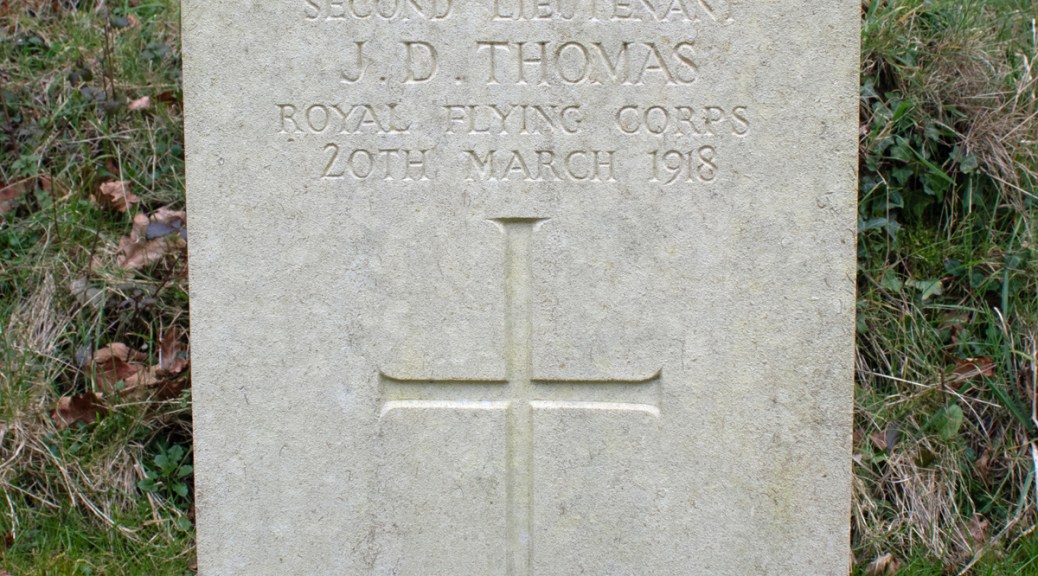

John Dobson Thomas was born in Leechburg, Pennsylvania, on 26th August 1889. He was the youngest of nine children to John and Isabella Thomas. John Sr was a steel inspector from Glamorganshire, while Isabella had been born in Newcastle-upon-Tyne: they emigrated to the United States in 1881, and John Jr was the second of their children to be born there.
When John Jr left school, he found work as a clerk, eventually getting into bonds and stocks. His father died in 1910, by which time the family had moved to Chicago, Illinois.
When war broke out, John stepped up to play his part. He enlisted on 6th January 1917, his service records showing that he was of medium height and build, with brown hair and brown eyes.
The American Army may not have met John’s needs as, just six months later, he enlisted again, this time joining the Canadian Expeditionary Force in Toronto. Along with his banking role, he was recorded as being an aviator cadet, his papers shoring that, at 23 years and 10 months old, he was 5ft 6ins (1.77m) tall.
Air Mechanic 3rd Class Thomas was shipped to Britain, and stationed near East Boldre, Hampshire. In October 1917, he took a commission in the Royal Flying Corps, with the rank of Second Lieutenant.
On 20th March 1918, John was flying his Sopwith Dolphin biplane, when he hit trouble. Practicing a dive, he appeared to have been unable to pull the aircraft up again and crashed into the ground. He was killed instantly.
The RAF Casualty Card cited a potential error of judgement on the part of Second Lieutenant Thomas: “[he] had proved himself a skilful pilot and well capable of handling his machine. He had previously practised many dives, but had, in his stunting, reduced his margin of safety to a minimum.”
John Dobson Thomas was 28 years of age when he died. Being thousands of miles from his family, he was laid to rest in the quiet setting of St Mary’s Churchyard, East Boldre, not far from the airfield at which he had been based.
 Death and Service