

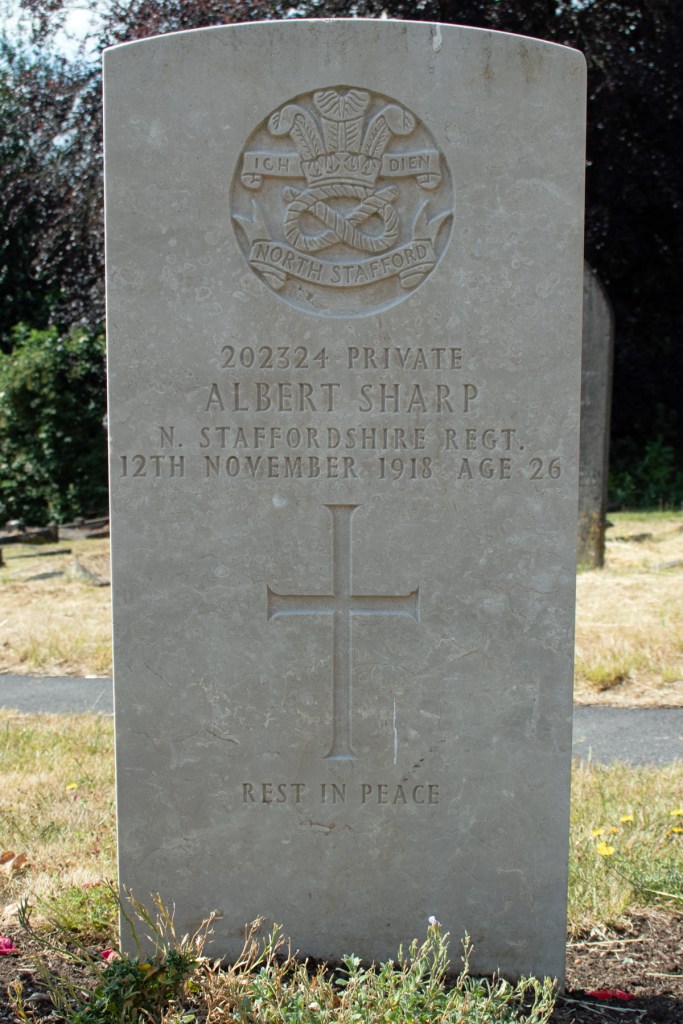
Albert Sharp was born in Rugeley, Staffordshire, in the summer of 1894. One of six children, his parents were George, who was a house painter, and Janet Sharp. When he left school, Albert found work as a bricklayer’s labourer, but, when war was declared, he sought a new adventure.
Albert enlisted in the army on 21st February 1916. Assigned to the North Staffordshire Regiment, he was initially attached to the 5th Battalion. His medical records show that Private Sharp was 5ft 6ins (1.6m) tall, and weighed 122lbs (553kg).
By November 1916, Albert found himself in France. Unusually, his life over the next couple of years is pretty well documented. His battalion saw action at the Hindenburg Line, the Third Battles of Ypres, Cambrai and the Third Battles of the Somme, but Private Sharp’s service records shed more light onto his life than simply where he fought.
Albert seems to have been a bit of a character, and this got him into trouble on more than one occasion. On 9th November 1916, he was confined to barracks for two days, for having untidy bedding and no towel on his bed. The following day, he was punished with another two days’ confinement for not attending his battalion’s role call.
On 18th December 1916, Private Sharp found himself in trouble again. This time, he was confined to barracks for five days for appearing dirty on parade, and committing a nuisance. Four days later, Albert was admitted to the camp hospital for reasons that are unclear. He returned to his unit just under a week later.
At the end of February 1917, Private Sharp transferred to the 31st Light Railway Operating Company of the Royal Engineers. He remained with the battalion for just under a year, although again his time there was not without incident. On 31st August 1917, Albert was confined to barracks for seven days for being absent from parade. The same punishment was meted out for the same offence on 8th January 1918.
Later that month, Private Sharp re-joined the North Staffordshire Regiment, and was this time attached to the 9th Battalion. He remained on the Western Front and was caught up in some of the fiercest fighting of the closing months of the conflict.
On 12th May 1918, Albert was caught up in a gas attack. Seriously injured, he was medically evacuated to Britain for treatment and admitted to the Bath War Hospital on 29th May. The next six months saw a slow and steady decline in his health. He passed away at 5:45am on 12th November 1918, the day after the Armistice was signed, from a combination of pneumonia and emphysema that was directly attributable to his injuries in France. Albert was 24 years of age.
It seems likely that Albert’s family were unable to pay for his body to be taken back to Staffordshire for burial. His service records give only his mother, Janet, as a next of kin, so it would seem that George had passed away by the time Albert enlisted. For some reason, however, while the British Register of Army Effects note that Private Sharp has effects to the value of £39 10s (£2250 in today’s money), this amount does not appear to have been paid. Janet passed away in the early 1920s, and Albert’s brother continued to try and obtain this gratuity on her behalf, but seems to have been unsuccessful.
Albert’s family did get his belongings when he died, however, which came to a postal order for 2s (around £3 today), 50 French centimes, a leather purse, two combs, two jack knives, a razor, a shaving brush, a toothbrush, two briar pipes and a pouch of tobacco, a nickel cigarette case, a text book, a wallet containing his pay book, his cap badge and six letters.
Unable to afford to bring Albert Sharp’s body back to his home town, he was, instead, laid to rest in the sweeping vista of Bath’s Locksbrook Cemetery, not far from the hospital in which he had breathed his last.

 Death and Service