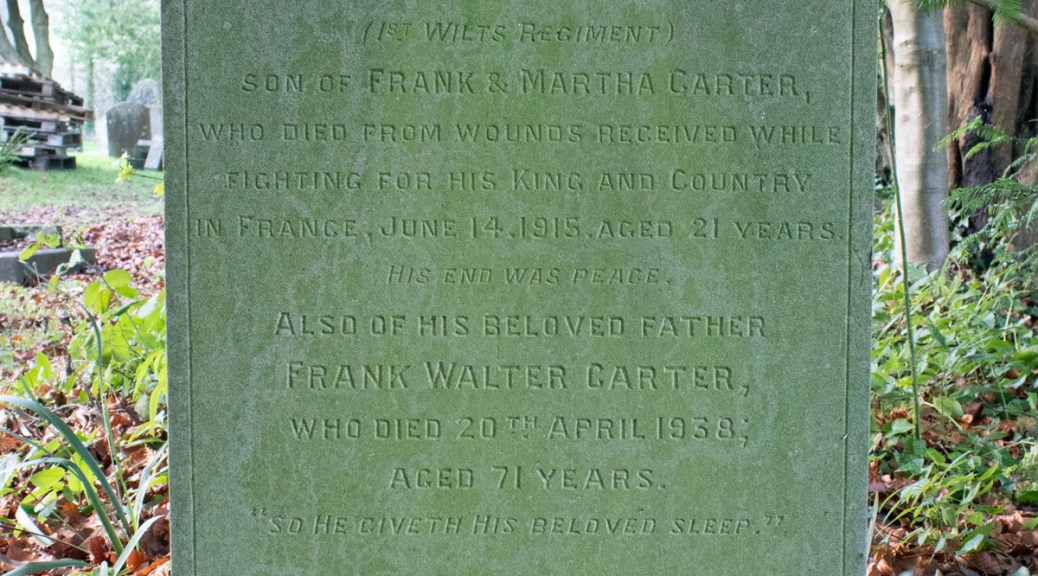
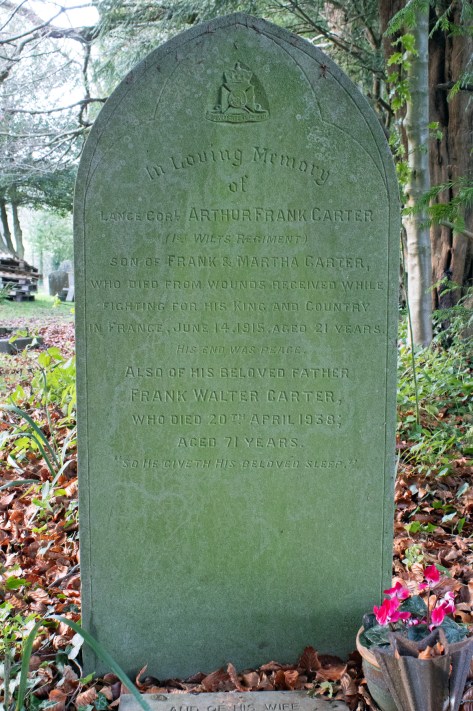
Arthur Frank Carter was born in the 10th July 1893 in Bratton, Wiltshire. The third of seven children, he was the oldest of four sons to Frank and Martha Carter. Frank was a farm labourer, and the family lived on Lower Street, to the north of the village centre.
When Arthur finished his schooling, he found work as a carter, probably unintentionally living up to his family’s name. When war broke out, however, he stepped up to play his part. Serving in the Wiltshire Regiment as a Private, he was attached to the 1st Battalion and, by the 19th January 1915, he found himself in France.
Full details of Private Carter’s service have been lost to time, but during his time overseas, he received a promotion to Lance Corporal. In June 1915 he was wounded, and was sent back to Britain for treatment. Admitted to hospital in London, Arthur’s injuries would prove to be too severe. He passed away on 12th June 1915, at the age of just 21 years old.
The body of Arthur Frank Carter was taken back to Wiltshire for burial. He was laid to rest in the family plot in St James’ Churchyard, Bratton.
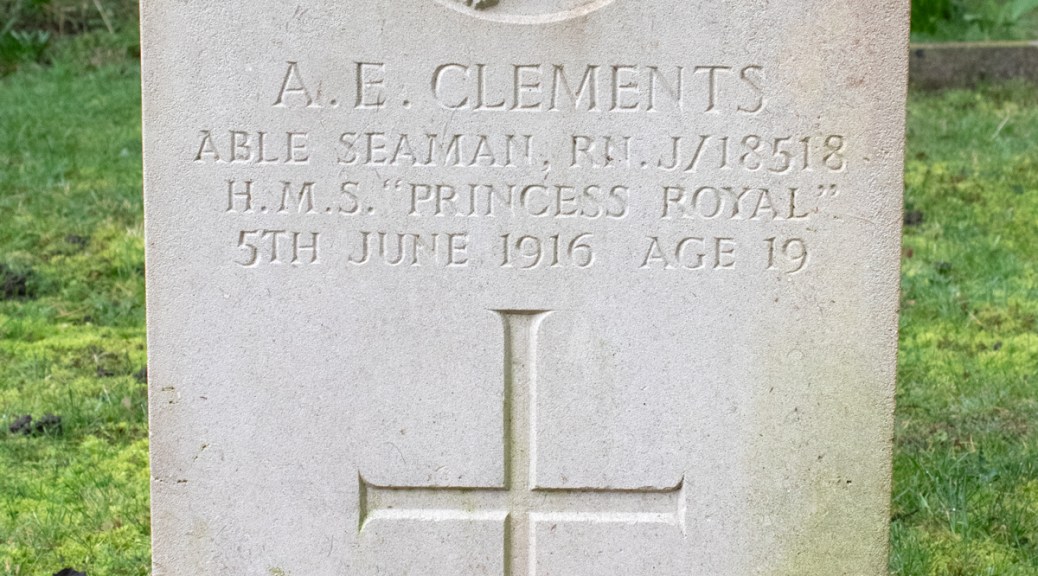
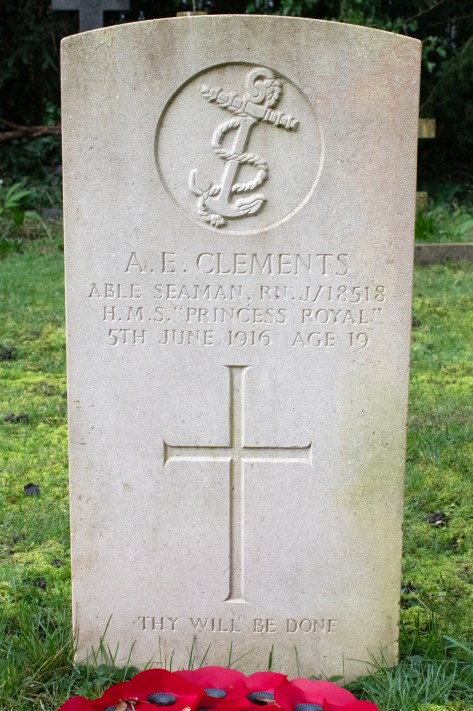
In spite of unpropitious weather, an exceedingly large number of people of all classes paid a last tribute to Able-Seaman Albert Edward Clements, at Eton, on Saturday last. The deceased, whose home was at 3, Tangier-lane, Eton, was on HMS Princess Royal, which took part in the naval fight in the North Sea, and he as severely injured by burns. He was taken on board HM Hospital Ship Plassy, but died on 31st May, and his remains were brought home on Thursday evening last week from Scotland. Clements as a boy showed an affection for the sea, and when old enough joined the merchant service and made several voyages. Five years ago from the day he was laid to rest he joined the Navy, and was at first on HMS Warspite and afterwards on the ship on which he received his mortal wounds. He was a loyal and devoted son, and after the death of his father three years ago was of great assistance to his mother. His father was for 29 years in the Royal service at Frogmore and consequently served under three Sovereigns – Queen Victoria, King Edward and King George. His elder brother, Charles George, was in the Oxford and Bucks LI, and was killed at Loos a year ago. The Admiralty, through pressure, was not able to send a representative, but his mother had received from that department a letter expressing its sympathy and appreciation of his services. A letter of sympathy has also been received from the King.
[Windsor and Eton Express: Saturday 17th June 1916]
The early life of Albert Edward Clements is a challenge to piece together. Born in 30th October 1896 in Marylebone, details of his parents are unclear and, by the time of the 1901 census, he seems to have been adopted by his paternal grandparents, George and Louisa. By this point the family were living at 4 Sunbury Road, Eton, the household being made up of Albert, his grandparents, and his four uncles and aunts.
At 45 years of age, George was a gardener’s labourer, but, as the newspaper report suggests, Albert had a hankering for the sea. He served on merchant vessels, but enlisted in the Royal Navy on 12th June 1912. Sent to HMS Ganges – the training base near Ipswich, Suffolk – he was given the Rank of Boy 2nd Class, as he was too young to formally join up.
By January 1913, Albert was assigned to the dreadnought battleship HMS St Vincent. Within four months he had moved to the heavy cruiser-turned-aircraft carrier HMS Vindictive. By the end of the year, however, Boy Clements received his main move, to HMS Princess Royal.
Albert was formally inducted in the Royal Navy on 28th May 1914, and was given the rank of Ordinary Seaman. His service records notes that he was 5ft 5ins (1.65m) tall, with dark brown hair, blue eyes and a fresh complexion. He was also recorded as having a birth mark on the back of his left arm.
Princess Royal would remain Albert’s home for more than three years and, on 1st April 1915, he received a promotion to Able Seaman. His ship would be involved in some of the Royal Navy’s fiercest skirmishes, including Heligoland Bight and Dogger Bank, but it was during the Battle of Jutland, on the night of the 31st May 1916, that Albert was injured and died of his wounds. He was just 19 years of age.
The hospital ship Plessy brought the body of Albert Edward Clements back to shore, and he was taken home to Berkshire for burial. He was laid to rest in the cemetery of St John’s Church in Eton.
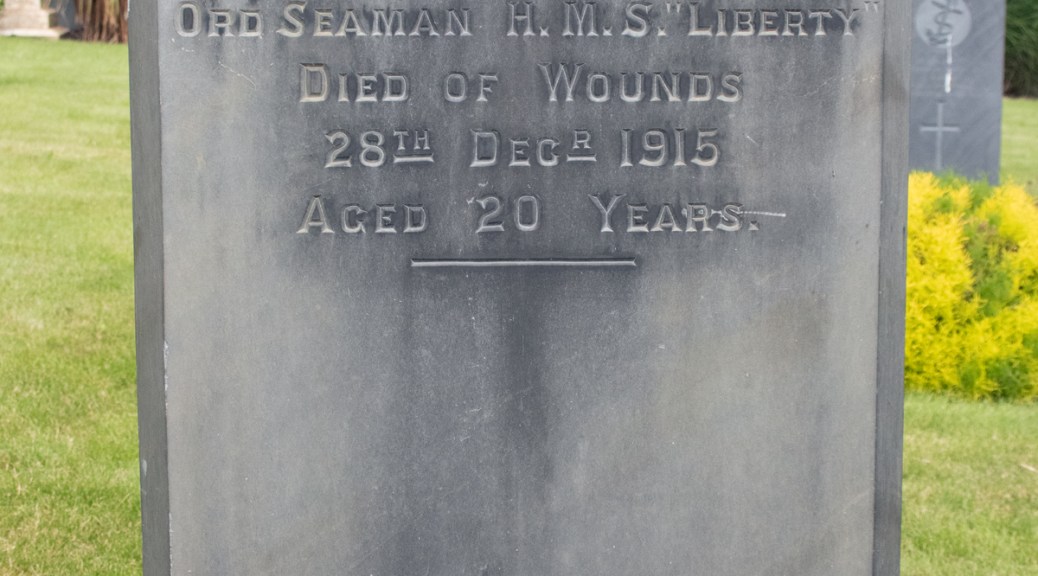
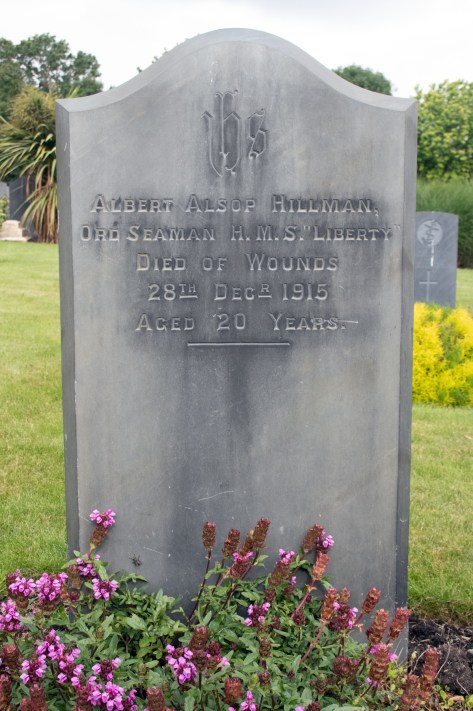
Albert Alsop Hillman was born in Islington, Middlesex, on 22nd September 1895. He was the second of five children to Alfred and Harriet Hillman. Alfred was a builder’s labourer from Hoxton, and, at the time of the 1901 census, the family had rooms at 36 Affleck Street, not far from King’s Cross Station.
The next ten years showed a downturn in the family’s fortunes. They had moved to rooms at 19 Chapel Street, but Alfred was no longer bringing in a wage, and was recorded as being an invalid. In fact, unusually, none of the household of seven – including Albert and his older brother, Alfred Jr, both of whom were of age to have left school – were recorded in any trade, and it is not clear what, if any, money was coming in.
This changed in 1913, when Albert joined the Royal Navy. He had been earning money as a van guard, but a life at sea offered a career and a regular wage. Sent to HMS Vivid, the Royal Naval Dockyard in Devonport, Devon, he spent the next five months learning the skills he would need as a seaman. Being below the age to formally enlist, however, he was given the rank of Boy 2nd Class.
On 15th November 1913, Boy Hillman was given his first assignment, on board the battleship HMS Venerable. She would remain his home for the next few months, during which time he was promoted to Boy 1st Class.
Albert was formally enlisted in the Royal Navy on 18th February 1914, and was given the rank of Ordinary Seaman. His service papers show that he was 5ft 7ins (1.7m) tall, with brown hair, hazel eyes and a fresh complexion. His papers also note that he had a scar on his right cheek, and a number of tattoos on his left forearm.
After a short spell at Chatham Dockyard in Kent – also known as HMS Pembroke – Albert was given his second assignment, aboard the destroyer HMS Liberty. In August 1914, she was involved in the Battle of Heligoland Bight and, in a skirmish with the German 5th Flotilla. She was hit by the enemy cruiser Mainz, which landed a direct hit on the bridge, killing the ship’s commander, Nigel Barttelot, and a number of other crew. Albert was wounded, and the ship made its slow way back to port.
When Liberty reached Pembroke once more, Albert was admitted to the Royal Naval Hospital in Chatham, and would remain there for the next more than a year.
The death has taken place in the RN Hospital, Chatham, of Able Seaman Albert Hillman, who sustained terrible injuries whilst serving in HM destroyer Liberty in the sea fight in the Bight of Heligoland on August 28th, 1914. For sixteen months the young fellow – he was only 19 years of age – suffered, but he bore his pain unflinchingly and without a murmur, winning the admiration of the medical and nursing staff. It will be remembered that Lieut.-Com. Nigel Barttelot and six members of the crew of the Liberty were killed in the action, one died from wounds, and eleven others were wounded.
[Sheerness Guardian and East Kent Advertiser: Saturday 15th January 1916]
The newspaper report includes a couple of errors – Albert held the rank of Ordinary Seaman, and was 20 years of age when he died – and has a stoic and heroic sense of how the injured man bore his wounds with grace and calm.
The body of Albert Alsop Hillman was laid to rest in the naval section of Woodlands Cemetery, Gillingham, not far from the Kent hospital in which he had been tended for so long.
Thomas Bidder was born on 10th April 1893 on Lower Winsham Farm, Braunton, Devon. One of twelve children, his parents were farmers John and Eliza Bidder.
Thomas sought a life away from the farm and he enlisted in the army, joining the prestigious Coldstream Guards. The 1911 census recorded Private Bidder as being in barracks in a camp in Chertsey, Surrey.
When war broke out, Thomas was mobilised, and soon found himself on the Western Front. It is unclear exactly when or how he served, but a later report suggests that he was wounded in February 1915, and medically evacuated to Britain for treatment.
After being treated in different hospitals, he was sent home to convalesce, but here (no doubt as the indirect result of the wounds) tuberculosis developed, and death was due to this cause.
[Western Times: Thursday 19th August 1915]
Thomas Bidder died on 16th August 1915, at the age of 23 years old. The newspaper report noted that he “was a man who was greatly admired for his soldierly and other qualities, and at Braunton he will long be held in the fondest remembrance.”[Western Times: Thursday 19th August 1915]
Thomas was laid to rest in St Brannock’s Church in his home town of Braunton.
Thomas was not the first of the Bidder siblings to die during the war. His younger brother, Walter, served in the 2nd Battalion of the Devonshire Regiment. Private Bidder was killed on 18th December 1914, aged just 19 years old. He is commemorated on the Le Touquet Memorial in France, and on the family headstone in Braunton.
Alexander McDougall Westgarth was born in Newcastle-upon-Tyne on the 28th June 1885. The middle of five children, and the only son, his parents were James and Janet Westgarth. James was a mariner, and the family moved to the village of Carlton Colville, on the outskirts of Lowestoft, Suffolk, in the late 1880s.
Alexander found work as a fitter’s apprentice when he finished school, but the sea was in his blood. Janet died in 1903, and by the time of the next census, taken in 1911, her son had enlisted in the Royal Navy and was a Stoker 1st Class. The document found him as part of the crew of the battleship HMS Russell, moored in a harbour on Malta.
On 31st October 1915, Alexander married Mabel Liffen. The daughter of a gas stoker, she also lived in Carlton Colville. She had a daughter, Irene, but there is no evidence that she was Alexander’s, nor that Mabel had a previous marriage.
At this point, Alexander’s trail goes cold. By the summer of 1917, he was based at HMS Pembroke, the Royal Naval Dockyard in Chatham, Kent. It was a particularly overcrowded base by this point in the conflict, with the planned replacement crew for the sunk HMS Vanguard waiting for new assignments, and an outbreak of meningitis meaning space was at an absolute premium. In the midst of this, Stoker 1st Class Westgarth was billeted in temporary accommodation in the dockyard’s Drill Hall.
On the night of the 3rd September 1917, Chatham was hit by an unexpected German air raid. Two bombs landed squarely on the Drill, shattering its glass roof, and killing dozens of men. Stoker Westgarth was badly injured, and was rushed to the Royal Naval Hospital in the town. His injuries would prove fatal and he passed away the day after the attack: he was 32 years of age.
The body of Alexander McDougall Westgarth was taken back to Suffolk for burial: he was laid to rest in Kirkley Cemetery, Lowestoft.
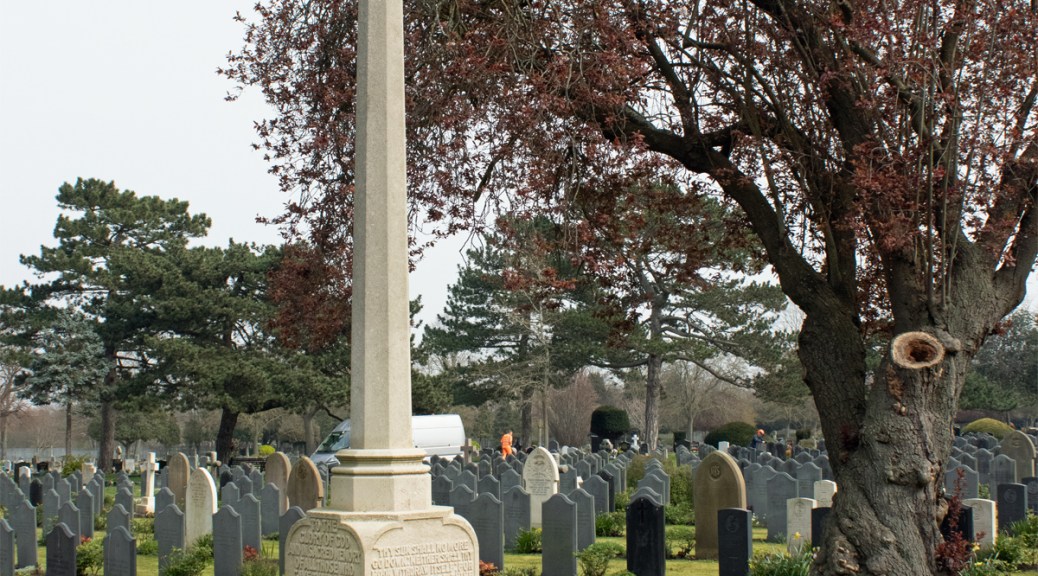
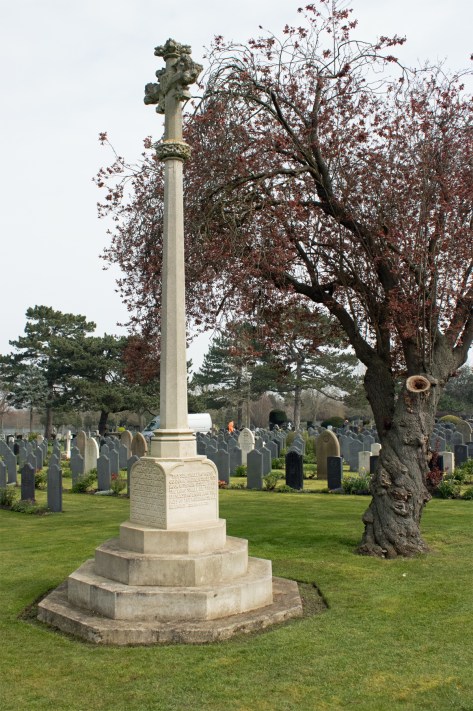
[Note: the photo above is of the memorial to the Chatham Air Raid victims, close to the mass grave for those whose bodies were not identified, in Woodlands Cemetery, Gillingham, Kent.]
William Edward Sullivan was born in Newport, Monmouthshire, on the 9th November 1898. He was one of seven children to John and Mary Sullivan. John was an iron dresser at a local foundry, but also worked as a grocer. The 1901 census found the family living at 15 Church Street, to the south of the town centre, but by 1911 they had moved to a larger property, 2 Scard Street.
When William finished his schooling, he took up work as a clerk. War broke out in the summer of 1914, and he would be called upon to play his part. On the 18th September 1916, he enlisted in the Royal Navy, taking the rank of Ordinary Seaman. His service papers show that he was 5ft 6.5ins (1.69m) tall, and that he had light brown hair, brown eyes and a fair complexion.
Ordinary Seaman Sullivan was sent to HMS Victory, the Royal Naval Dockyard in Portsmouth, Hampshire, for his training. By the end of May 1917, however, he had been transferred to HMS Pembroke, which was also known as Chatham Dockyard.
The base was a busy and overcrowded place by this point in the war, with a number of factors leading to temporary accommodation being set up in the dockyard’s Drill Hall. This is where William, who appears to have been waiting for his first formal posting, was billeted.
On the 3rd September 1917, the German air force carried out a daring night time raid on the North Kent coast. Chatham was in the firing line, and two bombs scored direct hits on the Drill Hall. Its glass roof shattered, raining shards down on the sleeping men. Dozens were killed in the explosions, and tens more, including Ordinary Seaman Sullivan, were wounded.
William was taken to the Royal Naval Hospital in Chatham for treatment, but his wounds would prove to be too severe. He passed away on the 4th September 1917, aged just 18 years old.
The body of William Edward Sullivan was taken back to Wales for burial. He was laid to rest in St Woolos’ Cemetery, a short walk from where his family still lived.
[Note: the photo above is of the memorial to the Chatham Air Raid victims, close to the mass grave for those whose bodies were not identified, in Woodlands Cemetery, Gillingham, Kent.]
James Richards was born in Liverpool, Lancashire, on 4th September 1891. The second of nine children, his parents were John and Christina Richards. John was a carter for the local railway and, according to the 1901 census, the family had rooms at 41 Paget Street, to the north of the city centre.
James sought a more permanent career for himself, and enlisted in the Royal Navy. Sadly, his service record has been lost, but the 1911 census return found him listed as one of the 786 crew of the battleship HMS Inflexible. Captained by Charles Napier, at the time of the census, she was moored off Howth Head, near Dublin, Ireland.
By the summer of 1917, Stoker 1st Class Richards found himself at HMS Pembroke, the Royal Naval Dockyard in Chatham, Kent. The base was busy and overcrowded at that point in the war: the battleship HMS Vanguard had been sunk, and its replacement crew were barracked in Chatham, waiting for new assignments. Add to this an outbreak of spotted fever, and temporary accommodation was set up to help space out the billets and slow its transmission. It was in this accommodation – set up in Pembroke’s Drill Hall, that James found himself sleeping.
On the night of the 3rd September 1917, the German air force carried out a daring raid on the North Kent coast. Chatham came under fire, and two bomb scored direct hits on the Drill Hall. Dozens of sleeping men were killed, while countless others, including Stoker 1st Class Richards, were injured.
James was taken to the Royal Naval Hospital in the town, but his wounds would prove too severe. He passed away on 4th September 1917, his 26th birthday.
The body of James Richards was taken back to Liverpool for burial. Strict Roman Catholics, John and Christina laid their son’s body to rest in the city’s Ford Cemetery.
[Note: the photo above is of the memorial to the Chatham Air Raid victims, close to the mass grave for those whose bodies were not identified, in Woodlands Cemetery, Gillingham, Kent.]
George William Rae was born on 7th February 1883 in South Shields, Country Durham. The youngest of five children, he was one of four sons to Henry and Elizabeth Rae. Henry was a boatman, and it seemed inevitable that George would follow in his father’s footsteps.
There are big gaps in George’s timeline: the 1891 census found him living with his aunt and uncle. The next record for him confirms his marriage to Mary Elizabeth Smith in January 1904. There is little information about her, but the couple had five children, three of whom died before they reached their first birthday.
Tragedy followed tragedy: George’s father died in 1908, and his mother passed the following year. Mary died shortly after the birth of her and George’s last child, also named George, in 1911. The census taken that year recorded George Sr as a fireman aboard the coal hulk Haytian, which was moored in Portland Harbour, Dorset. He was one of the vessel’s sixteen crew members.
Now a widower, George had two children to support. In the summer of 1913, he married a second time, to Elizabeth Flood. Again, there is little information available about her, but the couple went on to have a child, daughter Emily, who was born in the summer of 1914.
Conflict was closing in on Europe by this point, and on 24th March 1916, George formally joined the Royal Naval Reserve. His service record shows that he was 5ft 4ins (1.63m) tall, with blue eyes and a fair complexion. He was also noted as having a tattoo of a woman and two flags across his chest.
Engineman Rae was assigned to the gunboat-turned-minesweeper HMS Halcyon. She remained his home for the next eighteen months, patrolling off the coast of East Anglia. By the summer of 1917, George became shore-based, initially at HMS Actaeon in Portsmouth, Hampshire, then at HMS Pembroke, the Royal Naval Dockyard in Chatham, Kent.
Pembroke was a busy and overcrowded place at this point in the war. The battleship HMS Vanguard had sunk, and its replacement crew – who were stationed in Chatham – were left in limbo while new postings were found for them. The base also suffered an outbreak of meningitis, and temporary accommodation was set up to space out the servicemen and, hopefully, slow the spread of the disease. Engineman Rae found himself in one of these speedily-created barracks in the dockyard’s Drill Hall.
On the night of the 3rd September 1917, four German aircraft carried out a daring raid on the North Kent coast. Chatham came under fire, and two explosives landed a direct hit on the Drill Hall. Dozens of men were killed while they were sleeping, and many more – including Engineman Rae – were injured.
George was taken to the Royal Naval Hospital in Chatham for treatment, but his wounds would ultimately prove fatal. He succumbed to them on 11th September 1917, at the age of 34 years old.
The body of George William Rae was taken back to County Durham for burial. He was laid to rest in South Shields’ Harton Cemetery.
Tragedy would continue to haunt the Rae family. Elizabeth died a year after her husband, leaving three children – two from George’s first marriage, and one from his second – orphans. Sadly, there is little additional informational about what happened to them – none appear in the 1921 census.
[Note: the photo above is of the memorial to the Chatham Air Raid victims, close to the mass grave for those whose bodies were not identified, in Woodlands Cemetery, Gillingham, Kent.]
Bertie Pegram was born in the Hertfordshire village of Westmill, on 24th July 1893. The third of four children – all of them boys – his parents were John and Eliza Pegram. John was a farm labourer, and his oldest two sons followed him into that line of work.
Bertie chose a different path, however, and the 1911 census showed that he had taken employment at a local cement works. This was not a career, however, and so, on 11th August 1911, Bertie enlisted in the Royal Navy as a Stoker 2nd Class. His papers show that he was 5ft 5ins (1.65m) tall, with dark brown hair, grey eyes and a dark complexion. He was also noted as having a scar on his left leg.
Stoker Pegram was sent to HMS Pembroke, the Royal Naval Dockyard in Chatham, Kent, for his training. At the start of 1912, he was given his first posting, on board the battle cruiser HMS Indomitable. This would be a long-term move and she remained his home for more than five years.
In September 1912, Bertie was promoted to Stoker 1st Class; this was followed with another promotion – to Acting Leading Stoker – in July 1915. The rise in rank seemed not to suit him, however, and he reverted to Stoker 1st Class just six months later.
Indomitable was in the Eastern Mediterranean when war broke out, and was one of the ships that bombarded the Ottoman defences in the Dardanelles. During Bertie’s time on board, she also fought at the Battles of Dogger Bank and Jutland.
In September 1916, Bertie rose to Acting Leading Stoker once more. The promotion was made permanent on 29th March 1917, and he remained with Indomitable for the next couple of months.
On 1st July 1917, Leading Stoker Pegram returned to shore, and HMS Pembroke. At this point in the war, she was a bustling and overcrowded place. The sinking of HMS Vanguard left her replacement crew in limbo, stuck in the Kent dockyard while new assignments were found. There had also been an outbreak of meningitis, and the decision was taken to set up temporary accommodation to slow the spread of the disease. Bertie found himself billeted in the dockyard’s Drill Hall.
British defences were rendering day time German air raids less and less effective, and the decision was taken to trial a bombing raid after dark. On the night of the 3rd September the first of these attacks took place, and Chatham found itself in the firing line. The Drill Hall received two direct hits, and dozens of men inside were killed. Leading Stoker Pegram was badly wounded, and rushed to the Naval Hospital in the town. Sadly, Bertie’s injuries would prove too severe and he died the day after the raid: he was 24 years of age.
The body of Bertie Pegram was taken back to Hertfordshire for burial. He was laid to rest in the graveyard of St Mary’s Church, Westmill, just a short walk from the family home.
[Note: the photo above is of the memorial to the Chatham Air Raid victims, close to the mass grave for those whose bodies were not identified, in Woodlands Cemetery, Gillingham, Kent.]
Percy Walter Nicholls was born in West Ham, Essex, on 10th July 1898. One of seven children, he was the fourth son to Ernest and Selina Nicholls. Ernest was a carman for the local iron works, and the family lived close to the factory, in rooms at 28 Rocher Road.
The 1911 census recorded that the growing family had moved to 185 North Woolwich Road. Three of the family were employed by the iron works: Ernest and his oldest son Ernest Jr as carmen, while second son George was an iron worker. Percy, just twelve years of age, was still at school, and the document noted that his older brother, Charles, was unable to work as he had been epileptic since birth.
Percy chose a different route for himself when he left school, taking up work as a farm hand. He was after bigger and better things, however, and, on 17th June 1914 he joined the Royal Navy. Too young to formally enlist at that point, he was given the rank of Boy 2nd Class, and sent to HMS Ganges, the training base near Ipswich, Suffolk, for his induction.
It appears that Percy impressed his superiors: he was promoted to Boy 1st Class in January 1915, and was given a posting on board HMS Centurion, a dreadnought battleship, on the 20th March. She would remain his home for the next two years, during which time he came of age.
Now able to formally enlist, Percy was given the rank of Ordinary Seaman, his papers showing the young man he had become. He was noted as being just under 5ft 3ins (1.59m) tall, and had dark brown hair, dark brown eyes and a fresh complexion. He was also recorded as having a scar on his right eyebrow.
Centurion patrolled the waters around Scotland, and took part in the Battle of Jutland at the end of May 1916. Percy was proving to be a steady worker and, on 22nd February 1917, he was promoted to Able Seaman. His time on board the battleship was coming to a close, however, and, on 1st September 1917, he disembarked at HMS Pembroke, the Royal Naval Dockyard in Chatham, Kent.
The base was a busy and overcrowded place at that point in the war. The sinking of the Vanguard left its replacement crew shore-bound while they awaited their next assignments, and an outbreak of meningitis meant that temporary accommodation was needed to space out the men, and, with luck, slow the spread of infection. Able Seaman Nicholls found himself billeted in the dockyard’s Drill Hall.
On the night of the 3rd September 1917, the German air force carried out a daring raid on the North Kent Coast. Dozens of bombs were dropped on Chatham, two of which landed unplanned direct hits on the Drill Hall. The glass roof shattered showering the sleeping men below with deadly shards. Able Seaman Nicholls was badly injured, and taken to the Royal Naval Hospital in the town.
Percy’s wounds would ultimately prove fatal. He died from his injuries on 8th September 1917: he was just 19 years of age.
The body of Percy Walter Nicholls was taken back to Essex for burial. He was laid to rest in the East London Cemetery, Plaistow, a couple of miles from where his family were now living, on Ellesmere Road, West Silvertown.
[Note: the photo above is of the memorial to the Chatham Air Raid victims, close to the mass grave for those whose bodies were not identified, in Woodlands Cemetery, Gillingham, Kent.]