
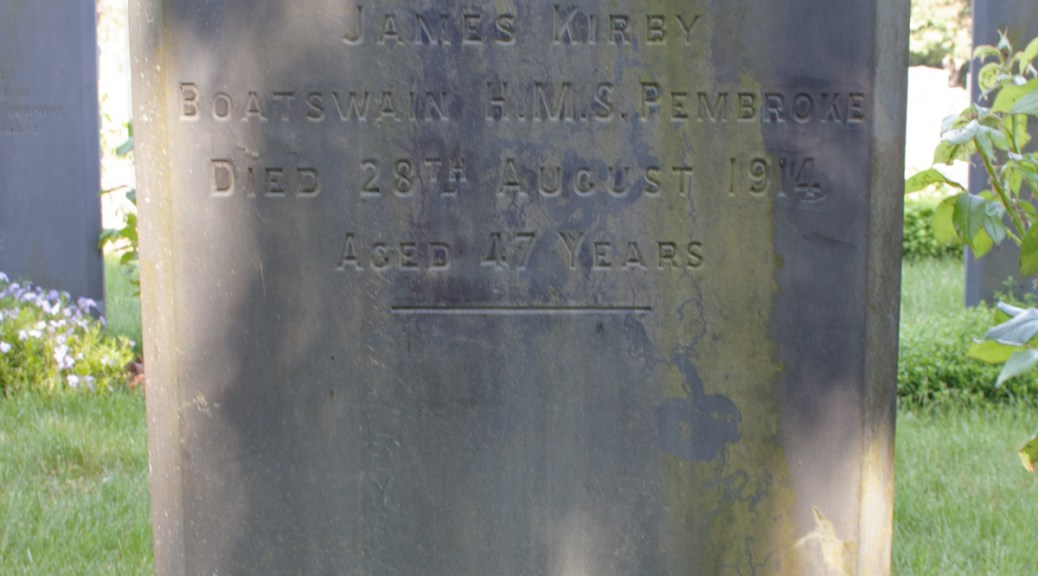
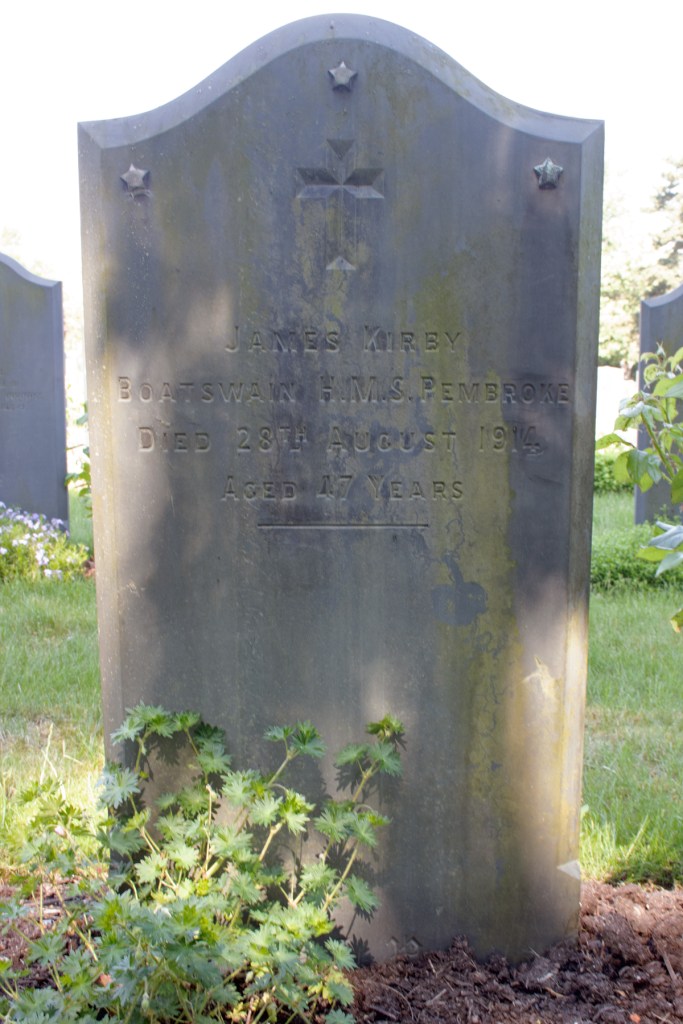
James Kirby’s life is one of intrigue and speculation. Born in Laytown, Ireland on 30th August 1867, the earliest documents relating to him are his Royal Naval Service Records.
He enlisted on 1st March 1883, while just fifteen years old, and was assigned the rank of Boy 2nd Class. Over the next couple of years, he served on two ships – HMS Lion and HMS Briton – and was promoted to Boy 1st Class.
On 30th August 1885, James came of age, and was formally enrolled in the Royal Navy. He enlisted for ten years’ service, and his records show that he stood 5ft 3ins (1.60m) tall, had brown hair, blue eyes and a fresh complexion. He was also noted as having a tattoo of an anchor on the back of his left hand.
Over the next ten years, Ordinary Seaman Kirby served on nine different vessels, and was obviously committed to his work. He rose through the ranks, making Able Seaman in January 1886, Leading Seaman (1889), Petty Officer (also 1889) and Chief Petty Officer (1895).
When his initial contract ended, he voluntarily continued with the Royal Navy, although his service record ends on 14th June 1896, at the point that he was promoted to Acting Boatswain.
A second service record picks up James’ details from 5th December 1902. Still serving as a Boatswain, he was assigned to the cruiser HMS Lancaster. His health, by this point, was beginning to suffer, and, it seems, his life was beginning to unravel.
In August 1904, he was injured in an accident involving a “hook rope” and “slightly amoral judgement”. Over the next couple of years his behaviour became increasingly erratic.
In December 1910, he was admitted to Shotley Hospital near Durham, suffering from acute mania and gonorrhoea, and was not be be fit for duty for a few weeks.
Just before Christmas that year, Boatswain Kirby was again admitted to hospital, this time in Chatham, Kent, remaining there for a number of months. He was deemed unfit for further service in March 1911, and was medically discharged with neurasthenia.
However, when war broke three years later, James volunteered his services once more, and was again employed by the Royal Navy. Tragically, this was a decision that would prove to be fatal.
The extraordinary death of a naval boatswain names James Kirby, aged 47, was the subject of an inquest at the Royal Naval Hospital, Chatham… Deceased, whose home was at Dublin, had retired, but had volunteered for service and was anxious to go to sea. On Friday evening [28th August 1914] he was watching a game of billiards in the warrant officers’ mess at the Royal Naval Barracks, Chatham, and appeared perfectly rational and sober. Suddenly he was observed to disappear through an open window beneath which he had been sitting. He went down, as one witness stated “with a smile on his face,” and called out “Good-bye.” A crash of glass below indicated that he struck the dining room window as he fell.
Kent Messenger & Gravesend Telegraph: Saturday 5th September 1914
The article gave further information about the injury James sustained previously: “It transpired that deceased fell out of a window at the Hospital eight years ago through walking in his sleep. He was then suffering from neurasthenia and had delusions.“
The inquest concluded that Boatswain James Kirby had committed suicide during temporary insanity. He was laid to rest in the Woodlands Cemetery, Gillingham, not far from the dockyard at which he was based.
James Kirby’s grave is maintained by the Commonwealth War Graves Commission on behalf of the Royal Navy Admiralty. However, as the naval authorities did not confirm Boatswain Kirby was a war casualty – possibly because of the nature of his death – he was never formally commemorated with a Commonwealth War Grave. However, I have included his story as it remains as pertinent as those of his contemporaries.
 Death and Service