

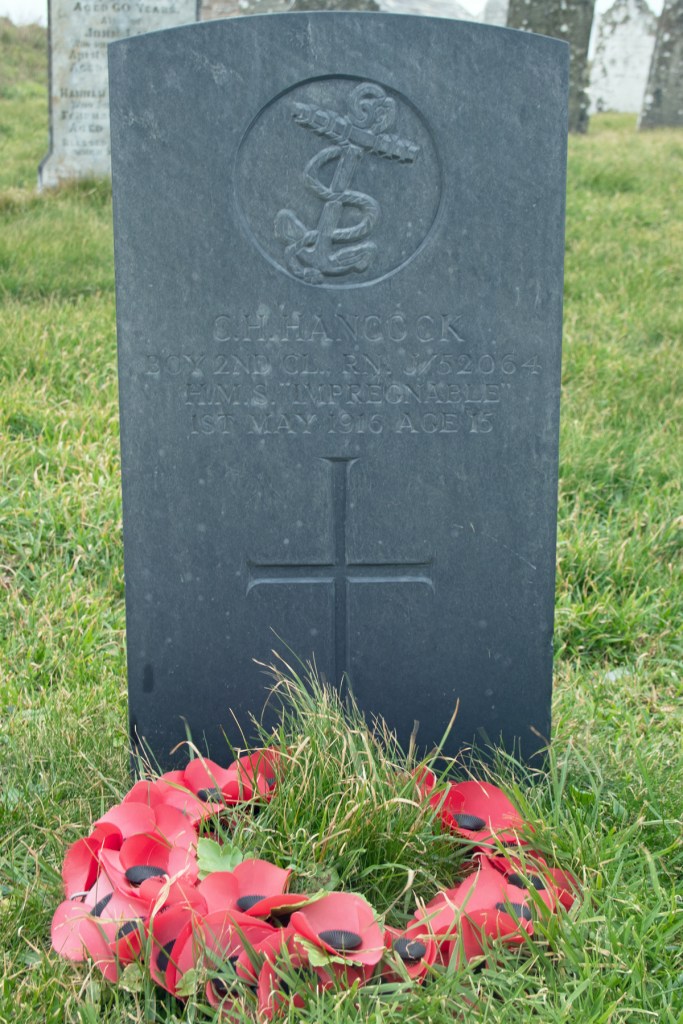
Charles Henry Hancock’s story underlines the innocence and exuberance of youth, and a life cut tragically short.
He was born on 9th July 1900 in Newton Abbot, Devon, the oldest of four children to Edward and Annie Hancock. Edward – who was also known by his middle name of Charles – was a jobbing gardener. By the time of the 1901 census, he had found employment as a groom and gardener with artist and sculptor Frederick Sturge in Tintagel, Cornwall. Annie was also employed by the family as a cook.
Edward passed away in June 1912, aged just 38 years old. Charles stepped up to help his mother, finding work as a farm labourer when he left school. War came to Europe, and while he was only 14 at the start of the conflict, he was drawn to play his part.
On 1st April 1916 Charles enlisted in the Royal Navy, either as a way to a permanent career to help bring in much needed money for his family, or because he was seeing his older peers going of to fight or King and Country. He was still underage, however, and was given the rank of Boy 2nd Class. Charles’ service records show that he was 5ft 2in (1.57m) tall, had fair hair, grey eyes and a fresh complexion.
Boy Hancock was sent to HMS Impregnable, the training ship based in Devonport, for his initial service. Tragically, this service was not to be a long one. Billeted in crowded barracks, he contracted measles and bronchial pneumonia, dying on 1st May 1916, while admitted to the Royal Naval Hospital in Plymouth, Devon. He was just 15 years of age, and had been in service for exactly one month.
Charles Henry Hancock was brought back to Cornwall for burial. He was laid to rest next to his father in the peaceful graveyard of St Materiana’s Church in Tintagel.
 Death and Service