
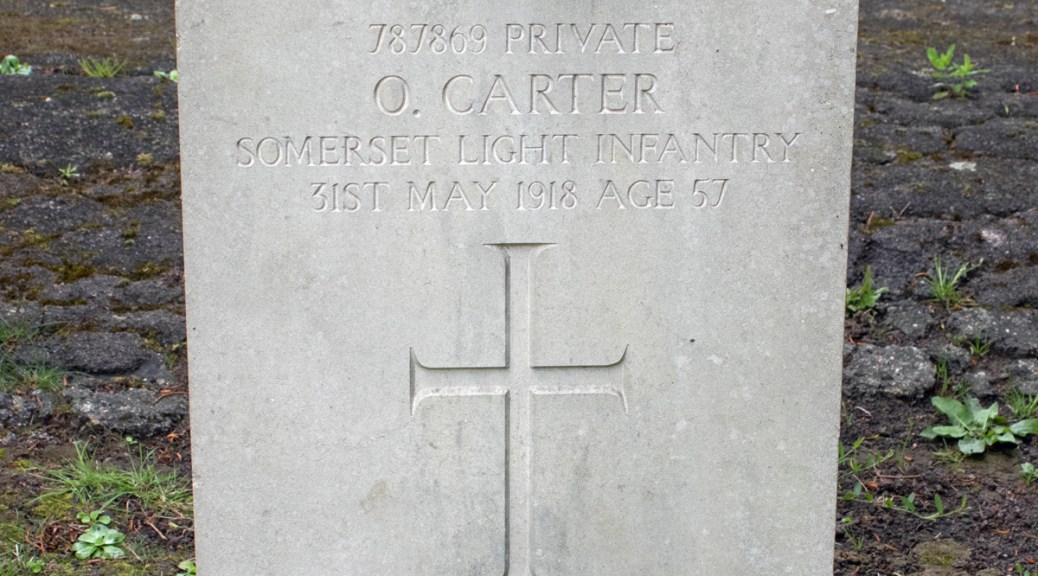

Oliver Carter was born in the spring of 1861 in East Budleigh, Devon. The youngest of four children, his parents were Ellis, who was a farm labourer, and Jane Carter.
As the years passed, Oliver’s older siblings left home and, by the 1881 census, he was the last of Ellis and Jane’s children to remain living with them. He was employed as a baker by this point, although he seemed to want more permanent employment.
On 9th February 1883, Oliver enlisted in the army. His service records show that he was 5ft 6.5ins (1.69m) tall and weighed 120lbs (54.4kg). He had a sallow complexion, with brown hair and grey eyes. The document confirmed no distinguishing marks (in the event that his body needed to be identified) and that his religious denomination was Church of England.
Private Carter was assigned the Commissariat and Transport Corps – a forerunner to the Royal Army Service Corps – for a period of twelve years. After eighteen months on home soil his unit was sent to South Africa, where he remained until December 1885. On returning to Britain, he spent the next nine years on reserve status, and was formally stood down from army service un February 1895.
The 1891 census return found Oliver back in Devon, where he working as a general labourer alongside his army commitments. Ellis, meanwhile, was employed as a miller’s waggoner, while Jane had also started taking in lacemaking jobs.
In the autumn of 1893, Oliver married Elizabeth Morrish. Eight years his senior, she was a widow with eight children of her own. The 1901 census recorded the couple living in a cottage near the King’s Arms Hotel in East Budleigh. They shared their home with three of Elizabeth’s children and their own daughter, Hilda. Oliver had changed jobs again, and was employed as a cowman on a farm.
Life continued on for the Carters. A chance of more regular employment as a labourer for the local council brought a move to Highbridge in Somerset. Elizabeth had her own account as a dressmaker, Hilda was keeping house and the family also had a boarder, Charles Smith, who was a butcher’s assistant. While they had made the move to a new county, they did not forget their roots: their house was called Budleigh.
When war broke out, Oliver seemed to be drawn to serve his country again. Full details of his second period of army service are lost to the mists of time, but some things can be gleaned from a contemporary newspaper report of his passing:
Death of a Volunteer
Much regret was expressed at Highbridge on Saturday when it became known that Mrs Carter, of Newtown Road, had received a telegram containing the news that her husband, Mr Oliver Carter, a member of the Somerset Volunteer Regiment, had died while undergoing training with his company under canvas.
Central Somerset Gazette: Friday 7th June 1918
Oliver had been assigned to the 1st (Volunteer) Battalion of the Somerset Light Infantry. His death was registered in Wiveliscombe, and the canvas reference would suggest that he was being trained on nearby Exmoor.
Given he was being trained at the time of his passing, Private Carter is likely to have been a new recruit to the Somersets. As he was 57 years of age when he passed, it is no surprise that he had volunteered for service. His age was to act against him, however: he passed away having contracted pneumonia.
Oliver Carter was brought back to Highbridge for burial. He was laid to rest in the town’s cemetery, a short walk from where his widow and daughter lived.
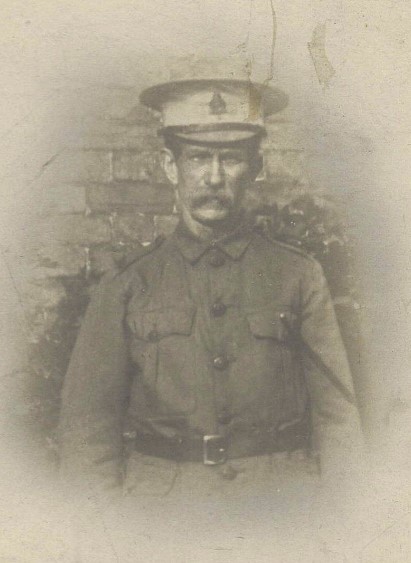
(from findagrave.com)
 Death and Service
One thought on “Private Oliver Carter”