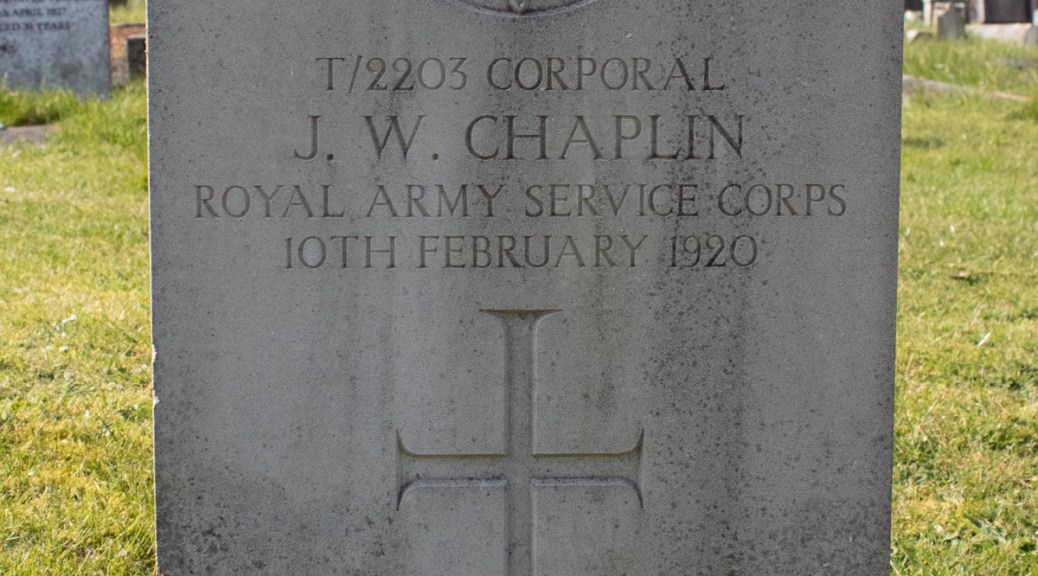
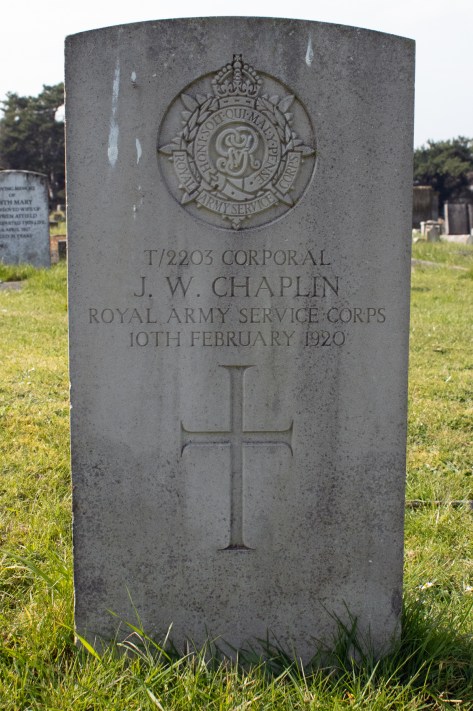
An inquest was held on Thursday at the Guildhall, Rochester… on the body of John William Arthur Chaplin (28)… who hanged himself in the lavatory on Tuesday. Deceased was a demobilised soldier and had served in France and Egypt during the war.
Mrs Sarah Jane Chaplin stated that lately her son had complained of pains in the back of his head. Usually he was of a cheerful temperament. Since leaving the Army he had spent his grstuity and being without money and our of employment he became depressed.
George William Lewis Paterson, deceased’s cousin who occupied the same bedroom with deceased, stated that at 10.40pm on Monday, deceased was reading a paper in the kitchen. Witness when to bed and awoke at 5.30am to find deceased had not been to bed. The light downstairs was still burning. In the lavatory he found deceased handing by the neck…
A verdict of “Suicide whilst of unsound mind” was returned.
[Chatham, Rochester and Brompton Observer: Saturday 14th February 1920]
The life of John William Arthur Chaplin remains frustratingly elusive. He does not recognisably appear on any census return, and, while it is clear that he served in the Army Service Corps as a Corporal, his military records are no longer available.
The body of Corporal Chaplin, the former solder with nowhere to turn, was laid to rest in St Margaret’s Cemetery, Rochester, Kent.
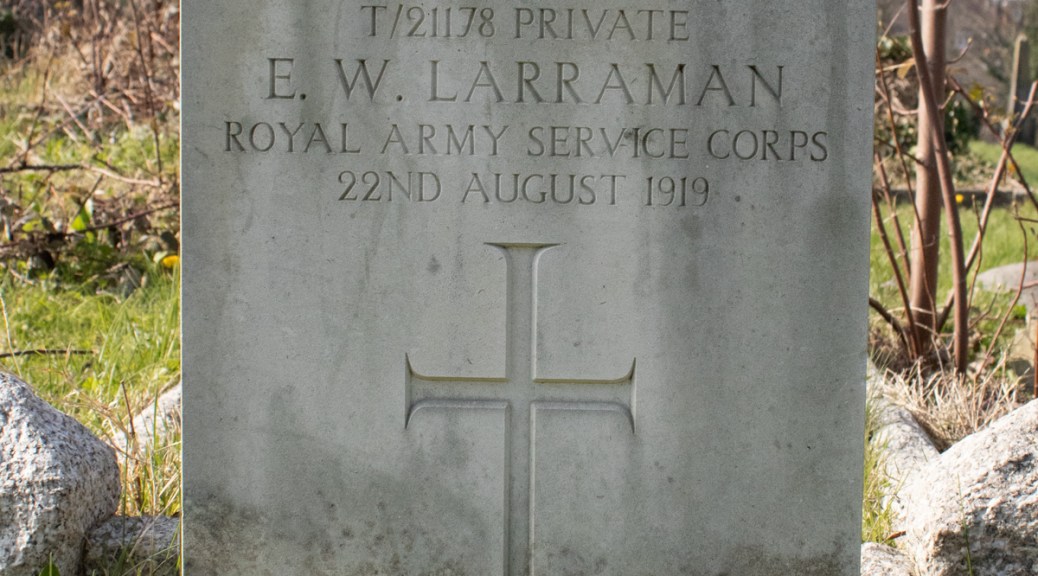
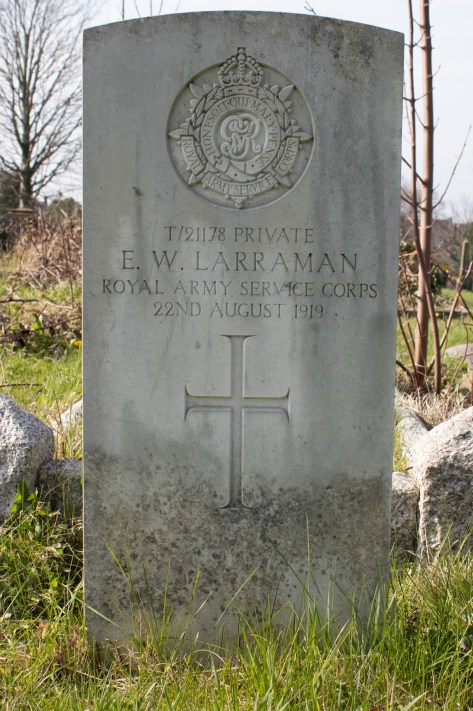
Edward William Larraman was born in Rochester, Kent, in December 1882. The third of seven children, he was one of five sons to Alfred and Mary Larraman. Alfred was a mariner who died when Edward was just ten years old.
Mary took work as a housekeeper, moving the family from their home at 4 Davis Square to rooms at 18 Northgate. Edward is missing from the 1901 census but, with later service records suggesting he volunteered with the Royal West Kent Regiment, it is possible that he was training with them when the return was taken.
The military life seemed to suit Edward and, on 4th November 1902, he gave up his job as a riveter to formally enlist, joining the Army Service Corps as a Private. His service papers from that time show that he was 5ft 4.5ins (1.64m) tall and weighed 120lbs (54.4kg). Hr was noted as having light brown hair, blue eyes and a fresh complexion.
Private Larraman spent the next four years on home soil, using the opportunity to gain a 3rd Class certificate in education, and rising to the rank of Lance Corporal.
On 23rd December 1907, Edward married Mabel Green. Born in Chatham, she was the daughter of a carpenter. The couple set up home at 3 Almon Place, Rochester – just a short walk from where Mary was living – and went on to have two children, Irene (born in 1908) and Thora (born in 1915).
Lance Corporal Larraman was medically discharged from the army on 18th May 1908. While it is unclear what affliction meant he was no longer fit to serve, he was awarded a pension for his service.
The next census, taken in 1911, found him and Mabel living in Almon Place with Irene and Mabel’s father Henry, and brother, George. Edward was listed as an army pensioner, while there were two salaries coming into the household: Henry was a carpenter and joiner at Chatham Dockyard, while George was a shop assistant.
At this point, Edward’s trail goes cold. It is clear that he re-enlisted when war broke out, although in what capacity, and for how long, is unclear. The only other record for him is that of his passing, on 22nd August 1919: he was 36 years of age.
The body of Edward William Larraman was laid to rest in St Nicholas’ Cemetery, Rochester, a short walk from where his family were still living.
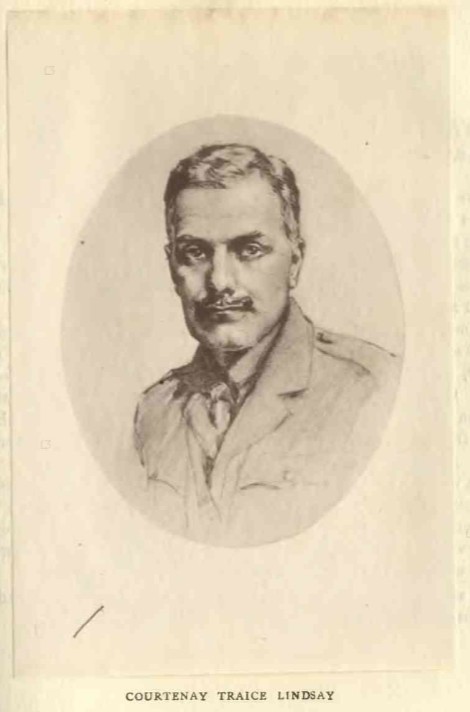
Courtenay Traice Lindsay was born in Belfast, Northern Ireland, on the 11th December 1874. The second of four children, he was the only son to Thomas and Ruth Lindsay. Thomas was an art teacher and examiner and, by the time of the 1881 census, he had moved the family to Rugby, Warwickshire, setting them up in the Temple Art Museum on Barby Road.
Education was important to Thomas, and it was obvious that his son’s passion was art. “He entered [Rugby] School in 1888 and left in 1892. He was afterwards Drawing Master at Seafield Park Engineering College, Hampshire, Trad Designer for textiles and pottery, and Examiner under the Board of Education in Geometrical Drawing.” [Memorials of Rugbeians Who Fell In The Great War, Volume VII]
On 10th January 1903, Courtenay married Charlotte Wetenhall. The daughter of a man of means, she was born in Stanwick, Northamptonshire, and the couple exchanged vows in her local parish church.
Courtenay’s mother died in 1905 and by the time of the 1911 census, he and Charlotte were living at 143 Beaufort Street, Chelsea, Middlesex. A five-storey Georgian building, they had let our rooms to aspiring artist Marion Forbes. Courtenay was an artist and designer himself, and he and Charlotte had an eight-month-old son, Courtenay Jr.
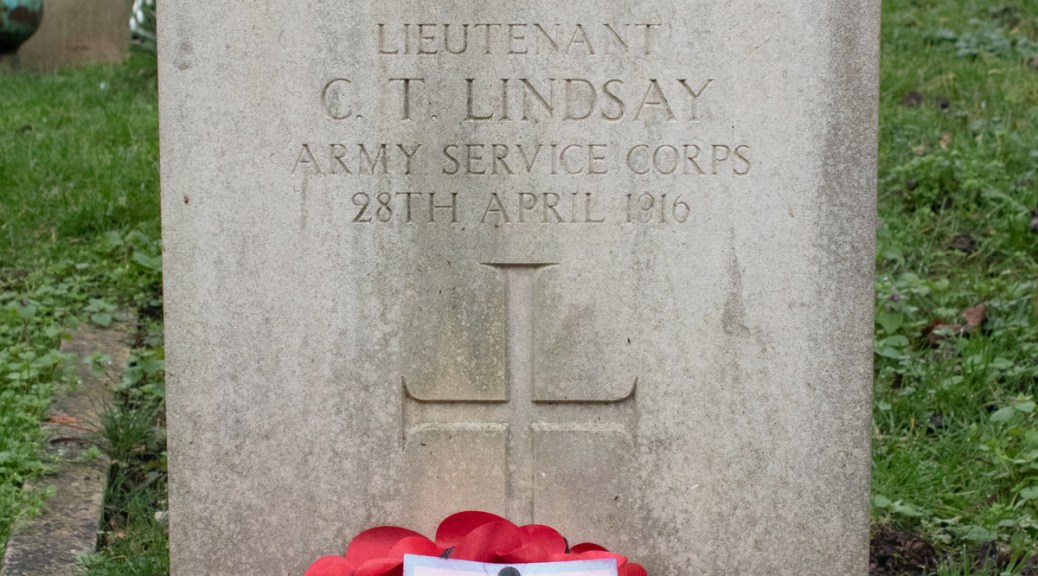
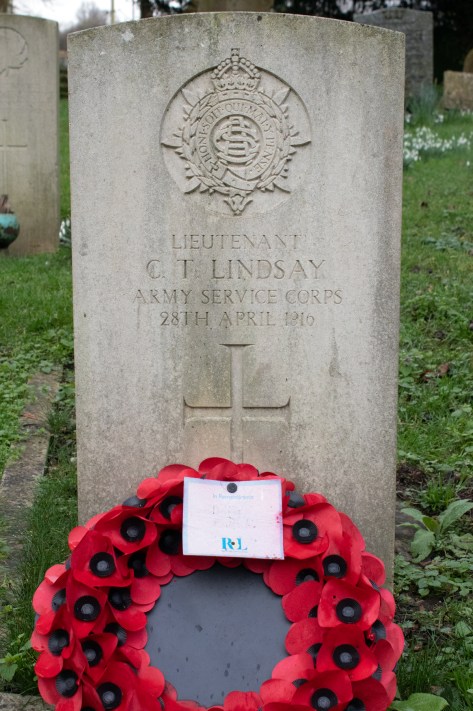
When war broker out, Courtenay stepped up to play his part. He gained a commission in the Army Service Corps, but did not see any service overseas. “He… was engaged on Road Transport, in the Northern Command. Hard work in the Transport Service undermined his constitution, and he died of heart failure, following on septic poisoning, on April 28th, 1916. Age 41.” [Memorials of Rugbeians Who Fell In The Great War, Volume VII]
Courtenay Traice Lindsay died at Burnham Abbey, near Maidenhead, Buckinghamshire. Interestingly, while Charlotte and their son were living four miles north in Burnham Beeches, he was laid to rest in Dorney Burial Ground, a short walk to the south of the hospital.
Lieutenant Courtenay Lindsay (from Memorials of Rugbeians Who Fell In The Great War, Volume VII)
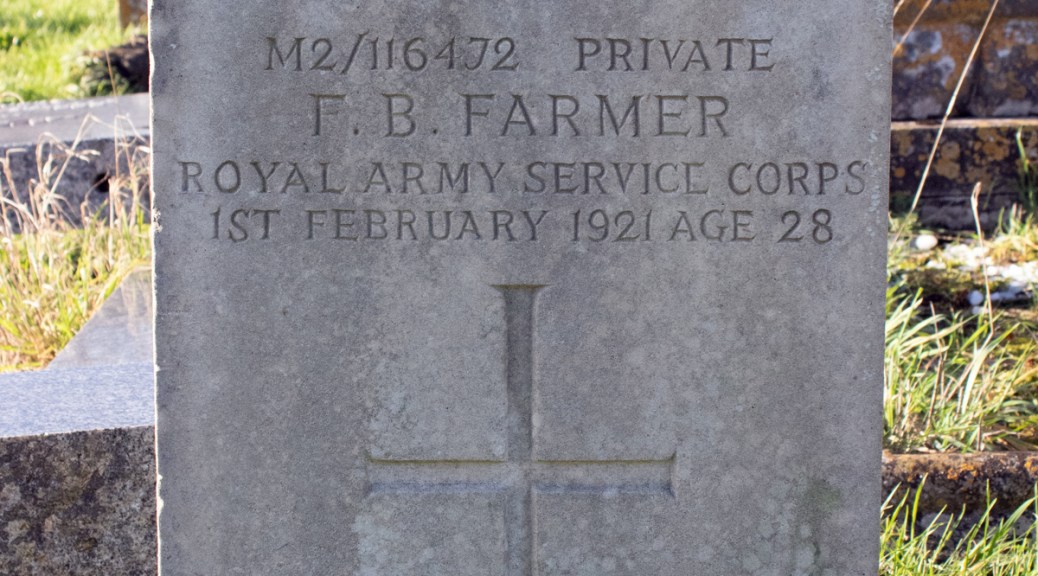
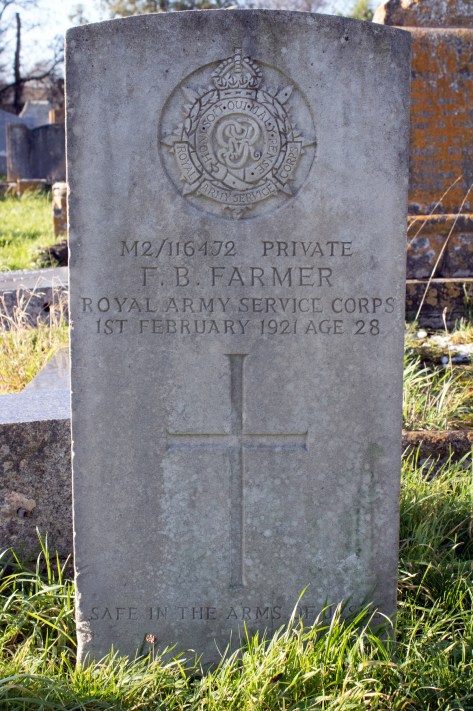
Frank Baden Farmer was born in the summer of 1892 in the Wiltshire village of Semington. The twelfth of thirteen children, his parents were groom and gardener John Farmer and his wife, Jane.
When he completed his schooling, Frank – who was known as Toby to his family and friends – found work as a labourer in a local iron foundry. War broke out in the summer of 1914, and he gave up his job to enlist. He joined the Army Service Corps as a Private and, by early August 1915, he was in France.
Details of Private Farmer’s life in the army have been lost to time, but he certainly survived the war, and returned home to Wiltshire. At this point, Frank’s trail goes cold. The next documents for him relate to his passing – from disease, on 1st February 1921. He was 27 years of age.
The body of Frank Baden Farmer was laid to rest in the graveyard of St George’s Church in his home village of Semington.
Interestingly, The Wiltshire News of the 18th February (thirteen days after Frank’s funeral) included a photograph of the newly installed war memorial tablet in St George’s. Unveiled the week before, it is likely that Private Farmer’s passing came to late for his name to be included on it.
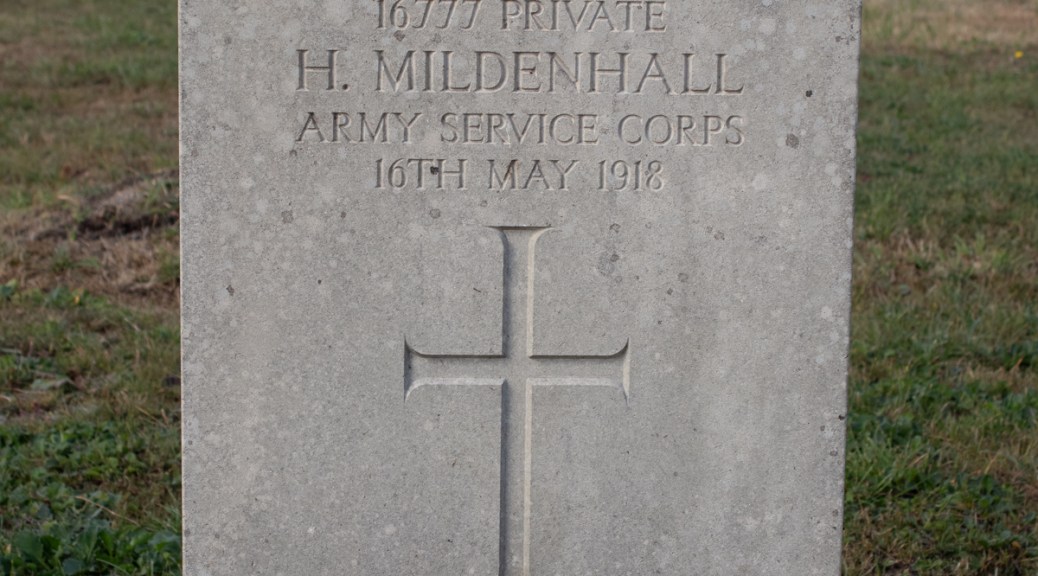
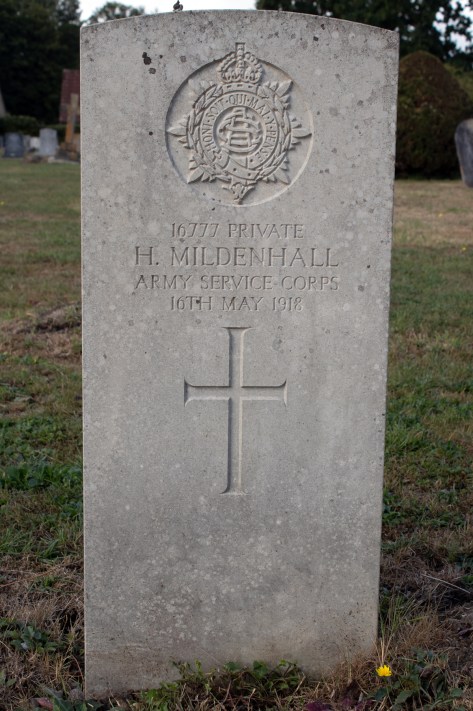
Harry Mildenhall was born in the autumn of 1873 in Eton, Buckinghamshire. The third of six children, his parents were Henry and Harriet Mildenhall. Henry was a groom, and the family lived on first on Mill Lane, before moving to Alma Road in nearby Boveney, by the time of the 1891 census.
The next census return, taken in the spring of 1901, recorded Harry as having left home. Initially apprenticed to house painter Glen Rowland, the document found him as boarding with his employer at 1 Thames View, Clewer, on the outskirts of Windsor, Berkshire.
It was not long before Harry would set out on his own. On 14th April 1906, he was living on Speedwell Street, Oxford. It was on that day that he married Annie Berridge in the parish church. Seven years her new husband’s junior, Annie was a labourer’s daughter, with a history of her own:
Annie Berridge (19), domestic servant, Peterborough, was charged with obtaining 4s. by false pretences from Martha Withers on Feb. 4th. The evidence showed that Berridge had been residing with Mrs Knighton of Wellington-street, who was known to Mrs Withers. On Monday week she visited the latter’s house at Oundle-road and stated that Mrs Knighton wanted to borrow 6s. In consequence Mrs Withers gave her 4s., but afterwards discovered that Mrs Knighton had never sent for the money. Accused pleaded guilty, electing to be dealt with summarily. The Bench gave defendant a chance to retrieve her character by dealing with her ad a first offender and binding her over to come up for judgment when called upon.
[Peterborough Standard: Saturday 16th February 1901]
But Annie was not done with the law just yet:
Annie Berridge (19), single soman, of no fixed abode, was charged with stealing from 11, City-road, a pair of shoes, value 4s. 6d., the property of Elizabeth Ryall, on the 24th. She was further charged with stealing from 7, Perseverance Cottages, Star-lane, money to the amount of 1s., the property of Ethel Norman, on the 18th. In the first care Elizabeth Ryall stated that accused asked for lodgings. She stayed one day and went out the following morning. As accused did not return witness looked round and missed a pair of shoes (produced), an old pair being left in their place. Detective-Sergeant Smith stated that he saw accused in Broadway on the 25th wearing the shoes missed by the previous witness. Accused, who cried bitterly, elected to be dealt with summarily, and pleaded guilty. The Chief Constable stated that a fortnight ago the accused was before the Bench and was then bound over to be of good behaviour. The Bench retired, and on their return into Court the Chairman stated that it appeared leniency was no good. That had been tried a fortnight previously, and a sentence of two months’ imprisonment would now be passed. The second charge was not proceeded with.
[Peterborough Standard: Saturday 2nd March 1901]
The 1902 census, taken just a month later, recorded Annie’s fate: she was imprisoned in Northampton Prison. Meeting Harry may have been what helped Annie back on the rails. After their wedding the couple took rooms at 6 Mill Street, Kidlington, Oxfordshire, and went on to have three children: Edward, Albert and Annie.
War came to Europe in the summer of 1915, and, despite his age, Harry would step up to play his part. He enlisted in the Army Service Corps on 16th September 1915, his papers confirming that he was of Church of England by faith, and was 5ft 5.5ins (1.66m) tall.
Private Mildenhall was sent to France within a fortnight of enlisting, although his exact role is unclear. He certainly remained overseas until April 1917, when he returned home for three months. He returned to the fray in July 1917, transferring to the Labour Corps.
Harry next returned to Britain in May 1918. By this point, however, he had fallen ill, and was admitted to Station Road Hospital in Gillingham, Dorset, suffering from bronchitis. Any treatment proved to be too little, too late: Private Mildenhall died from heart failure at 8:15pm on 16th May 1918, at the age of 44 years old.
The body of Harry Mildenhall was laid to rest in Gillingham Cemetery, not far from the hospital where he had breathed his last.
Of Annie there is no further record. The 1921 census records the three children boarding with separate families: Edward and Albert were living with the Bowd family at 35 Gracious Street, Whittlesey, Cambridgeshire. Annie, meanwhile, was living with Joseph and Harriett Wing, just around the corner from her brothers at 5 Whitmore Street. The census records note that the children’s father was dead, but their mother alive.
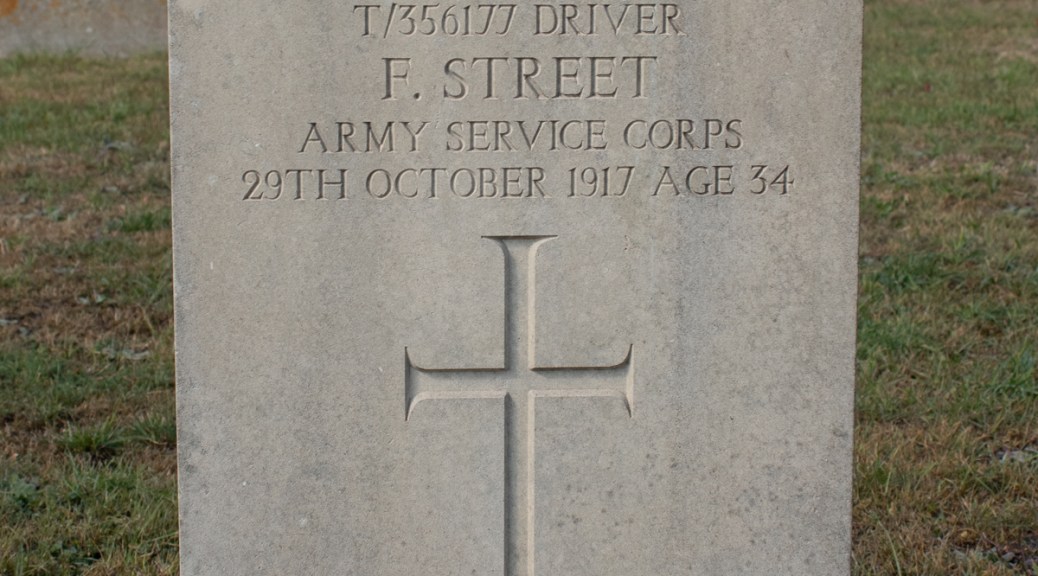
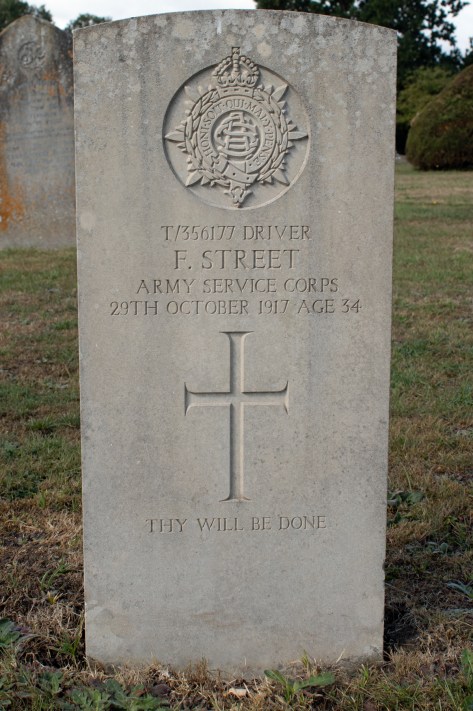
Frederick Street was born in the autumn of 1882, and was one of ten children. His parents were James Street and his wife Izett (or Izit, Ezit, or Iyitt, depending on which document you are looking at: both of Frederick’s parents were illiterate, and so there is no consistency in how his mother’s unusual name was spelt). James was a general labour from East Stour, Dorset, but it was in the nearby town of Gillingham where the family were born and raised.
When Frederick completed his schooling, he also took up work as a labourer. In the autumn of 1908 he married Mary White. Born in Yeovil, Somerset, in 1885, she was working as a servant for draper Sidney Clement when the couple exchanged vows. They set up home on Milton Lane, Gillingham, and went on to have two children: Charles, born in 1909, and William, born in 1916.
Frederick had taken work as a gardener by the outbreak of war. He was called upon to play his part and, while full details of his service have been lost to time, it is clear that he had enlisted in the Army Service Corps no earlier than the spring of 1917.
Sent to Kent for his service with the No. 2 Horse Transport Depot Company, Driver Street fell ill with tetanus. He was admitted to the Brook War Hospital in Woolwich, but the condition would prove too severe. Frederick died on 29th October 1917: he was 34 years of age.
The body of Frederick Street was taken back to Dorset for burial: he was laid to rest in Gillingham Cemetery, not far from where his widow and children were still living. This was the second death in the family in six months, James Street having died in March: the location of his burial is unclear.
Military honours were accorded at the funeral, on Saturday, of Lieutenant Arthur Edwin Cartland, of the Royal Flying Corps, who was killed in a flying accident near Newcastle.
The deceased officer was a son of Mrs FA Cartland, of Wentworth House, Western-place, and although only twenty-one years of age, he had seen considerable active service in France, having joined the Flying Corps in July, 1913, or some thirteen months before the outbreak of the War.
He took up his Commission in September last, and was home on leave only three days before his death, in order to see his brother, who is in the Motor Transport Section of the Army Service Corps.
[Worthing Gazette: Wednesday 6th March 1918]
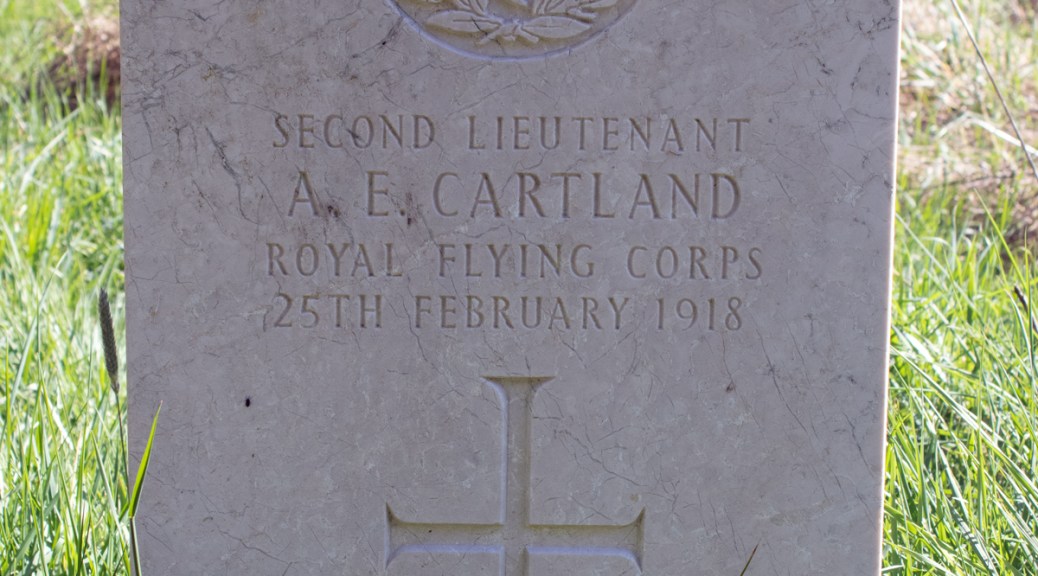
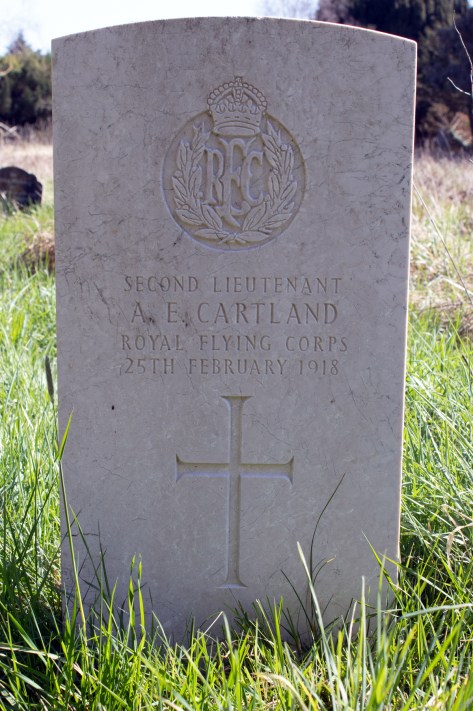
Arthur Edward Cartland was born in Winkfield, Berkshire, on the 12th January 1897. One of seven children, his parents were general labourer William Cartland and his wife, Ann.
When Arthur left school, he found work on a local farm, although from here on in, his trail becomes more of a challenge to decipher. While some of the information in the newspaper article is incorrect, he definitely joined the Royal Flying Corps on 17th July 1913. By this point, the family had moved to West Sussex.
When war broke out, the now Air Mechanic 1st Class Cartland was sent to France, although he did have two months out in 1915, due to an operation on a hernia. In May 1916, Arthur had been promoted to Sergeant, with his commission following eighteen months later.
In February 1918, Second Lieutenant Cartland was attached to the 75th Training Squadron at Cramlington Airfield, Northumberland. He was flying a de Havilland DH4 on the 25th February, when the accident that ended his life occurred. The Casualty Card noted that:
…the accident was due to 2L Cartland attempting to turn back to [the] aerodrome when only 50ft up. He stalled on [the] turn and nose dived into the ground. The adjustable tail plane control was right back in the landing position, this would tend to make the machine stall on a turn. As far as was possible to ascertain from the examination of the crash the controls were okay.
Arthur Edward Cartland was laid to rest in Broadwater Cemetery, to the north of Worthing town centre.
The brother Arthur had come home to visit – Stephen Cartland – had found work as a page when he completed his schooling. In December 1908 he enlisted in the Royal Navy, spending five years as an Officer’s Steward and Cook. When war broke our he joined the Army Service Corps.
Another brother, William, had also served in the First World War, rising to the rank of Corporal in the 1st Battalion of the Royal Berkshire Regiment. He was badly wounded at Ypres in the autumn of 1914, succumbing to his injuries on the 9th November. Also 21 years of age, Corporal Cartland was laid to rest in Poperinghe Old Military Cemetery.
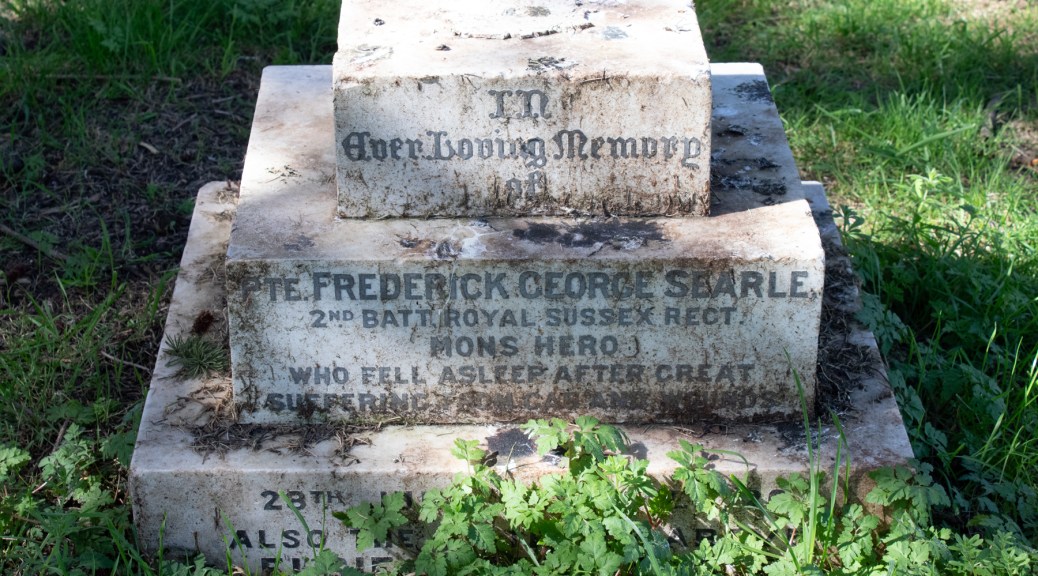
Frederick George Searle was born in the Sussex village of Warminghurst in the spring of 1894. One of thirteen children, his parents were William and Annie Searle.
William was a carter, and moved the family to where the work was. The 1901 census found the Searles living in Wiggonholt, between Pulborough and Storrington. By 1911, however, they had moved south, and were living in a cottage on the golf links in Broadwater, to the north of Worthing.
By this point, William was employed as a carter at the golf course, while three of the Searle children were also working at the club. Frederick – now 16 years of age, was a caddie, while his older brothers did mainly grounds work.
As one of thirteen siblings, Frederick was keen to make his own mark on the world and, on 24th September 1912, he enlisted in the Royal Sussex Regiment. His papers show that he was 5ft 5ins (1.65m) tall, and weighed 121lbs (54.9kg). He had light brown hair, grey eyes, and a number of scars – two on his back, one on the left side of his head and one at the base of his right forefinger.
When war broke out, Private Searle’s unit – the 2nd Battalion – was sent to France. He survived the Battle of Mons and subsequent retreat, but was badly wounded in the left arm on 13th November 1914, and medically evacuated to Britain for treatment. Frederick was moved to a depot while he recuperated, but because of his injury, he was formally discharged from the army on 30th April 1915.
Frederick returned to Sussex, and family life. In time, he took up his role on the golf club once more, but this seemed not to be enough for him. On 31st May 1917, he re-enlisted, joining the Mechanical Transport unit of the Army Service Corps as a Private. He was posted to Isleworth, Surrey, but his injury seemed to still be nagging at him. Despite his best efforts, and with the support of his superiors, at the end of August he took the decision to stand down, and was discharged from duty once more.
At this point, Frederick’s trail goes cold. What can be confirmed is that he passed away on 28th June 1919: he was 25 years of age.
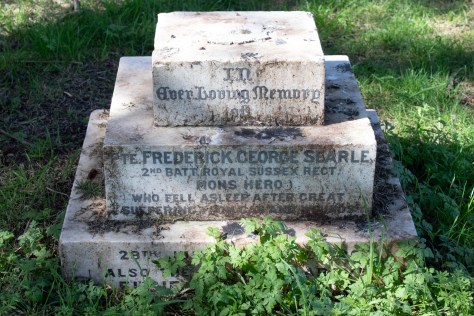
The body of Frederick George Searle, former Private in two regiments, was laid to rest in the family plot in Broadwater Cemetery, not far from where his family still lived.
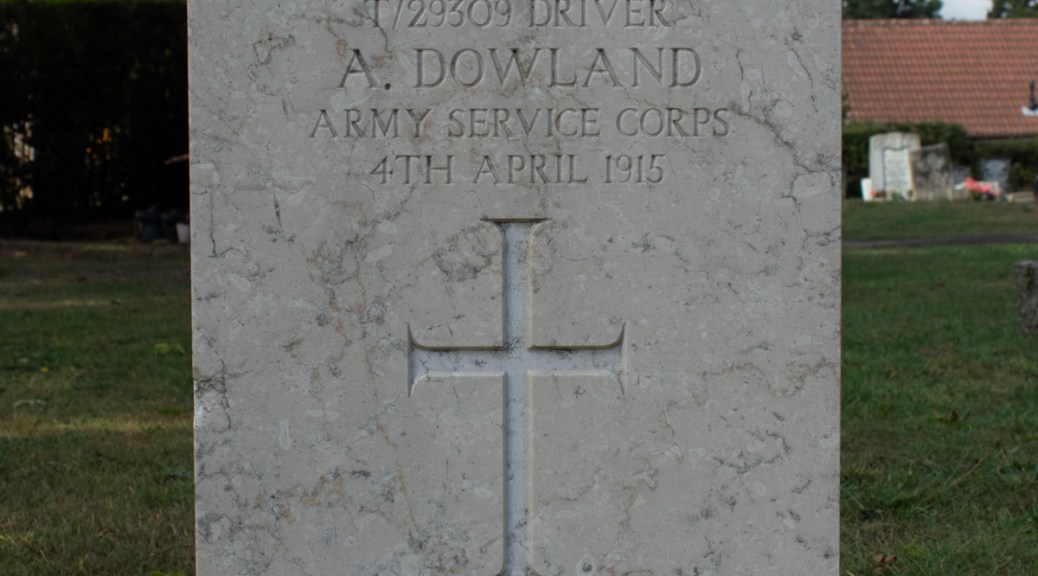
Arthur Dowland was born in the spring of 1884, and was the third of seven children to Austin and Maria Dowland. Austin was a coachman from Dorset, and the family seemed to travel with his work. By the time Arthur was born, they were living in Bourton, on the Dorset, Somerset and Wiltshire borders.
There is little in the way of documentation to track Arthur’s life. He does not appear in the 1911 census, and a separate record suggests that he may have emigrated to Canada for work, returning to Britain by the time war broke out.
Driver Dowland’s service papers have been lost to time, but it is clear that he had enlisted in the Army Service Corps, and was attached to one of the Horse Transport companies.
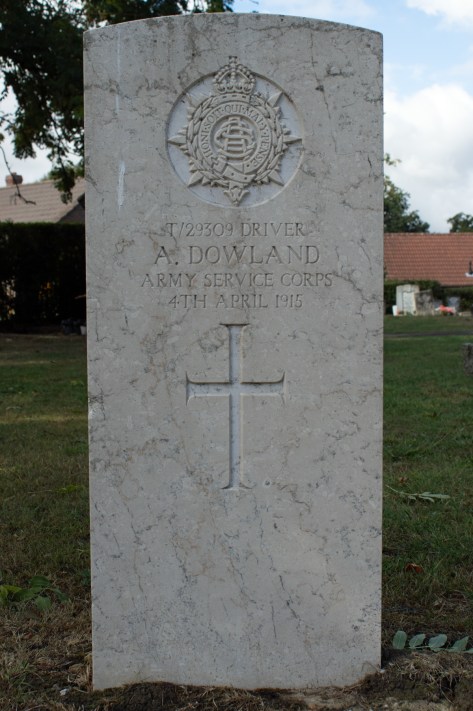
Arthur’s time in the army was not to be a lengthy one, and it appears that he fell ill while training. He passed away at his parents’ home in Gillingham, Dorset, on 4th April 1915, at the age of 31 years old.
The body of Arthur Downland was laid to rest in Gillingham Cemetery.
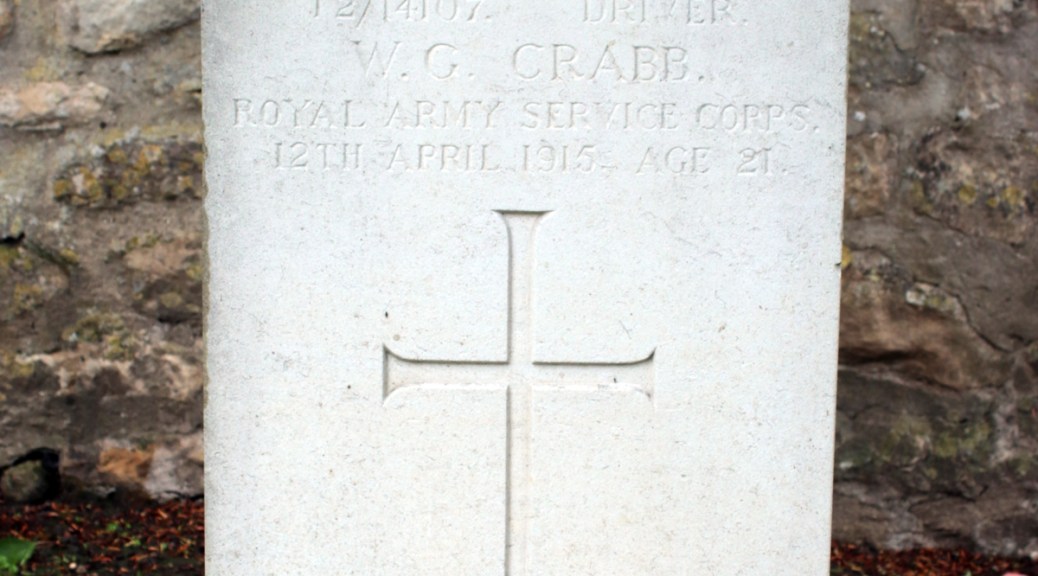
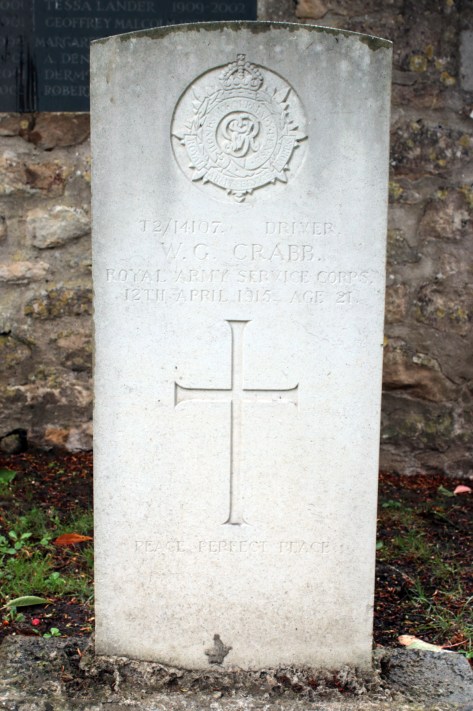
Walter George Crabb was born in the spring of 1893 in the Castleton area of Sherborne, Dorset. The oldest of ten children, his parents were Fred and Selina Crabb. Fred was a sawyer, but when Walter completed his schooling, he found employment as a bricklayer’s labourer. The 1911 census recorded the family as living in a 5-roomed cottage on Long Street.
When war came to Europe, Walter was quick to step up and play his part. His service records have been lost to time, but it is clear that he had enlisted by October 1914. As a Driver, he was attached to the 108th Horse Transport Company and, by the following spring, was barracked at Curragh Camp, to the south west of Dublin.
The next record for Driver Crabb is his entry in the British Army Register of Soldiers’ Effects. This confirms that he passed away in Curragh Hospital on 12th April 1915. The cause of his death is not recorded, but he was just 21 years of age.
The body of Walter George Crabb was taken back to Dorset for burial. He was laid to rest in the peaceful surroundings of St Mary Magdalene Churchyard, Castleton.