Tag Archives: South Africa

Corporal Alfred Storey

Corporal Alfred Storey

Alfred Story was born in the summer of 1876 in Poplar, Middlesex. The youngest of three children, his parents were Benjamin and Margaret. Benjamin was an engine fitter from North Shields, Tyne and Wear, but he and Margaret had moved to London by the time their eldest was born in 1863.

Margaret died in the 1880s, and, when Alfred left school, he found work as a draper’s assistant. He did not carry out this trade for long, however, and took up a career in the Royal Army Medical Corps. His First World War service papers suggest that he remained in the army for twelve years, gaining the Kedive’s Star for service in the Sudan in 1898, and the Queen’s Medal with five clasps and the King’s Medal with two clasps for his time in South Africa.

By the time of the 1911 census Alfred was living at 1 Belle Vue, Eton, Berkshire, and that he was a house porter at Eton College. He was recorded as having married Alice in 1905 (although a later document suggests they did not exchange vows until 26th October 1916), and the couple were living there with their daughter, May, who was three years old. While no formal marriage certificate is available, it would seem that Alice was a widow when they got together: also living at 1 Belle Vue were her children, William Mallaband (who was 15) and Violet Mallaband (13).

The next record for Alfred is his service papers for the First World War. He enlisted on 26th February 1917, and was assigned back to his former regiment as a Private. His medical confirms that he was 5ft 8ins (1.72m), and that he weighed 160lbs (72.6kg). He was recorded as having brown hair, blue eyes and a fresh complexion.

Private Storey carried out his duties on home soil, and was attached to 18th Company. He survived the conflict, and rose to the rank of Corporal, then Acting Sergeant. When he was stood down on 16th February 1919, we readily volunteered to extend his service for a further twelve months. On 20th November that year, he collapsed and died from a cerebral haemorrhage. He was 39 years of age.

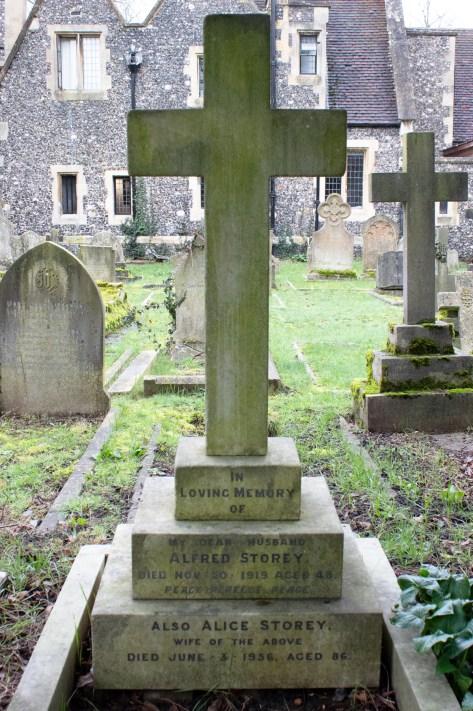
The body of Alfred Storey was taken back to Berkshire for burial. He was laid to rest in the peaceful graveyard of St John’s Church, Eton. He was reunited with Alice when she died in 1956: husband and wife buried together after 37 years.
Private Patrick O’Neill

Private Patrick O’Neill

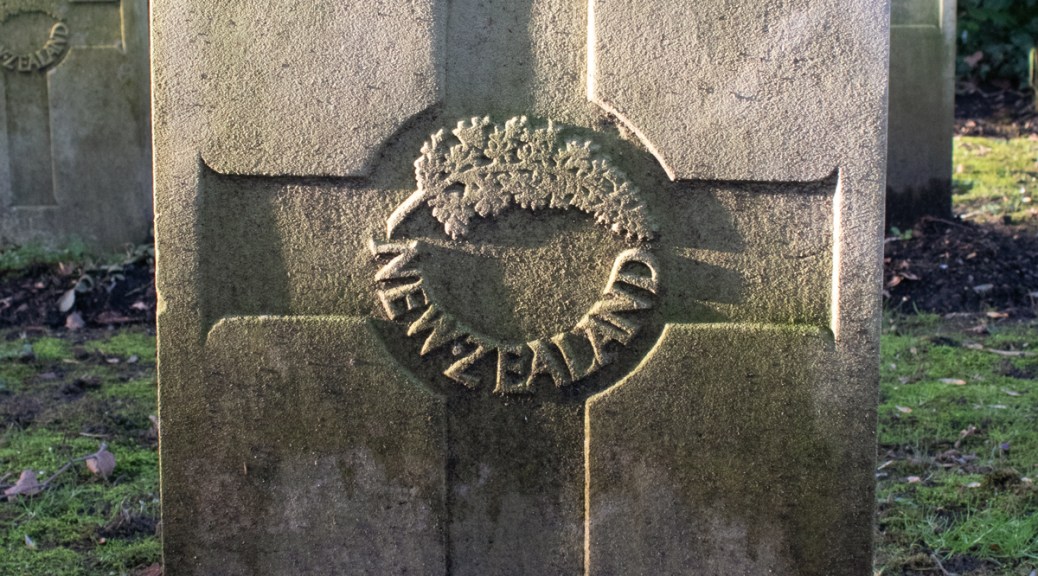
Patrick Thomas O’Neill was born in Wellington, New Zealand, on 2nd March 1888. Little information is available about his early life, but the Commonwealth War Graves Commission confirms he was the son of Jane O’Neill, and the family lived at 151 Taranaki Street.

When he completed his schooling, Patrick found work as a driver for Munt, Cotterell & Co. A large transport and cartage company, when the First World War broke out, they became involved in transporting supplies to the military camp at Trentham. Because of this connection, many of the company’s workers – Patrick included – enlisted.

Patrick’s service papers show that he joined up 22nd August 1916. His medical confirms that he was 5ft 4.5ins (1.64m) tall and had fair hair, blue eyes and a fair complexion.

After his training at Trentham, Private O’Neill’s unit – the New Zealand Machine Gun Corps – left Wellington for Europe. After a week’s break in Simon’s Town, South Africa, their ship – the Walmer Castle – arrived in Devonport, Devon, on 27th March 1917. During the second part of the voyage, Patrick was admitted to the ship’s hospital, for an infestation of pubic lice.

The voyage from New Zealand to Britain had taken nearly three months, so when the regiment finally arrived at their camp in Sling, Wiltshire, it must have been something of a relief. For Private O’Neill, however, it marked the beginning of a regular pattern of misdemeanours.

In April 1917, Patrick moved to a base in Tidworth. A matter of weeks later, he went AWOL, and forfeited three days’ pay as a result. Private O’Neill was then sent to Grantham, Lincolnshire, where the ANZAC united had their machine gun training base. Over the next two months, he went AWOL on four separate occasions, resulting in him losing a total of 10 days’ pay and, for the final absence, 96 hours’ detention.

Private O’Neill disappearances seem to have been those of a lad about town: a couple of days after his final return, he was admitted to the venereal section of the camp hospital in Grantham. His condition – and probably his behaviour – was such that he was transferred back to Wiltshire, and admitted to the No. 3 New Zealand General Hospital near Codford.

Private O’Neill was not done, however. On 6th December 1917, and having been discharged back to his unit just a day before, he went AWOL again, this time in spectacular fashion. He was arrested by military police in Edinburgh on 14th January 1918. Taken in handcuffs back to Codford, he forfeited 71 days’ pay – plus a 2s fine for his arrest – and punished with 90 days in the cells.

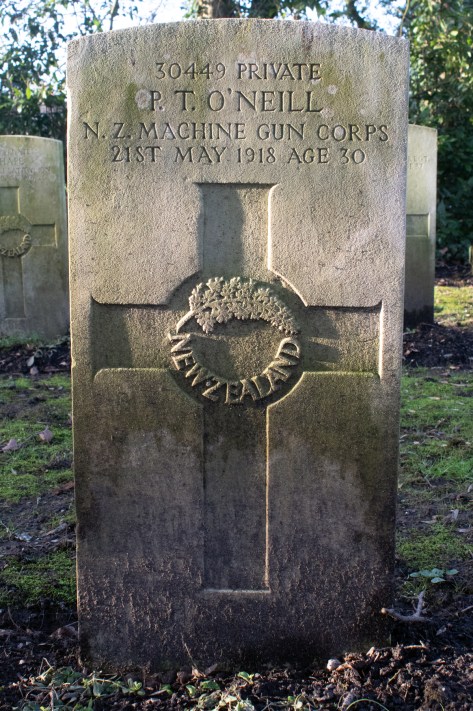
Patrick’s imprisonment began on the 1st March 1918, but it was a sentence he would not complete. On 16th May, he was taken from his cell and admitted to the camp hospital, once again to the venereal section. Less than a week later, he was dead, having suffered an embolism. Private O’Neill was 30 years of age when he passed, on 21st May 1918.

The body of Patrick Thomas O’Neill was laid to rest in the extension to St Mary’s Church, Codford, not far from the base in which he had been incarcerated and hospitalised.


Gunner Robert Dobson

Gunner Robert Dobson

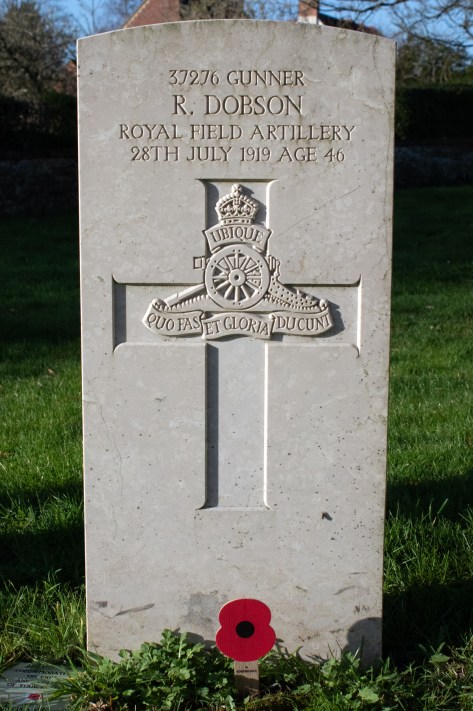
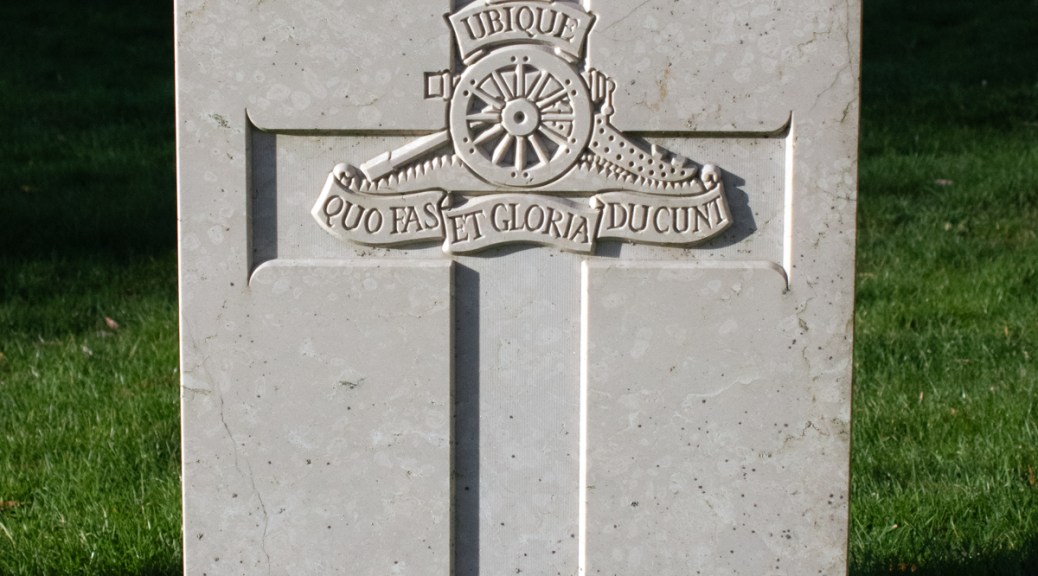
In the graveyard of St Mary’s Church in Steeple Ashton, Wiltshire, is a headstone dedicated to the memory of Gunner R Dobson of the Royal Field Artillery. The early life of Robert Dobson, however, is a challenge to unpick.

Born in Kilbride, County Wicklow, in 1873, he was the son of John Dobson and, according to his later service papers, he had three brothers: William, John Jr and Richard.

When he finished his schooling, Robert found work as a gamekeeper, but he wanted more adventure, and, on 27th April 1891, he enlisted in the Royal Artillery. Given the rank of Gunner, his papers note that he was a little over 5ft 6ins (1.68m) tall, and weighed 150lbs (68kg). A Presbyterian, he had brown hair, blue eyes and a fresh complexion.

Gunner Dobson signed up for a period of seven years, and during this time he travelled the world. From March 1893, he was based in India, but was invalided home for reasons unclear in November 1894. He would remain on home soil for the next three years, and was stood down to reserve status in April 1898.

While back on home soil, love had blossomed and, on the 14th May 1898, Robert married Mary Bull. A labourer’s daughter from Steeple Ashton, the couple wed in the parish church. Robert gave his address as the same village, and, given the proximity of the garrison town of Trowbridge, it is likely a local posting is how the couple met.

On 3rd November 1899, Gunner Dobson was called into duty once more. Attached to the 3rd Battalion of the Royal Field Artillery, his unit headed to South Africa, and he was quickly caught up in the Boer War. He would remain overseas until the spring of 1901, at which point he returned to Britain once more.

After a total of twelve years’ service, Robert was formally stood down from army service on 26th April 1903, returning to Steeple Ashton and Mary. The 1911 census – the only one of the four returns taken during his lifetime on which he appeared – found the couple living in a cottage on Common Hill, to the north of the village centre. Robert, now 38 years old, was working as a farm labourer.

When war broke out in Europe, Robert stepped up to serve his country once more. He initially re-joined his old unit, but seems to have transferred over the Labour Corps, and was attached to the 95th Company. His service records for this period have been lost, so it is unclear when or how he served.

Robert survived the conflict, but would pass away on 28th July 1919. The cause of his passing is unclear, but he was 46 years of age when he died.

The body of Robert Dobson was laid to rest in the peaceful graveyard of St Mary’s Church in Steeple Ashton.


Serjeant Frederick Bewley

Serjeant Frederick Bewley

Frederick John Edwin Bewley was born in Calne, Wiltshire, on 10th May 1882. Noticeably absent from the 1891 and 1901 census records, his parents were Chelsea pensioner John Bewley, and his wife, Annie.

Following in his father’s footsteps, Frederick was drawn to a life in the army. Having already been a volunteer in the local militia, on 20th November 1900, he enlisted in the Wiltshire Regiment. His service papers show that, at 5ft 6ins (1.68m) tall, he weighed 125lbs (56.7kg). He sported brown hair, grey eyes and a fresh complexion. He was also noted as having a scar on his right thigh and calf.

Private Bewley’s contract was for 12 years. During that time, he travelled the world spending three years in South Africa, and more than five in India. He was back in South Africa when his initial term of service came to an end, and he re-enlisted without thinking about it.

In May 1904 Frederick has been promoted to Lance Corporal, a rank he would hold for the next 12 years. During his second term of service, war broke out, but he would only spend short periods of time overseas.

…a member of the regular army, [Frederick] crossed to France with Lord French’s Expeditionary Force in August, 1914, and was wounded in the thigh at the battle of Mons. After a short period at Netley Hospital he went to Flanders in the following November. The awful conditions prevailing in the trenches was responsible for an attack of frost-bite, and tuberculosis following, he was treated at Winsley and Harnwood Sanatoriums…

[Wiltshire Times and Trowbridge Advertiser: Saturday 27th December 1919]

From 1th January 1915, Lance Corporal Bewley would remain on home soil. The sharp clarity of near-death experiences, along with a reconnection with home life, led to love blossoming and, on 6th May, he married labourer’s daughter Lilian Fidler. Both were living in Holt, Wiltshire, by this point, and it was in the village’s church that the couple exchanged vows.

Back on home soil, a new opportunity had opened up for Frederick, and he transferred to the Military Provost Staff Corps, a unit set up to police the army. In January 1916, he was promoted to Corporal; just weeks later, Vivian gave birth to their first child, Eric. and he rose to Sergeant eighteen months later.

On 1st August 1917, Corporal Bewley was promoted again, taking the rank of Serjeant. By this point, however, his bouts of poor health were coming back to haunt him, and, just six weeks after his promotion, he was medically discharged from the army.

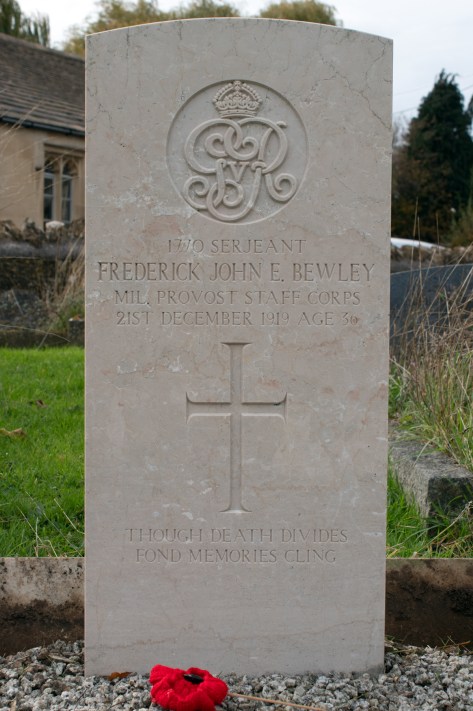
After returning to Holt, Frederick welcomed a second son with Lilian on New Year’s Eve 1918, when Vivian was born. The following winter, his tuberculosis struck again, and this time it was clear the illness would prove fatal. He passed away on 21st December 1919, aged 37 years old.

The body of Frederick John Edwin Bewley was laid to rest in Hold Old Cemetery.


Corporal Ernest Ritchens

Corporal Ernest Ritchens

Ernest Ritchens was born in the summer of 1872 in the Wiltshire village of Semington. The youngest of nine children, he was one of seven boys to Isaac and Sarah Ritchens. Isaac was a farm labourer, and this is a job into which Ernest also followed when he completed his schooling.

Farming was not something Ernest wanted to be in for the long term, however, and, after the death of his parents – Isaac in 1895, and Sarah four years later – he joined the army. Details of his military career have been lost to time, but it seems that he joined the Wiltshire Regiment and, as a Private, spent time in South Africa. By the time he was stood down, he had risen to the rank of Lance Corporal.

Back home and, in the summer of 1907, Ernest married Sarah York, a wheelwright’s daughter from Hilperton near Trowbridge, Wiltshire. The newlyweds would set up home in the village, and go on to have four children. The 1911 census found the young family living on Devizes Road, Ernest back working as a farm labourer.

When war broke out, Ernest was again called upon to play his part . He was given the rank of Corporal, and attached to the Wiltshire Regiment (although other records he was assigned to the Hampshire Regiment). He did not appear to have spent any time overseas and, was soon transferred over to the 160th Company of the Labour Corps.

DEATHS

RITCHENS – On February 1st, at No. 1, Australian Hospital, Sutton Veny, Corporal Ernest Ritchens, of the Labour Corps, and formally of the Wilts Regiment, resident of Hilperton…

[Wiltshire News: Friday 7th February 1919]

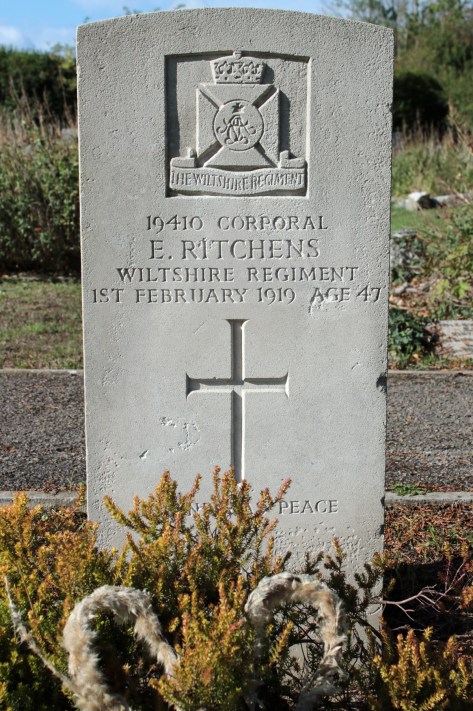
Ernest Ritchens was 46 years of age when he passed away in 1919. While the cause us not reported, it is likely to have been an illness of some sort. His body was taken back to Hilperton, and he was laid to rest in the village cemetery.


Lieutenant Colonel Thomas Bingham Day

Lieutenant Colonel Thomas Bingham-Day

Thomas Hulkes Bingham Day was born on 2nd January 1855 in Frindsbury, Kent. The youngest of four children, his parents were Thomas and Emma Day. Thomas Sr was a banker and a justice of the peace. He died when his youngest was just a child, and Emma was left to raise the family, albeit with the help of five servants.

Thomas sought out a life in the military. After volunteering in the local militia, for a number of years, he gained a commission in the Dorsetshire Regiment. He took on the role of Lieutenant on 29th November 1876.

Over the next two decades, Thomas served around the world, spending time in Malta, Gibraltar, and the East Indies. He was also promoted through the ranks, rising to Captain in 1883 and Major in 1893.

On 25th March 1884, while serving in India, Thomas married Katharine Watts. The couple had a daughter, Winifred, who was born in July 1885, and, eventually they settled in Wiltshire as their base in Britain.

Major Bingham Day served in South Africa during the Boer War, taking part “in the operations at Parde Kraal, and in the operations at Poplar Grove… Vet River, Zand River, Johannesberg and Pretoria. He had the Queen’s and the King’s medals with five bars.” [Lincoln Leader and County Advertiser – Saturday 28 April 1917]

Thomas retired in 1903, and his trail goes cold until the time of the 1911 census. He and Katherine were on holiday when it was taken, and they were listed as boarding at the Beach Lodge on Roseville Street in St Helier, Jersey.

When war broke out, Thomas stepped up to play his part once more. He was put in charge of the 4th (Reserve) Battalion of the Devonshire Regiment, which was based at Sutton Veny in Wiltshire. It seems that he lived off site, as he and Katherine moved into a house in nearby Warminster.

A military funeral took place… on Monday, when Lieutenant-Colonel TH Bingham-Day, in command of a regiment at Sutton Veny, was laid to rest in the churchyard. The deceased officer died suddenly while at mess, as the result of a seizure.

[Devizes and Wilts Advertiser: Thursday 19th April 1917]

Lieutenant Colonel Thomas Hulkes Bingham Day was 62 years of age when he passed away on 11th April 1917. He was laid to rest in the graveyard of St Aldhelm’s Church in Bishopstrow, Wiltshire, not far from the base at which he had so dutifully served.


Serjeant George Bailey

Serjeant George Bailey

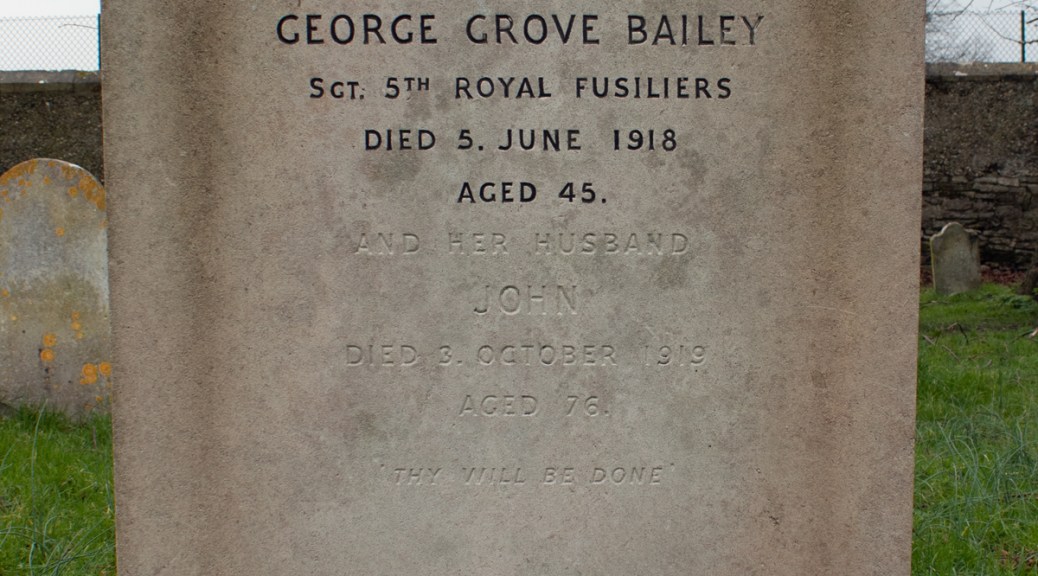
George Grove Bailey was born towards the end of 1873, in the Hampshire town of Lymington. He was the second of two children to John and Emma Bailey. John was a butler, but when Emma died when their youngest boy was just two years old, he seems to have changed career. The 1881 census found the family living at 45 High Street, Lymington, not far from the school and the Church of St Thomas the Apostle.

While he had the support of domestic servant Mary Ann, John was still young and, in 1884, he married again. His new bride was Sarah Woodman, and the couple would go on to have a daughter, Edith, two years later.

George falls off the radar at this point, and it is only from a newspaper report of his funeral in June 1918 that we are able to fill in some of the details:

The funeral took place on Monday afternoon of Sergt. George Bailey, youngest son of Mr John Bailey, of Highfield, Lymington, who passed away in the military hospital at Brighton, following a short illness. The deceased, who was 45 years of age, and was recently married, served in the South African War, and joined up at the commencement of the present war, being for some twelve months in the Fusiliers at the front. He was wounded, and since his return to this country has been acting as sergt.-instructor.

[Hampshire Advertiser: Saturday 15th June 1918]

George’s new wife was Winifred Mary Bailey, but there is little additional information about her. His regiment – the 5th Battalion of the Royal Fusiliers – was based on home soil, and would not have been the unit with which he had served on the Western Front. It’s not possible, therefore, to determine where he fought, or how he was wounded.

George Grove Bailey was buried in the family plot in the graveyard of St Thomas’ Church, Lymington, not far from where his father’s shop had been. John, who had been working as a poor rate collector, died a year after his son, and was laid to rest alongside his wife and youngest child.


Corporal George Collins

Corporal George Collins

The funeral of Corporal GH Collins, of the Royal Engineers, who died at Devonport at the age of 46, took place at Tiverton, where his mother and stepfather and sister reside. Corporal Collins’s wife and two children are at present in India. He had been in the army since 1899, and served in the South African War, for which he received the Queen’s and King’s medals with four clasps. He went to India in 1902, where he remained until the outbreak of the present war, when he came to France with his regiment. Corporal Collins was wounded, losing two fingers. He afterwards contracted fever, from which he died. The funeral was accorded military honours.

[Exeter and Plymouth Gazette – Monday 29 October 1917]

George Henry Collins was born in West Anstey, Devon, and was the son of George and Harriett Collins. There is little additional information about his early life available, and his was not an uncommon name in the area at the time.

George married Stella Euphrasia Constance O’Leary on 11th October 1911. At the time he was stationed in Myanmar, and the couple exchanged vows in the town of Maymyo, to the west of Mandalay. They would go on to have two children: Mary was born in August 1912, with Gertrude arriving the following November.

When the First World War broke out, it seems that Corporal Collins initially joined the Devonshire Regiment, but soon transferred to the Royal Engineers. Documentation suggests that he was assigned to the Special Brigade Depot at Saltash, Cornwall. However, this may have been the unit he was nominally allocated to when arrived in Britain for treatment to his injuries.

Frustratingly, there is little additional information available about George’s life. He died on 21st October 1917 was laid to rest in Tiverton Cemetery.


Serjeant Samuel Dymond

Serjeant Samuel Dymond

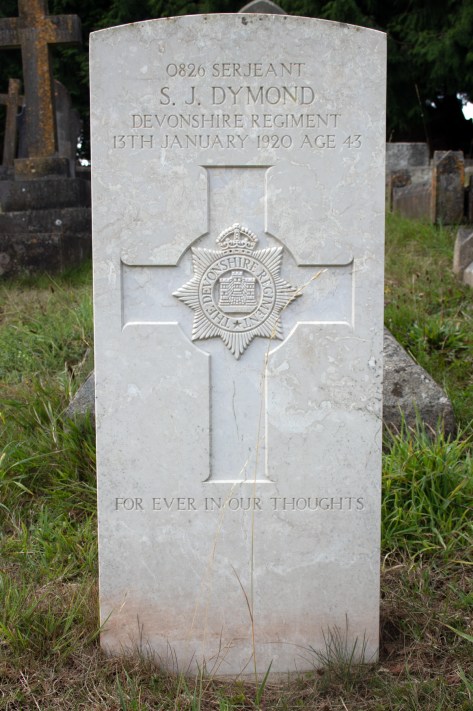
Samuel John Dymond was born in Broadhempston, Devon, in 1878. The son of Samuel and Jane Dymond, his childhood appears to have been disjointed: the 1881 census found him living with his uncle and aunt, while a decade later he was under his grandmother’s roof.

This background may have driven him to a more stable life and, on 22nd May 1896, he enlisted in the army. Joining the Devonshire Regiment, his service records show that he was 5ft 5.5ins (1.66m) tall and weighed 126lbs (57.2kg). He had fair hair, grey eyes, a fresh complexion and two scars on his right kneecap.

Private Dymond spent the first couple of years on home soil. In February 1898, however, he journeyed overseas, serving in the East Indies and South Africa, for which he was awarded the South Africa Medal, with a clasp for the defence of Ladysmith. By January 1902, Samuel was on the move again, and he spent the next two years in India.

At the beginning of 1904, Samuel returned to Britain. He remained on home soil until his contract came to an end on 21st May 1912.

Away from the army life, love beckoned. Samuel married Alice Reynolds on 9th October 1904 in the parish church at Marldon, Devon. The couple went on to have three children: Dorothy, Annie and Albert.

By the time of the 1911 census, Samuel was working as a labourer, and the family were living at Vine Cottage on Church Street, Paignton, Devon.

When war broke out, Samuel was called into service once more but, frustratingly, it is at this point that his trail goes cold. Returning to the Devonshire Regiment, he was certainly in France by 11th December 1914. Later on in the war he transferred across to the regimental depot, but whether this was on home soil of overseas is unclear.

The next record for Samuel is that of his passing. He died in a military hospital in Devonport on 13th January 1920, the British Record of Soldiers’ Effects only at that point confirming that he had reached the rank of Serjeant. He was 42 years of age.

Samuel John Diamond was laid to rest in Paignton Cemetery, overlooking the town that had become his home.


Serjeant Edwin Huxtable

Serjeant Edwin Huxtable

Edwin Huxtable was born in the summer of 1863, the youngest of eight children to William and Sarah. William was a tailor and Sarah a dressmaker, and they raised their family in their home village of South Molton, Devon.

William’s two younger sons followed him into tailoring, although the family disappears from records for more than 20 years. William passed away in 1889, and a later newspaper report suggests that Edwin enlisted in the army in some capacity, serving in South Africa during the Second Boer War.

Back in Britain, Edwin married Hester Cole in 1904. She was a dressmaker from South Molton as well: the couple set up home and their business at 10 Broad Street in the village. They had two children: Sidney was born in 1905, and Herbert in 1906, although their younger boy passed away when just a babe-in-arms.

When war broke out, Edwin was called back into service. Details of his military career have been lost, but it is clear from what remains that he enlisted in the Devonshire Regiment, and served in the 11th (Reserve) Battalion. His previous time in the army was taken into account, and he was given the rank of Serjeant.

It is unclear whether Edwin saw any time overseas as part of the First World War, but his age and health were against him. Suffering from pneumonia, he was admitted to a hospital in Torquay. The lung condition got the better of him, however, and he passed away on 14th April 1915. He was 52 years of age.

Taken back to South Molton for burial, Edwin Huxtable was laid to rest in the village’s cemetery.


The 1921 census showed that Hestor was keeping up the family business. She was living in East Street, South Molton, and listed as a dressmaker and employer.