

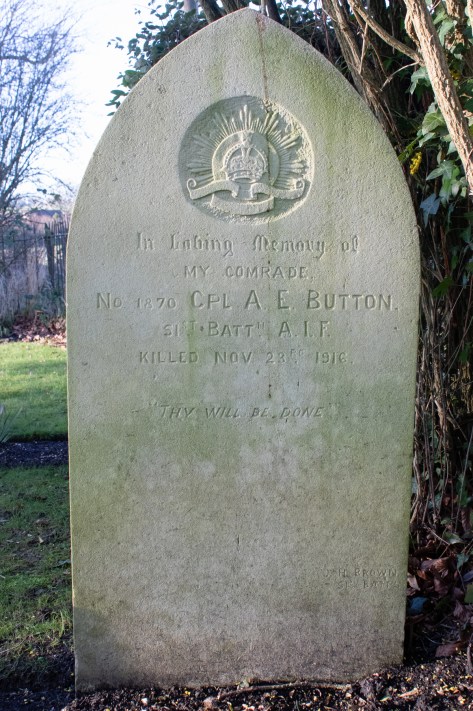
The early life of Albert James Button is a challenge to piece together. Born in Melbourne, Australia, in 1892, his father was also called Albert. When he finished his schooling, he found work as a hotel clerk, settling at 58 Stirling Street, Fremantle. He married a woman called Gladys, and, in his free time, he volunteered in the local militia.
When war broke out, Albert stepped up to play his part. He enlisted in the Australian Imperial Force on 9th December 1915, his service papers confirming that he was 5ft 8ins (1.72m) tall and weighed 129lbs (58.5kg). He was noted as having fair hair, blue eyes and a fresh complexion: he also had two vaccination marks on his left arm, and a mole on the right side of his neck.
Private Button spent the first half of 1916 training. His voluntary experience put him in good stead, and, he was promoted to Sergeant on 28th March. Towards the end of July, his unit – the 44th Battalion – left Fremantle for Britain, and he arrived in Plymouth, Devon, some two months later.
Sergeant Button was billeted at the ANZAC camp in Codford, Wiltshire. For a unknown reason, when he arrived at the base on 19th September, he was demoted to the rank of Corporal – it is unclear whether or not this was his choice. At this point, he was transferred to the 51st Battalion.
While in Wiltshire, Albert’s training continued. A local newspaper described what happened next:
Mr FAP Sylvester held an inquest at Codford, on Saturday, relative to the death of Corporal Albert James Button, 23, of the Australian Imperial Forces. The deceased, with several of his comrades, was in a bay awaiting his turn to throw a hand grenade, when a private named Taylor, who was in the throwing bay with an instructor, landed his grenade in the opposite direction to that intended, with the result that it pitched into the midst of the soldiers in the waiting bay. Being warned most of the men got away, but the deceased seemed paralysed and stayed until the bomb exploded. He was struck in the head and died almost immediately. Several of his comrades were struck i the legs, but their wounds were not serious. Pte. Taylor’s explanation was that the lever of the grenade caught in his thumb and caused him to swing his arm around. A verdict of “Accidental death” was returned.
[Devizes and Wilts Advertiser: Thursday 30th November 1916]
Albert James Button died on 23rd November 1916: he was 24 years of age. He was laid to rest in the recently extended graveyard of St Mary’s Church, Codford. The epitaph on his headstone starts “In loving memory of my comrade”, but it is unclear who specifically paid for it. Was it Private Taylor? We may never know.
Gladys seems to have distanced herself from her husband’s passing. His memorial plaque and medals were returned undelivered, and his pension seems to have gone unclaimed. It was only in 1923 that the Australian Military Forces were able to confirm that she had remarried, and moved to Sydney.

(from findagrave.com)
Private Button’s service papers shed more detail on the incident that took his life. Evidently a summary of notes taken during the inquest, they are light on punctuation:
Inquiry into the death of a soldier in that he on 23.11.16 at Codford whiles in the bay of a live bomb throwing pitch was killed. The bomb was known by 2264 Pte Taylor of 50th Btn now attached to the 13th Inf Btn, which struck against the top of the parapet to the head of the thrower, owing probably to the spin of the bomb came back and dropped on the inside edge of the bay. All men were warned… to reach cover with the exception of 1870 Cpl Button AJJ 51st Battn. who seemed paralysed with fear. He remained in the bay and was found after the explosion lying across the sandbags which were placed at the entrance to prevent the bombs which were thrown against the parapet from falling into the pen. Other soldiers were wounded by shrapnel effect, because instead of falling down flat when a short distance from the bay, continued to run. The bomb not being as was thought a five second bomb, exploded in three seconds (witness 2nd Liet. JW Swanse 45th Bn)… The Court declared that the occurrence was purely accidental owing to the inexperience of live bomb throwing and nervousness on the part of the thrower, also that no blame is attached to any persons concerned in the practice.
[Service papers for Corporal Albert Button]
 Death and Service