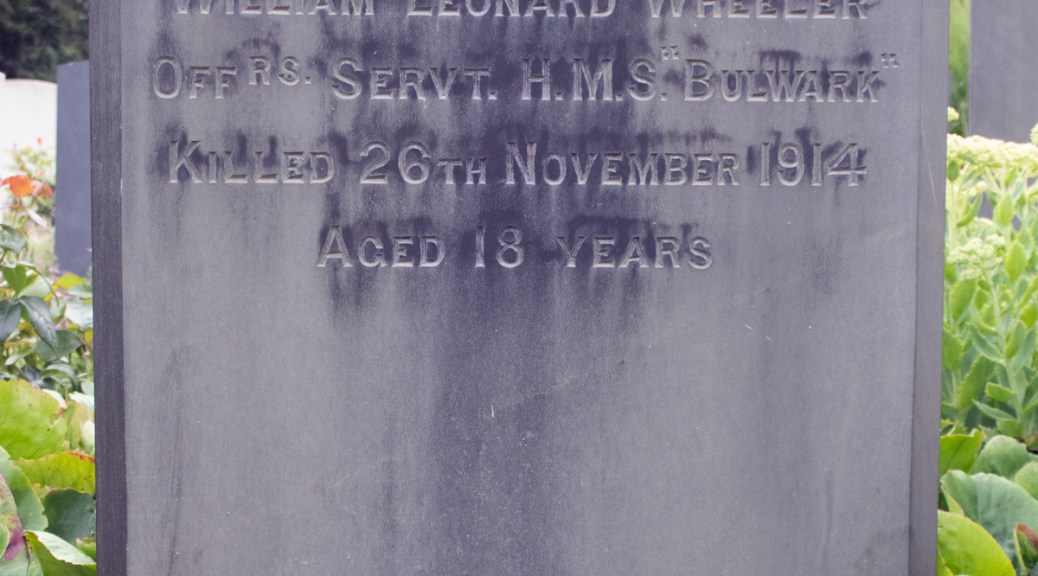
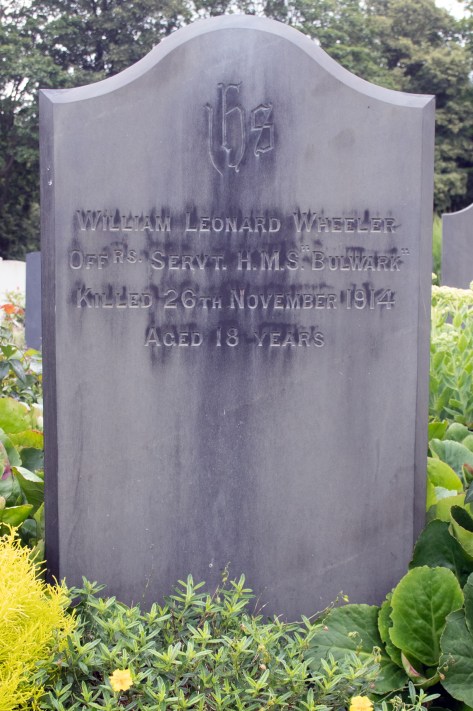
William Leonard Wheeler was born in Epsom, Surrey, on 8th September 1896. He was the fourth of six children to John and Mary Wheeler. John was a carman in a brickyard, and the family lived in Nonsuch Cottage on Leith Road.
When William finished his schooling, he took work as a gardener. He sought bigger and better things, however, and, on 12th September 1912, he joined the Royal Navy. Too young to formally enlist, he was given the rank of Boy 2nd Class, and sent to HMS Impregnable, the training ship, to start learning the skills he would need.
Impregnable would remain Boy Wheeler’s home for the next nine months, during which time he was promoted to Boy 1st Class. On 18th June 1913, he was give his first posting, on board the cruiser HMS Gibraltar. In November 1913, William was reassigned, and took up a post on board the battleship HMS Bulwark.
William came of age in September 1914, and fully enlisted in the Royal Navy. Given the rank of Ordinary Seaman, his service papers show that he was 5ft 1in (1.55m) tall, and had light brown hair, grey eyes and a fresh complexion.
Bulwark was part of the Channel Fleet, tasked with patrolling and defending Britain’s southern coast. On 26th November 1914, she was moored in the River Medway, close to Sheerness, and was being resupplied with shells and ammunition. That morning, a handful of the cordite charges overheated, detonating the shells stored nearby. The explosion ripped through the vessel, and more than 740 crew – including 18-year-old William – were killed.
Ordinary Seaman Wheeler’s body would be recovered from the wreckage until 8th July 1915. He was laid to rest in the naval section Woodlands Cemetery, Gillingham, Kent, a short distance from the the Royal Naval Dockyard in Chatham.
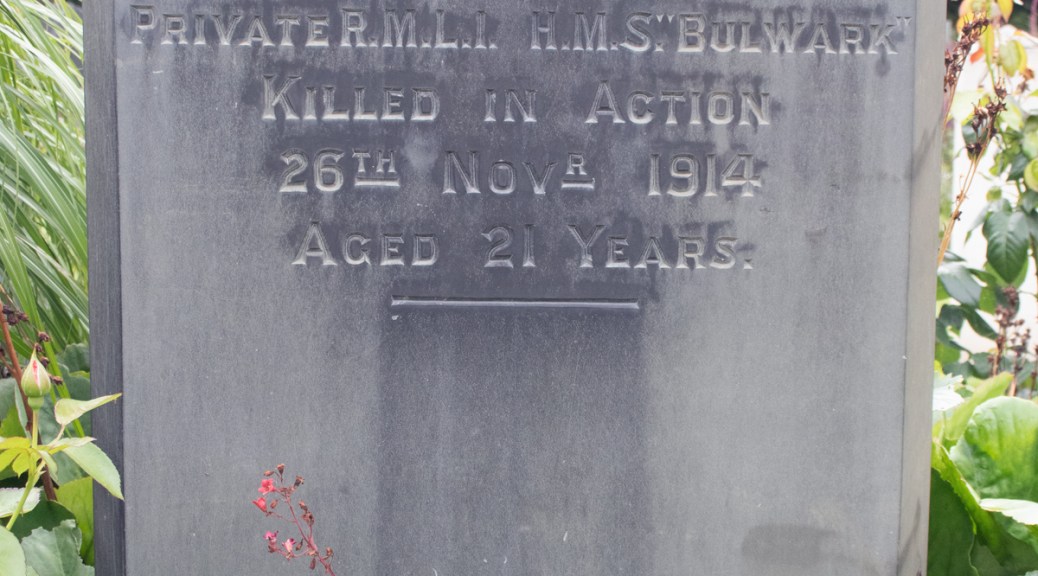
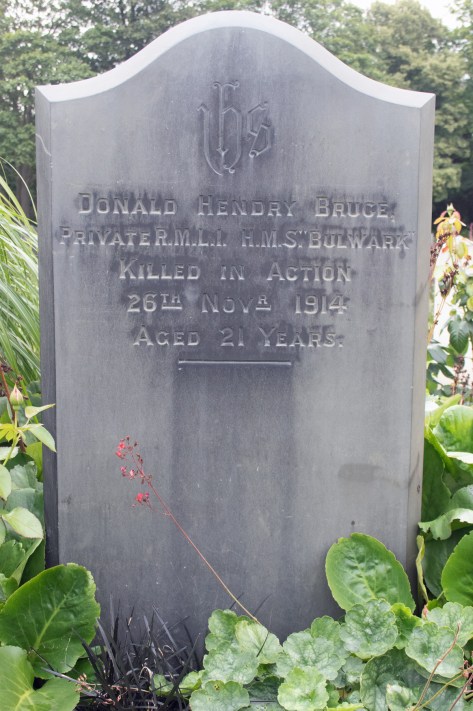
Donald Hendry Bruce was born on the 23rd July 1893 in the remote Logiealmond estate in Perthshire, Scotland. The oldest of six children, his parents were slate quarrier Hugh Bruce, and his wife, Ellen.
There is little information available about Donald’s early life, but the 1911 census records that he had enlisted in the Royal Marine Light Infantry as a Private, and was based at the barracks in Deal, Kent.
By the time war broke out, Private Bruce was assigned to the battleship HMS Bulwark. Part of the Channel Fleet, she was tasked with patrolling and defending Britain’s southern coast.
On 26th November 1914, Bulwark was moored in the River Medway, close to Sheerness, and was being stocked with shells and ammunition. That morning, some poorly stowed cordite charges overheated, detonating the shells stored nearby. The resulting explosion ripped through the battleship, and more than 740 crew were killed. Donald’s body was among those recovered: he was 21 years of age.
Those who were killed in the explosion were buried in the naval section of Woodlands Cemetery, Gillingham, Kent. As his body had been identified, Donald Hendry Bruce was laid to rest in a marked grave.
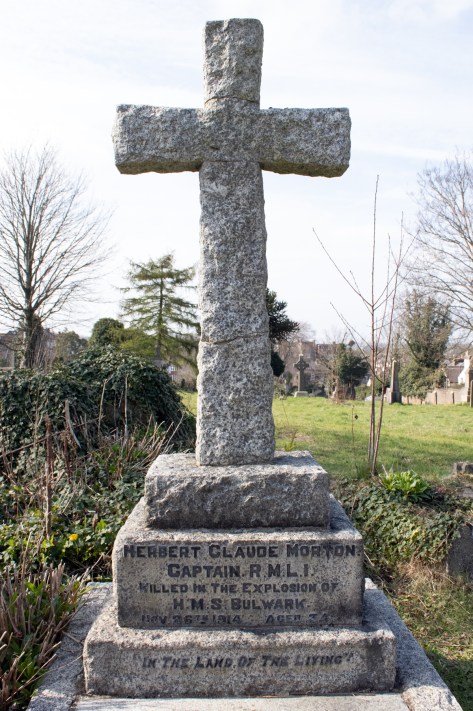
The mortal remains of Capt. Herbert Claude Morton, RMLI, were laid to rest in St Nicholas Cemetery, Rochester, on Tuesday afternoon, the first portion of the Burial Service being conducted in the Cathedral, where the deceased office was married, on September 17th, 1908, to Evelyn St Aubyn Lennard, eldest daughter of Col. and Mrs DL Barratt, late of Star-hill, Rochester. Captain Morton, who was 34 years of age, was the only son of Mr John Ellis Morton, of County Cavan, and Mrs Werry, of Cowes, Isle of Wight. He served during the campaign in China and was awarded the medal. His home was at Gosport.
[Chatham, Rochester and Brompton Observer: Saturday 5th December 1914]
The early life of Herbert Claude Morton is a challenge to piece together. The 1911 census states that he was born in France, and confirms that he and Evelyn were living with their then two children at 139 Stoke Road, Gosport, Hampshire.
This was the only census on which Herbert features and, as the “campaign in China” that the newspaper reported would have been the Boxer Rebellion of 1900, this may account for the lack of other documentation for him.
When war broke out, Captain Morton assigned to the battleship HMS Bulwark. He was on board Bulwark on the 26th November 1914, when she was moored close to Sheerness, Kent. That morning, an explosion ripped through the ship, sinking it and killing more than 740 people. Herbert was amongst them: he was 34 years of age.
The body of Herbert Claude Morton was laid to rest in a marked grave in St Nicholas’ Cemetery, Rochester, Kent.
The summer after her husband’s death, Evelyn gave birth to another child, daughter Stella, who would never know her father.
Arthur Frederic Thornton Phripp was born in Gillingham, Dorset, in the summer of 1894. The middle of three children, and the only son, his parents were Frederick and Kate Phripp. Frederick was a farmer, and the family lived in Slaughter Gate, to the west of the town centre.
The 1911 census recorded Frederick and Kate managing the farm, and raising their youngest child, daughter Lucy. Arthur, however, is missing, and it seems that he had taken started working for the Post Office as a boy clerk. Where he was living is unclear, but later documents suggest that he may have moved to London.
When war broke out, Arthur stepped up to play his part, joining the 1/21st (County of London) Battalion of the London Regiment, which was also known as the First Surrey Rifles. Private Phripp arrived in France on the 16th March 1915 and, over the next couple of years, fought at Loos, the Somme and Messines. He rose through the ranks, reaching Sergeant and, in the autumn of 1917, he was awarded a commission to Second Lieutenant.
Arthur returned to Britain to formally take the commission, and was transferred to the Duke of Wellington’s (West Riding) Regiment. Back on home soil, it was a chance to see family again, but tragedy was to strike.
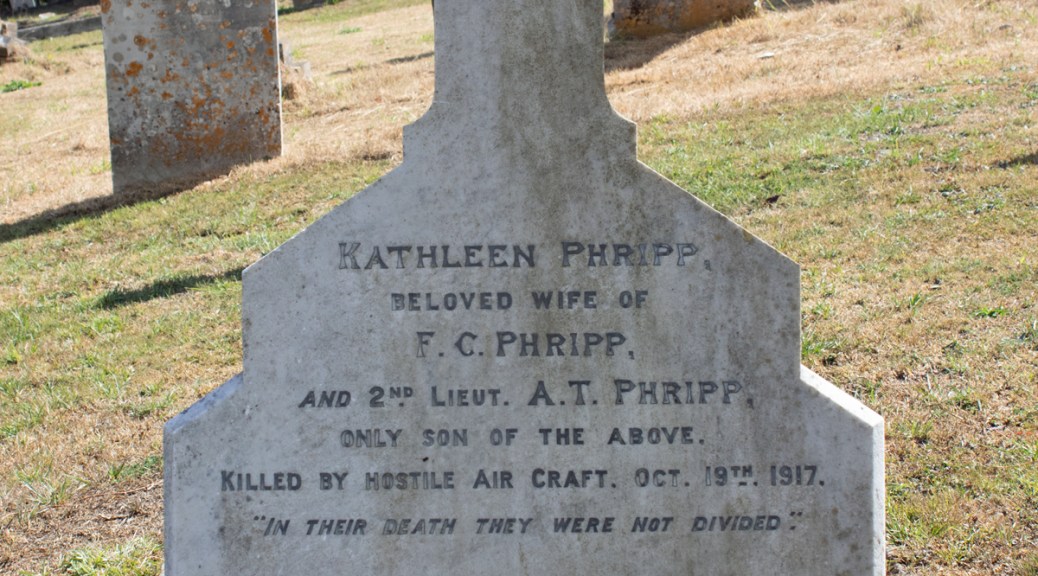
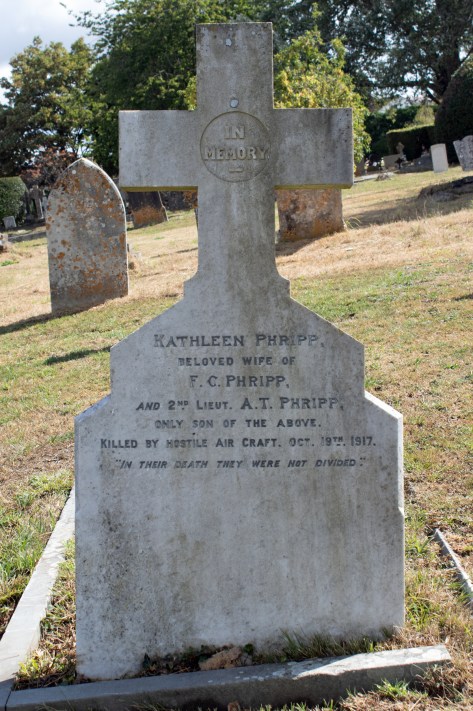
A painful sensation was created in the town when it became known that Mrs Kate Phripp, 65, of Slaughtergate Farm, and her son, Arthur TF Phripp, 23, had been killed in the Zeppelin raid on Friday.
At the inquest on seven of the victims on Monday evidence was given that Mr Phripp was stopping with some friends, and his mother went up from Gillingham on Friday to see him. Evidence given by the police showed that warning had been given in every principal thoroughfare in the district where the fatalities occurred, and the theatres had been warned. The bomb came quite unexpectedly. Besides the killed nine people were seriously injured and nine slightly injured. A great amount of glass was smashed. It was mentioned that Mrs Phripp and her son had been attending the theatre, where is was announced that the warning had been given, and that the play would continue until the guns were heard. The play was continued to the end, and the deceased left at their own risk. The Coroner observed that it was clear that some people took the optimistic view that the raid was over. If people went out into the street after a warning they did to at their own risk. A formal verdict was returned, and they commended the work of the police, special constables and ambulance workers, who, they said, had acted promptly and pluckily…
[Bridport News: Friday 26th October 1917]
The Zeppelin that raided London that night had originally been one of eleven aircraft tasked with attacking Britain’s northern industrial towns. But strong winds disrupted the operation, and one airship – L45, commanded by Kapitänleutnant Waldemar Kölle – was blown south instead.
Meanwhile, Second Lieutenant Phripp and his mother had just left His Majesty’s Theatre in the Haymarket, where they had been watching the comedy Chu Chin Chow, and were making their way across Piccadilly Circus, returning to their friend’s house.
By ill twist of fate, at that moment Kölle released a 100kg (220lb) bomb, which exploded in the road outside the Swan & Edgar department store. The resulting explosion destroyed the building’s frontage and left a crater in the road some 10ft (3m) across and 4ft (1.2m) deep. Seven people were killed: this included Kate and her son.
The bodies of Kate and Arthur Phripp were taken back to Dorset for burial. They were laid to rest together in Gillingham Cemetery, not far from where Frederick and Lucy were grieving.
[Note: My thanks go to Tony Otton for his insight into the event that led to the passing of Arthur and his mother.]
Alexander McDougall Westgarth was born in Newcastle-upon-Tyne on the 28th June 1885. The middle of five children, and the only son, his parents were James and Janet Westgarth. James was a mariner, and the family moved to the village of Carlton Colville, on the outskirts of Lowestoft, Suffolk, in the late 1880s.
Alexander found work as a fitter’s apprentice when he finished school, but the sea was in his blood. Janet died in 1903, and by the time of the next census, taken in 1911, her son had enlisted in the Royal Navy and was a Stoker 1st Class. The document found him as part of the crew of the battleship HMS Russell, moored in a harbour on Malta.
On 31st October 1915, Alexander married Mabel Liffen. The daughter of a gas stoker, she also lived in Carlton Colville. She had a daughter, Irene, but there is no evidence that she was Alexander’s, nor that Mabel had a previous marriage.
At this point, Alexander’s trail goes cold. By the summer of 1917, he was based at HMS Pembroke, the Royal Naval Dockyard in Chatham, Kent. It was a particularly overcrowded base by this point in the conflict, with the planned replacement crew for the sunk HMS Vanguard waiting for new assignments, and an outbreak of meningitis meaning space was at an absolute premium. In the midst of this, Stoker 1st Class Westgarth was billeted in temporary accommodation in the dockyard’s Drill Hall.
On the night of the 3rd September 1917, Chatham was hit by an unexpected German air raid. Two bombs landed squarely on the Drill, shattering its glass roof, and killing dozens of men. Stoker Westgarth was badly injured, and was rushed to the Royal Naval Hospital in the town. His injuries would prove fatal and he passed away the day after the attack: he was 32 years of age.
The body of Alexander McDougall Westgarth was taken back to Suffolk for burial: he was laid to rest in Kirkley Cemetery, Lowestoft.
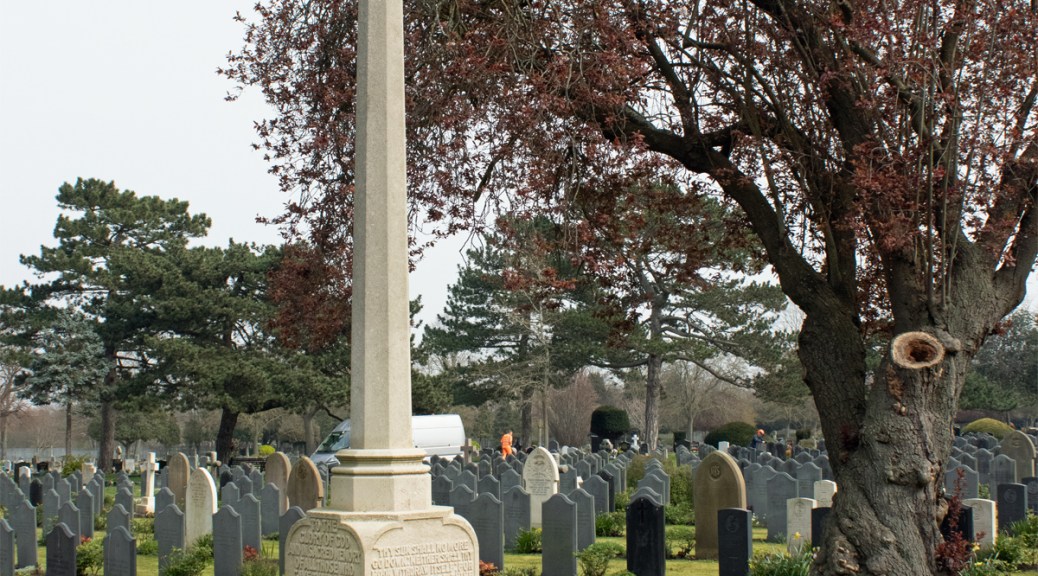
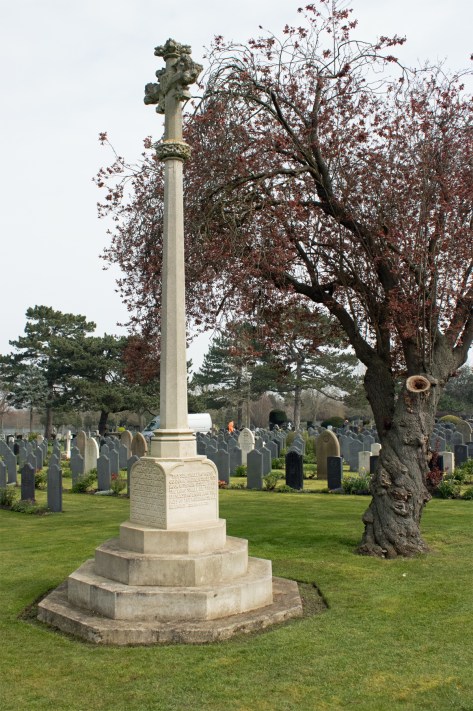
[Note: the photo above is of the memorial to the Chatham Air Raid victims, close to the mass grave for those whose bodies were not identified, in Woodlands Cemetery, Gillingham, Kent.]
The funeral of John William Venney (27), a trimmer in the minesweeping section of the RNR, who was one of the victims in the Chatham air raid, took place on Saturday afternoon with full naval honours. A contingent of men from the minesweepers formed an escort, and with the body resting on a gun-carriage, covered by the Union Jack, the cortege attracted a lot of sympathetic interest as is proceeded from deceased’s home, at No. 40 Elliston-street. A large number of people assembled at the cemetery, and, after the body had been committed to the grave, the naval firing party paid the last honours to their comrade. Deceased was one of a number of Grimsby men who were accommodated at Chatham. Several of them were killed but all, with the exception of Venney, were buried at Chatham.
[Grimsby News: Friday 14th September 1917]
John William Venney was born on 6th July 1890 in Grimsby, Lincolnshire. The oldest of eight children, of which five survived childhood, his parents were William and Ann Venney. William was a sailor, and, when he finished his schooling, John also went to sea, taking work as a ship’s fireman.
In 1914, John married Florence Johnson. There is little information about her life: she was born in Lincoln, Lincolnshire, in the summer of 1892, but there is no further documentation for her. The couple went on to have a daughter, Ivy, in October 1916.
By this point, war was raging across Europe, and John would be called upon to play his part. Assigned to the Royal Naval Reserve as a Trimmer, his service papers show that he was 5ft 6ins (1.67m) tall, with blue eyes and a sallow complexion.
Formally enlisted on 13th June 1917, Trimmer Venney spent the next three months at the Royal Navy’s shore bases in Chatham (HMS Pembroke) and Sheerness (HMS Actaeon), Kent. Pembroke was a particularly busy and overcrowded place at this point in the war, and John found himself billeted in temporary accommodation in the Drill Hall.
On the night of the 3rd September 1917, the German Air Force carried out a bombing raid on the North Kent coast. Chatham found itself in the firing line, and the Drill Hall received two direct hits. Dozens of sleeping men died in the explosions that followed, Trimmer Venney among them. He was 27 years of age.
The body of John William Venney was taken back to Lincolnshire for burial. He was laid to rest in Cleethorpes Cemetery.
[Note: the photo above is of the memorial to the Chatham Air Raid victims, close to the mass grave for those whose bodies were not identified, in Woodlands Cemetery, Gillingham, Kent.]
William Edward Sullivan was born in Newport, Monmouthshire, on the 9th November 1898. He was one of seven children to John and Mary Sullivan. John was an iron dresser at a local foundry, but also worked as a grocer. The 1901 census found the family living at 15 Church Street, to the south of the town centre, but by 1911 they had moved to a larger property, 2 Scard Street.
When William finished his schooling, he took up work as a clerk. War broke out in the summer of 1914, and he would be called upon to play his part. On the 18th September 1916, he enlisted in the Royal Navy, taking the rank of Ordinary Seaman. His service papers show that he was 5ft 6.5ins (1.69m) tall, and that he had light brown hair, brown eyes and a fair complexion.
Ordinary Seaman Sullivan was sent to HMS Victory, the Royal Naval Dockyard in Portsmouth, Hampshire, for his training. By the end of May 1917, however, he had been transferred to HMS Pembroke, which was also known as Chatham Dockyard.
The base was a busy and overcrowded place by this point in the war, with a number of factors leading to temporary accommodation being set up in the dockyard’s Drill Hall. This is where William, who appears to have been waiting for his first formal posting, was billeted.
On the 3rd September 1917, the German air force carried out a daring night time raid on the North Kent coast. Chatham was in the firing line, and two bombs scored direct hits on the Drill Hall. Its glass roof shattered, raining shards down on the sleeping men. Dozens were killed in the explosions, and tens more, including Ordinary Seaman Sullivan, were wounded.
William was taken to the Royal Naval Hospital in Chatham for treatment, but his wounds would prove to be too severe. He passed away on the 4th September 1917, aged just 18 years old.
The body of William Edward Sullivan was taken back to Wales for burial. He was laid to rest in St Woolos’ Cemetery, a short walk from where his family still lived.
[Note: the photo above is of the memorial to the Chatham Air Raid victims, close to the mass grave for those whose bodies were not identified, in Woodlands Cemetery, Gillingham, Kent.]
William James Steed was born on 3rd August 1897 in the village of Reculver, near Herne Bay, Kent. The oldest of three children, he was the only son to Gilbert and Edith Steed. Gilbert was a platelayer for the South Eastern and Chatham Railway, and the family lived in the hamlet of Hillborough.
When he finished his schooling, William took up work as a general labourer. “…he worked for Mr Hardy in the building of the King’s Hall at Herne Bay, and on the Herne and Reculver Sewage Works, and subsequently at the colliery at Westbere.” [Herne Bay Press: Saturday 15th September 1917]
Gilbert died in September 1912 and, when war broke out, William stepped up to serve his country. He enlisted in the Royal Navy on 9th November 1915, taking the role of Stoker 2nd Class. His service records show that he was 5ft 10.5ins (1.79m) tall, and had light brown hair, brown eyes and a fresh complexion. He was also noted as having a linear scar on the dorsum on [his left] index finger.
Stoker Steed was sent to the Royal Naval Dockyard in Chatham, Kent – also known as HMS Pembroke – for his training. Within a couple of months he was given his first posting, on board the battlecruiser HMS Inflexible. She “took part in the Battle of Jutland. He came safely through this; but later was the victim of an accident, and was for some time in hospital.” [Herne Bay Press: Saturday 15th September 1917]
Details of the accident have been lost to time, but William, who had been promoted to Stoker 1st Class on 1st June 1916, returned to HMS Pembroke to recuperate. He was given a short period of leave, during which he returned home, but was back on base by the end of July 1917.
Pembroke was a busy and overcrowded place by this point in the war. The battleship HMS Vanguard had been sunk, and its planned replacement crew were left in the dockyard to await new postings. In addition, an outbreak of meningitis meant that additional accommodation was set up, in an attempt to slow the spread of infection. Stoker 1st Class Steed was among those to be billeted in temporary digs in the dockyard’s Drill Hall.
Britain’s improving defences meant that daytime raids by the German sir force were being thwarted. They changed tack, and, on 3rd September 1917, they attempted a night time raid on the North Kent coast. Chatham bore the brunt of the attack, and two bombs landed direct hits on the Drill Hall. Its glass roof shattered, raining shards down on the sleeping men below. Dozens were killed in the explosions, including Stoker 1st Class Steed: he had not long turned 20 years of age.
The body of William James Steed was taken back to Reculver for burial. He was laid to rest in the graveyard of St Mary’s Church, the newspaper reporting that “All who knew him speak of him as a good living young fellow, who won the respect of all, and his mother and sisters have lost a good son and brother.” [Herne Bay Press: Saturday 15th September 1917]
[Note: the photo above is of the memorial to the Chatham Air Raid victims, close to the mass grave for those whose bodies were not identified, in Woodlands Cemetery, Gillingham, Kent.]
Sydney Gordon Rigden was born in Whitstable, Kent, on 29th June 1897. One of six children, his parents were William and Annie Rigden. William was a fishmonger, and the family lived above the shop, at No. 43 High Street.
When Sydney finished his schooling, he took work as a general labourer. He was called upon to serve his King and Country, however, and, on 27th June 1916, he was conscripted into the Royal Navy. Stoker 2nd Class Rigden’s service papers note that he was 5ft 6ins (1.68m) tall, with brown hair, grey eyes and a fresh complexion.
Sydney was sent along the coast to HMS Pembroke, also known as Chatham Dockyard, for his training. He remained there for a couple of months, before being given his first and only posting, on board the light cruiser HMS Dartmouth. A seasoned ship, she had already seen action in Africa and the South Atlantic and, in the year before Stoker Rigden joined her, she formed part of the support for the Gallipoli campaign.
Stoker Rigden spent seven months with Dartmouth, much of that serving in the Adriatic. On 1st May 1917 he was promoted to Stoker 1st Class, and he returned to Britain towards the end of that month.
In the summer of 1917, Sydney married his childhood sweetheart, Annie Mount. The daughter of a carter, by the time of the 1911 census, she had taken up work as a domestic servant for retired commercial traveller Alexander Paterson and his family. Just 14 years old at this point, she lived with the family, at 186 Lower Clapton Road, London.
After the wedding, Stoker 1st Class Rigden returned to duty, and to HMS Pembroke. The base was a particularly overcrowded place by this point in the war, and temporary additional accommodation was set up. Sydney was one of those to be billeted in the dockyard’s Drill Hall.
On the night of the 3rd September 1917, Chatham came under fire during a daring German air raid. Two of the bombs that were dropped landed squarely on the Drill Hall, shattering its glass roof, and killing dozens of men who were sleeping below. This included Stoker 1st Class Rigden: he was just 20 years of age.
The body of Sydney Gordon Rigden was taken back to Whitstable for burial. He was laid to rest in the town’s cemetery.
Annie was now widow after just a couple of months’ marriage. Sadly, she disappears from the records, so it is unclear what became of her.
[Note: the photo above is of the memorial to the Chatham Air Raid victims, close to the mass grave for those whose bodies were not identified, in Woodlands Cemetery, Gillingham, Kent.]
James Richards was born in Liverpool, Lancashire, on 4th September 1891. The second of nine children, his parents were John and Christina Richards. John was a carter for the local railway and, according to the 1901 census, the family had rooms at 41 Paget Street, to the north of the city centre.
James sought a more permanent career for himself, and enlisted in the Royal Navy. Sadly, his service record has been lost, but the 1911 census return found him listed as one of the 786 crew of the battleship HMS Inflexible. Captained by Charles Napier, at the time of the census, she was moored off Howth Head, near Dublin, Ireland.
By the summer of 1917, Stoker 1st Class Richards found himself at HMS Pembroke, the Royal Naval Dockyard in Chatham, Kent. The base was busy and overcrowded at that point in the war: the battleship HMS Vanguard had been sunk, and its replacement crew were barracked in Chatham, waiting for new assignments. Add to this an outbreak of spotted fever, and temporary accommodation was set up to help space out the billets and slow its transmission. It was in this accommodation – set up in Pembroke’s Drill Hall, that James found himself sleeping.
On the night of the 3rd September 1917, the German air force carried out a daring raid on the North Kent coast. Chatham came under fire, and two bomb scored direct hits on the Drill Hall. Dozens of sleeping men were killed, while countless others, including Stoker 1st Class Richards, were injured.
James was taken to the Royal Naval Hospital in the town, but his wounds would prove too severe. He passed away on 4th September 1917, his 26th birthday.
The body of James Richards was taken back to Liverpool for burial. Strict Roman Catholics, John and Christina laid their son’s body to rest in the city’s Ford Cemetery.
[Note: the photo above is of the memorial to the Chatham Air Raid victims, close to the mass grave for those whose bodies were not identified, in Woodlands Cemetery, Gillingham, Kent.]