

Austin Wyard Blackie was born in Spring Bay on Ontario’s Manitoulin Island on 17th November 1895. The seventh of eight children, his parents were farmers John and Mary Blackie. John took the family to where the work was: by the time of the 1901 census they had relocated to Algoma, 190km (120 miles) to the north west.
Little further information is available about Austin’s early life. When war broke out, he stepped up to play his part. His military records take a bit of unpicking, but he joined the Canadian Expeditionary Force on 10th April 1916, and was assigned to the 227th Battalion as a Sergeant. He was dismissed from service on 15th December 1916, as he was deemed medically unfit.
Undeterred, Austin’s service papers confirm that he re-enlisted on 7th March 1917, and that he was a student at the University of Toronto Officers’ Training Corps at the time. This document also gives his year of birth incorrectly as 1894.
Austin’s medical in 1917 confirmed that, at 22 years of age (based on the incorrect year of birth), he was 5ft 7.5ins (1.71m) tall and weighed 143lbs (64.9kg). He had fair hair, grey eyes and a fair complexion, good hearing and 20/20 vision. He was also recorded as having a number of scars: two either side of his stomach from an operation, and a third on the right side of his left ankle.
Sergeant Blackie’s time in the army was not destined to be a lengthy one, and there is a sense of his determination to better himself. On 5th May 1917, he was discharged from service again, but this time because he mad the transfer to Canadian Royal Flying Corps.
At this point, Austin’s trail goes frustratingly cold. He was shipped out to Britain, and was based at the 29th Training Depot Station in East Boldre, Hampshire. When the Royal Air Force was formed, he transferred across, and, at some point during this time, he was promoted to the rank of Lieutenant.
Mr A C Hallett, Deputy County Coroner, held inquests on Tuesday, of Lieut. Austin Wyard Blackie, RAF, of California, and Second-Lieut. Arthur Fred Belyea, RAF, of Calgary, Canada, who met thwir deaths while flying. The evidence showed that their machines collided at a great height, and that death in each case must have been instantaneous. Verdicts of “Accidental death” were returned.
[Hampshire Advertiser: Saturday 21st September 1918]
The report’s suggestion that Austin was from California is incorrect, although his parents had, by this point, moved there from Canada.
The RAF’s own report gave a little more detail on what happened:
The court considered the evidence, found that the cause of the accident was entirely due to misadventure in that the [Lieutenant Blackie’s] foot became entangled behind the rudder bar, the machine thus being our of control.
It appears that Austin had been offered a different aircraft to the Sopwith Camel in which he he had been killed. “He apparently took his machine up without asking his Flight Commander’s permission or his Instructor’s, contrary to standing orders.”
Second Lieutenant Belyea’s report card adds a stark twist to the crash: “The cause of the accident was in our opinion an error of judgement on one pilot (unknown) in flying his machine into the other machine from the rear, causing the left hand frame of Camel C8322 and the right hand frames of Camel C96 to collapse, thus causing each machine to spin to the ground. The one pilot was probably attempting to obtain good photographs of the other machine.”
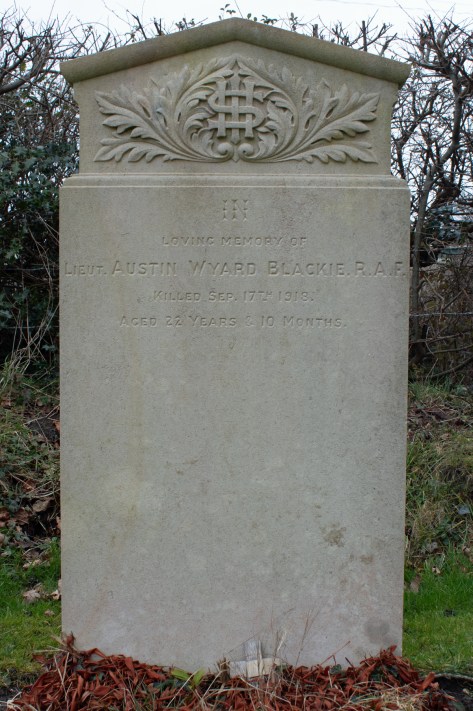
Austin Wyard Blackie was just 22 years of age when he died on 17th September 1918. He was laid to rest alongside Second Lieutenant Belyea in the graveyard of St Paul’s Church, East Boldre, not far from the base in which he had served.
You can read about Second Lieutenant Belyea’s life here.

(from findagrave.com)
 Death and Service
One thought on “Lieutenant Austin Blackie”