
Charles Albert Frost was born in Daventry, Northamptonshire, at during the winter of 1882/3. The third of eight children, his parents were William and Louisa Frost. William was a foreman at a shoe factory in Northampton and, at the time of the 1891 census, the family were living at what looks to be 47 Ardington Road or Abington Road (the return is not clearly legible).
Charles also found work in the shoe trade when he completed his schooling, but his is not a career he wanted to make for himself. Instead he was drawn to the army and, on 26th January 1900, he joined up. The now Driver Frost’s service records show that, at 18 years of age, he was 5ft 4.5ins (1.63m) tall and weighed 127lbs (57.6kg). He had brown hair, blue eyes and a fresh complexion.
Assigned to the Army Service Corps, Charles spent the next few years on home soil. Attached to the 17th Company, he would work hard and that dedication would pay off. He was promoted to Lance Corporal in April 1902, and 2nd Corporal just six months later. By January 1903 he had risen to Corporal, extending his term of service the same month.
Interestingly, in March 1904, Charles reverted to the role of Driver at his own request. He would remain at that rank until for the next four years, when he was stood down to reserve status.
The 1911 census found Charles living back home with his parents and siblings. By this point there were six adults and three children living at 74 Hood Street, Northampton, a seven-roomed terraced house on the east of the town centre. Charles had found work as a blouse cutter in a local factory, and with his father and older siblings all involved in factory work in some way.
Life on civvy street seemed not to appeal, however, and in November 1911 Charles was re-engaged with the Army Service Corps. This was initially planned to be for four years, but he would remain in the army for nearly twice that long.
In August 1914, Driver Frost was shipped out to France. and, barring leave, he would remain there for the next three years. In the summer of 1915, he returned home briefly, marrying Daisy Harris at St Edmund’s Church in Hardingstone, Northamptonshire, when he did so. He was soon sent back out to France, however, and remained on the other side of the Channel until April 1917.
Back on home soil, Charles’ career had taken a surprising turn. In January 1915 he was promoted to Acting Corporal, rising to Acting Sergeant just four months later. By November 1916 he had been promoted to Acting Quartermaster Sergeant, a role that was formalised just four months later.
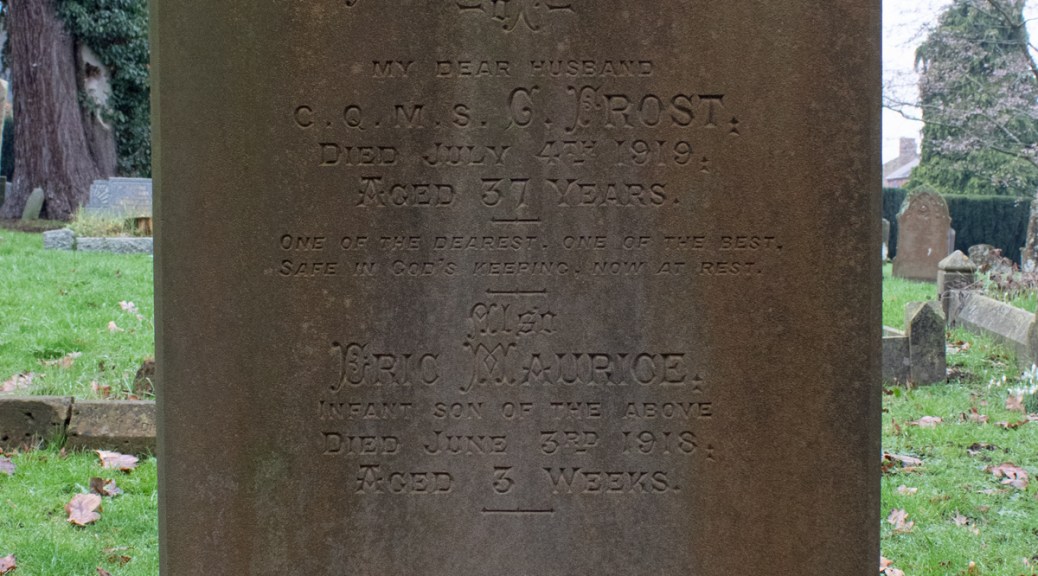
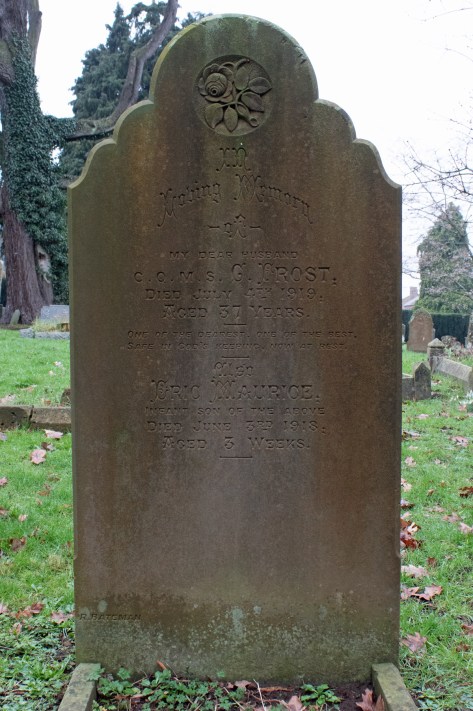
In May 1918, Daisy gave birth to their first – and only – child, a boy they called Eric. Tragically, he passed away just three weeks later, from a combination of pemphigus and asthma: with Charles away, Daisy had to register the death.
Quartermaster Sergeant Frost survived the war, but was admitted to the Mill Road Hospital in Liverpool, Lancashire, on 28th June 1919. He was suffering from a cerebral tumour, but his treatment would prove ineffectual. He died at 3:20am on 4th July 1919: he was 37 years of age.
The body of Charles Albert Frost was taken back to Northamptonshire for burial. He was laid to rest in the graveyard of St Edmund’s Church, Hardingstone, alongside Eric: a father and son reunited.
Daisy had not lost her son and husband in just over a year. The 1921 census found her back living with her father and sister, carrying out home duties while they worked.
 Death and Service