
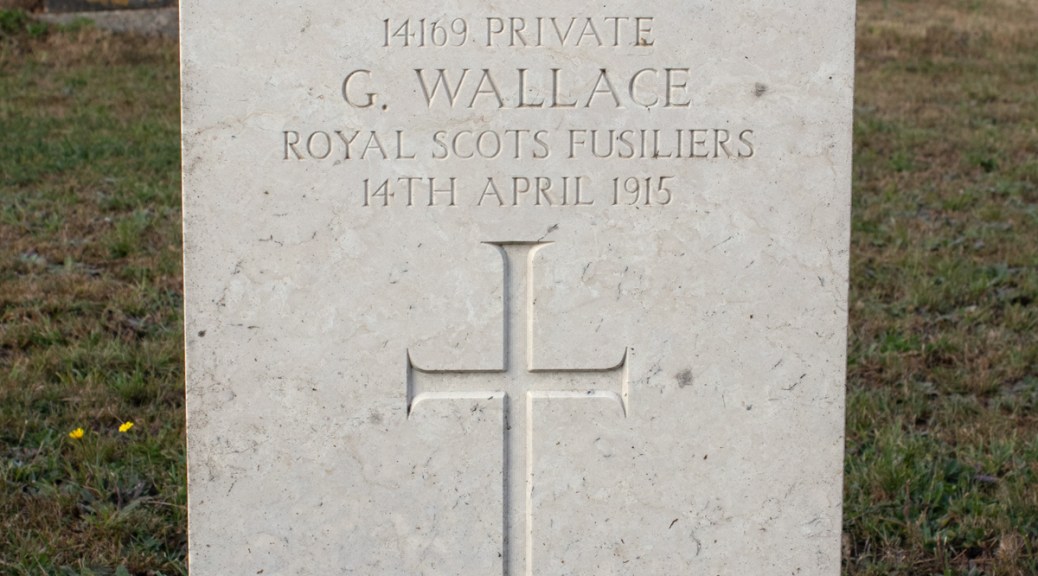
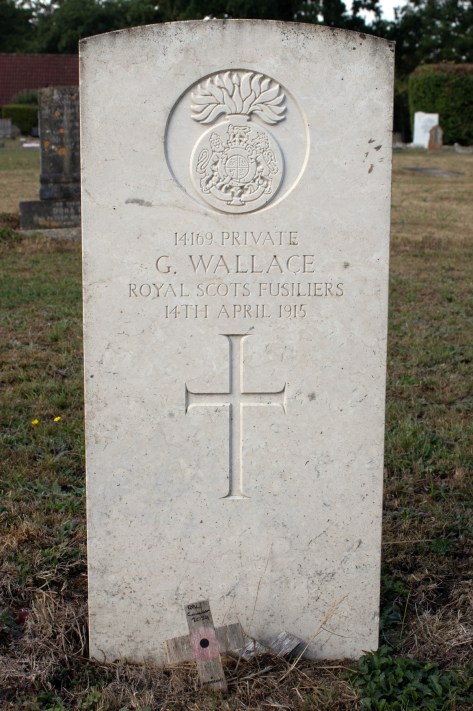
In the town cemetery of Gillingham, Dorset, is the grave of Private G Wallace of the Royal Scots Fusiliers, who died on 14th April 1915. His entry in the British Register of Soldiers’ Effects confirms his first name as George, and that he died on the town’s Leatham Red Cross Hospital. Private Wallace was recorded as being in the 8th Battalion, and his beneficiary was noted as being his father, James.
Unfortunately, beyond this, there is little concrete information about George’s early life: his regiment would suggest that he was born north of the border, but, without a year or location of birth, it is impossible to narrow down the documentation.
A newspaper report does, however, confirm how his life came to an end:
An inquest was held at the Drill Hall on Friday morning, on the body of Private George Wallace, of the Royal Scots Fusiliers, who died at the Gillingham Red Cross Hospital as a result of injuries by the kick of a horse at Codford Camp… Corporal James Doig, of the 12th Argyll and Sutherland Highlanders, said the accident occurred on the Wednesday, April 7th. The stable was only an open shed, and deceased was going up the near side of the horse when it let our and kicked Wallace in the pit of the stomach and knocked him over. He fell in towards the stall among the feet of the horse, which let out again and caught him in the head. While witness went to the horse’s head another witness Private O’Neil, hauled Wallace our. When Wallace was pulled out O’Neil took him to the field hospital, where he managed to walk with some assistance. Lieutenant WE Hopkins, RAMC, proved attending to the deceased as far as possible. There were no facilities for serious cases, and, thinking it was only a case of slight concussion, he had the deceased sent to the Gillingham Red Cross Hospital. If he had been aware it was a fracture of the skull, he should have sent the case to Salisbury Infirmary. The field hospital was only a detention ward, with no hot or cold water supply and no instruments. He cleaned the wound in the head as far as possible. Dr Huntly said he examined the deceased at the Gillingham Hospital. The skull was fractured, and everything was done for him by himself and Dr Morgan, but he died from septic inflammation. If the wound had been “sweet” it would have given him a better chance after the operation was performed. A verdict of “Accidental death” was returned.
[Southern Times and Dorset County Herald: Saturday 24th April 1915]
The body of George Wallace was laid to rest in Gillingham Cemetery, not far from the hospital in which he had died.

