
Category Archives: Royal Lancashire Regiment

Sapper William Dove

Sapper William Dove

William Henry Dove was born in the autumn of 1871 in Stafford, Staffordshire and was one of seven children to William and Louisa Dove. William Sr was a gardener by trade, but his son wanted bigger and better things.

On leaving school, he initially took up a post as a junior teacher, but military service was calling him and, on 21st February 1891 he enlisted in the Royal Lancaster Regiment. Private Dove’s service records show that he was 5ft 7ins (1.70cm) tall and 136lbs (61.8kg) in weight. He had sandy hair, grey eyes and a fair complexion. He also gave his age as 18 years and 3 months, although he was actually a year older.

Private Dove signed up for seven years’ service and completed this on home soil. In October 1891 he was promoted to Lance Corporal, and a year later he was promoted again, this time to Corporal.

In November 1894, William was found guilty of ‘conduct to the prejudice of good order and drunkenness‘ and was sentenced to be reduced in rank, so became a Private again. He learnt the error of his ways, though, and was reinstated to Lance Corporal in March 1897.

William’s service was completed in February 1898, and he was transferred across to the Army Reserve. This was intended to be for a further five years, but on 15th February 1900, he was discharged from future active service, having been found to be medically unfit. During his time in the army, William had been treated for a two bouts of gonorrhoea, as well as four further infections. The cause of his final medical discharge, however, is unclear.

While on reserve, William had found employment as a railway porter. His work took him to Llangollen, Denbighshire and, this is where he set up home. On 18th April 1899, he married Ellenor Roberts, a labourer’s daughter from the town: the young couple set up home in Ashfield House, Regent Street – now the busy A5.

The 1911 census records William as a porter: the couple had no children of their own, but had adopted a girl, Cissie, who was then eight years old. A live-in domestic servant – Esther Williams – was also recorded on the census.

War was coming to Europe by this point and, while details of his service are unclear, William stepped up to play his part once more. He enlisted in the Royal Engineers as a Sapper, at some point during the conflict, although exact details are lost to time.

Sapper Dove survived the war and returned to Llangollen. The 1921 census records him Ellenor and Cissie living at Bronhaul, and that William was working as a parcel’s porter for Great Western Railways. On 18th August 1921, he collapsed and died with a brain aneurysm. He was 39 years of age.

William Henry Dove was buried in the graveyard of St John’s Church in Llangollen, a short distance from the station at which he portered for so long.


Ellenor lived on until her late 70s. When she passed away, she was laid to rest in the family plot, reunited with her husband after 35 years.
Private Arthur Rousell

Private Arthur Rousell

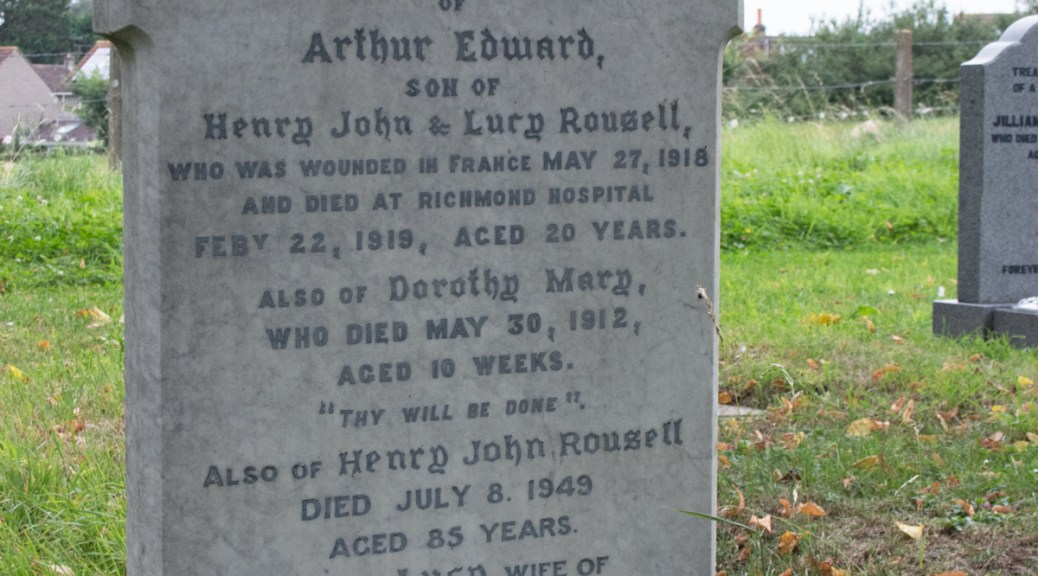
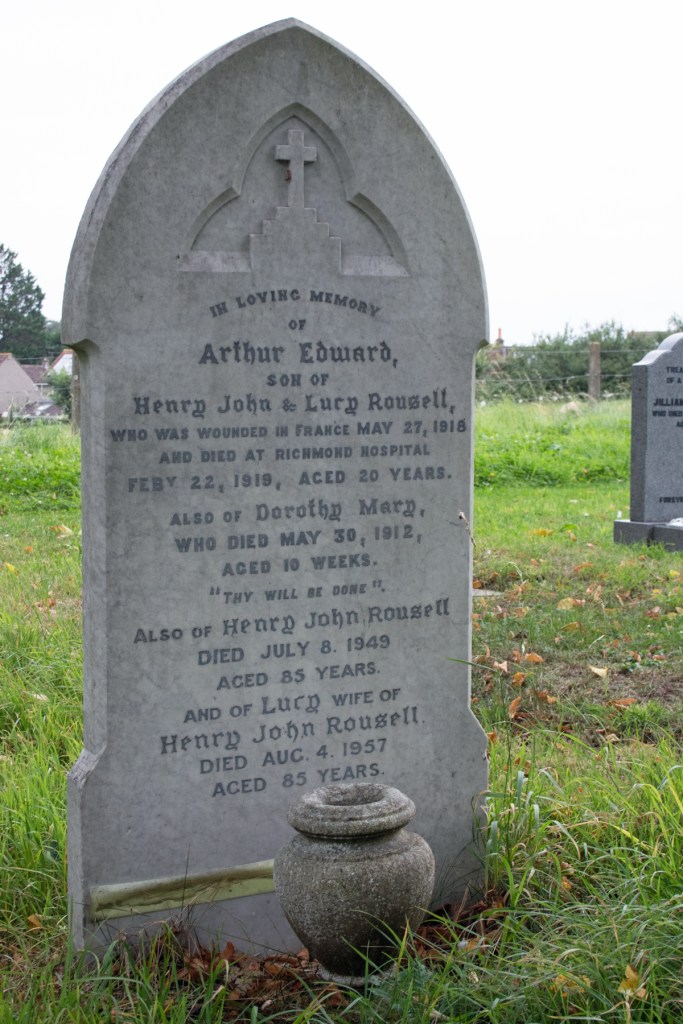
Arthur Edward Rousell was born in the summer of 1898, one of five children to Henry and Lucy Rousell. Henry was a police constable in Worle, near Weston-super-Mare, and this is where he initially raised his family. By the time of the 1911 census – when Arthur was a schoolboy of 12 years old – the family had moved to the village of Huish Episcopi, on the outskirts of Langport.

Details of Arthur’s military career are sketchy. Initially enlisting with the Royal Lancashire Regiment, he was soon transferred over to the 1st Battalion of the Lincolnshire Regiment. He certainly saw action abroad, and was caught up on the Western Front.

Private Rousell was injured on 27th May 1918, this the first day of the Battle of Aisne. His battalion was certainly involved in the battle, but whether this was where he was injured, and what his injuries actually were, cannot be confirmed.

Evacuated back to England for treatment, Private Rousell was admitted to the South African Hospital in Richmond. Whether he was there for a long time, is not recorded, but he was certainly there in nine months after he was wounded.

It seems that his injuries left him susceptible; his pension record confirms that he died of sickness, and it seems likely that this was one of the lung conditions – pneumonia, influenza – that was prevalent following the cessation of hostilities.

Private Arthur Edward Rousell died on 22nd February 1919, at the age of 20 years old. His body was brought back to Huish Episcopi, and he lies at rest in the family grave in the graveyard of St Mary’s Church.


UPDATE : 19th April 2022

An article on Arthur’s passing sheds more light onto his life:

We regret to record the death of Pte. AE Rousell, of the 1st Lancs. Regt., eldest son of PC and Mrs HJ Rousell of Newtown, which occurred at Richmond Hospital on Saturday morning. Deceased, who was 20 years of age, had been seriously ill a week with influenza, death being due to septic pneumonia, which followed.

The late Pte. Rousell, was a member of the staff of “The Langport and Somerton Herald” where he served his apprenticeship, when war broke out, and joined up early in 1917, his regiment being the King’s Own Yorkshire Light Infantry. After a period of training he proceeded to the front and took part in several engagements. He was gassed, and in the winter of that year was invalided home with trench feet. On recovery he was transferred to the Lancs. Regt., and again proceeded to the front.

On May 27th last he was severely wounded in the right leg by shrapnel, the bones being badly splintered. He was sent to a military hospital in this country and had been in hospital ever since. He had made a fairly good recovery and his parents were expecting him home shortly, when on Thursday last week a wire was received, informing them of his serious illness. Mrs Rousell at once proceeded to Richmond and was able to see her son before he passed away.

Deep sympathy is extended to the relations in their sad bereavement.

Langport & Somerton Herald: Saturday 1st March 1919