Category Archives: Surrey

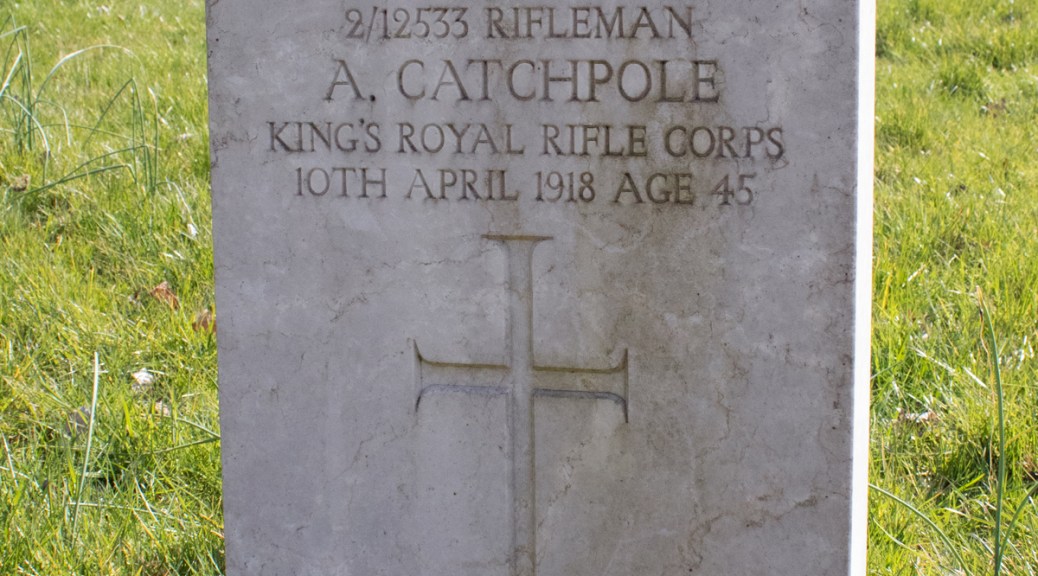
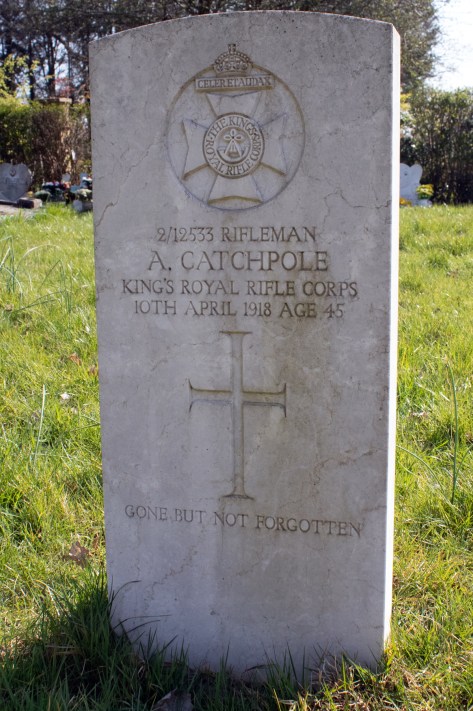
Rifleman Arthur Catchpole

Rifleman Arthur Catchpole

Arthur Ernest Catchpole was born in the spring of 1874 in the Suffolk village of Aldringham. The seventh of eight children, and the youngest of two boys, his parents were Joseph and Sarah Catchpole.

Joseph was employed as a gas fitter and, by the time of the 1881 census, had moved the family to Croydon, Surrey, presumably for work. The document recorded the family as living at 8 Cecil Terrace, a small cottage to the north-west of the town centre.

It seems that Arthur sought a way out as early as he could. The next census he appears on is from 1901, and this gives his profession as a Private in the King’s Royal Rifle Corps. Intriguingly, there is a record for a solder from Suffolk by his name, who was imprisoned in Dumfries in 1891. There are no other documents relating to the offence, but, as Arthur is absent from that year’s census, a link seems possible.

The 1901 census recorded Arthur – who was now known by his middle name – as living in the village of Speldhurst, between Tonbridge and Tunbridge Wells, in Kent. It also confirms that he was married, he and local woman Ellen Hoadley having exchanged vows in the summer of 1896. The would go on to have ten children between 1896 and 1916, all of them boys.

By the time of the next census return, the Catchpole family had moved back to Surrey, and were living in a small cottage at 12 Paxton Place, West Norwood. Ernest was now working as a domestic gardener, with Ellen left to raise their then seven sons.

When war came to Europe in the summer of 1914, it is likely that Ernest stepped up to play his part. Full details of his time in the army have been lost to time, but he was medically discharged from service on 10th February 1916. Arthur (his military documents reverting to his first name) had contracted tuberculosis, and was suffering from chronic myocarditis, and, as a result, was deemed unfit to remain a soldier.

At this point, Arthur’s trail goes cold. It seems likely that he returned home, with a later document noting the family’s residence as 4A Durban Road, a ground-floor flat in a Victorian terrace house.

It seems likely that Arthur’s health caught up with him. He passed away on 10th April 1918: he was 44 years of age. His widow posted a note in the local newspaper: “In loving memory of Ernest Arthur Catchpole, late of KRR, the beloved husband of Ellen Catchpole, who fell asleep on 10th April, 1918.” [Norwood Press and Dulwich Advertiser: Saturday 20th April 1918]

The body of Arthur Ernest Catchpole was laid to rest in the sweeping Streatham Park Cemetery, a short distance from his grieving family.


Lieutenant W Fairbairn

Lieutenant W Fairbairn

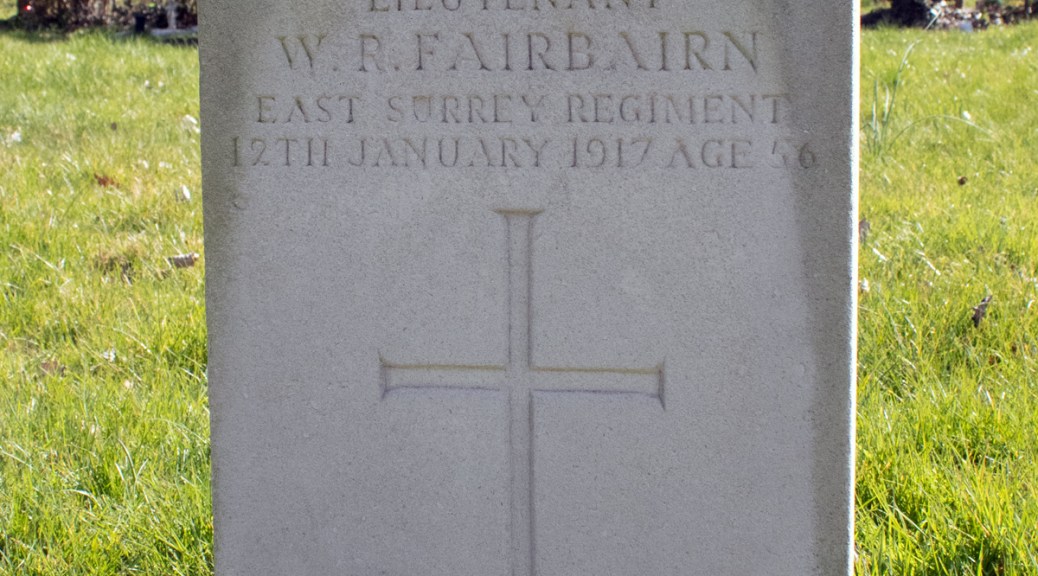
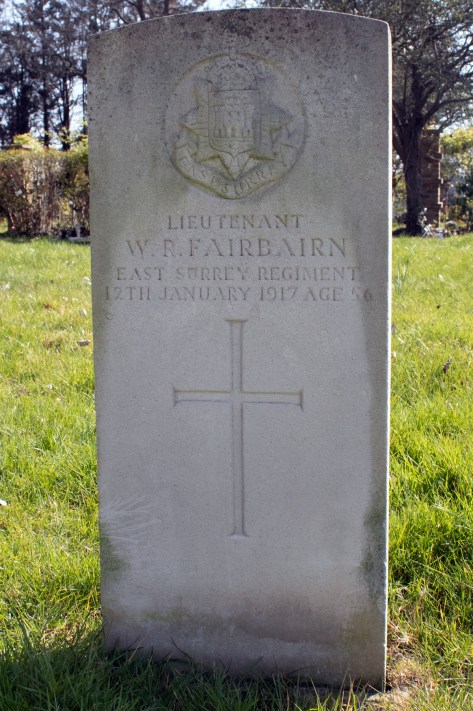
In the sprawling Streatham Park Cemetery, Surrey, is a headstone dedicated to Lieutenant WR Fairbairn of the East Surrey Regiment, who died on 12th January 1917, at the age of 56.

There is frustratingly little information available about Lieutenant Fairbairn. The Commonwealth War Graves Commission records confirm his widow as Mrs F Fairbairn, of 35 Egerton Road, Bexhill-on-Sea, Sussex, but this was a boarding house and the couple were not resident there at the time of the 1911 census.

Without a confirmed first name, or place of birth, it isn’t possible to track down baptism or parental records, and Lieutenant Fairbairn’s name does not appear in contemporary newspaper reports.

As a commissioned officer, standard military records do not exist, and with no service number available, his time with the East Surrey Regiment is a mystery.

One document gives a tiny insight into Lieutenant Fairbairn’s life: the Hospital Registers for 1914-1919 confirms that he was admitted to the Queen Alexandra Military Hospital on Millbank, Westminster, on 12th December 1916. While the document doesn’t confirm his first name, it does show that he had been in the army for some 41 years, which might explain his absence from any census records. Now attached to the 21st Training Reserve, he was suffering from chronic bronchitis and nephritis.

Lieutenant Fairbairn was discharged from hospital on 6th January 1917, and for the next six days his trail goes cold. Whether he was sent to Streatham to recuperate, or whether he was based there with his wife is unclear.

Either way, Lieutenant WR Fairbairn passed away on 12th January 1917, ad the age of 56 years old. He was buried in Streatham Park Cemetery, taking the details of much of his life with him.


Serjeant Alexander Hurst

Serjeant Alexander Hurst

Within a few weeks of following his youngest brother Fred to the grave, Sergt. Alexander Hurst has himself passed away, after a shirt but severe illness, in his 55th year. Born at the Grammar School, Cavendish, on Michaelmas Day, 1862 (being the day on which his father, the late Mr Robert Hurst, commenced his duties as headmaster there) he early closely associated himself with the social life of the village. A keen sportsman, he achieved considerable success on the cricket field, being a stead batsman, and a bowler with plenty of “spin.” He also devoted much time and study to campanology, an ort of which he was a skilful exponent, and composed several peals. On leaving Cavendish in 1884, he was the recipient of a handsome testimonial from the parishioners in recognition of the good work he had done in the village… At Long Melford he was for many hears a member of the Volunteer force, in which he attained the rank of Sergt. He was an excellent rifle shot, and on several occasions he the satisfaction of figuring in the prize list at Bisley. On the football field he was a particularly neat half-back, and was a member of the winning County Senior Cup team in the season 1887-88. As a musician Sergt. Hurst showed considerable ability, being gifted with a critical ear, and possessing a baritone voice of sympathetic timbre. For many years he officiated as organist at Bulmer Parish Church. For the past twelve years or so Sergt. Hurst had resided in London, where he was in the employ of Sir Herbert Marshall & Rose as expert piano tuner. Shortly after the outbreak of war, notwithstanding his 50 odd years, he offered himself for service and joined the County of London Battalion with the rank of Sergeant. He devoted himself to his military duties with utmost zeal, and it seems more than probable that his anxiety to serve his country to the best of his ability hastened his end.

[Suffolk and Essex Free Press: Wednesday 7th March 1917]

Alexander Burnett Hurst was the middle of seven children – all boys – to Robert and Margaret Hurst. By the time of the 1881 census, he was teaching at Cavendish Grammar School, Suffolk, which was a small educational establishment with a dozen boarding students.

The next census followed the family’s move to Long Melford, and by this time Alexander was working as a pianoforte tuner, while his older brother Bernard was employed as an organist.

On 30th October 1899, Alexander married Maude Thurston. The daughter of a chemist from Ipswich, Suffolk, the couple married in her local parish church, St Lawrence’s. The couple’s wedding certificate recorded the groom as an organ builder.

By 1901, the newlyweds had set up home in Long Melford, taking a cottage two doors up from the historic Bull Hotel, and next door to Bernard and his family. Alexander was now working as a music teacher, although it seems likely that he had his fingers in many melodic pies by this point.

Alexander and Maude would go on to have three children – daughters Geraldine and Evelyn, and son Kenneth. The 1911 census suggests that the family had moved south by 1907, as this is where young Kenneth was born. The document recorded them in rooms at 134 Kennington Park Road, sharing the building with teachers, actresses and music hall artists.

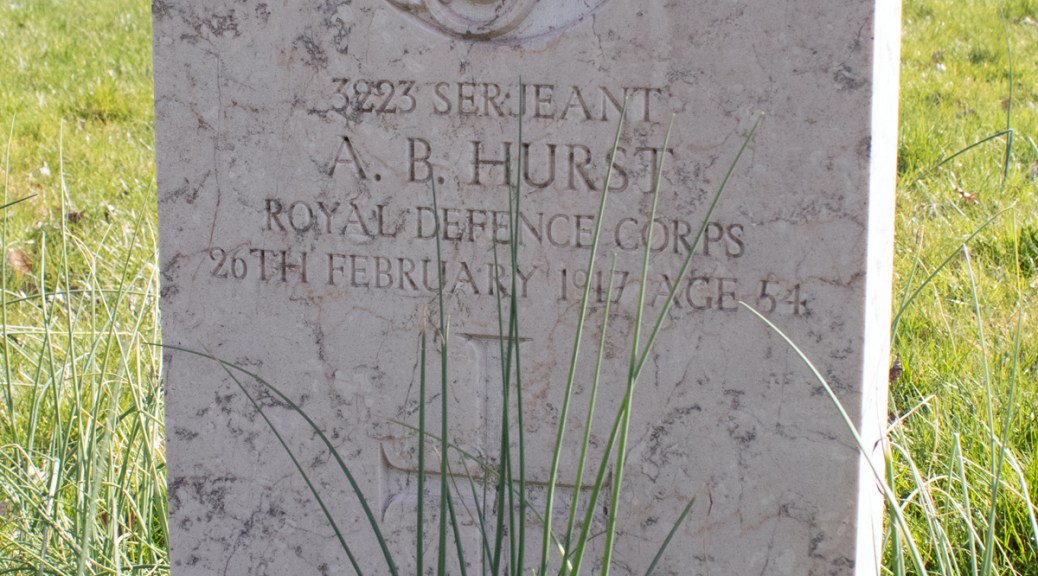
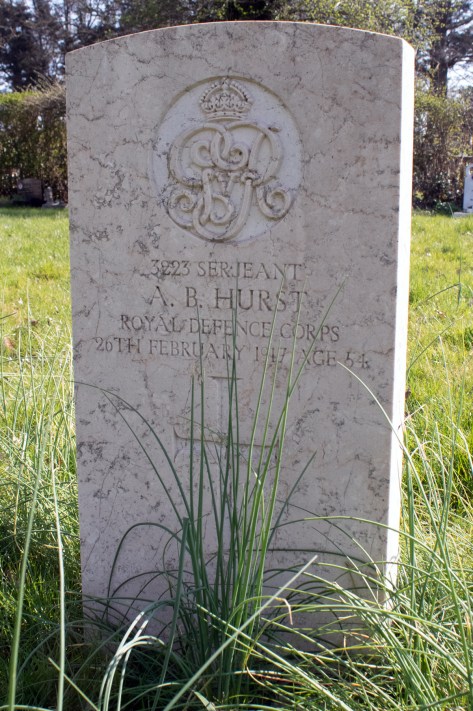
Little information remained about Alexander’s military service. While the newspaper report suggests he was assigned to the London Regiment, other documents confirm he was a member of the Royal Defence Corps. The unit was specifically set up for older service personnel and, attached to No. 1 Protection Company, Serjeant Hurst was based in London.

Alexander Burnett Hurst died from pneumonia on 26th February 1917: he was 54 years of age. He was laid to rest in Streatham Park Cemetery, a short distance from where his widow and family were living.


Maude remained living on Kennington Park Road. By the time of the 1921 census she shared her home with her two daughters – the eldest of whom was working as a clerk and typist for the Shell Motor Oil Company – and her widowed mother, Mary Thurston.


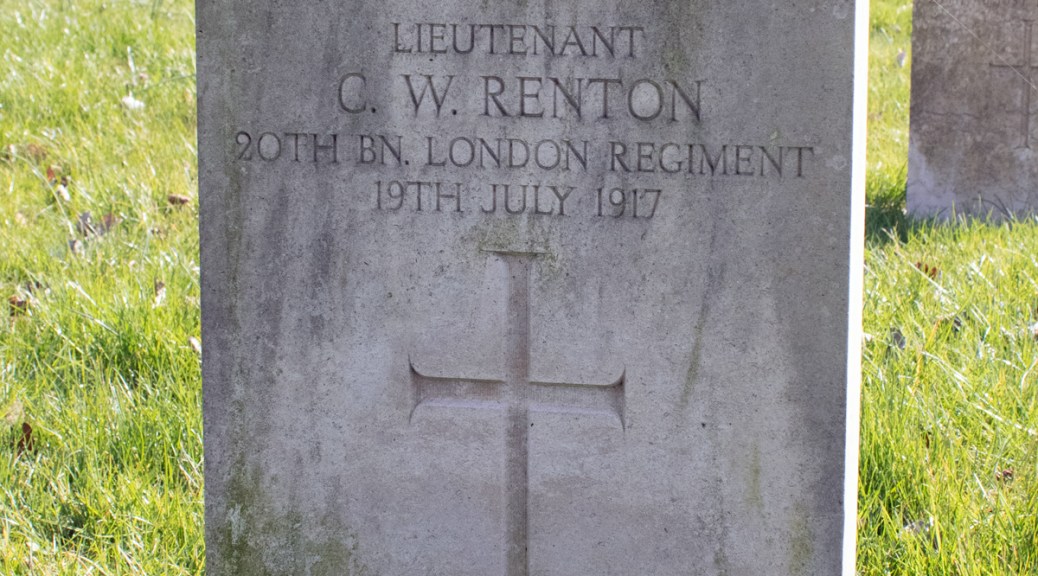
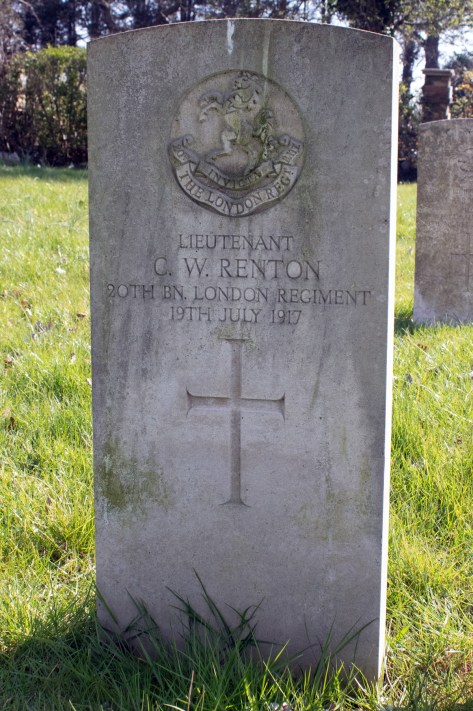
Lieutenant Cyril Renton

Lieutenant Cyril Renton

Cyril William Renton was born in Brixton, Surrey, on 27th November 1872. The older of two children, hie parents were Edward and Emily Renton. Edward was an engraver and artist and, when Emily died shortly after Cyril’s younger brother was born, he married again, to Harriett Predier: the couple went on to have two children, Cyril’s half-brother and half-sister.

By the time of the 1891 census, Edward had moved the family to Hampstead, Middlesex. Setting up home in the illustrious South Hill, their home – a Georgian semi-detached villa backing onto Hampstead Heath – served as a fine setting for the now art dealer head of the household.

When Cyril completed his schooling, he found work as a stockbroker. On 22nd December 1894, he married Mary Nettleton at St Paul’s Church in Kentish Town. Mary was the daughter of a solicitor’s clerk, and Cyril’s new father-in-law seems to have helped his career.

The 1901 census found the young couple living at 33 Tivoli Road in Hornsey, Middlesex. Their eldest child, Lionel, had been born four years before, and Mary’s father and brother were also living with them. Cyril was now recorded as being an articled clerk for a firm of solicitors.

Second son Esmonde was born in 1897, and Cyril’s career continued its upward journey. By 1911 the Rentons had moved to 46 Glasslyn Road in Crouch End, and had taken on two servants to support the family. Cyril was now a full-blown solicitor and counted an estate agent’s clerk, a cement company secretary, a master stevedore and a human hair merchant amongst his neighbours.

[He] practised as a solicitor as the Police Court. For several years he represented the National Society for the Prevention of Cruelty to Children. He was at one time the vice-president of the Highgate Thirty Club, and in 1914-15 became the president.

[Hornsey & Finsbury Park Journal: Friday 3rd August 1917]

While obviously good at his job, Cyril wanted more:

At a time when he seemed very likely to make a big name for himself in the various courts he attended, he decided to dispose of his practice and to study for the bar. In the Michaelmas law examination of 1913 he successfully passed in all the subjects and the “final,” and was thereupon duly “called.” He was getting on extremely well in the higher branch of his profession when war broke out…

[Hampstead & Highgate Express: Saturday 28th July 1917]

Cyril felt a call to serve his country, and so stepped up to enlist.

[He] joined the Inns of Court OTC, and went into training. When he obtained his commission je joined a battalion of the London Regiment, and, having been through a course at Hythe, he became a musketry instructor and was engaged in that capacity for many months. At last the authorities yielded to his repeated applications to be sent on active service, and he went to France. There he had six months’ fighting, and only returned after he had been wounded.

[Hampstead & Highgate Express: Saturday 28th July 1917]

Attached to the 20th (Country of London) Battalion (Blackheath and Woolwich), Lieutenant Renton’s older son, Lionel, was also fighting, and was attached to the 16th Service Battalion – also known as the Public Schools Battalion – of the Middlesex Regiment.

It is unclear whether Cyril returned to the fray, and by the spring of 1917, having recovered from injuries, he fell ill. His health seems to have been impacted by his injuries, and he passed away from his condition on 19th July: he was 44 years of age.

The body of Cyril William Renton was taken to Streatham, Surrey, for burial: the reasons are unclear, but it is likely that this is where his mother and father (who had died in 1904) had been buried. Private Lionel Renton was recuperating from injuries, and was able to attend the funeral with Mary and Esmonde.


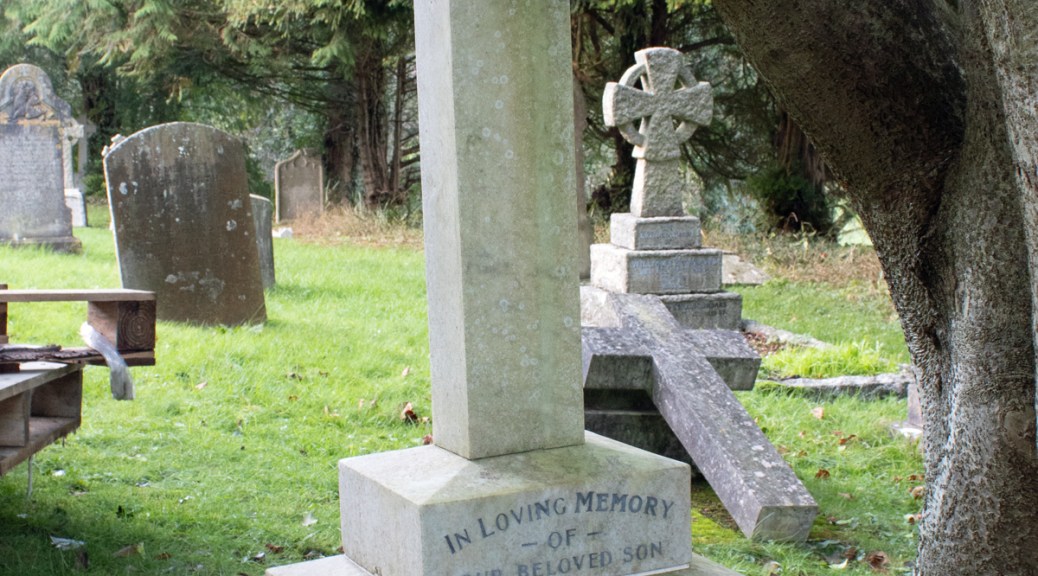
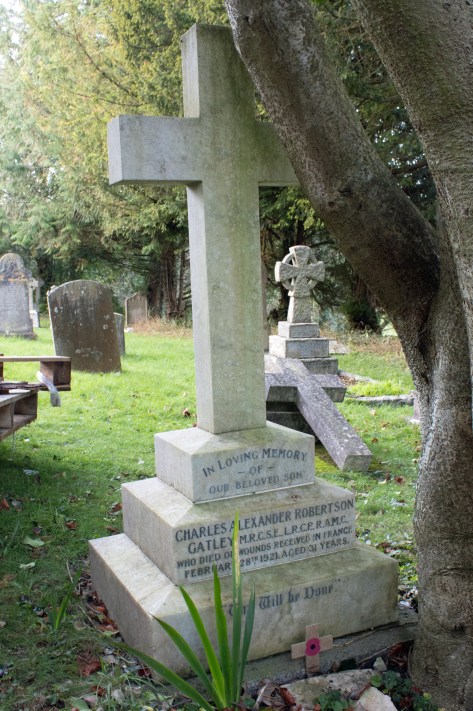
Captain Charles Gatley

Captain Charles Gatley

A gloom was cast over Bratton and the neighbouring villages when it became known on February 28th, that Dr Gatley had passed away, after an illness of about a fortnight. Although he had only lived at Bratton since 1919, he had endeared himself to everyone with whom he came into contact.

Dr Gatley had become partner with Dr Trevor Shorland, of Westbury, in September 1919, and after working for six months with him in Westbury, went to live at Mill Vale House, Bratton. He was the only son of Dr HR Gatley and Mrs Gatley, of Kingston-on-Thames, and received his education at Marlborough College and Guy’s Hospital, London, where he was house surgeon for some time. On the outbreak of war he went as house surgeon to Mrs Hal Walker’s (not Lady Wavertree) hospital, in Regent’s Park, and a year later went to France, and was attached to the East Kents.

It was while at Cherisy in 1917, that he was very severely wounded, and the effects of the wound he received brought about his death at the early age of 31.

Dr Gatley was medical officer for the Bratton district and the Westbury Board of Guardians, and he was also a member of the Pensions Board for Wiltshire.

[Wiltshire News: Friday 11th March 1921]

Charles Alexander Robertson Gatley was born in the spring of 1889 in Norbiton, Surrey. The youngest of three children, his parents were general practitioner Henry Gatley, and his wife, Isabella.

The family moved around the area with Henry’s work and status: in 1891 they were recorded as living in a villa on Kingston Hill; by 1901 they had moved to Adelaide Road, Surbiton; and the 1911 census recorded the family residing at 12 Surbiton Road, Kingston. Interestingly, Henry is not recorded as being at home for the latter two documents and, in fact, does not appear on the census records again until 1921, when he is the Assistant Medical Officer for the Warneforld Mental Hospital in Oxfordshire.

Charles, meanwhile, was continuing his education and, according to the 1911 census, was a medical student. He and Isabella were sharing their Kingston home with his older newlywed sister and brother-in-law, Marion (or May) and Russell Fawcus. The family were supported by two servants, Edith and Sarah.

The Wiltshire News outlined Charles’ studies and career: wounded in France, he was invalided out of the Royal Army Medical Corps, and moved to the county to set up his practice. He died on 28th February 1921, at the age of 31, and was laid to rest in the village’s St James’ Churchyard.


Tragically by this point, Henry and Isabella had outlived all three of their children. Their eldest, daughter Jane, had died in 1900, aged just 16 years old. Marion – May – passed away in 1918, at the age of 30.


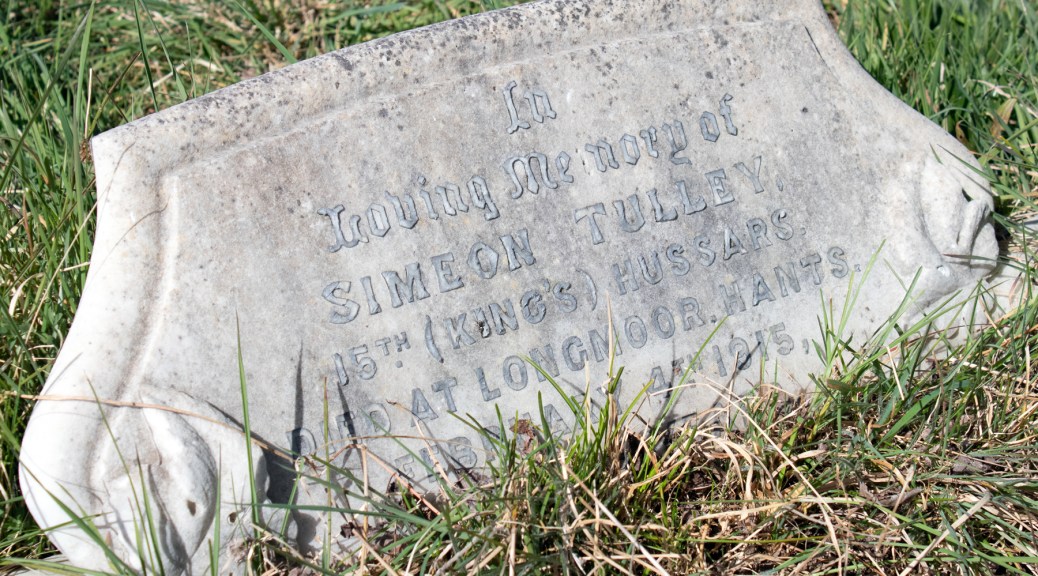
Private Simeon Tulley

Private Simeon Tulley

Simeon Tulley was born in Caterham, Surrey, in the summer of 1891. The middle of five children, he was the oldest son to Simeon and Mary Tulley. Simeon Sr was a farmer, and the family moved to where his work took him. The 1901 census found the Tulleys living in Keymer, Sussex, while the next return, taken in 1911, recorded them at Blackbrook Farm, near Hassocks, Sussex.

When Simeon Jr finished his schooling, he also found work on the farm. At the outbreak of war, however, he stepped up to serve his country. His service records have been lost to time, but he had joined the 15th (The King’s) Hussars during the open weeks of the conflict.

Private Tulley was sent to Longmoor Camp, near Petersfield, Hampshire, for his training and it is at this point that his trail goes cold. He passed away on 4th February 1915, at the age of 23 years old.

The body of Simeon Tulley was taken back to Sussex for burial. The family had moved to Coates Farm, Durrington, by this point, and he was laid to rest in Broadwater Cemetery, Worthing.


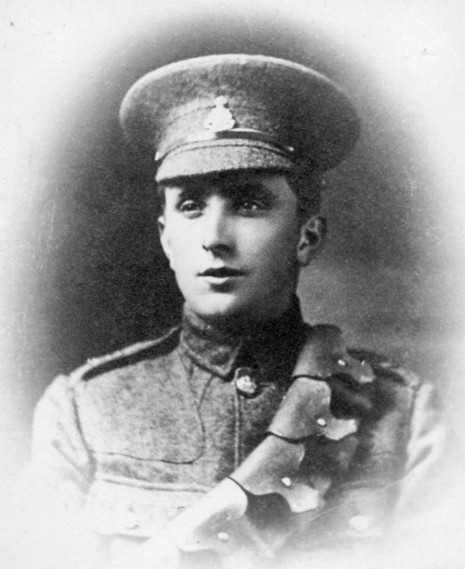
Private Simeon Tulley
(from findagrave.com)

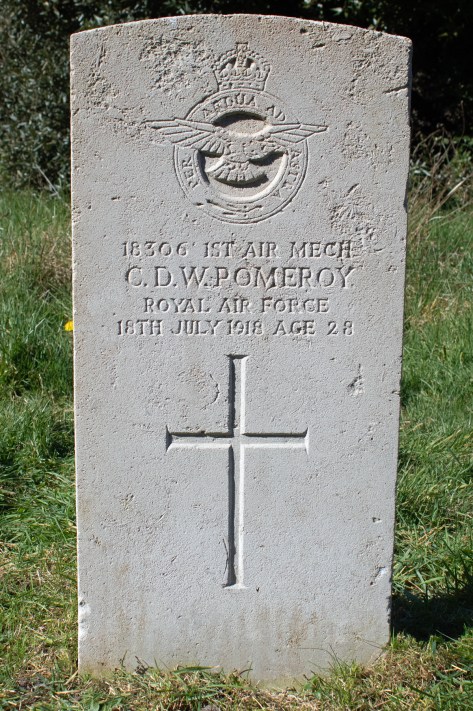
Air Mechanic 1st Class William Pomeroy

Air Mechanic 1st Class William Pomeroy

William Carrow D. Pomeroy was born at the start of 1892 in Worthing, West Sussex. One of six children, his mother was Sarah Pomeroy. She had been born in the Clifton area of Bristol, Gloucestershire, but by the time William was born, she had moved to Worthing.

According to the 1901 census, Sarah was a widow, and was running a lodging house at 3 Warwick Road. The next census return found the family living at the same address, where Sarah’s lodging house was now noted as being apartments.

William had completed his schooling by this point, and had found work as a cycle mechanic. His dedication and skill eventually took him to London, where, by the outbreak of war, he was employed as a mechanic with the London Fire Brigade in Southwark, Surrey.

The First World War brought new opportunities, and, on 14th January 1916, William enlisted in the Royal Flying Corps. Details of his military service are sketchy, but it is clear that he was an Air Mechanic 1st Class, and was based at in Reading, Berkshire.

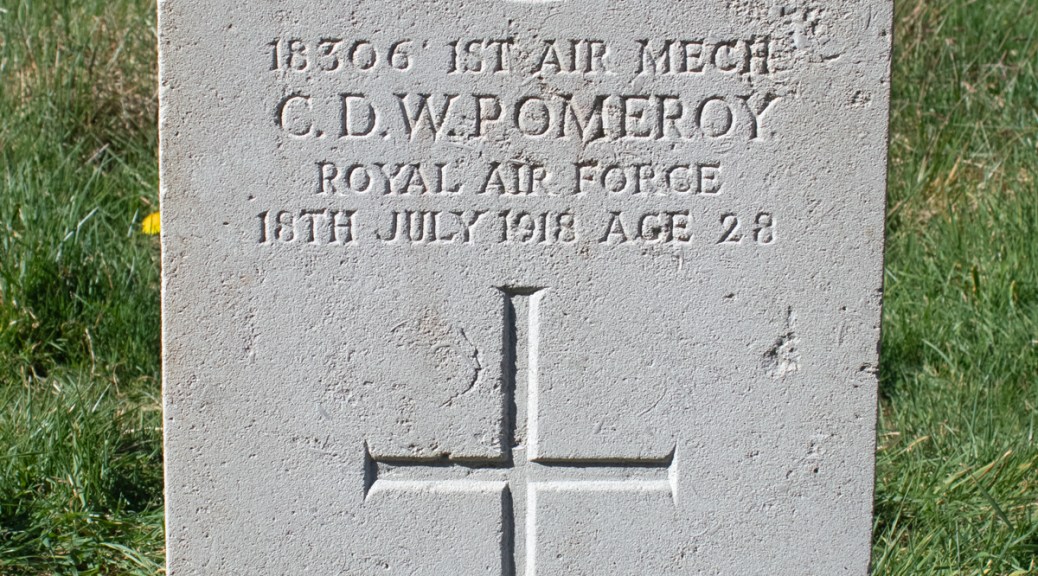
Air Mechanic Pomeroy was transferred over to the Royal Air Force on its creation on 1st April 1918. Within weeks, however, he had been admitted to Reading War Hospital, suffering from pneumonia. The condition was to get the better of him, and he passed away on 18th July, at the age of 26 years old.

The funeral of First-Class Air Mechanic E [sic] Pomeroy, who died at Reading last week, from complications following an attack of influenza, took place at Broadwater Cemetery on Monday afternoon, with full Military honours.

The deceased, who was twenty-five years of age, was the son of the late Mr Pomeroy, well-known locally as a former Inspector of Weights and Measures.

[Worthing Gazette: Wednesday 24th July 1918]


William’s headstone gives his name as CDW Pomeroy. All other records, including the registration of his birth, give his name as William Carrow D Pomeroy. There is no record of what the D stood for.


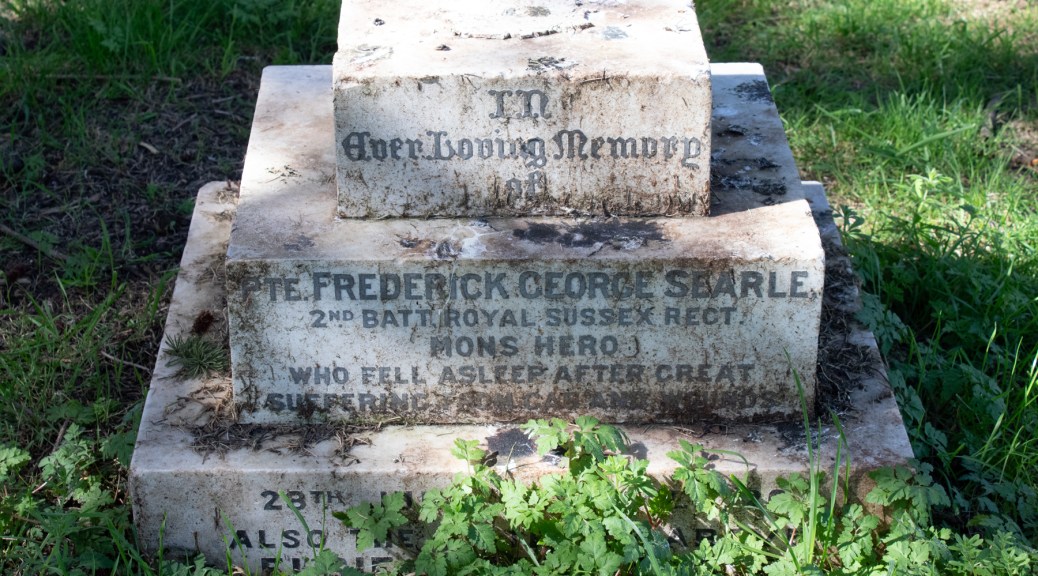
Private Frederick Searle

Private Frederick Searle

Frederick George Searle was born in the Sussex village of Warminghurst in the spring of 1894. One of thirteen children, his parents were William and Annie Searle.

William was a carter, and moved the family to where the work was. The 1901 census found the Searles living in Wiggonholt, between Pulborough and Storrington. By 1911, however, they had moved south, and were living in a cottage on the golf links in Broadwater, to the north of Worthing.

By this point, William was employed as a carter at the golf course, while three of the Searle children were also working at the club. Frederick – now 16 years of age, was a caddie, while his older brothers did mainly grounds work.

As one of thirteen siblings, Frederick was keen to make his own mark on the world and, on 24th September 1912, he enlisted in the Royal Sussex Regiment. His papers show that he was 5ft 5ins (1.65m) tall, and weighed 121lbs (54.9kg). He had light brown hair, grey eyes, and a number of scars – two on his back, one on the left side of his head and one at the base of his right forefinger.

When war broke out, Private Searle’s unit – the 2nd Battalion – was sent to France. He survived the Battle of Mons and subsequent retreat, but was badly wounded in the left arm on 13th November 1914, and medically evacuated to Britain for treatment. Frederick was moved to a depot while he recuperated, but because of his injury, he was formally discharged from the army on 30th April 1915.

Frederick returned to Sussex, and family life. In time, he took up his role on the golf club once more, but this seemed not to be enough for him. On 31st May 1917, he re-enlisted, joining the Mechanical Transport unit of the Army Service Corps as a Private. He was posted to Isleworth, Surrey, but his injury seemed to still be nagging at him. Despite his best efforts, and with the support of his superiors, at the end of August he took the decision to stand down, and was discharged from duty once more.

At this point, Frederick’s trail goes cold. What can be confirmed is that he passed away on 28th June 1919: he was 25 years of age.

The body of Frederick George Searle, former Private in two regiments, was laid to rest in the family plot in Broadwater Cemetery, not far from where his family still lived.


Sergeant Edwin Ward

Sergeant Edwin Ward

Edwin James Ward was born at the start on 3rd December 1879 in London. The oldest of four children, his parents were William and Emma Ward. William, who was a printer, had also been born in London, and the family lived initially in rooms on Trafalgar Street, Walworth, then Hardaker Street in Shoreditch.

There are tantalising gaps in Edwin’s life, and it is a challenge to piece together what happened to him after the 1891 census. He disappears from the records for nearly two decades, and is it likely that he had enlisted in the Royal Marine Light Infantry, and spent time overseas.

On 21st August 1908, Edwin married a woman called Kate. There is no further information available about her, although the couple went on to have a daughter, Kitty, who was born in Portsmouth on 13th November 1911.

Edwin’s trail goes cold again at this point. He appears to have risen through the ranks with the Royal Marines and, by the summer of 1914, was a Sergeant. He was assigned to the battleship HMS Bulwark, and was on board on the 26th November 1914, when she was moored close to Sheerness, Kent. That morning, an explosion ripped through the ship, sinking it and killing more than 740 people. Sergeant Ward was amongst them: he was 34 years of age.

The body of Edwin James Ward was laid to rest in a marked grave in the naval section of Woodlands Cemetery, Gillingham, Kent.


Private William Fisher

Private William Fisher

William Victor Fisher was born in Battersea, Surrey, at the beginning of 1899. The youngest of nine children, his parents were William and Julia Fisher. William Sr was a blacksmith and farrier, and, when William was born, the family were living in rooms at 9 Gladstone Street.

Julia died in 1902, and William Sr was left to raise the children on his own. This he seemed to have done well, and by the time of the 1911 census, he was still living in the same house, with five of his children. William Jr’s eldest brother, Mark, was assisting their father in the business.

When war broke out, William Jr was still at school. However, he was keen to play his part and enlisted on 29th August 1915, lying abut his age to do so. As happened at the time, the recruiting officer took the age he stated – 19 years, 255 days – as being correct. He was assigned as a Private in the Royal West Surrey Regiment, and remained in Battersea for training.

Private Fisher’s time in the army was to be a brief one, but it was not without incident. He was confined to barracks for three days on 12th October, when he lost a pair of boots. Just a month later, he was reprimanded again for being absent without leave for nearly six hours on 17th November: he was again confined to barracks, this time for four days.

William’s lie was to catch up with him, and, on 27th November 1915, he was discharged for giving an incorrect age on his recruitment papers.

Two years later, William stepped up to play his part once more. This may have been a result of the death his older brother – Francis. A Private in the 2nd Battalion of the Royal Fusiliers, he was killed in action on the Western Front on 28th February 1917: he was just 20 years of age.

Details of William’s second stint in the army have been lost to time, but it is clear that he was initially assigned to the 46th Training Reserve Battalion. Private Fisher then transferred to the 626th Home Service Employment Company of the Labour Corps, and was billeted in Wiltshire.

Tragically, Private Fisher’s time in the army was also to be brief. His entry in the British Register of Soldiers’ Effects show that he died on 12th July 1817, and, intriguingly, that the cause was asphyxiation. His death certificate confirms that this was asphyxia from inspiration of vomited matter, and that he died at No. 12 Camp in Longbridge Deverill: he was just 18 years of age.

The body of William Victor Fisher was laid to rest in the tranquil grounds of St Peter & St Paul’s Church, not far from where he had passed away.