

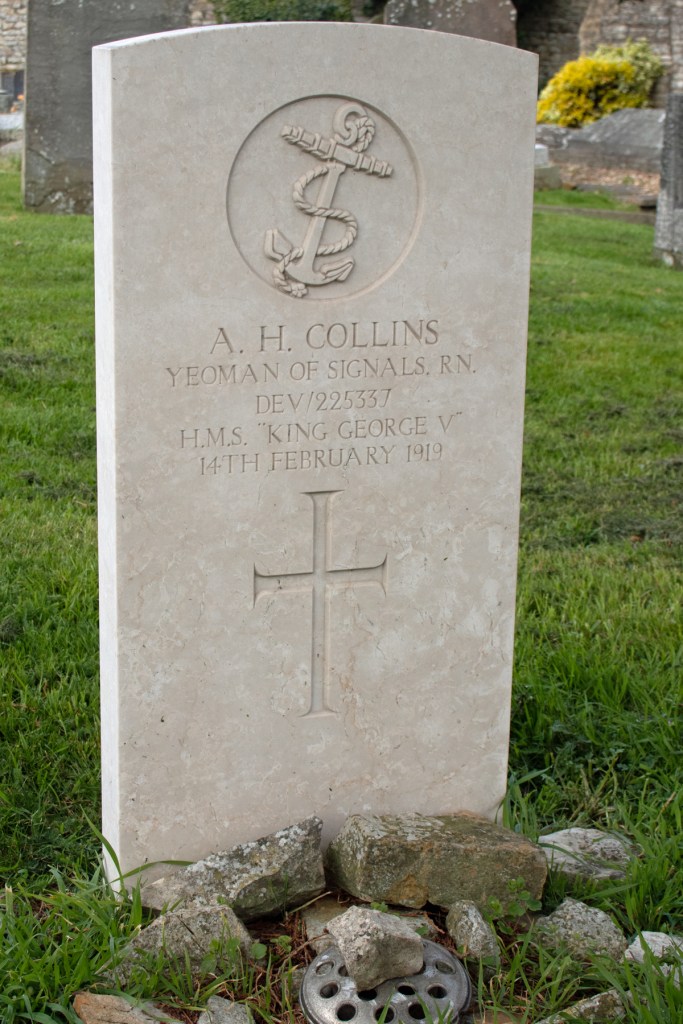
Alfred Henry Collins was born on 22nd August 1886, in the Gloucestershire village of Wotton-under-Edge. One of five children, his parents were cowman and farm labourer Samuel George Collins and his wife, Jane. Samuel’s work took the family south, and by the time of the 1901 census, the Collinses had settled in Whitchurch, near Bristol.
When Alfred finished his schooling, he also found employment labouring on a farm, but he was drawn to a more reliable career and a life at sea. On 9th March 1903, Alfred enlisted in the Royal Navy. His service records show the young man he was becoming. He was 5ft 4ins tall, with brown hair, brown eyes and a fresh complexion.
Alfred was still underage in the navy’s eyes, and so he was given the rank of Boy 2nd Class. He was assigned to HMS Northampton, a training ship, and must have shown some promise, as within three months he had been promoted.
In June 1903, Boy 1st Class Collins was assigned to HMS Victory, the Royal Naval Dockyard in Portsmouth, Hampshire, and his trajectory was still upwards. When he turned seventeen on 22nd August, Alfred was formally enrolled in the Royal Navy, and was given the rank of Ordinary Seaman. However, his training in Portsmouth continued, and by November he had become a Signalman.
In December 1903 he was posted to the cruiser HMS Isis and, over the next decade he served on ten different ships, returning to HMS Vivid, the Royal Naval Dockyard in Devonport, in between voyages. During this time he was promoted to Leading Signalman, and his annual reviews showed him as having a very good character and a superior ability.
With war now brewing across Europe, the role of the navy intensified. When conflict was declared, Leading Signalman Collins was serving on board the cruiser HMS Pomone and, after nine months back at HMS Vivid, possibly in a training role, Alfred was assigned to the newly-refitted battleship HMS Bellerophon, on board which he would serve for more than two years.
Bellerophon served at the Battle of Jutland, and remained patrolling the southern part of the North Sea for the rest of the war. In July 1917, Alfred was promoted again, to Yeoman of the Signals, and transferred to HMS King George. He remained in the North Sea, but his new ship was there to protect the convoys transporting good between the UK and Norway, so he was based in Scotland.
Yeoman of the Signals Collins survived the war, but in February 1919 he was admitted to the Royal Naval Hospital in Granton, near Edinburgh, suffering from pneumonia. Sadly, the condition was to get the better of him and he died on 14th February 1919, at the age of 32 years old. He had served for just short of sixteen years.
The body of Alfred Henry Collins was brought back to Somerset for burial. He was laid to rest in the graveyard of St Nicholas’ Church in Whitchurch.
 Death and Service