

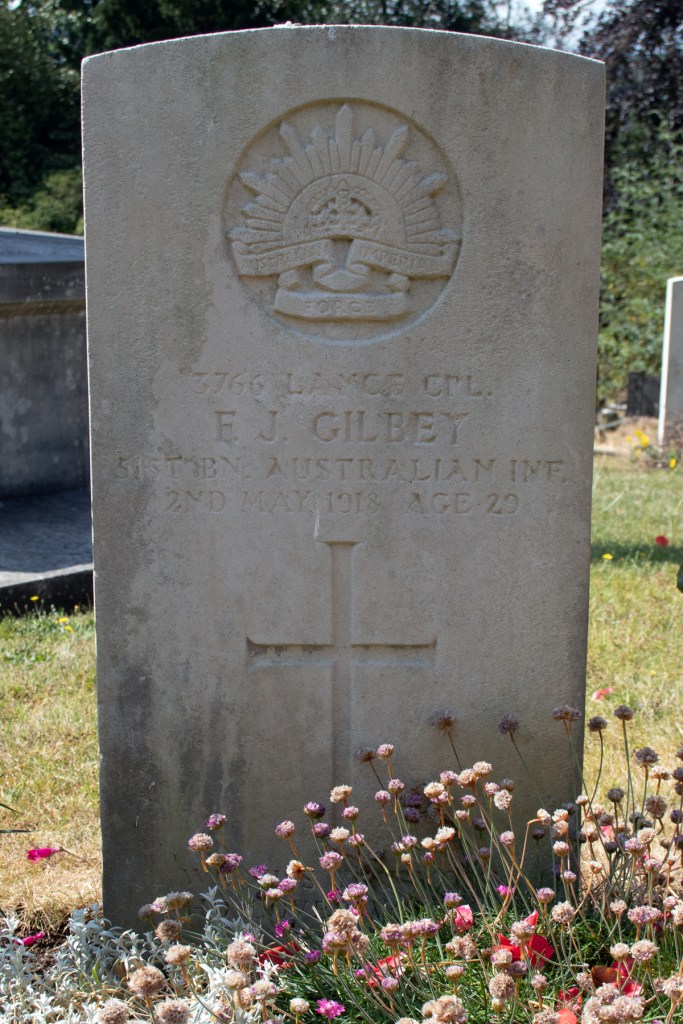
Frederick James Gilbey was born on 1st September 1888 in Walthamstow, Essex. The oldest of nine children, his parents were Alfred and Emily. Alfred was a general labourer, and the family initially lived on Chingford Road, before moving to an end-of-terrace house at 41 MacDonald Road.
On 28th August 1910, Frederick married Katherine Heathorn. Little more information is available about her, although the young couple’s marriage seemed to be the start of something bigger: the newlyweds emigrated shortly afterwards, arriving in Fremantle, Australia, in October 1910. Frederick’s immigration records noted that he was employed as a salesman, while Katherine was working as a dressmaker.
The couple settled into their new life well. The 1916 Electoral Records found the family living at 20 Oswald Street in the leafy Victoria Park suburb of Fremantle. Frederick was now working as a tram conductor, while Katherine was busy raising their two children, Leslie and Arthur.
By this point, Europe was two years into a bloody conflict. Frederick’s younger brother William, a Private in the Royal Fusiliers, had been killed at Gallipoli in August 1915, and it would seem that he also felt pulled to serve his King and Empire.
On 12th September 1916, Frederick enlisted in the Australian Imperial Force. His service documents note that he was 5ft 6.5ins (1.69m) tall and weighed 140lbs (63.5kg). Private Gilbey had auburn hair, blue eyes and a fresh complexion.
After initial training, he left Fremantle for the two-month journey back to Britain. Assigned to the 13th Training Battalion, his unit was based in Codford, Wiltshire. In November 1917, Frederick attended the 15th Rifle Course at the School of Musketry in Tidworth, where he qualified as 1st Class, with a fair working knowledge of the Lewis Gun.
The following February, Private Gilbey was transferred to the 51st Battalion of the Australian Infantry, and sent with his unit to France. On 20th April, days before the Battle of Villers Bretonneux, he was promoted to Lance Corporal.
The battle, however, was to prove to be his last. Wounded in the right thigh by gun shot, he was medically evacuated to Britain, and admitted to Bath War Hospital, Somerset, for treatment. His wounds were too severe, however: Private Gilbey passed away on 2nd May 1918, at the age of 29 years old.
With his widow and children on the other side of the globe, Frederick James Gilbey was laid to rest in the military section of Bath’s Locksbrook Cemetery.
 Death and Service