

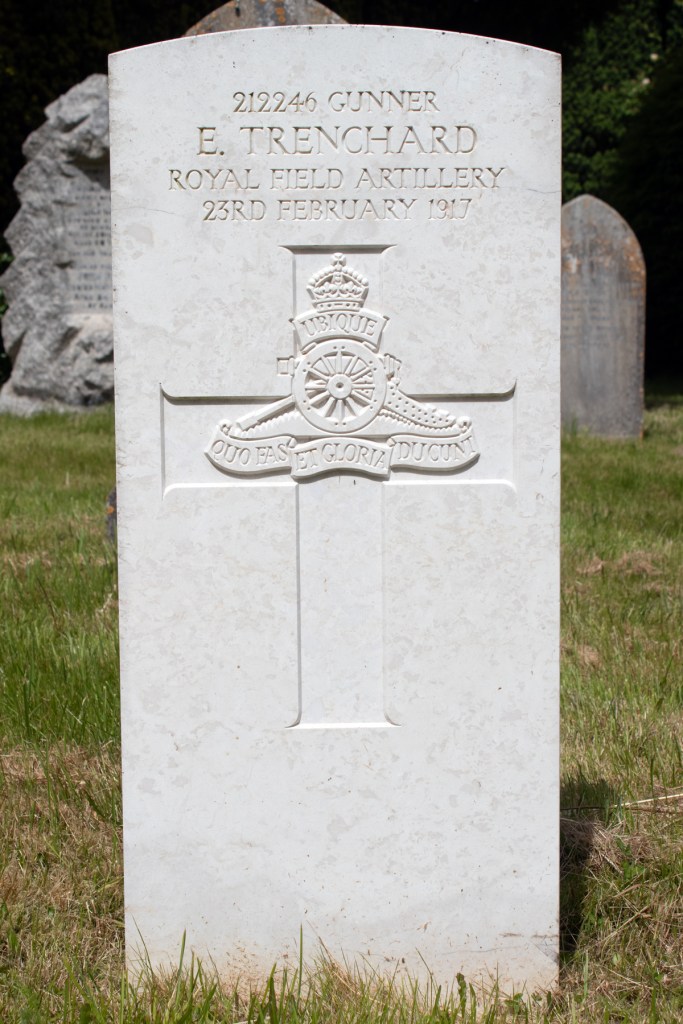
Eli Trenchard and his twin Reuben were born on 29th December 1889 in Axminster, Devon. Two of nine children, their parents were George and Mary Trenchard. George was a gamekeeper turned farmer, and the family were brought up at Uphay Farm on the outskirts of the town.
The whole family helped out on the farm and, by the time of the 1911 census, when the twins were 20, seven of the Trenchards – George, Mary, Eli, Reuben and three of their siblings – were all living in the farmhouse and employed in the business.
On 25th March 1913, Eli married Lily Gillingham. Born in Dorset, she was the daughter of the landlord of the Lamb Inn in Axminster, and working as a dressmaker in her own right. The couple moved to the village of Chardstock in Devon, and went on to have a daughter, Lilian, who was born later that year.
In 1915, Eli found himself brought to the Petty Sessions in Axminster, charged with “moving pigs from Dorset to Devon without the necessary license” [Western Times: Wednesday 27th October 1915]. Eli stated that he had purchased the pigs from his brother, Reuben, at Uphay Farm. Despite Reuben confirming this, it was subsequently determined that they had, in fact, been bought from a Mr Wells of Penn in Dorset. Eli have been convicted of a similar offence before, and was fined £10.
War was raging across Europe by this point, and Eli was called upon to play his part. He enlisted in the Royal Field Artillery in January 1917. Assigned to the 23rd Reserve Battery, Gunner Trenchard was sent to a camp near Sutton Veny in Wiltshire.
Eli’s time in the army was not to be a long one, however, and he was soon admitted to the camp hospital, suffering from pneumonia. The lung condition was to get the better of him, and Eli passed away on 23rd February 1917. He was 27 years of age.
The body of Eli Trenchard was taken back to Devon for burial. He was laid to rest in Axminster Cemetery, not far from where his widow and family still lived.
The Trenchard family were soon back in the court, however, with Lily bringing a lawsuit against her father-in-law, George, in December 1917. The widow said that Eli and his father had agreed her late husband’s immediate tenancy of two fields the month before Eli had been called up for to serve.
However, the month after his death, when she had gone to the fields to sow them for the coming season, the gates had been locked and her entrance barred. George responded by saying that he had agreed to pass the fields to his son, but only on the event of his own death. He subsequently sold the land to another farmer.
The judge in the case found that Lily had “failed to prove that an agreement had been made between [George] and his son” [Western Times: Thursday 6th December 1917] and found in the defendant’s favour.
 Death and Service