

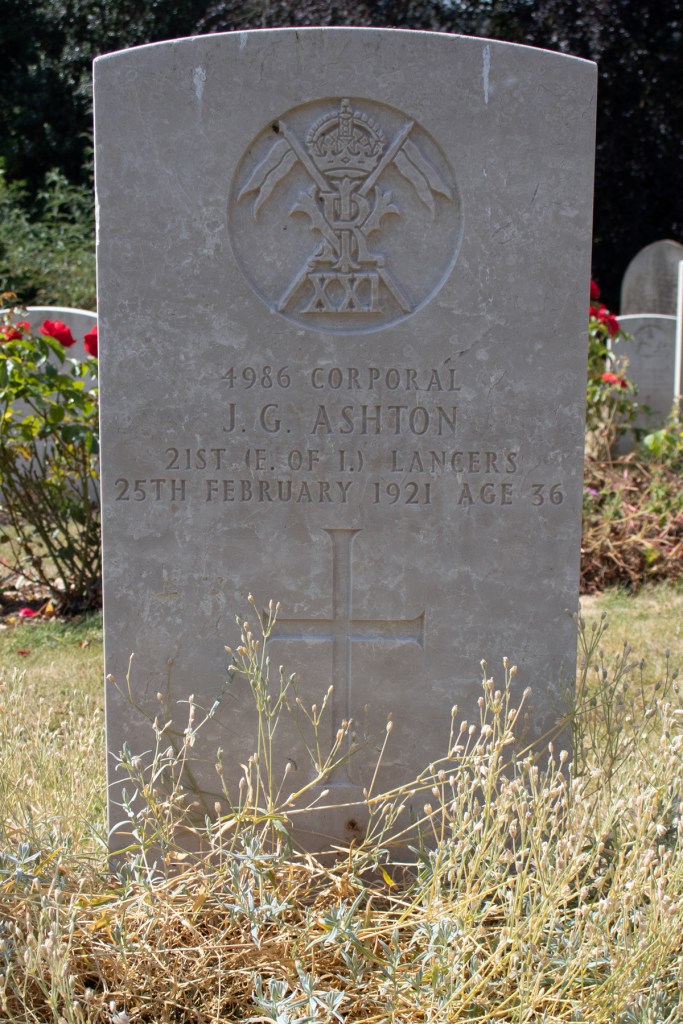
John Gordon Ashton was born at the start of 1885, and was one of at least two children to John and Elizabeth. Little information is available about his early life, although later records confirm that he was born in Newcastle-upon-Tyne, and that the family were living on Elswick Road, leading west out of the city, by 1900.
John found work as a musician, but sought a bigger and better career for himself. On 3rd October 1900, he enlisted in the army, joining the 21st (Empress of India’s) Lancers. His service records show that, at not yet sixteen years of age, he was just 5ft 1in (1.55m) tall, and weighed 101lbs (46kg). He had brown hair, grey eyes and a dark complexion, and two moles on the front of his left shoulder.
Private Ashton joined up for a period of 12 years’ service, and spent most of it on home soil. The army seemed to suit him, and he steadily rose through the ranks. By August 1901, John was promoted to Bandsman; five years later, he took the rank of Trumpeter; the start of 1908 brought with it a promotion to Lance Corporal.
In September 1910, John’s unit was sent to Egypt: the move brought him a further promotion. Corporal Ashton spent two years in Cairo, before returning to Britain in the autumn of 1912. He had completed his contract of service with the 21st Lancers, and was formally discharged from service on 4th October.
Back on civvy street, John once again found work as a musician. Life outside of the army seemed not to suit him, however, and he joined the reserve forces in March 1913. The now Lance Sergeant’s service records show the man he had become: he now stood 5ft 9ins (1.75m) tall, and bore a large oval scar on the underside of his right knee.
When war was declared the following summer, John was formally mobilised once more. He was attached to the 9th (Queen’s Royal) Lancers and, by 27th August 1914, was in France. Lance Sergeant Ashton’s time overseas was not to last long, however; he returned to Britain just before Christmas that year, and was based at Tidworth Camp in Wiltshire.
John’s military record was not without its hiccups. On 11th March 1910, while based in Canterbury, he was severely reprimanded for being in neglect of his duty whilst in charge of a barrack room. In 1915, however, he received a more severe punishment: on 23rd January, he was found guilty of using insubordinate language to his superior officer – in front of six ranking witnesses – and was demoted to Corporal.
It would seem that John’s health was beginning to suffer, and, after a career of nearly sixteen years, he was medically discharged from the army because of a heart condition.
At this point, his trail goes cold. He remained in the Wiltshire area, and seems to have been receiving ongoing medical treatment. At some point, he married a woman called Mary, although no other information is readily available for her.
Early in 1921, John was admitted to the Pensions Hospital in Bath, Somerset, having contracted pneumonia. He passed away there on 25th February following an aneurysm of the heart. He was 36 years of age.
John Gordon Ashton was laid to rest in the sweeping Locksbrook Cemetery in Bath.


 Death and Service