
Tag Archives: 1918

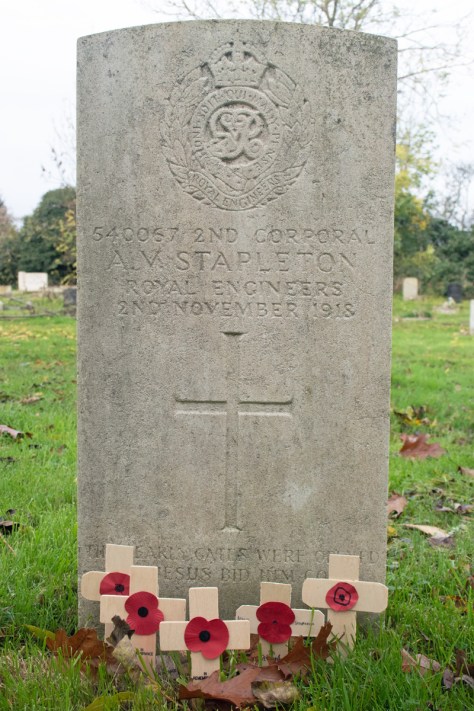
Lance Corporal Albert Stapleton

Lance Corporal Albert Stapleton

Albert Victor Stapleton was born in East London in 1893. One of five children to James and Mary Anne Stapleton, he lost his father when he was only eight years old. Mary Anne married again, and where her first husband has been a glass blower, her second, Edward, was a cooper/barrel-maker, and the family moved to Rainham in Kent.

Albert joined the armed forced early, enlisting in the Royal Engineers in December 1910 for a period of four years. When war was declared, this was extended for a further four years.

In 1915, Private Albert married Daisy, and they lived in the Rainham area. Over the next couple of years, he was promoted, joining the London Electrical Engineers and becoming Lance Corporal.

On 24th October 1918, just a couple of weeks before the end of the war, Albert was admitted to hospital in South London with influenza; while there, he developed pneumonia in the right lung. Lance Corporal Stapleton died on 2nd November 1918. He was 25 years old.

Lance Corporal Albert Victor Stapleton lies at rest in the churchyard of St Mary the Virgin in the quiet village of Upchurch in Kent.


Tragically, just weeks after Albert’s death, Daisy gave birth to a son. Albert William Stapleton would never know his father.

Serjeant Leonard Paul

Serjeant Leonard Paul

Leonard Paul was born in Chesham, Hertfordshire. One of six children, he was the second son PC Harry Paul and his wife Mary Martha.

By the time of the 1901 census, Harry had been promoted and had moved his young family – William, Ivy, Leonard and Stuart – to Harmondsworth, where he worked as the Station Sergeant.

It’s clear than Leonard wanted to better himself, as in August 1908 he enlisted in the Royal Field Artillery. After training, he was posted overseas, arriving in India in March 1910. He is listed as a driver in the barracks at Ambala on the 1911 census.

When war broke out, his battalion was moved to the Western Front and he arrived in France in November 1914. Leonard was appointed a Shoeing Smith at the start of 1915, before being promoted to Farrier Serjeant later that year.

Serjeant Paul’s battallion, the 110th Brigade, fought in some of the bloodiest battles of the war – Somme, Pozieres, Third Ypres – and it is almost certain that he was involved in this battles in some respect.

Leonard’s records show that he was admitted hospital in St Omer on 16th March 1917 with Trench Fever, before being invalided back to the UK a few weeks later.

Serjeant Paul was medically discharged from the RFA at the end of April; his release notes show that he was “physically unfit with tubercle of the lung”. His father having retired from the police force, his parents has moved to Kent by this point, and were living in Rainham, where Leonard joined them.

A contemporary newspaper picks up Serjeant Paul’s story from there.

The young man… joined the Army, and had served in France, where he was gassed. This undermined his health, and he fell into a decline, and after lingering for a year at home, died on Saturday [25th May 1918].

East Kent Gazette: Saturday 1st June 1918

A century on, the cause of Leonard’s lung affliction (a gas attack or trench fever) is neither here nor there. Either way, he suffered for a long time before finally succumbing. He was 29 years old.

Serjeant Leonard Paul lies at peace in the St Margaret’s Churchyard, Rainham.