Herbert Leonard Pittard was born in 1896, the youngest of two children – both boys – to Frederick and Lily Pittard. Frederick was a bootmaker, employed by the Clark’s factory in the town.
Herbert’s mother died in 1910, and by the time of the 1911 census, he was living with his father, brother and grandmother in Park Terrace, Glastonbury. All three of the household’s men were bootmakers, all were working at the Clark’s factory in Street.
Frederick Pittard was out to seek pastures new, emigrating to America in 1912. Herbert is recorded as having visited his brother a year later.
Herbert’s military records are sparse; it seems that he enlisted in the Devonshire Regiment, joining the 3rd Battalion as a Private, before transferring to the Southern Command Labour Centre of the Labour Corps. When this happened, and for how long he enlisted, is not known, but he survived through to the Armistice in 1918.
A short notice in the Central Somerset Gazette (Friday 29 November 1918) confirmed that “Mr Pittard, Park Terrace [Glastonbury], has just lost his younger son through the influenza epidemic. Private Bert Pittard died in Bath War Hospital from pneumonia subsequent to influenza at the age of 22.“
Herbert Leonard Pittard died on 26th November 1918. He lies at rest in the cemetery in Street, Somerset.
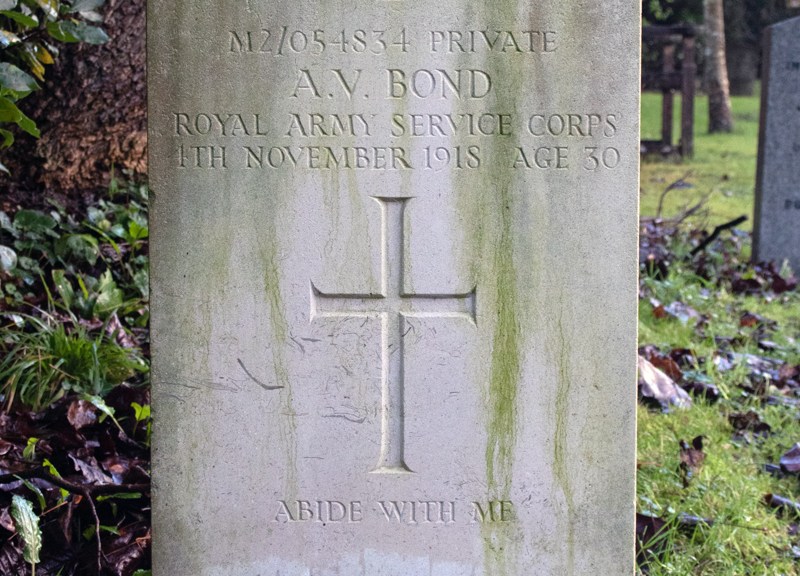
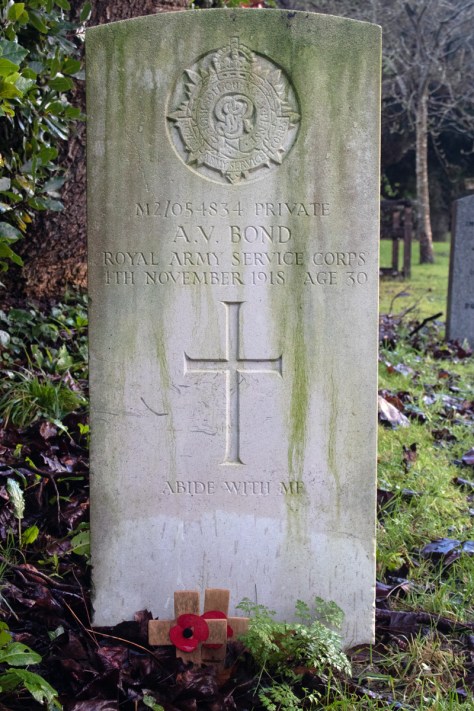
Albert Victor Bond was born in 1887, the only child of John and Sarah Bond. John was an engine driver, with a steam roller, and the family lived in the Somerset village of Butleigh.
Albert started working for the local baker and, by the time of the 1911 census, when his parents were celebrating their 25th Wedding Anniversary, this is the job he was doing.
He enlisted in March 1915, joining the Royal Army Service Corps. While his full service record is not available, Private Bond’s service was relatively short lived. He was discharged as medically unfit in February 1916, having served for just 332 days.
He was discharged with pneumonia, and this seems not to have cleared up and he was eventually admitted to the military hospital in Wool, Dorset. Albert passed away from the disease on 4th November 1918, just a week before the Armistice. He was 30 years old.
Albert Bond lies at rest in the graveyard of St Leonard’s Church in his home village of Butleigh.
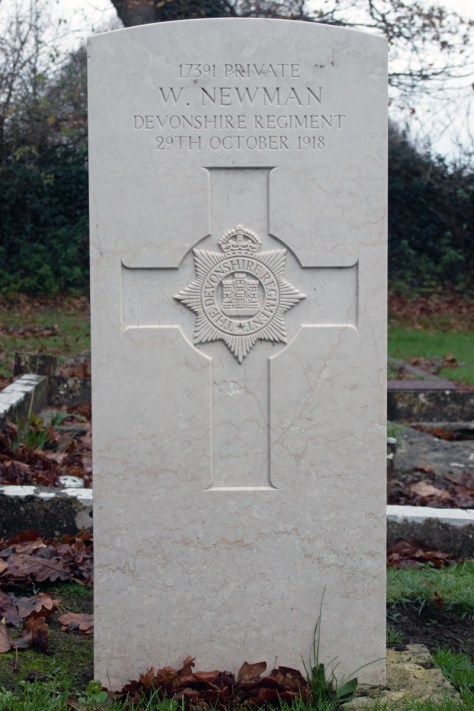
William Newman was born in Dorset in 1880, the oldest of six children to George and Margaret Newman. George worked as an agricultural labourer and a carter, and, after leaving school, William followed suit.
William’s life has been a challenge to piece together; however, I have managed to sketch together some information from a number of sources.
By the 1911 census, he was living with his now widowed father and three of his siblings. Listed as single, he was working as a labourer.
When William joined up, he enlisted in the Devonshire Regiment, before being transferred over to the Labour Corps. He was assigned to 652 Agriculture Company, serving on the home front, presumably somewhere close to home.
There are no details of Private Newman’s death – contemporary newspapers do not highlight anything out of the ordinary or sudden about his passing. I can only assume, therefore, that he passed through natural causes, perhaps influenza or pneumonia.
He died on 29th October 1918, in the village of Martock, Somerset. He was 37 years old.
It appears that William did not marry – his war pension was allocated to his sisters Edith, Alice and Louisa and no spouse is mentioned (nor is his father).
William Newman lies at rest in the quiet churchyard of St Margaret’s in the Somerset village of Tintinhull.
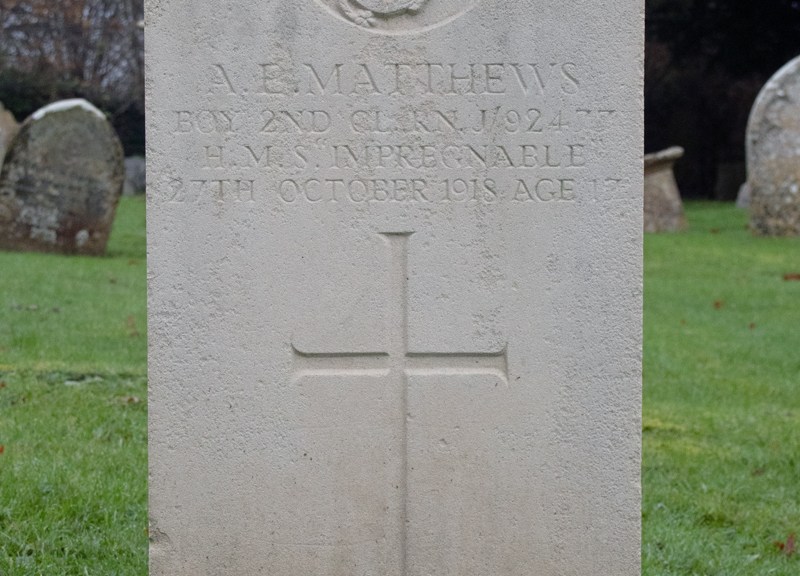
Albert Edward Matthews was born in October 1901 in the Somerset village of Tintinhull. His father James was a glove maker, and he and his wife Mary had three children in all, Percival, born in 1897, Clementina, born in 1898, and Albert, the youngest.
Sadly, Clementina died in 1909, aged just 11 years old. Percival also passed away six years later, aged just 17. James and Mary must have been distraught when Albert announced his decision to do his bit for King and country.
He enlisted almost as soon as he was able to, joining the Royal Navy on 14th September 1918, and you can almost sense his enthusiasm to get involved before missing out on the glory of military service.
Boy Matthews was assigned to HMS Impregnable, the ship based in Devonport, Plymouth, where he was to receive his training. Standing at 5ft 8ins (1.73m) tall, with brown hair, brown eyes and a fair complexion, he was recorded as having a very good character and satisfactory ability.
Sadly, however, Albert was not destined to meet his full potential. Shortly after beginning his training, he contracted influenza and pneumonia, succumbing to the disease on 27th October 1918.
He had just turned 17 years old.
Albert Edward Matthews lies at rest in the graveyard of St Margaret’s Church in his home village of Tintinhull.
The story of this family continued to be tragic. By the time of Albert’s death, the Spanish Flu pandemic was sweeping the world and his tiny part of Somerset was in no way immune.
Just four days after Albert Matthews passed away, his mother, Mary, also fell victim to the illness.
In the space of just nine years, poor James Matthews had buried all three of his children and his wife. A newspaper reported on Mary’s funeral, recognising the “very heavy trials” he had undergone.
The same paper, reports that the influenza pandemic is fizzling out.
A large number of parishioners have been attacked with “flu”, but the epidemic is now on the wane. The school has been closed for the last fortnight.
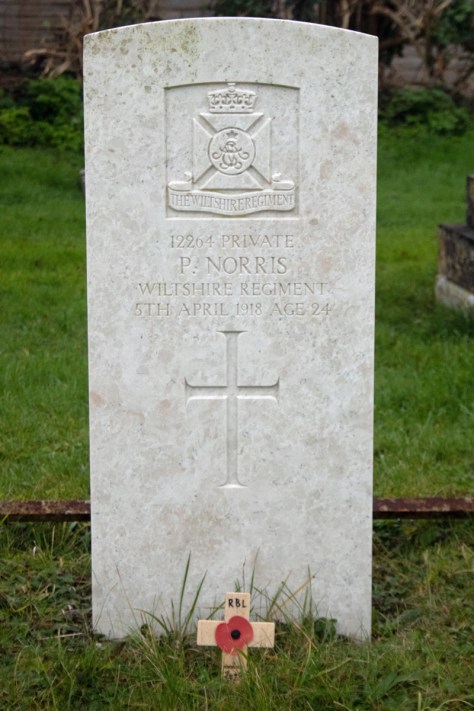
Percy Norris was born in 1894, the youngest of eleven children to William and Julia Norris. William was the caretaker for the water works in Somerton, Somerset, and this is where the family of eleven lived.
By the time of the 1911 census, Percy’s older brother Henry had joined his father at the water works. Julia had passed away five years before, and Percy and three of his siblings continued to live with William. At this point Percy was working as a gardener.
Private Norris’ full military records are not readily available, but it is evident that he enlisted in the 7th Battalion of the Wiltshire Regiment. This was a service troop, formed in 1914, who saw service in France and the Balkans.
It seems that it was during one of the skirmishes that Private Norris was injured. While there is no confirmation of exactly when or where this happened, it is likely to have been at some point in the spring of 1918. Percy was shipped back the England for treatment, and admitted to the Red Cross Hospital in Bridgwater, Somerset.
Sadly, Private Norris did not recover from his injuries. He passed away on 5th April 1918, aged 24 years old.
Percy lies at rest in the cemetery of Somerton, his home town.
Percy’s older brother Henry Norris also died in the Great War. Joining the Royal Naval Volunteer Reserves, Able Seaman Norris was also wounded on active duty, dying of his injuries in January 1918, aged 32. He is buried at the St Sever Cemetery in Rouen, France.
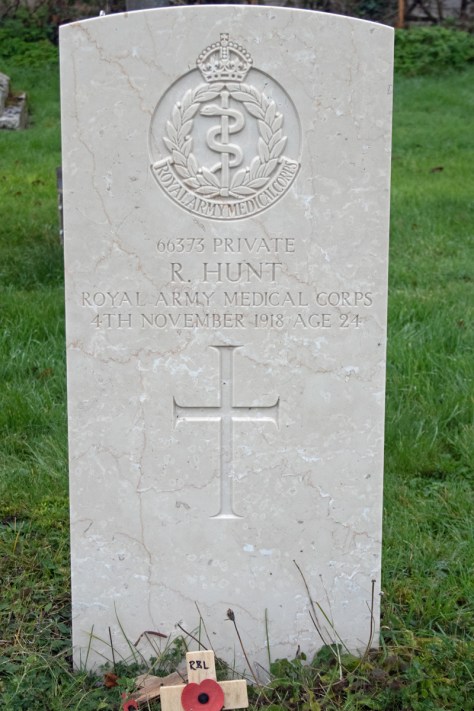
Robert Edward Nichols Hunt was born in Somerton, Somerset in 1894. One of five children to Charles and Rose Hunt, his father was a bootmaker.
By the 1911 census, however, things had taken a different turn; Charles and two of his sons were working for a brewer, Rose was working as a shop assistance in Boots, and the youngest of the family, Kate, was apprenticed to a dressmaker.
It was against this backdrop that war came, and, within a year, Robert had enlisted in the Royal Army Medical Corps. His sign-up documents confirm that he was short sighted, although this was corrected with glasses and he was deemed fit for active service.
Sent to the Western Front in October 1915, Private Hunt definitely found himself in the thick of the action.
In August 1916, he was supporting the fighting at High Wood on the Somme, when a gas shell exploded near him. He fell and, when he woke, he remembered little of what happened. Robert had inhaled a lot of gas, however, and was left coughing with difficulty breathing. He was transferred back to England by train and ship to recover, arriving back on the 2nd September.
There is no record of Robert having gone back to the front. The impact of the gas appears to have been severe and long-lasting. At the end of October 1918, he was admitted to the Becket House Auxiliary Hospital in St Albans with influenza and bronchial pneumonia. Sadly, this was to be a battle he would not recover from, and he passed away on 4th November 1918. He was 24 years old.
Robert Edward Nichols Hunt lies at rest in the cemetery of his home town, Somerton.
What I have discovered while researching the Commonwealth War Graves, is that, despite the general themes I find, the people behind the names always have an individual story to tell. Sometimes that story raises an eyebrow, or produces a gasp.
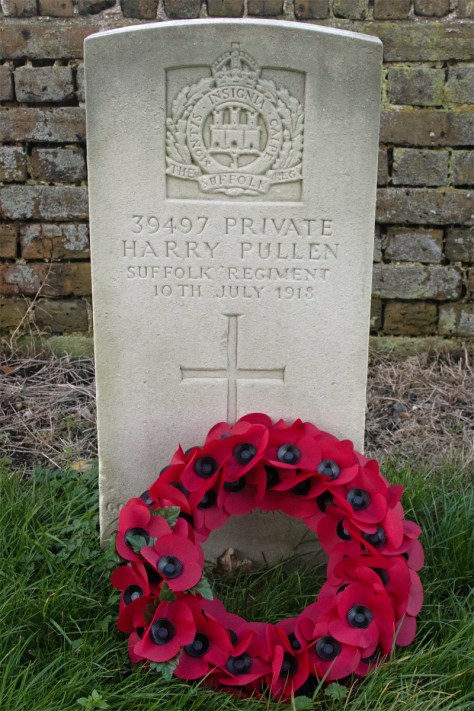
Such was the story of Private Harry Pullen.
What raised the eyebrow? Two words, written on the Army Records of Soldiers’ Effects.
Accidentally Drowned.
Harry Pullen was born in Shirehampton, Gloucestershire in 1886. His father, Robert Edward Pullen, was a carpenter; he and his wife Hannah Presulga Cissy Pullen had three other children, Gwendoline, Herbert and John.
By the time of the 1901 census, Robert is boarding in a house in Bristol with his three sons; Hannah and Gwendoline are not listed (nor do they appear on any other census records I have been able to locate).
Harry is listed as a Telegraph Boy, as is his brother Herbert, but he seemed to have wanted to take up a trade; by 1910 he had moved up to London.
In March of that year, Harry married Harriet Critchell, a spinster fifteen years his senior. On their marriage records for Christ Church, St Pancras, Harry lists himself as a tradesman. The census a year later confirms this – head of the household, he is an Agent for the Provident Clothing Supply Company. (Founded in Bradford, West Yorkshire, Provident’s mission was to help working-class families provide for themselves through the use of vouchers. These were exchanged for goods in local shops, and paid for in affordable instalments.)
Harry enlisted at some point after 1916. His regiment, the 1st (Reserve) Garrison Battalion of the Suffolk Regiment, was not formed until March of that year, and, after starting in Buckinghamshire, it moved to Tilbury in Essex and Gravesend in Kent. The battalion was finally settled in Grain, North Kent in 1918, and it was here that he served.
Here the trail goes frustratingly cold…
Private Pullen’s enlistment and service records are not available, so research is limited to the Army Register of Soldier’s Effects and the Pension Ledgers.
All we have about his death are those two words – Accidental Drowning. There are no contemporary news reports of his passing, which you might expect given the circumstances, so the circumstances surrounding his death are elusive.
Private Pullen died on 10th July 1918. He was 31 years old.
His records confirm that Harriet was entitled to a weekly pension of 15s for the duration of the war and twelves months after.
Harry Pullen is buried in the graveyard of St James’ Church in Grain, Kent, close to where he was stationed.
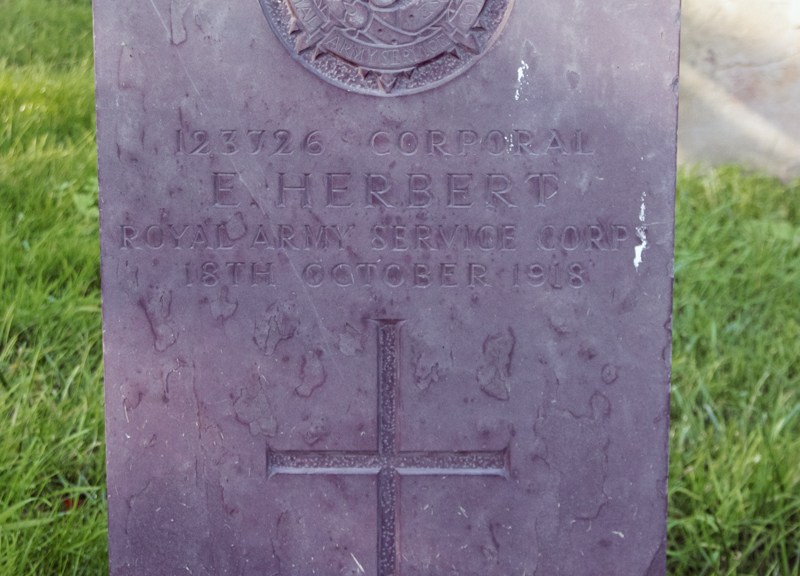
Edwin Herbert was born in 1864, the third of three children to Moses and Melina Herbert of Hove in East Sussex. Moses worked in the cement industry as a labourer, a job that had taken him from his home in Kent to Sussex, and which, by the 1871 census, would return him to his home county.
Edwin married Amelia Charlotte Titus in 1885 and the couple’s first child – a daughter, Nelly – was born a year later.
By the 1891 census, Edwin was also labouring in the North Kent cement industry, something he continued to do for at least the next twenty years, as confirmed in the following two censuses.
The Herberts’ second child, Amelia, was born in 1901, the year after Edwin’s mother passed away. The family were, by then, living in Cuxton, just to the south of Rochester. The cement industry was one of the large employers in the Medway valley, and it is not surprising that the family lived in and around that area for so long.
In 1910, Edwin’s father also died, at the age of 69. After the death of Melina, Moses had moved in with his daughter – Edwin’s older sister – in Rochester, and the family were also still labouring in the cement and brickmaking industry.
Edwin’s military records are sketchy. Piecing the evidence together, he enlisted in the Royal Army Service Corps.
It is likely that he did so on a voluntary basis. The cement industry was not protected by exemption. Kitchener’s initial conscription in March 1916 excluded married men. When this was extended in May 1916, there was still a maximum age limit of 41 (Edwin was 52 year old by this point).
By whichever means he had enlisted, Edwin served as a Corporal (there is nothing to confirm whether he was promoted from Private, or if he went straight into service at that rank). He was discharged on 30th July 1918, and it is likely that this was on a medical basis.
Corporal Herbert’s pension documents record that he passed away on 30th October 1918, as a result of carcinoma of the liver and exhaustion. He was 54 years old.
Edwin Herbert lies at peace in the quiet churchyard of St Helen’s in Cliffe, Kent.
The majority of the the Commonwealth War Graves Commission headstones in the UK are made from Portland stone, although, in face, over 50 different natural stones have been used.
Corporal Cornell’s headstone is one of two in St Helen’s Churchyard that have been fashioned from dark grey slate.
Charles Cornell was born in July 1885, the youngest of six children to Philip and Martha Cornell, from Ashdon in Essex. Philip was an agricultural labourer, and Charles and his older brother Daniel followed their father into the trade.
Charles was keen to further himself, however, and enlisted in the army. The 1911 census records him as a Private soldier at the Salamanca Barracks in Aldershot.
Private Cornell married Elizabeth Fanny Hoare in Strood, Kent, in October 1913. Beyond this there is little information on either Charles or Elizabeth.
Charles was assigned to the 3rd Battalion of the East Yorkshire Regiment and was promoted to Corporal. This reserve battalion was initially based in the town of Beverley, before moving to Hull and then nearby Withernsea. It seems unlikely, therefore, that Corporal Cornell saw active service on the Western Front.
His passing seems to have been sudden; his pension record shows that he had been admitted to the Military Hospital at Wharncliffe with nephritis (inflamed kidneys). He passed away on 27th January 1918, aged 32 years old.
Corporal Charles Cornell is buried in the graveyard of St Helen’s Church in Cliffe, Kent, the village his widow’s family were from. He is also commemorated in his own family’s village of Ashdon in Essex (where the memorial states he had attained the rank of Sergeant).
The majority of the the Commonwealth War Graves Commission headstones in the UK are made from Portland stone, although, in face, over 50 different natural stones have been used.
Corporal Cornell’s headstone is one of two in St Helen’s Churchyard that have been fashioned from dark grey slate.
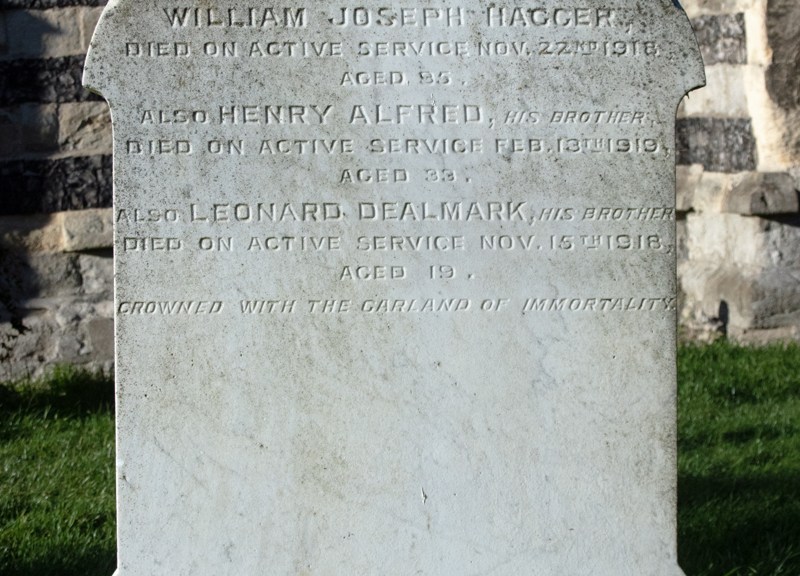
William Joseph Hagger was born in the spring of 1885, one of thirteen children to William Henry Hagger and his wife Emily Ann. The family lived on the Isle of Grain in Kent, where William Sr worked as a labourer in the local cement works.
William Jr was evidently keen to travel. On the 1901 census he is listed as a navyman on HMS Lion, a training vessel in Devonport, Plymouth.
His First World War records state that he officially joined the Royal Navy in 1906, travelling to West Africa as an Able Seaman. While there, he contracted a fever, and was invalided out of the service the following year.
William married Esther Elizabeth Reed in May 1909; by the 1911 census, she was living in Northfleet, Kent, working as a cartridge maker for the local arsenal. William himself is not recorded at the same property, and I have been unable to locate him at this point.
He next appears on the enlistment papers for the Royal Engineers. He joined up very early in the war – December 1914 – and after his training, Driver Hagger embarked for the Western Front in August 1915.
While serving, it seems that his previous affliction resurfaced, and William was dogged by colds and coughs. In the autumn of 1916, he was admitted to a field hospital with haemoptysis (coughing up blood), eventually returning to his unit three months later.
Driver Hagger’s health was fair until, in October 1917, his unit was gassed; he was sent back to England and hospitalised in Aldershot, and this time was discharged from the army six months later.
It seems that William did not recover from his illness and passed away on 22nd November 1918. He was 33 years old.
William Joseph Hagger lies at peace in a quiet corner of St Helen’s Churchyard, in Cliffe, North Kent.
William’s gravestone also acts as memorial to two of his brothers, Henry and Leonard.
Henry Alfred Hagger was born two years after William. He was also keen to make a name for himself, emigrating to California, and working as a streetcar conductor in Oakland. Initially declaring himself exempt from draft as he had a wife to support, he subsequently joined the British Columbia Regiment on 31st July 1917.
Henry was attached to the Forestry Depot of the Canadian Expeditionary Force, who were to be shipped to Europe to harvest trees for use on the Western Front. However, at the point of his medical – in September 1917 – he was discharged as unfit for active service due to his asthma.
Henry Hagger died on 13th February 1919, presumably of his lung condition. He is buried in Ross Bay Cemetery in British Columbia.
Leonard Dealimark Hagger was born in 1899. He enlisted as soon as he was able to, just short of his 18th birthday. Joining the York & Lancaster Regiment, he was posted in 1918.
His battalion saw some of the fiercest of the battles in the closing months of the war – Estaires, Messines, Bailleul, Kemmel Ridge, Scherpenberg, Selle, Valenciennes – and it is likely that Leonard was involved in some of these engagements.
Private Hagger was wounded in the closing weeks of the war, and passed away in a hospital in Liege, Belgium on 15th November 1918. He had just turned 19 years of age.
Private Leonard Hagger lies at peace in the Robermont Cemetery in Belgium.