Tag Archives: 1921

Sergeant William Gardner

Serjeant William Gardner

William Gardner was born in Cirencester, Gloucestershire, in around 1877. While I have been unable to totally confirm this, his parents seem to have been William and Sarah Carpenter; William Sr was an agricultural labourer, and both he and his wife were from Cirencester.

It has been difficult to track down William’s early life, because of the potential variations of his surname and the number of William Gardner’s in the Gloucestershire area.

The first time I can definitively identify him is on the 1911 census; he was living in Cheltenham and working as gardener. While the census shows that he had been married for 16 years and had one child. However, William’s wife is not recorded on the census; instead a Lily Marie Denley is boarding with him, as is her daughter, Irina May Gardner Denley.

William’s military life also needs a little piecing together. His gravestone confirms that he was a Serjeant in the Gloucestershire Regiment, and it seems that he enlisted towards the end of the 1800s, as he is recorded as having served in South Africa.

Serjeant Gardner re-enlisted (or was called back up) when the Great War broke out; at the age of 39, he was sent to France, collecting the Victory Medal, the British Medal and the 1915 Star for his service. At some point, however, he transferred back to England, joining the 440th Agricultural Coy. Labour Corps.

While there is no evidence of why William transferred, his later records certainly seem to suggest there were some issues going on in his life. When he was demobbed in February 1919, this seems to have been for medical reasons; his pension records show that he was suffering from neurasthenia (or shell shock), and that this was directly attributable to his war service.

William’s suffering evidently continued: a further record shows that he was admitted to an asylum in March 1921 and the 1921 census corroborates this. William was noted as being one of nearly 900 patients at the Somerset and Bath Pauper Lunatic Asylum in Wells and this is where he died, just a month later. While there is no cause of death, he passed away on 14th July 1921, at the age of 45 years old.

William Gardner lies at peace in the Cemetery in Wells, Somerset.


One additional point for William’s story. Another part of his was pension records give Miss Lily Denley as his dependent, and that she was guardian of his child. No eyebrows raised now, but how must their relationship have been viewed in 1911?


Private William Rawle

Private William Henry Rawle

William Henry Rawle was born in 1890, the eldest child of George Rawle, a sailor, and Louisa, his wife.

At the time of the 1911 census, William was working as a carter on a farm not far from Porlock in Somerset.

He enlisted in August 1914, joining the Somerset Light Infantry and serving as part of the Expeditionary Force. After a couple of postings, Private Rawle was transferred to the Pioneer Depot in March 1916.

Six months later William was medically discharged as unfit for continued service. His notes highlight his distinguishing marks as 3 marks on his left arm, birth mark under his right nipple and gunshot wound to the left eye (which I am guessing is what led to his discharge).

William died on 11th June 1921, aged 27 years old. I have been unable to find anything specific relating to his death and it is likely, therefore, that no misadventure was involved.

Private William Henry Rawle lies at peace in the churchyard of Lydeard St Lawrence, alongside his brothers Stephen and Ernest.


George and Louisa’s other son – Edward – also served, enlisting in the Somerset Light Infantry and fighting in the Balkans. Private Edward Rawle survived the war, returning home in March 1919.

It should be noted that, by June 1921, George and Louisa had lost three of her four sons to the Great War. Their daughter, Norah, had also passed away in 1918.

The 1921 census found Louisa living in East Town, in the parish of Tolland, not far from Lydeard St Lawrence. Edward was living with her, as were her three-year-old granddaughter, Lorna, and her eighteen-month-old grandson Beatty. It is unclear whose children they were. George, at this point, was helping his younger brother out on the family farm in Williton.


Private Stanley Sansom

Some of the research on the Commonwealth War Graves has been fairly straightforward – information has been readily available on sites like Ancestry, or the death has been unusual or sudden enough for it to have made contemporary newspapers.

Other times, the search goes on for a while and only the tiniest of leads manages to turn up some information.

Private Stanley Sansom falls firmly into the second category.


Private Stanley Sansom

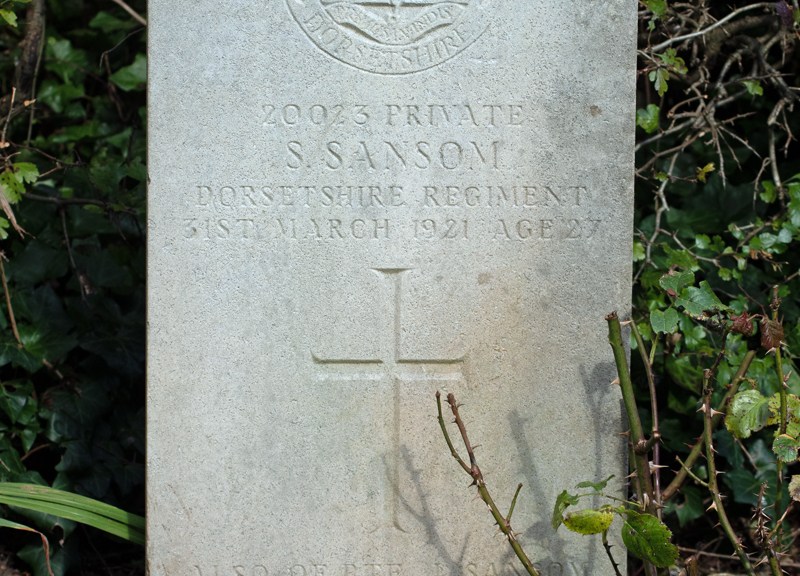
In a corner of Sherborne Cemetery stands a gravestone. It is dedicated to 20023 Private S Sansom of the Dorsetshire Regiment. He died on 31st March 1921, aged 27 years.

Searching just on a surname doesn’t turn up a great deal, even for one as seemingly uncommon as Sansom.

My default first sites for this research are the Commonwealth War Graves Commission and Find A Grave. Both sites, however, list the soldier’s name as Sanson, even though the stone clearly says Sansom.

The FAG site provides no other information, although the CWGC page does name the soldier’s father, Thomas Sanson of Sherborne. Again, an Ancestry search does not bring anyone by that name in Dorset.

My next option is usually the British Newspaper Archive; no Sansons are recorded, but the surname Sansom does turn up just after the date on the stone:

Mrs Sansom desires to thank all friends who have expressed sympathy with her in the sad bereavement she has sustained by the death of her husband.

Western Gazette: Friday 22nd April 1921

Nothing conclusive, but it did suggest that Sansom may be the correct spelling.

Back on Ancestry, Thomas Sansom doesn’t turn up anything, but a random check on the surname and specific date of death did show a few family trees for a Stanley Sansom, born in 1892. Again nothing conclusive here, particularly as none of the trees include any military records or spouses, but there was enough information to collate an overview of his life.


Stanley Sansom was born in September 1892 in Sherborne. He was one of six children to Thomas Sansom, a glove cutter, and his wife Jane.

The cloth business was a large employed in the Dorset town, and after leaving school, Stanley became an apprentice tailor.

There don’t appear to be any records of Private Sansom’s military service. However, he enlisted in the Dorsetshire Regiment, and his Service Number identifies that he served in the 1st/4th Battalion.

According to the Dorsetshire Regiment records, this battalion sailed for India on 9th October 1914, so Private Sansom must have enlisted at the outbreak of hostilities.

After a year’s training, his battalion moved to the Eastern Front, where soldiers saw action against the Turks in what is now Iraq. From what records there are, it can only be assumed that Private Sansom survived the war pretty much unscathed and returned to England in 1918 to be demobbed.

There is no record of Stanley marrying, so whether the Western Gazette’s article relates to him, or to another Sherborne Sansom is unclear.

All that can be confirmed is that Private Stanley Sansom died on 31st March 1921, aged 27.

He lies at rest in the cemetery of his home town in Dorset.


As I was writing this post, I happened to notice an additional inscription at the bottom of Stanley’s gravestone:

Also of Private J Sansom, Dorsetshire Regiment. Died at Basra June 1916

Stanley had a younger brother, Jack, who also enlisted in the 1st/4th Battalion. The brothers were shipped to India and Mesopotamia together; while Stanley came home, Jack died in battle and is buried in Basra War Cemetery. He was just 20 years old.