Tag Archives: 1921

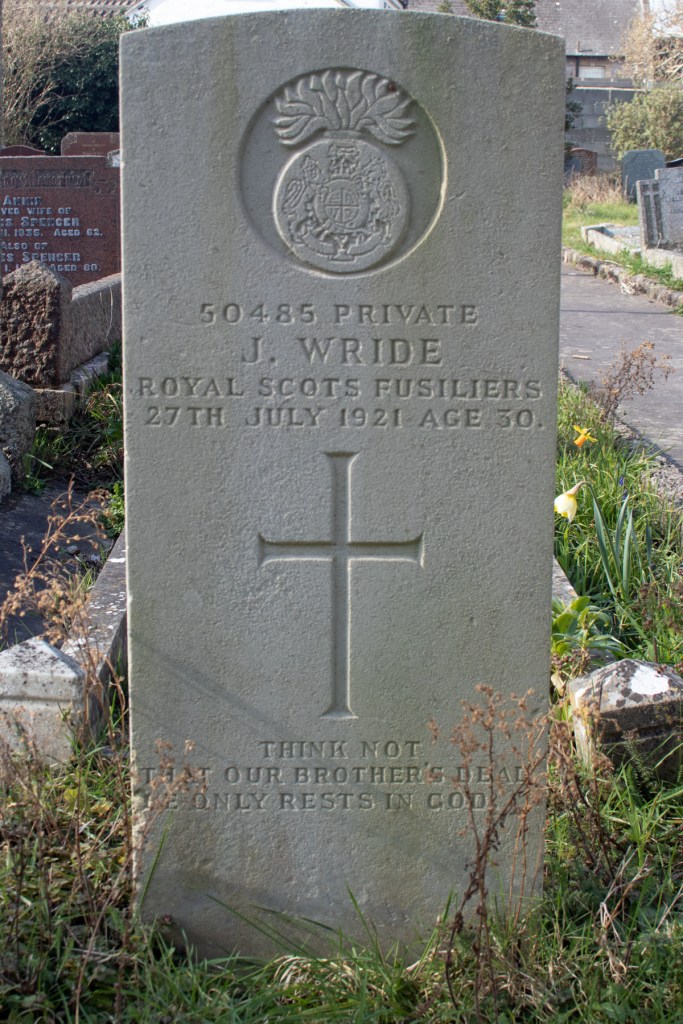
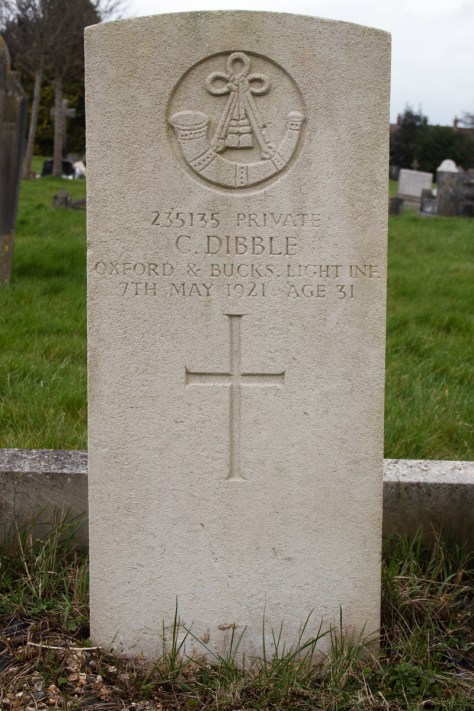
Lance Corporal Sidney Turner

Lance Corporal Sidney Turner

Sidney Joseph Turner was born in 1888, the oldest of four children to Sidney and Matilda Turner from Bridgwater in Somerset. Sidney Sr was a carter, while his son became a labourer in a local cement works. Sadly, Sidney Sr died in 1903, when Sidney Jr was 15, leaving Matilda with three other children, one of whom was only 18 months old.

Sidney Jr travelled to get work, and had moved to South Wales to work as a miner by 1909. Here he married Rose Shattock, who was born in Bristol, although within a couple of years the young couple had moved back to Somerset.

Sidney and Rose had a son, also called Sidney, although sadly he died when he was only a couple of months old. Tragically for Sidney, the records seem to suggest that Rose may have died in childbirth, or shortly after, as her passing was registered in the same quarter as her son’s birth.

By this time, Sidney was living in Bailey Street, Bridgwater, a short distance from some railway sidings. This might have driven some determination in him as, by the following year, he was listed as an engine driver. In December 1913 he married his second wife, Bessie Sharman. She was the daughter of a mariner, who had become a machinist in a shirt factory by the time of their marriage. The couple went on to have a son, also called Sidney, in April 1914.

When war broke out, Sidney enlisted in the Highland Light Infantry, initially in the 12th (Service) Battalion. They landed in France in July 1915 and were there for the remainder of the war. At some point, Lance Corporal Turner transferred to the 53rd (Young Soldier) Battalion. Very much a training brigade, it seems that Sidney’s experience of the front line may have proved useful for the upcoming recruits.

Lance Corporal Turner was demobbed on 21st March 1919; his pension record shows that, during the course of his service, he had fractured his tibia and had contracted bronchitis. The 1921 census found Sidney back in Bridgwater. He was listed as being a gas engine driver for John Board & Co., although he was, at that point, out of work. He, Bessie and Sidney Jr were living at 1 Price’s Buildings.

Sidney’s health conditions were to prove his downfall, as, within a months of the census return, he had succumbed to pulmonary tuberculosis and exhaustion. He died on 2nd July 1921, aged just 32 years old.

Sidney Joseph Turner lies at rest in St John’s Cemetery in his home town of Bridgwater, Somerset.

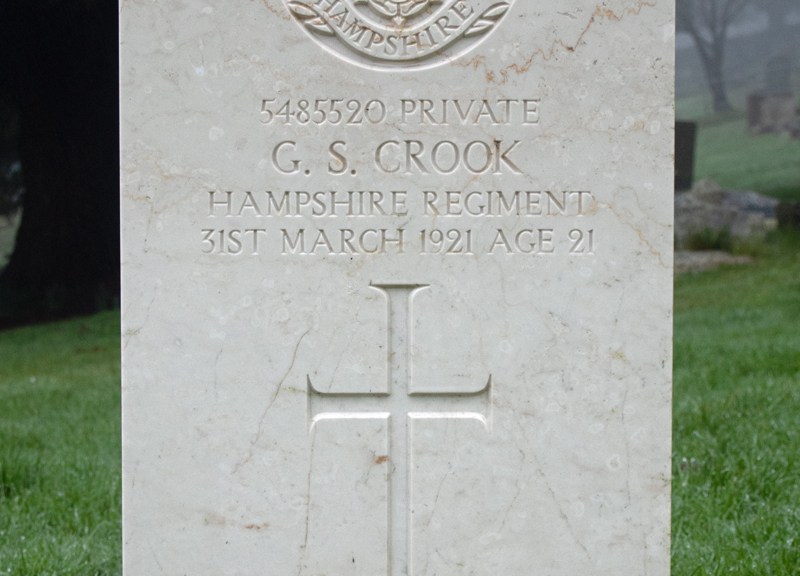
Private Gordon Crook

Private Gordon Crook

Gordon Spencer Crook was born in 1900, one of thirteen children to William and Elizabeth Crook from Somerset. William, like his father, was a gardener, and the family lived in Lower Lane, a small lane sandwiched between the railway and a stream in the centre of Shepton Mallet.

The military records for Gordon, who seems also to have gone by the name of George, are a challenge to piece together. His older brothers Walter and Bertram both died as a result of the fighting, both in 1916, and it seems likely that Gordon was keen to do his bit as soon as he could, to honour their memories.

He enlisted in the Hampshire Regiment, whose battalions served both in France and on the home front. There is conflicting information about his service, but Private Crook appears to have fought at the front, gaining the Victory and British Medals.

Again, with his passing, there is little information surrounding Gordon, or George. A brief notification in the Shepton Mallet Journal stated that “On March 31, at Royal Victoria Hospital Netley, Gordon Spencer, the dearly loved son of W and E Crook, aged 21 years.”

Gordon Spencer Crook lies at rest in the cemetery of his home town, Shepton Mallet.


Gordon’s brother Walter is also buried in Shepton Mallet Cemetery – read his story here.


A third brother, Bertie, was also gave his life in the Great War. The local newspaper had given a touching report on his death in April 1916.

Bertie Crook left school at the age of 13, and went into service with Mrs Dickinson at Whitstone, as a stable lad. He was there a year and then, on account of Mrs Dickinson giving up horses and leaving the town, they recommended him to Lord Derby’s stables at Newmarket, under the Hon. G Lambton. Small as he was, Bertie Crook undertook the railway journey alone, with a label in his buttonhole. He served five years apprenticeship, which expired at the beginning of October [1915]. He then tried to join the Royal Field Artillery, but not being tall enough he joined a West country regiment on the 20th October, and left Tidworth Barracks for France in the early part of January. He was in his 21st year, having been born on the 29th July. 1895.

The Hon. George Lambton writes “I was terribly shocked and grieved to hear of the death of your boy… Mrs Lambton and I send our deepest sympathy… I always liked your boy so much when he was in my stable; and I felt sure that with his quiet and courageous character he would make a good soldier. I shall have a plate put up in the stable in memento of his glorious death.”

Shepton Mallet Journal: Friday 21st April 1916

Lance Corporal Bertram Stanley Crook is buried at the 13th London Graveyard in Lavantie, France.


Air Mechanic Hedley Chinn

Air Mechanic Hedley Chinn

Hedley Walter Chinn was born in April 1900, one of six children to Walter and Kate Chinn. Walter was the butcher in the Somerset village of Middlezoy, and this is where the family had made their home.

There is little information on Hedley’s pre-war life, beyond the two census records of 1901 and 1911. With war breaking out and his older sister Lilian dying while nursing the troops (see below), it seems that Hedley was eager to do his duty.

Within months of Lilian’s death in 1917 – and basically as soon as his age allowed – Hedley enlisted in the Royal Naval Air Service as a mechanic. He carried out his initial training on the land-based ships President II, Impregnable and Cranwell, before officially joining the newly-formed Royal Air Force in May 1918.

Air Mechanic Chinn continued his service at Calshott, where he worked as a wireless operator for the flying boats guarding the Solent around Southampton. He continued in the role for the remainder of the war and beyond.

Hedley was eventually transferred to the RAF Reserve in February 1920, when, presumably, he returned to the family home in Somerset.

Little further is evident of Hedley’s life; but he passed away less than a year after being demobbed. There is nothing to confirm the cause of his death; given he died more than two years after the war, it is likely that it was as a result of an illness, although this is a presumption on my part. Either way, he died on 2nd January 1921, aged just 20 years old.

Hedley Walter Chinn lies at rest in the peaceful graveyard of Holy Cross Church in Middlezoy, Somerset.


It is worth noting that Hedley’s sister Lilian also served – and perished as a result of the Great War. Click here to learn more.


When I was researching Hedley’s life, I ran through the contemporary newspapers to trace his name. Nothing evident came up, although Hedley’s father, Walter’s name did appear.

In 1910, he declared himself bankrupt after being unable to pay for meat for his shop, that he had bought at auction. It appears that he had run up debts of over £300 (approximately £23,500 in today’s money) over a number of years; he put these debts down to a number of factors – “illness of my children, bad debts, having to maintain my mother for 14 years; and loss on sale of Middlezoy House, Middlezoy, three years ago, which realised £200 less than the amount I gave for it, and the amount expended on improvements”.

The 1921 census found Walter and Kate still running the butcher in Middezoy, their home empty but for each other. Walter’s debts were finally cleared in 1928 and the bankruptcy annulled.


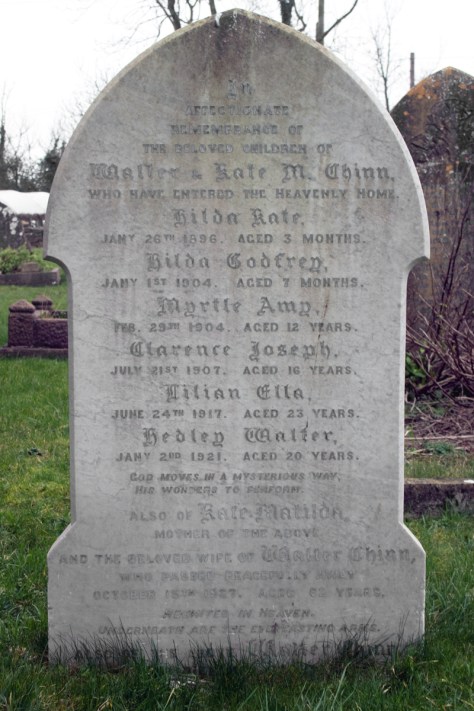
The gravestone in Holy Cross Churchyard is a haunting memorial to the tragic lives of the Chinn family.

Walter and Kat had six children, and would outlive every one of them. The stone confirms that each of their children lies in the grave:

  • Clarence Joseph (born 1891, died 1907)
  • Myrtle Amy (born 1892, died 1893)
  • Lilian Ella (born 1893, died 1917)
  • Hilda Kate (born 1895, died 1896)
  • Hedley Walter (born 1900, died 1921)
  • Hilda Godfrey (born 1903, died 1904)

The grave’s epitaph – God moves in a mysterious way, his wonders to perform – sounds cruelly hollow to 21st century ears. The only comfort to take, I guess, is that the whole family was destined to be together again: both Kate (who died in 1927) and Walter (who died in 1933) are also buried in the family grave.


Sergeant William Gardner

Serjeant William Gardner

William Gardner was born in Cirencester, Gloucestershire, in around 1877. While I have been unable to totally confirm this, his parents seem to have been William and Sarah Carpenter; William Sr was an agricultural labourer, and both he and his wife were from Cirencester.

It has been difficult to track down William’s early life, because of the potential variations of his surname and the number of William Gardner’s in the Gloucestershire area.

The first time I can definitively identify him is on the 1911 census; he was living in Cheltenham and working as gardener. While the census shows that he had been married for 16 years and had one child. However, William’s wife is not recorded on the census; instead a Lily Marie Denley is boarding with him, as is her daughter, Irina May Gardner Denley.

William’s military life also needs a little piecing together. His gravestone confirms that he was a Serjeant in the Gloucestershire Regiment, and it seems that he enlisted towards the end of the 1800s, as he is recorded as having served in South Africa.

Serjeant Gardner re-enlisted (or was called back up) when the Great War broke out; at the age of 39, he was sent to France, collecting the Victory Medal, the British Medal and the 1915 Star for his service. At some point, however, he transferred back to England, joining the 440th Agricultural Coy. Labour Corps.

While there is no evidence of why William transferred, his later records certainly seem to suggest there were some issues going on in his life. When he was demobbed in February 1919, this seems to have been for medical reasons; his pension records show that he was suffering from neurasthenia (or shell shock), and that this was directly attributable to his war service.

William’s suffering evidently continued: a further record shows that he was admitted to an asylum in March 1921 and the 1921 census corroborates this. William was noted as being one of nearly 900 patients at the Somerset and Bath Pauper Lunatic Asylum in Wells and this is where he died, just a month later. While there is no cause of death, he passed away on 14th July 1921, at the age of 45 years old.

William Gardner lies at peace in the Cemetery in Wells, Somerset.


One additional point for William’s story. Another part of his was pension records give Miss Lily Denley as his dependent, and that she was guardian of his child. No eyebrows raised now, but how must their relationship have been viewed in 1911?


Private William Rawle

Private William Henry Rawle

William Henry Rawle was born in 1890, the eldest child of George Rawle, a sailor, and Louisa, his wife.

At the time of the 1911 census, William was working as a carter on a farm not far from Porlock in Somerset.

He enlisted in August 1914, joining the Somerset Light Infantry and serving as part of the Expeditionary Force. After a couple of postings, Private Rawle was transferred to the Pioneer Depot in March 1916.

Six months later William was medically discharged as unfit for continued service. His notes highlight his distinguishing marks as 3 marks on his left arm, birth mark under his right nipple and gunshot wound to the left eye (which I am guessing is what led to his discharge).

William died on 11th June 1921, aged 27 years old. I have been unable to find anything specific relating to his death and it is likely, therefore, that no misadventure was involved.

Private William Henry Rawle lies at peace in the churchyard of Lydeard St Lawrence, alongside his brothers Stephen and Ernest.


George and Louisa’s other son – Edward – also served, enlisting in the Somerset Light Infantry and fighting in the Balkans. Private Edward Rawle survived the war, returning home in March 1919.

It should be noted that, by June 1921, George and Louisa had lost three of her four sons to the Great War. Their daughter, Norah, had also passed away in 1918.

The 1921 census found Louisa living in East Town, in the parish of Tolland, not far from Lydeard St Lawrence. Edward was living with her, as were her three-year-old granddaughter, Lorna, and her eighteen-month-old grandson Beatty. It is unclear whose children they were. George, at this point, was helping his younger brother out on the family farm in Williton.


Private Stanley Sansom

Some of the research on the Commonwealth War Graves has been fairly straightforward – information has been readily available on sites like Ancestry, or the death has been unusual or sudden enough for it to have made contemporary newspapers.

Other times, the search goes on for a while and only the tiniest of leads manages to turn up some information.

Private Stanley Sansom falls firmly into the second category.


Private Stanley Sansom

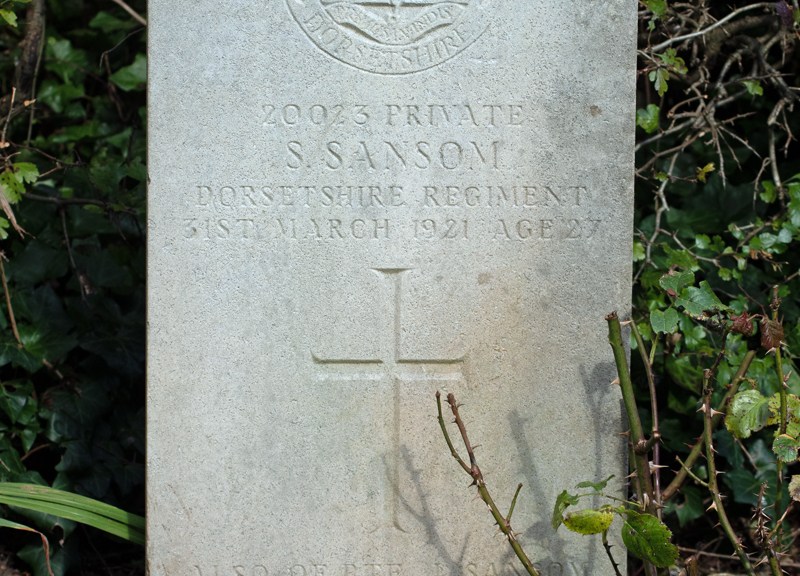
In a corner of Sherborne Cemetery stands a gravestone. It is dedicated to 20023 Private S Sansom of the Dorsetshire Regiment. He died on 31st March 1921, aged 27 years.

Searching just on a surname doesn’t turn up a great deal, even for one as seemingly uncommon as Sansom.

My default first sites for this research are the Commonwealth War Graves Commission and Find A Grave. Both sites, however, list the soldier’s name as Sanson, even though the stone clearly says Sansom.

The FAG site provides no other information, although the CWGC page does name the soldier’s father, Thomas Sanson of Sherborne. Again, an Ancestry search does not bring anyone by that name in Dorset.

My next option is usually the British Newspaper Archive; no Sansons are recorded, but the surname Sansom does turn up just after the date on the stone:

Mrs Sansom desires to thank all friends who have expressed sympathy with her in the sad bereavement she has sustained by the death of her husband.

Western Gazette: Friday 22nd April 1921

Nothing conclusive, but it did suggest that Sansom may be the correct spelling.

Back on Ancestry, Thomas Sansom doesn’t turn up anything, but a random check on the surname and specific date of death did show a few family trees for a Stanley Sansom, born in 1892. Again nothing conclusive here, particularly as none of the trees include any military records or spouses, but there was enough information to collate an overview of his life.


Stanley Sansom was born in September 1892 in Sherborne. He was one of six children to Thomas Sansom, a glove cutter, and his wife Jane.

The cloth business was a large employed in the Dorset town, and after leaving school, Stanley became an apprentice tailor.

There don’t appear to be any records of Private Sansom’s military service. However, he enlisted in the Dorsetshire Regiment, and his Service Number identifies that he served in the 1st/4th Battalion.

According to the Dorsetshire Regiment records, this battalion sailed for India on 9th October 1914, so Private Sansom must have enlisted at the outbreak of hostilities.

After a year’s training, his battalion moved to the Eastern Front, where soldiers saw action against the Turks in what is now Iraq. From what records there are, it can only be assumed that Private Sansom survived the war pretty much unscathed and returned to England in 1918 to be demobbed.

There is no record of Stanley marrying, so whether the Western Gazette’s article relates to him, or to another Sherborne Sansom is unclear.

All that can be confirmed is that Private Stanley Sansom died on 31st March 1921, aged 27.

He lies at rest in the cemetery of his home town in Dorset.


As I was writing this post, I happened to notice an additional inscription at the bottom of Stanley’s gravestone:

Also of Private J Sansom, Dorsetshire Regiment. Died at Basra June 1916

Stanley had a younger brother, Jack, who also enlisted in the 1st/4th Battalion. The brothers were shipped to India and Mesopotamia together; while Stanley came home, Jack died in battle and is buried in Basra War Cemetery. He was just 20 years old.