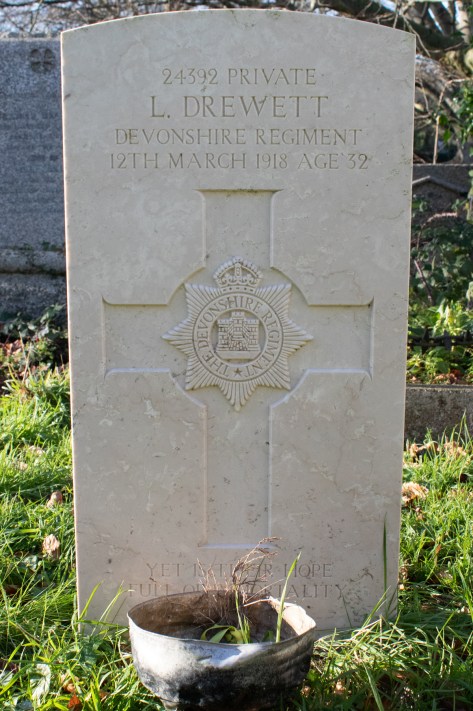
Leonard Stephen Lovelock was born early in 1887 in the Wiltshire village of Edington. The son of Ellen Lovelock, there is no confirmation of who his father was. Ellen married Stephen Drewett in 1889, and from this point on Leonard took that surname. Stephen was a sawyer, and he and Ellen set up home in Kington Langley, near Chippenham.
Leonard, however, was destined for a different upbringing. The 1891 census return found him living with Jesse and Ann Coldrake, who were recorded as his grandparents: also in the household were Betsy Drewett (Jesse’s mother-in-law) and Emily Drewett (his daughter-in-law). The relationships are a little confusing, but Leonard remained with Jesse and Ann for the1901 and 1911 census records.
When he completed his schooling, Leonard followed Jesse into farm labouring. The later census return recorded the family living in a three-roomed cottage on Tinhead, the road leading north from Edington village centre.
Farm work was only the first step for Leonard and, by the time war broke out, he was employed as an attendant at the Wiltshire County Asylum in Devizes. He enlisted on 12th January 1916, his medical records showing that he was a little under 5ft 6ins (1.67m) tall, and weighed 170lbs (77.1kg).
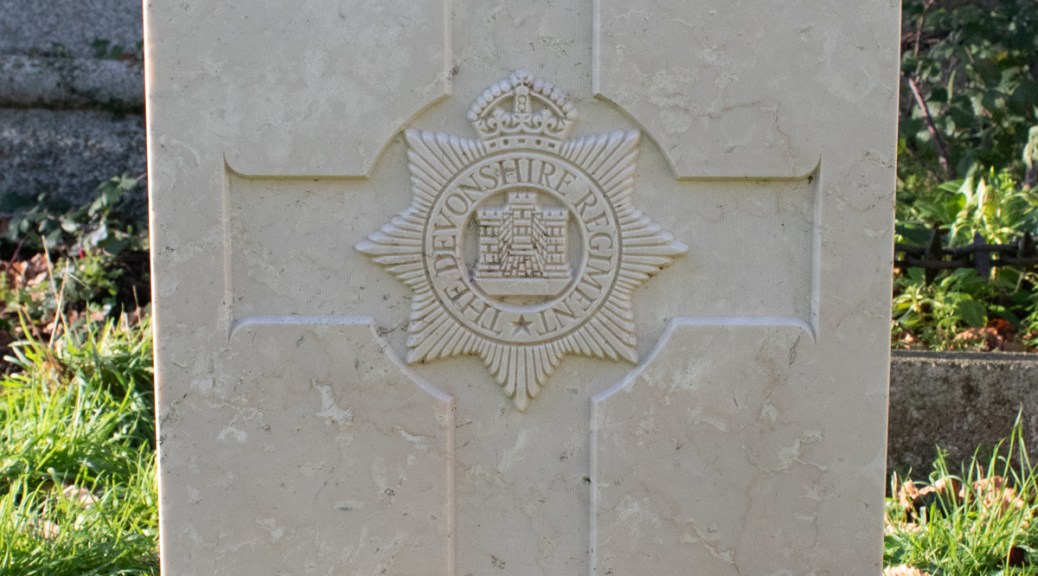
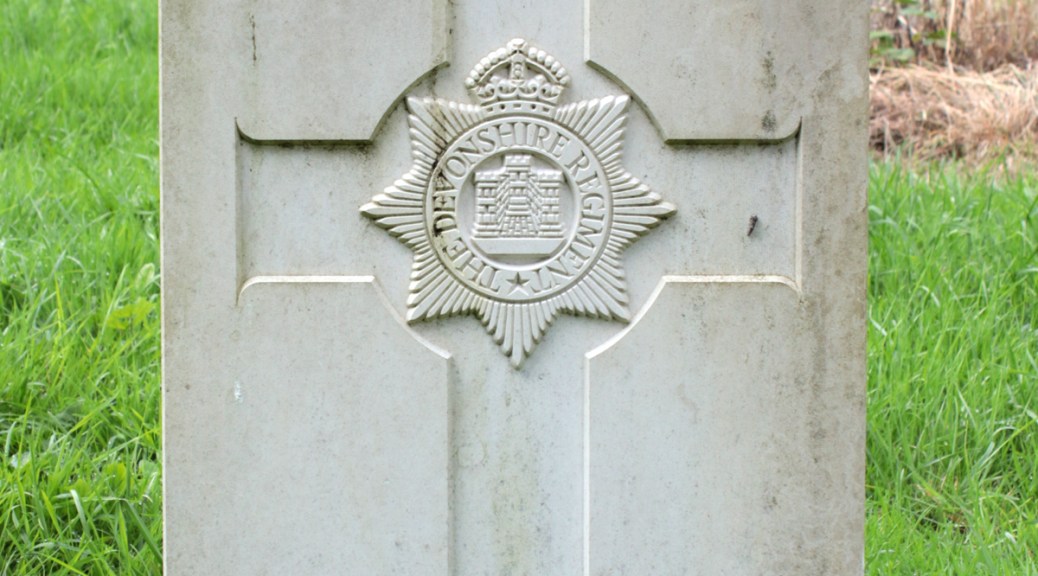
Private Drewett was initially assigned to the 12th Battalion of the Devonshire Regiment and, on 14th June 1916, his unit crossed the channel for France. While there, he was transferred to the Labour Corps, and was attached to the 152nd Labour Company. In the summer of 1917, Leonard joined the 5th Army School of Cookery, but after just six weeks he was admitted to a camp hospital suffering from epileptic seizures.
Moved from the camp hospital to the 2nd Australian General Hospital in Wimereux, by the end of the year, Private Drewett had been medically evacuated to Britain for treatment. He was sent to the General Military Hospital in Colchester, Essex, but his condition would ultimately prove fatal. Leonard died on 12th March 1918: he was 32 years of age.
The body of Leonard Stephen Lovelock Drewett was taken back to Wiltshire for burial. He was laid to rest in the graveyard of Ss Mary and Katherine and All Saints in his home village of Edington.
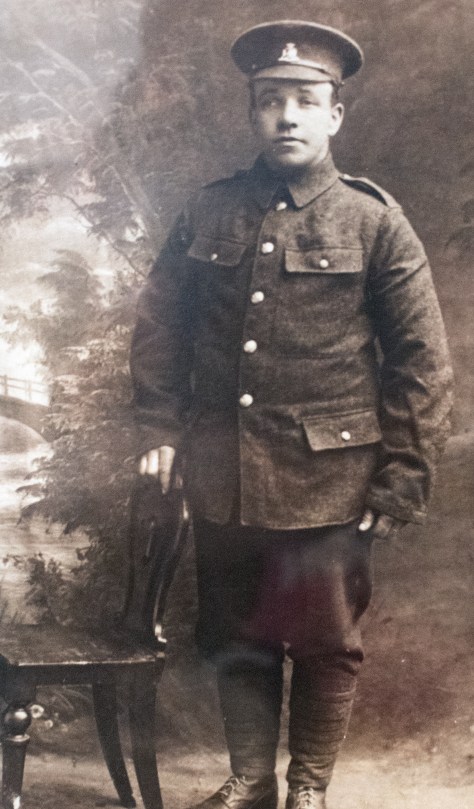
Private Leonard Drewett (from Edington Church memorial)
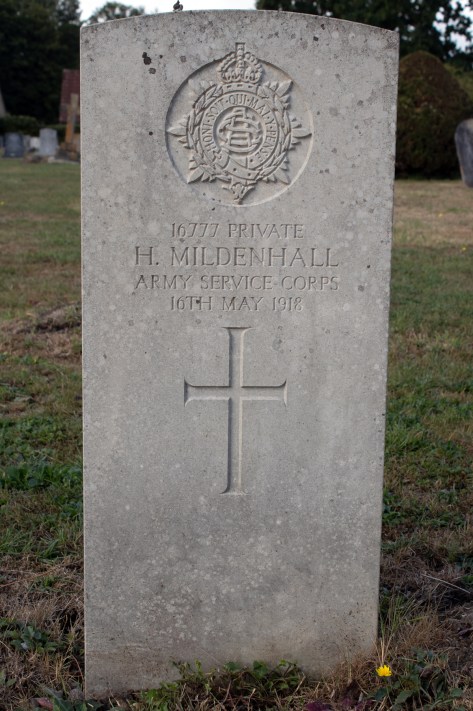
Harry Mildenhall was born in the autumn of 1873 in Eton, Buckinghamshire. The third of six children, his parents were Henry and Harriet Mildenhall. Henry was a groom, and the family lived on first on Mill Lane, before moving to Alma Road in nearby Boveney, by the time of the 1891 census.
The next census return, taken in the spring of 1901, recorded Harry as having left home. Initially apprenticed to house painter Glen Rowland, the document found him as boarding with his employer at 1 Thames View, Clewer, on the outskirts of Windsor, Berkshire.
It was not long before Harry would set out on his own. On 14th April 1906, he was living on Speedwell Street, Oxford. It was on that day that he married Annie Berridge in the parish church. Seven years her new husband’s junior, Annie was a labourer’s daughter, with a history of her own:
Annie Berridge (19), domestic servant, Peterborough, was charged with obtaining 4s. by false pretences from Martha Withers on Feb. 4th. The evidence showed that Berridge had been residing with Mrs Knighton of Wellington-street, who was known to Mrs Withers. On Monday week she visited the latter’s house at Oundle-road and stated that Mrs Knighton wanted to borrow 6s. In consequence Mrs Withers gave her 4s., but afterwards discovered that Mrs Knighton had never sent for the money. Accused pleaded guilty, electing to be dealt with summarily. The Bench gave defendant a chance to retrieve her character by dealing with her ad a first offender and binding her over to come up for judgment when called upon.
[Peterborough Standard: Saturday 16th February 1901]
But Annie was not done with the law just yet:
Annie Berridge (19), single soman, of no fixed abode, was charged with stealing from 11, City-road, a pair of shoes, value 4s. 6d., the property of Elizabeth Ryall, on the 24th. She was further charged with stealing from 7, Perseverance Cottages, Star-lane, money to the amount of 1s., the property of Ethel Norman, on the 18th. In the first care Elizabeth Ryall stated that accused asked for lodgings. She stayed one day and went out the following morning. As accused did not return witness looked round and missed a pair of shoes (produced), an old pair being left in their place. Detective-Sergeant Smith stated that he saw accused in Broadway on the 25th wearing the shoes missed by the previous witness. Accused, who cried bitterly, elected to be dealt with summarily, and pleaded guilty. The Chief Constable stated that a fortnight ago the accused was before the Bench and was then bound over to be of good behaviour. The Bench retired, and on their return into Court the Chairman stated that it appeared leniency was no good. That had been tried a fortnight previously, and a sentence of two months’ imprisonment would now be passed. The second charge was not proceeded with.
[Peterborough Standard: Saturday 2nd March 1901]
The 1902 census, taken just a month later, recorded Annie’s fate: she was imprisoned in Northampton Prison. Meeting Harry may have been what helped Annie back on the rails. After their wedding the couple took rooms at 6 Mill Street, Kidlington, Oxfordshire, and went on to have three children: Edward, Albert and Annie.
War came to Europe in the summer of 1915, and, despite his age, Harry would step up to play his part. He enlisted in the Army Service Corps on 16th September 1915, his papers confirming that he was of Church of England by faith, and was 5ft 5.5ins (1.66m) tall.
Private Mildenhall was sent to France within a fortnight of enlisting, although his exact role is unclear. He certainly remained overseas until April 1917, when he returned home for three months. He returned to the fray in July 1917, transferring to the Labour Corps.
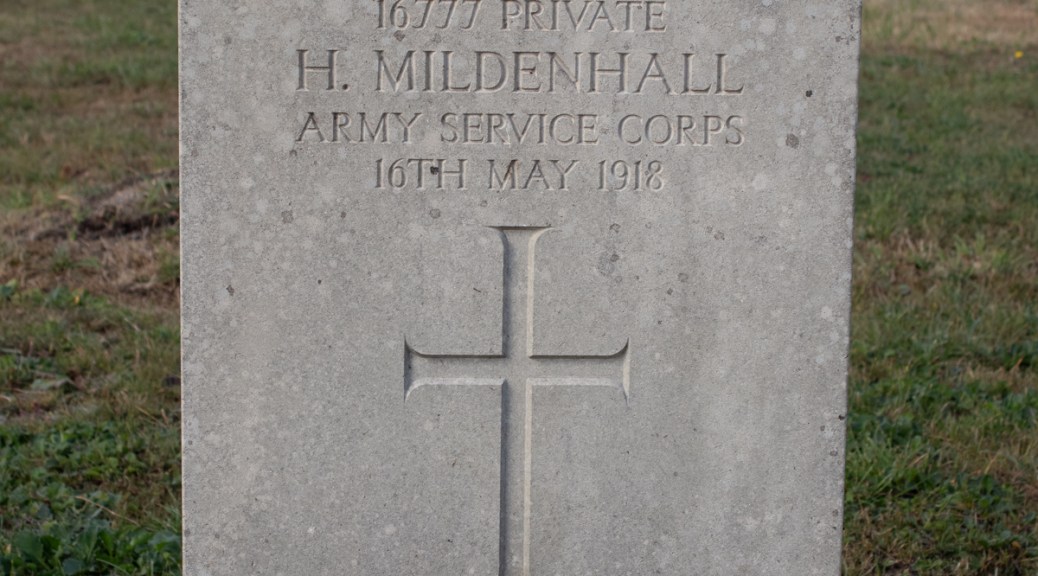
Harry next returned to Britain in May 1918. By this point, however, he had fallen ill, and was admitted to Station Road Hospital in Gillingham, Dorset, suffering from bronchitis. Any treatment proved to be too little, too late: Private Mildenhall died from heart failure at 8:15pm on 16th May 1918, at the age of 44 years old.
The body of Harry Mildenhall was laid to rest in Gillingham Cemetery, not far from the hospital where he had breathed his last.
Of Annie there is no further record. The 1921 census records the three children boarding with separate families: Edward and Albert were living with the Bowd family at 35 Gracious Street, Whittlesey, Cambridgeshire. Annie, meanwhile, was living with Joseph and Harriett Wing, just around the corner from her brothers at 5 Whitmore Street. The census records note that the children’s father was dead, but their mother alive.
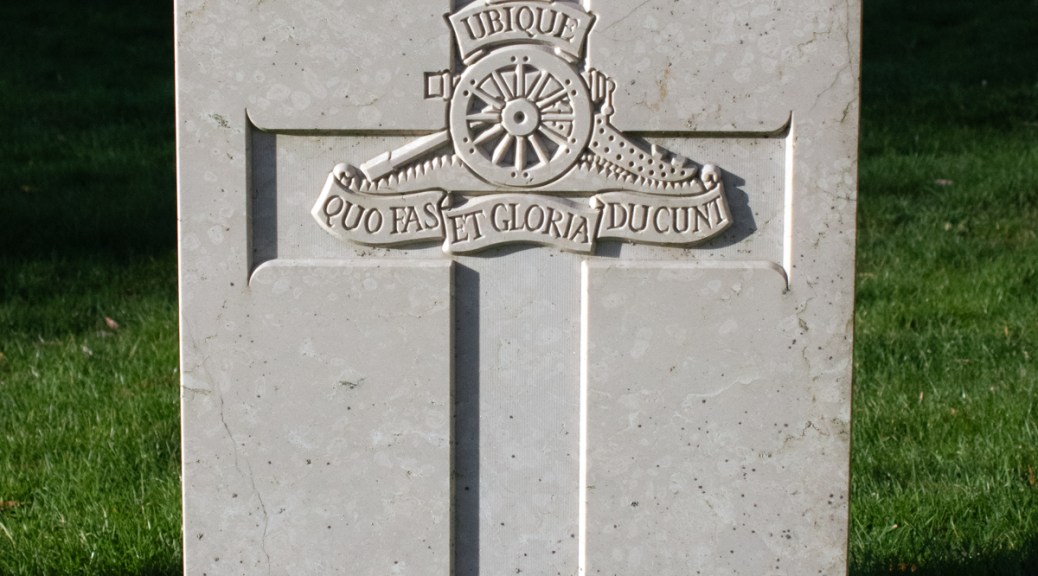
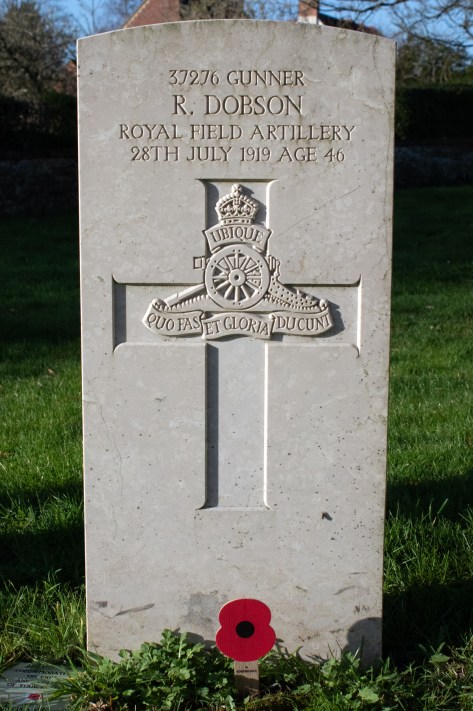
In the graveyard of St Mary’s Church in Steeple Ashton, Wiltshire, is a headstone dedicated to the memory of Gunner R Dobson of the Royal Field Artillery. The early life of Robert Dobson, however, is a challenge to unpick.
Born in Kilbride, County Wicklow, in 1873, he was the son of John Dobson and, according to his later service papers, he had three brothers: William, John Jr and Richard.
When he finished his schooling, Robert found work as a gamekeeper, but he wanted more adventure, and, on 27th April 1891, he enlisted in the Royal Artillery. Given the rank of Gunner, his papers note that he was a little over 5ft 6ins (1.68m) tall, and weighed 150lbs (68kg). A Presbyterian, he had brown hair, blue eyes and a fresh complexion.
Gunner Dobson signed up for a period of seven years, and during this time he travelled the world. From March 1893, he was based in India, but was invalided home for reasons unclear in November 1894. He would remain on home soil for the next three years, and was stood down to reserve status in April 1898.
While back on home soil, love had blossomed and, on the 14th May 1898, Robert married Mary Bull. A labourer’s daughter from Steeple Ashton, the couple wed in the parish church. Robert gave his address as the same village, and, given the proximity of the garrison town of Trowbridge, it is likely a local posting is how the couple met.
On 3rd November 1899, Gunner Dobson was called into duty once more. Attached to the 3rd Battalion of the Royal Field Artillery, his unit headed to South Africa, and he was quickly caught up in the Boer War. He would remain overseas until the spring of 1901, at which point he returned to Britain once more.
After a total of twelve years’ service, Robert was formally stood down from army service on 26th April 1903, returning to Steeple Ashton and Mary. The 1911 census – the only one of the four returns taken during his lifetime on which he appeared – found the couple living in a cottage on Common Hill, to the north of the village centre. Robert, now 38 years old, was working as a farm labourer.
When war broke out in Europe, Robert stepped up to serve his country once more. He initially re-joined his old unit, but seems to have transferred over the Labour Corps, and was attached to the 95th Company. His service records for this period have been lost, so it is unclear when or how he served.
Robert survived the conflict, but would pass away on 28th July 1919. The cause of his passing is unclear, but he was 46 years of age when he died.
The body of Robert Dobson was laid to rest in the peaceful graveyard of St Mary’s Church in Steeple Ashton.
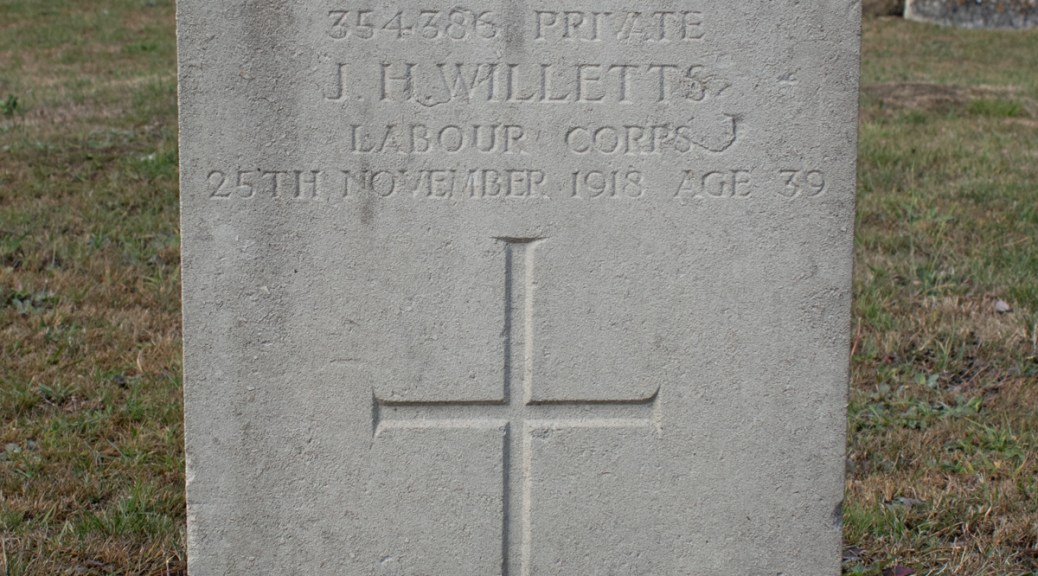
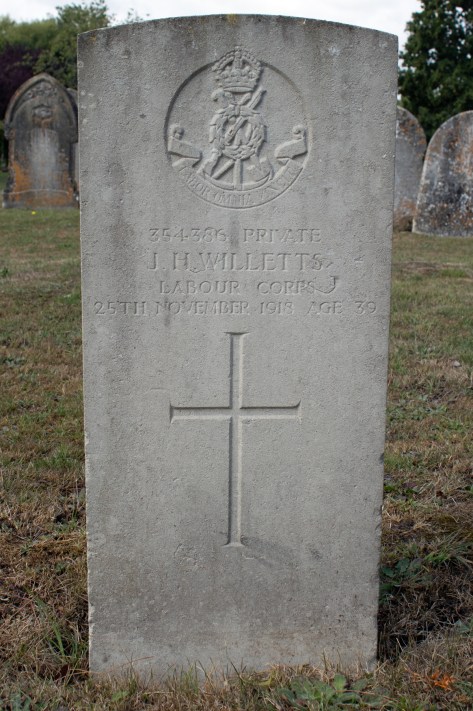
In the peaceful grounds of Gillingham Cemetery, Dorset, is the grave of Private James Henry Willetts of the Labour Corps, who died on 25th November 1918, at the age of 39 years old. The Commonwealth War Graves Commission records confirm that he was the son of James Willetts who, at the time of his son’s passing, was living in Springhill, Birmingham.
Private Willetts’ service records no longer exist, but his entry on the British Register of Soldiers’ Effects state that he was attached to the 443rd Agricultural Company, and died in Peasemarsh, Dorset. It also noted that his next of kin would not be able to claim a war gratuity: this suggests that he had served for less than six months when he passed.
A further document – the Pension Ledger Index Card – gives James’ dependent as his stepmother, Elizabeth Willetts. The record also confirms that his brother George had also died while serving as a Corporal in the Royal Warwickshire Regiment.
The challenge with trying to trace James’ early life is that there aren’t enough confirmed details. His mother’s name is not known, nor is it clear when James Sr married Elizabeth. Census records are available, but none give a clear match for father and son. Given James Jr shared his father’s name, it may also be that he went by his middle name, but this too could have been changed to Harry.
It seems, therefore, that James Henry Willetts’ life is destined to remain a mystery, taken to the grave in the Dorset cemetery.
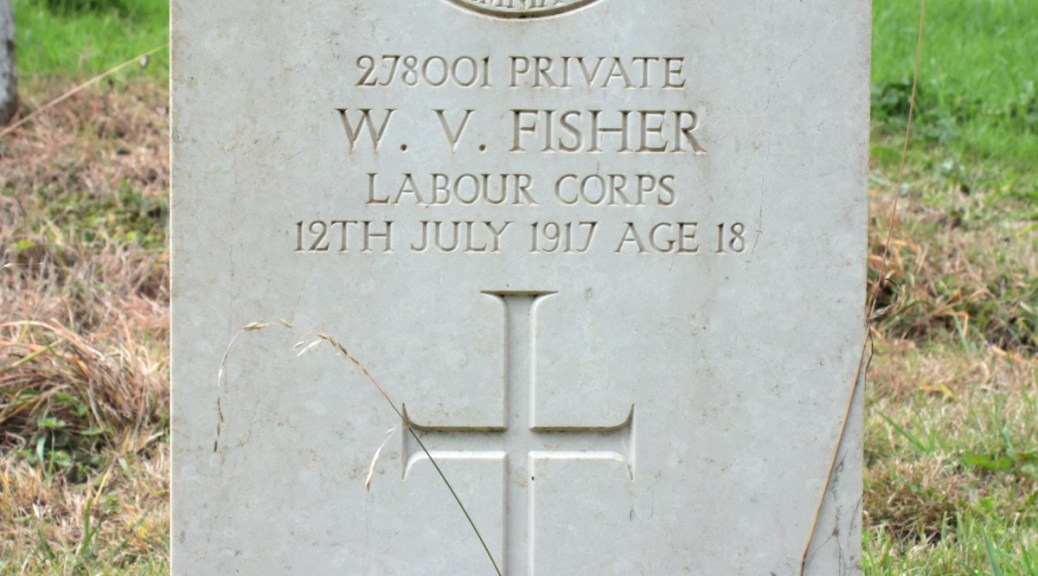
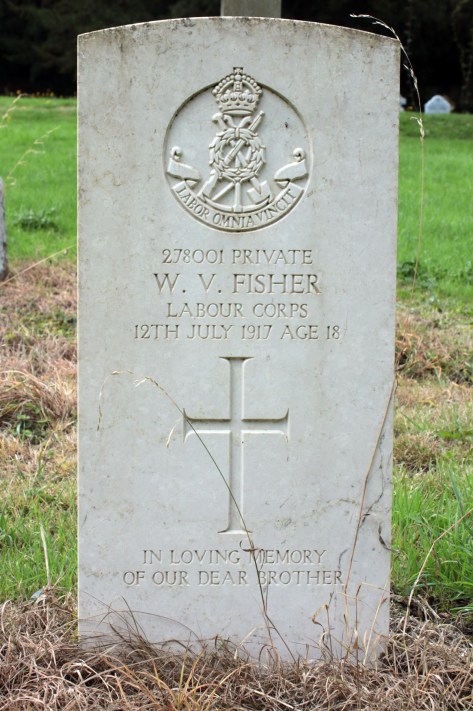
William Victor Fisher was born in Battersea, Surrey, at the beginning of 1899. The youngest of nine children, his parents were William and Julia Fisher. William Sr was a blacksmith and farrier, and, when William was born, the family were living in rooms at 9 Gladstone Street.
Julia died in 1902, and William Sr was left to raise the children on his own. This he seemed to have done well, and by the time of the 1911 census, he was still living in the same house, with five of his children. William Jr’s eldest brother, Mark, was assisting their father in the business.
When war broke out, William Jr was still at school. However, he was keen to play his part and enlisted on 29th August 1915, lying abut his age to do so. As happened at the time, the recruiting officer took the age he stated – 19 years, 255 days – as being correct. He was assigned as a Private in the Royal West Surrey Regiment, and remained in Battersea for training.
Private Fisher’s time in the army was to be a brief one, but it was not without incident. He was confined to barracks for three days on 12th October, when he lost a pair of boots. Just a month later, he was reprimanded again for being absent without leave for nearly six hours on 17th November: he was again confined to barracks, this time for four days.
William’s lie was to catch up with him, and, on 27th November 1915, he was discharged for giving an incorrect age on his recruitment papers.
Two years later, William stepped up to play his part once more. This may have been a result of the death his older brother – Francis. A Private in the 2nd Battalion of the Royal Fusiliers, he was killed in action on the Western Front on 28th February 1917: he was just 20 years of age.
Details of William’s second stint in the army have been lost to time, but it is clear that he was initially assigned to the 46th Training Reserve Battalion. Private Fisher then transferred to the 626th Home Service Employment Company of the Labour Corps, and was billeted in Wiltshire.
Tragically, Private Fisher’s time in the army was also to be brief. His entry in the British Register of Soldiers’ Effects show that he died on 12th July 1817, and, intriguingly, that the cause was asphyxiation. His death certificate confirms that this was asphyxia from inspiration of vomited matter, and that he died at No. 12 Camp in Longbridge Deverill: he was just 18 years of age.
The body of William Victor Fisher was laid to rest in the tranquil grounds of St Peter & St Paul’s Church, not far from where he had passed away.
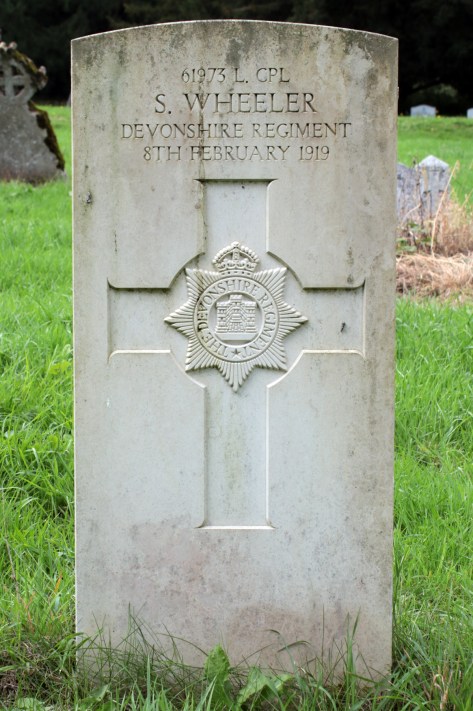
Walter Sydney Wheeler was born in the autumn of 1887 in Crockerton, Wiltshire. The oldest of three children, his parents were Walter and Lore Wheeler. Walter Sr was an agricultural labour, but when his son – who was known by his middle name – finished school, he found work as a stable boy. The 1901 census found the family living at 12 Church Street, Longbridge Deverill.
Sydney married a woman called Mary in 1907. There is little information about her, and the couple did not go on to have any children. By the time of the 1911 census, the couple were living at Priors Cottages, Semley, where Sydney had found farm work.
War came to Europe in 1914, and Sydney stepper up to play his part. Full details of his service have been lost to time, but it is clear that he had joined up no later than the summer of 1918. He initially joined the Devonshire Regiment, but later transferred to the 651st Agricultural Company of the Labour Corps. By the end of the conflict he had risen to the rank of Lance Corporal.
Sydney survived the war, and by the start of 1919, he was back in Wiltshire. His health was impacted, however, and that February he was admitted to the VAD Hospital in Trowbridge. While his condition is unknown, it was one to which he would succumb. Lance Corporal Wheeler passed away on 8th February 1919, at the age of 31 years old.
The body of Walter Sydney Wheeler was taken to Longbridge Deverill for burial: he was laid to rest in the graveyard of St Peter & St Paul’s Church.
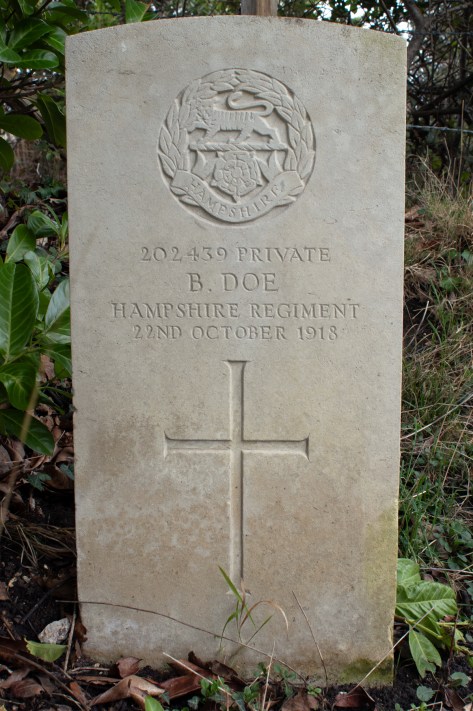
Bert Doe was born in Woking, Surrey, in 1881. One of twelve children, his parents were France and Louisa Doe. Francis – who went by his middle name, John – was a general labour and, over the years, his work took the family across the south of England. The 1891 census found the Does living in the village of Sopley, Hampshire, and this is where they seemed to settle.
There are large gaps in Bert’s early life, On 19th April 1916, he married Ellen Lackey. She was a broom maker’s daughter from Lyndhurst, Hampshire, and the couple had a son, Francis, who had been born a few weeks before they exchanged vows.
By the summer of 1918, Bert had enlisted in the army. He was attached to the Hampshire Regiment, but at some point had transferred over to the 441st Agricultural Company of the Labour Corps. Moves of this nature were often a way to rehabilitate injured or sick servicemen, and it is apparent that Private Doe fell into the latter category.
In October 1918, Bert had fallen ill with a combination of influenza and pneumonia. He was admitted to the Union Infirmary in Winchester, Hampshire, but the conditions were to prove too severe. He died on 22nd October 1918, at the age of 37 years old.
It would seem that Ellen was living in the East Boldre area of the New Forest by this point, and it was in the village’s St Paul’s Churchyard that her husband was laid to rest.
With a young son to raise, Ellen moved back in with her parents, Silas and Anna Lackey. The 1921 census found them living in Warsash Road, Sarisbury, Hampshire. Silas was employed as a labourer, while two of Ellen’s brothers were working as hawkers. Shockingly to today’s mindset, the census document records the family as ‘gipsies’.
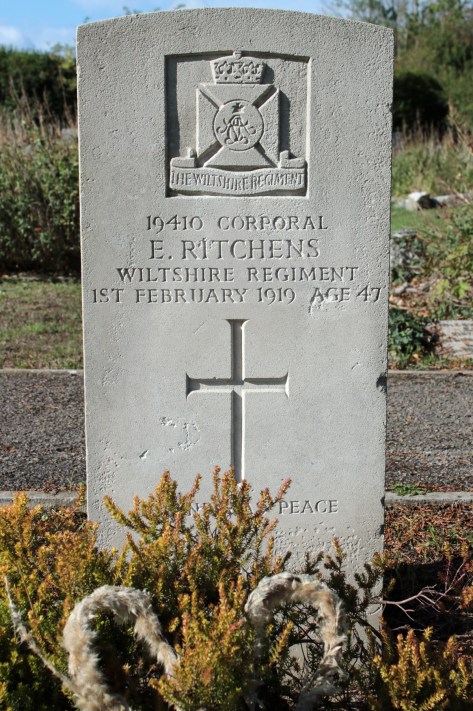
Ernest Ritchens was born in the summer of 1872 in the Wiltshire village of Semington. The youngest of nine children, he was one of seven boys to Isaac and Sarah Ritchens. Isaac was a farm labourer, and this is a job into which Ernest also followed when he completed his schooling.
Farming was not something Ernest wanted to be in for the long term, however, and, after the death of his parents – Isaac in 1895, and Sarah four years later – he joined the army. Details of his military career have been lost to time, but it seems that he joined the Wiltshire Regiment and, as a Private, spent time in South Africa. By the time he was stood down, he had risen to the rank of Lance Corporal.
Back home and, in the summer of 1907, Ernest married Sarah York, a wheelwright’s daughter from Hilperton near Trowbridge, Wiltshire. The newlyweds would set up home in the village, and go on to have four children. The 1911 census found the young family living on Devizes Road, Ernest back working as a farm labourer.
When war broke out, Ernest was again called upon to play his part . He was given the rank of Corporal, and attached to the Wiltshire Regiment (although other records he was assigned to the Hampshire Regiment). He did not appear to have spent any time overseas and, was soon transferred over to the 160th Company of the Labour Corps.
DEATHS
RITCHENS – On February 1st, at No. 1, Australian Hospital, Sutton Veny, Corporal Ernest Ritchens, of the Labour Corps, and formally of the Wilts Regiment, resident of Hilperton…
[Wiltshire News: Friday 7th February 1919]
Ernest Ritchens was 46 years of age when he passed away in 1919. While the cause us not reported, it is likely to have been an illness of some sort. His body was taken back to Hilperton, and he was laid to rest in the village cemetery.
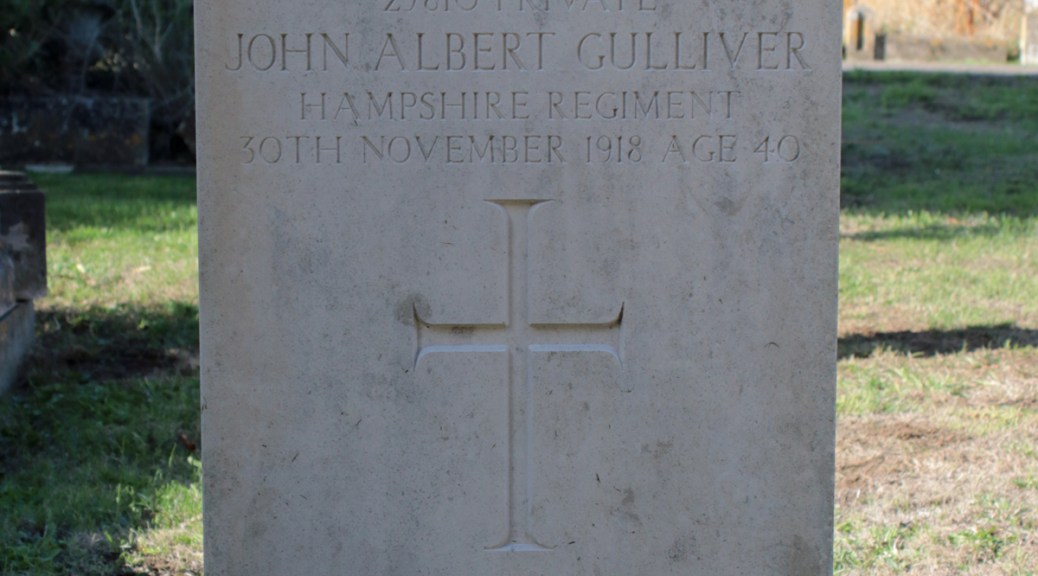
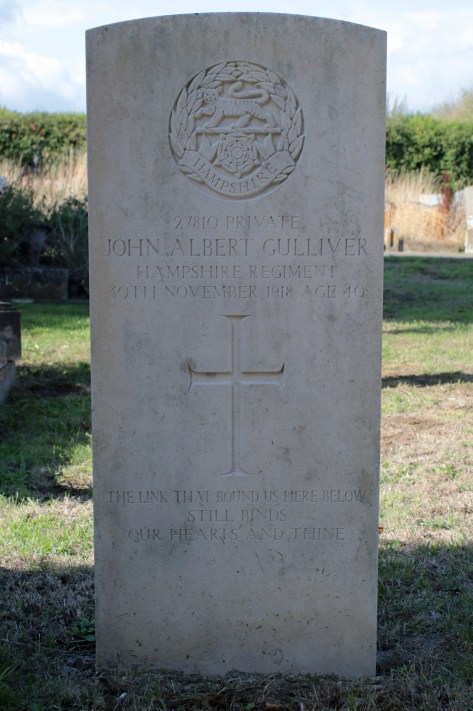
John Albert Gulliver was born in the summer of 1878. He was the second of six children – and the first boy – to farmers John and Ruth Gulliver. The family were raised in the Wiltshire village of Steeple Ashton, but had moved to Hilperton, on the outskirts of Trowbridge, by the time their eldest son had turned ten years old.
John Jr found work as a builder’s labourer when he finished his schooling. The 1911 census recorded him as living with his parents and sister on Horse Road, Hilperton, although the document suggests he was working in Edington, six miles to the south of the village. The Gulliver family also had a visitor – Bristol-born Albert Davies, who was a Lance Corporal in the Coldstream Guards.
When war broke out, John Jr was called upon to play his part. His service records have been lost to time, but it is clear that he had joined up by 1917. There is some confusion over his military service, however.
The Commonwealth War Graves Commission records give Private Gulliver’s initial unit as the 3rd Battalion of the Hampshire Regiment, and he was awarded a ‘wounded stripe’ following an injury on 10th September 1917. However, John’s Medal Roll Index Card suggests he joined the Duke of Cornwall’s Light Infantry. Either way, Private Gulliver did not appear to spend any time overseas and, by the autumn of 1918, he had transferred to the 442nd Agricultural Company of the Labour Corps.
Private Gulliver survived the war, but his health had been impacted. He had contracted pneumonia, and passed away at home on 30th November 1918. He was 40 years of age.
The body of John Albert Gulliver was laid to rest in the tranquil grounds of Hilperton Cemetery, not far from where his grieving parents still lived.
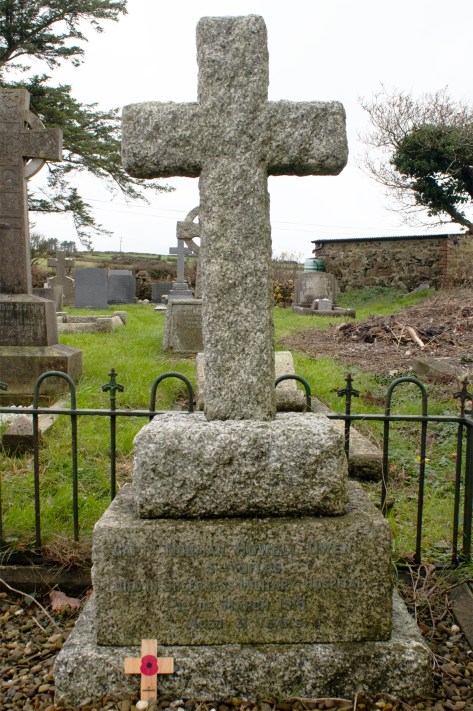
Norman Howell Owen was born in the spring of 1888, and was the third of four children – all boys – to John and Elizabeth. John was a surgeon from Pembroke Dock, Pembrokeshire, but the family were raised in Fishguard, where his practice was based.
Norman was an educated young man and, in 1906, attended the Sir Isaac Pitman & Son Phonetic Institute in Bath Somerset. He was studying shorthand, passing an examination in the subject after just three months. He passed an entrance exam for the National and Provincial Bank the following year, and, by the time of the 1911 census, he was working in the Fishguard branch and living back with his parents.
When war came to Europe, Norman was called upon to play his part. Full details of his service have been lost to time, but what remains paints an interesting picture of his time in the army. He appears to have enlisted in the King’s Liverpool Regiment as a Private, before transferring to the Labour Corps, then the Army Ordnance Corps.
By 1918 the Pembrokeshire Voters List noted Norman and two of his brothers as absentee voters – serving in the army, so not at home. Norman is recorded as being a Captain in the Army Service Corps, having received a commission on 8th February 1915. His older brother John is recorded as being a Captain in the Royal Army Medical Corps, while his younger brother, Lionel, was a Captain in the Royal Field Artillery.
The mystery of Norman continued: he survived the conflict, but by February 1919 had been admitted to the Broadway Military Hospital in Sheerness, Kent. He passed away on 1st March, the cause of his passing not readily available. Captain Owen was 31 years of age.
The body of Norman Howell Owen was taken back to Pembrokeshire for burial. He was laid to rest in Fishguard Church Cemetery.
Norman died intestate: his family went through probate, and his effects – totalling £1003 8s 10d (approximately £67,000 today) were left to his father.