
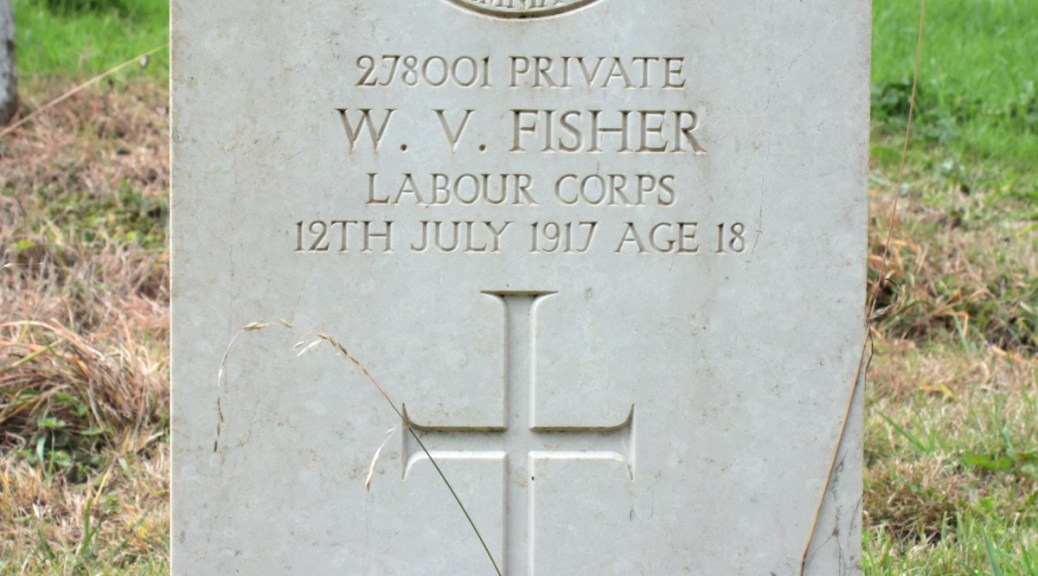
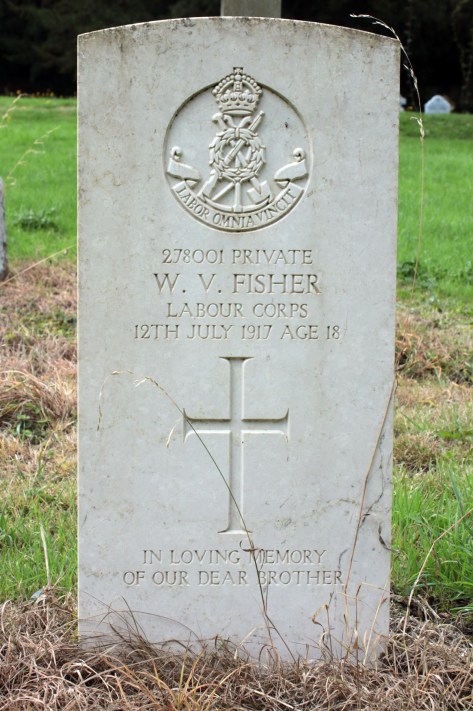
William Victor Fisher was born in Battersea, Surrey, at the beginning of 1899. The youngest of nine children, his parents were William and Julia Fisher. William Sr was a blacksmith and farrier, and, when William was born, the family were living in rooms at 9 Gladstone Street.
Julia died in 1902, and William Sr was was left to raise the children on his own. This he seemed to have done well, and by the time of the 1911 census, he was still living in the same house, with five of his children. William Jr’s eldest brother, Mark, was assisting their father in the business.
When war broke out, William Jr was still at school. However, he was keen to play his part and enlisted on 29th August 1915, lying abut his age to do so. As happened at the time, the recruiting officer took the age he stated – 19 years, 255 days – as being correct. He was assigned as a Private in the Royal West Surrey Regiment, and remained in Battersea for training.
Private Fisher’s time in the army was to be a brief one, but it was not without incident. He was confined to barracks for three days on 12th October, when he lost a pair of boots. Just a month later, he was reprimanded again for being absent without leave for nearly six hours on 17th November: he was again confined to barracks, this time for four days.
William’s lie was to catch up with him, and, on 27th November 1915, he was discharged for giving an incorrect age on his recruitment papers.
Two years later, William stepped up to play his part once more. This may have been a result of the death his older brother – Francis. A Private in the 2nd Battalion of the Royal Fusiliers, he was killed in action on the Western Front on 28th February 1917: he was just 20 years of age.
Details of William’s second stint in the army have been lost to time, but it is clear that he was initially assigned to the 46th Training Reserve Battalion. Private Fisher then transferred to the 626th Home Service Employment Company of the Labour Corps, and was billeted in Wiltshire.
Tragically, Private Fisher’s time in the army was also to be brief. His entry in the British Register of Soldiers’ Effects show that he died on 12th July 1817, and, intriguingly, that the cause was asphyxiation. His death certificate confirms that this was asphyxia from inspiration of vomited matter, and that he died at No. 12 Camp in Longbridge Deverill: he was just 18 years of age.
The body of William Victor Fisher was laid to rest in the tranquil grounds of St Peter & St Paul’s Church, not far from where he had passed away.


 Death and Service