
Tag Archives: car

Private Samuel Smith

Private Samuel Smith

Samuel Herbert Smith was born on 15th March 1886 in Liverpool, Lancashire. He was one of six children to parents Henry – a road labourer for the local council – and Elizabeth.

There is little concrete information about Samuel’s early life. While the 1901 census confirms he was employed as an apprentice, the writing is not legible enough to identify the trade he was in. A later record suggests he spent two years in the Royal Engineers, although, again, no supporting documents evidences this.

Samuel married a woman from South Wales. Her details are lost, but his war pension record gives the name Mrs SH Smith, and gives her address as 34 Albany Street, Newport, Monmouthshire.

It would seem that Samuel was keen to build a bigger and better life for the couple, and left Britain to find work overseas. By 1914 he was living in Valcartier, Quebec, and working as a bartender. War was declared in the summer of that year, however, and he immediately stepped up to serve his country.

Samuel enlisted in the Canadian Expeditionary Force on 23rd September, and was assigned to the 13th Battalion of the Canadian Infantry. His service records suggest he cut a striking figure: he stood 6ft 1in (1.85m) tall and weighed 168lbs (76.2kg). He had light brown hair, hazel eyes and a medium complexion, and his records note that he had a crossed hands tattoo on his right arm.

His unit set sail for England and, by the end of October, Private Smith was installed at Bustard Camp on Salisbury Plain, Wiltshire.

An enquiry was led into the death of Samuel Herbert Smith… Private Smith was travelling… in a motor car, and while the car was passing over uneven ground he fell into the road and was almost instantaneously killed.

George William Hincks, a private in the Canadian Force… was driving from Salisbury… in a motor car, which was meant to carry a machine gun, and was, therefore, open at the sides. Private Smith was seated next to [him] and was inclined to be rather sleepy. He had travelled in the train from Liverpool on the previous day. hey had gone some distance on their journey when deceased said “I want to get out of this.” [Hincks] said “Sit still, Bert. We will be soon be there,” Smith smiled and said “Oh, all right.” Almost immediately the car jolted on a rough piece of road, and Smith pitched on his head in the road. The car was immediately stopped, and [Hincks] went back to him and found him lying with his knees up, on his back, with wounds in his head. He was dead. [Hincks] returned to Salisbury and reported the occurrence to superior officers. The road on which fatality happened was rough and had been badly cut up, more especially at the place where deceased fell from the car.

Salisbury and Winchester Journal: Saturday 31st October 1914

The accident occurred on 29th October, Private Smith was just 28 years of age.

Samuel Herbert Smith’s widow was unable to cover the cost of bringing her husband back to Wales for burial. Instead, he was laid to rest in Amesbury Cemetery, not car from Bustard Camp.
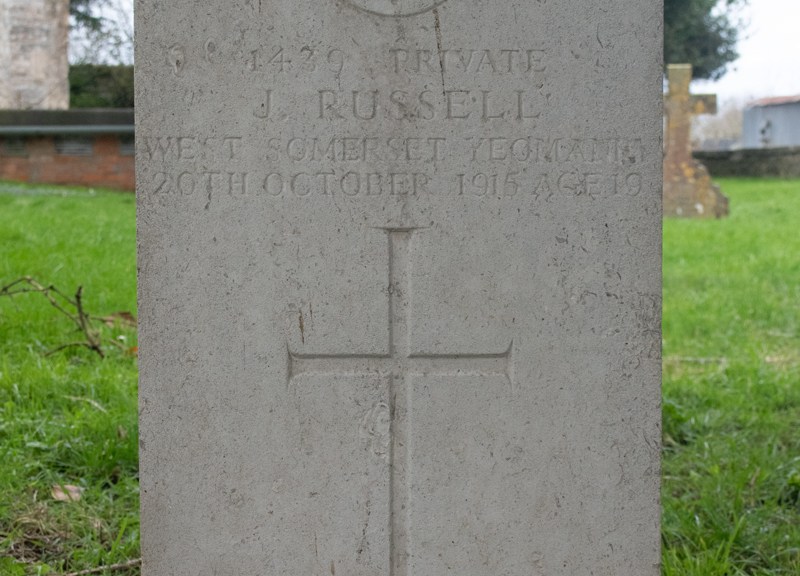

Private John Russell

Private John Russell

Born in September 1896, John Russell was one of thirteen children to Henry and Ellen Russell. Henry worked as a turf cutter on the Somerset levels, and the family lived in the village of Meare, near Glastonbury.

By the time of the 1911 census, John, aged 15, had left school and joined his father’s business.

When war broke out, John joined up; sadly, his military records are absent, but what we do know for certain is that he enlisted in the West Somerset Yeomanry, and was based at the Stanway Camp near Colchester in Essex.

Sadly, much is written of Private Russell’s death. He was acting as a sentry at the camp on the morning of Tuesday 19th October 1915 when he was hit by a car; taken to the military hospital in Colchester, he passed away the following morning.

An inquest was held into the incident, and the following was ascertained:

Vera Coysh, aged 19, was driving near the camp with two friends and her gardener; as she was approaching the entrance, a horse-drawn military wagon ahead of her turned and she swerved to avoid it. In doing so, she hit Private Russell “and carried him some way along the ground”.

John’s injuries were significant. When admitted to hospital, he “was suffering from bruises on the back of the head and haemorrhage from the right ear and nose. His left hand and the lower part of his left arm were swollen from bruising. He was semi-conscious and restless…”

The inquest identified some discrepancies in what happened.

Witnesses in the military wagon and a second one following it all saw a turning signal being given, although not necessarily in time for Vera to slow down or stop. All of the army witnesses stated that she was driving at a quick speed, possibly as much as 35mph.

Vera and her passengers all stated that they saw no signal, saying that the wagon pulled across without indication. They also stated that they were not travelling at speed.

The inquest was a lengthy one, but the final verdict was one of accidental death, with a recommendation that signs were put up on the road to warn of the entrance to the camp.

John Russell was just 19 years old when he died. He was laid to rest in the graveyard of the Church of the Blessed Virgin Mary and All Saints in his home village of Meare, Somerset.


It’s worth also having a look into the life of the driver of that fated motor car.

Vera Murdoch Coysh was born in September 1896, the eldest child of Commander William Henry Coysh and his wife Beatrice Murdoch. The family lived in Yorkshire and, by the time of the incident, William and Beatrice had had four other children – Humphrey Cecil (who became a Commander), Geoffrey Ernest (who went on to be Sub Lieutenant), John William and Barbara Daphne.

Three months after the accident, Vera married Second Lieutenant Trevor Davidson, of the Essex Regiment, and the couple soon emigrated to Mozambique.

All was not well, however, as, by 1924, Vera has moved back to England, the couple had divorced and she had remarried, to a Douglas Stuart-Jervis. The couple went on to have two children.

Meanwhile, Vera was also making a bit of a name for herself in the literary world, writing a number of novels under the name of Jane England. While rarely seen nowadays, she wrote books with such ‘pulp fiction’ titles as Red Earth, Romantic Stranger, Flowering Harvest, Stormy Passage and Winter Jasmine.

It’s bittersweet to see that Vera made a life for herself, in the way that John Russell was sadly unable to.