


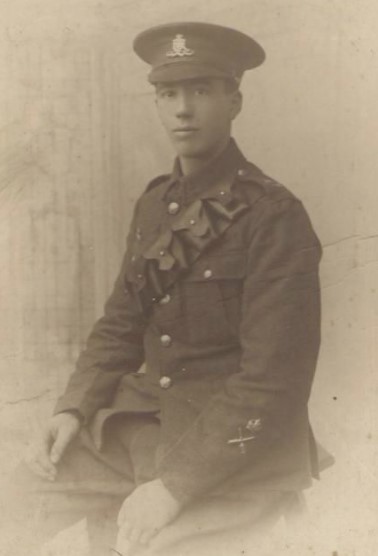
Wallace Waterman Parsons was born in the autumn of 1893 and was one of thirteen children. His parents were both Somerset-born, David and Mary Parsons, and it was in a small terraced house in Bampton Street, Minehead, that the family were raised.
David was a chimney sweep and by the time of the 1911 census, eight of the then household of nine people were earning a wage. Six of the Parsons children – ranging in age from 15 to 33 – were living with their parents, working variously as a chair caner, a labourer and a French polisher. Wallace, 17 years old by this point, was employed as a stone worker, presumably alongside his older brother, David, who was a mason.
When war came to European shores, at least two of the Parsons brothers enlisted. While full service records no longer exist, it is clear that Wallace joined the Somerset Light Infantry, and was attached to the 8th (Service) Battalion.
Private Parsons arrived in France on 11th October 1915, and may have been involved in the closing days of the Battle of Loos. Over the next year, he would have been caught up in the fighting at the Somme, but by the autumn of 1916, he had fallen ill and returned to Britain.
Whatever condition Wallace had contracted led to his discharge from the army: his final day in service was 19th December 1916. He was awarded a Silver Star for his service: this confirmed his honourable discharge, and he wore it to show that he had served his country and was not, in effect, a coward for walking the streets of his home town, while other sons, brothers and fathers were fighting for their country.
At this point, Wallace’s trail goes cold. It is likely that he returned home, but his health continued to dog him. He passed away from anaemia on 17th July 1920, at the age of 26 years old.
Wallace Waterman Parsons was laid to rest in the sweeping vista of Minehead Cemetery.
Wallace’s older brother Hubert also served in the Somerset Light Infantry. Attached to the 1st/5th Battalion, he fought in the Middle East and rose to the rank of Corporal. Hubert fell ill with enteritis, dying from the condition on 13th April 1916. He was laid to rest 3,500 miles (5632km) from home, in the Kut War Cemetery, Iraq.


 Death and Service