Tag Archives: syphilis

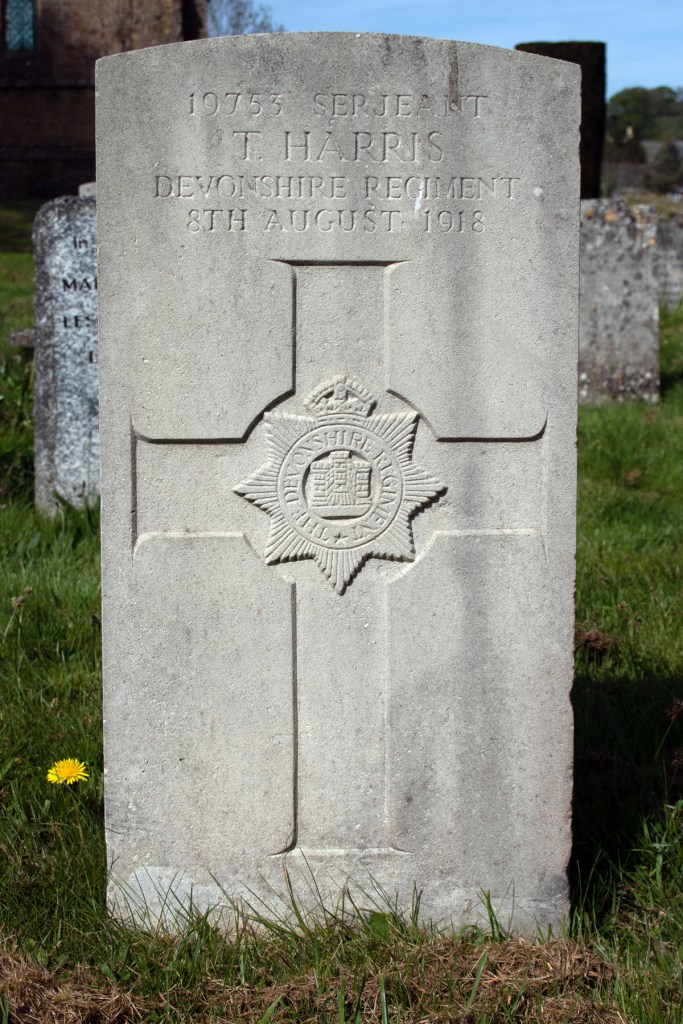
Serjeant Tom Harris

Serjeant Tom Harris

Thomas Harris – known as Tom – was born on 13th October 1876, the only son of Edmund and Mary Harris. Edmund was an agricultural labourer from the Somerset village of Seavington St Mary, and this is where Tom was born and raised.

Mary had married Edmund in the spring of 1876, but had been married before; she was widowed when her previous husband, Alfred Vickery, died ten years before. They had had seven children of their own, half-siblings to Tom.

Edmund died in the Wells Lunatic Asylum when Tom was only six years old. When he left school, he found work as a farm labourer, but sought bigger and better things, even though he was now the only one of Mary’s children still living at home.

Tom enlisted in the Somerset Light Infantry in January 1893, and soon found himself overseas. During his sixteen years’ service, he spent seven years in India and six months fighting in the Second Boer War. Corporal Harris seems to have had a sickly time of it, and while in India, was admitted to hospital a number of times for fever, ague and diarrhoea, as well as a bout of conjunctivitis.

When Tom’s contract came to an end in 1909, he returned to Britain, setting up home in Newport, South Wales, where he found work as a sheet weigher at the local steel works.

Mary died of senile decay and cardiac failure in May 1910. She was 74 years old, and sadly passed away in the Chard Workhouse, in similar circumstances to her late husband.

In October 1913, Tom married Ada Long in Chard. She was the daughter of a shopkeeper, and the couple set up home in South Wales, where Tom was still working.

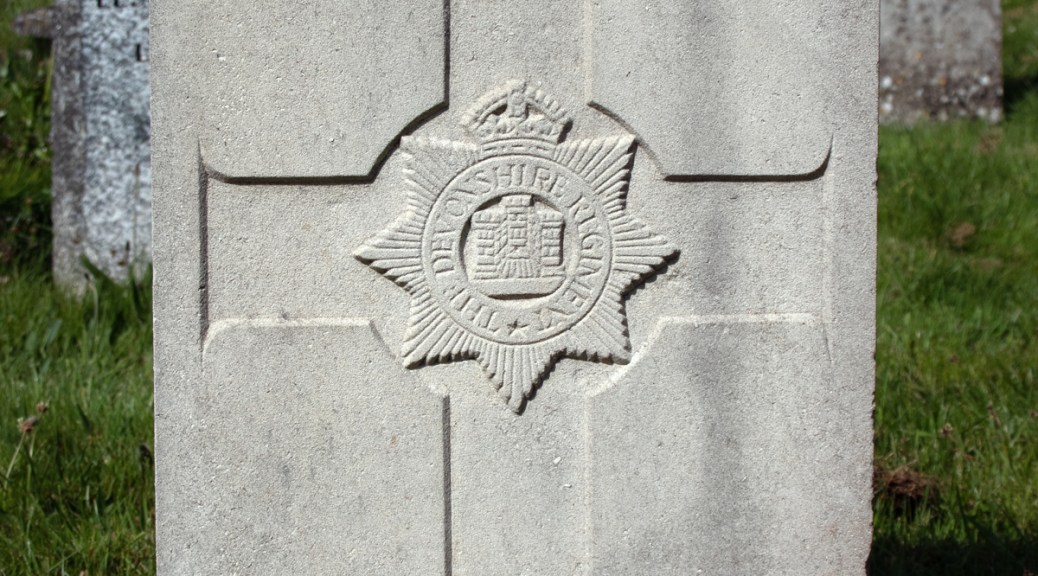
War, by now, was closing in on Europe, and Tom wanted to use his previous experience to serve his country once again. He enlisted on 20th August 1914 in Newport, joining the Devonshire Regiment as a Private, although he was quickly promoted first to Corporal and then to Serjeant. His service records show that he was 5ft 8ins (1.73m) tall, had blue eyes, brown hair and a tattoo of a Spanish girl on his right forearm.

After a year on the Home Front, Serjeant Harris was sent to Egypt in September 1915. On the way out, he contracted a severe cold, which left him deaf in his left ear. He was also suffering from varicose veins, which left him in pain in his right leg. He was treated for both conditions, and put on light duties for three months.

In November 1916, Serjeant Harris was supporting a food convoy when it came under attack. Buried in sand and wounded, he was laid up in a hole for two days and nights before help came. He was initially treated for shell shock in the camp hospital, but was eventually evacuated to Britain for treatment.

The incident had put too much of a strain on Tom, and he was medically discharged from the army in April 1917. While his medical report confirmed that the general paralysis he was suffering from was a result of the attack, it also noted on six separate occasions that he had previously suffered from syphilis, suggesting this may also have been a contributing factor to his mental state.

Tom was discharged initially to an asylum in South Wales, before returning home to Ada. The couple were soon expecting a child, and a boy, Sidney, was born in February 1918. By that summer, however, Tom’s condition had worsened enough for him to be admitted back to the Whitchurch Military Hospital in Cardiff.

It was here that Tom passed away, dying from a combination of chronic phlebitis – an extension of the varicose veins he had previously complained of – and general paralysis on 8th August 1918. He was, by this point, 41 years of age.

Tom Harris was brought back to Somerset for burial. He was laid to rest – finally at peace – in Chard Cemetery.


Serjeant Tom Harris
(from ancestry.co.uk)

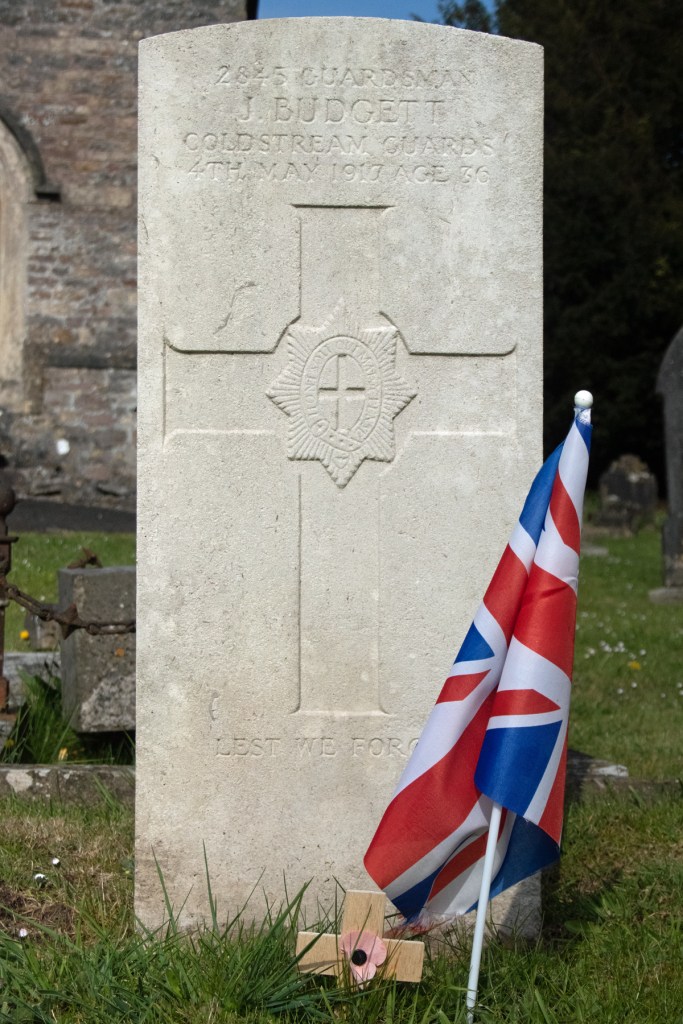
Guardsman James Budgett

Guardsman James Budgett

James Budgett was born in October 1880 and was one of nine children to Henry and Eliza Budgett. Henry was a labourer, and the family lived in the small village of Stoke St Michael, near Shepton Mallett in Somerset.

While initially following his father in to labouring, James was drawn to the military as a career. He enlisted in the army in August 1899, and was assigned to the Coldstream Guards. James’ bearing would certainly have stood him in good stead for this wing of the army; his medical examination shows he was 6ft 1in (1.85m) tall.

Guardsman Budgett’s initial service was for twelve years; during this time, he spent six months in Australia, but his records show that most of his time was spent on home soil.

When his term ended in August 1911, he enrolled for a further four years. Initially assigned to the Reserve Battalion, he was formally mobilised when war broke out. Sent to France as part of the British Expeditionary Force in August 1914, he was wounded in the foot two months later, and was sent home for treatment.

According to Guardsman Budgett’s medical records, the treatment unearthed a two other issues. One was that he was suffering from syphilis, which was treated. The other was that an x-ray identified an aneurysm in his aortic arch. This was considered harmful enough for him to be medically dismissed from the army, and he left active service on 25th March 1915.

After this, details of James’ life get a bit hazy. His pension records show that he married a woman called Bessie, but there is nothing to confirm when the marriage took place.

The next record for James Budgett is confirmation of his passing. He died from an aneurysm on 4th May 1917, at the age of 36. He lies at rest in the graveyard of St Michael’s church in his home village of Stoke St Michael, Somerset.


Private Albert Bellringer

Private Albert Bellringer

Albert George Bellringer was born in April 1889, the youngest of three children to Charles and Sarah. Charles was a sawyer in a local timber yard, and his son followed suit.

Little detail of Albert’s early life remains, but he married Elizabeth Burge in December 1909, and the couple went on to have three children – Albert Jr, Cecil and Charles.

Albert enlisted when war appeared inevitable, joining the Somerset Light Infantry in June 1914. When his training was complete, his troop – the 2nd Battalion – were shipped off to India, and this is where Private Bellringer spent the majority of the war.

Distance from home and family made some soldiers act in ways they otherwise wouldn’t. On 15th August 1917, Albert was admitted to hospital with a venereal sore. He was then admitted to the Dinapore (now Danapur) Station Hospital on 2nd December 1917, “in a very excited condition. He was childish, silly and had grandiose delusions”.

Things were not going well for Private Bellringer’s health. He was transferred back to England for treatment on the Hospital Ship Wandilla – this was torpedoed on the journey home, although the device failed to explode. While on board, he was seen to be “exalted in his ideas, and to have physical signs of GPI [General Paresis (or Paralysis) of the Insane]”.

The ship arrived back in England on 25th April, and Albert was admitted to the Royal Victoria Hospital in Netley, Hampshire. The medical report again showed that “he was foolish, demented and [that] the physical signs of GPI were marked.”

Moved to Dykebar Hospital in Paisley – a mental health institution – for specialist attention, Private Bellringer was eventually discharged from the army. Medical grounds were the reason for his dismissal, and his last day of service was 5th July 1918.

Sadly, however, Albert’s health faltered; he was transferred again, this time to the Somerset and Bath Asylum in Somerset, and it was there that he passed away. Albert George Bellringer died on 5th December 1918; he was 30 years old.

Albert lies at rest in the Wembdon Road Cemetery in his home town of Bridgwater.


So, what was the cause of Albert’s illness and death? His initial hospital admission identified a venereal sore, and, based on his subsequent decline, it is likely that this was syphilis. One of the last symptoms of the disease is mental illness – insanity – and so this underlines the probably diagnosis.

However, mental illness only usually appears on average 10 to 30 years after the STI is first contracted, and then only if it is not treated (which, given that this would have been Victorian England, is it likely not to have been).

What this suggests, therefore, is that Albert contracted syphilis before the war, probably before his marriage to Elizabeth, and he may not have been unfaithful while serving in India.