
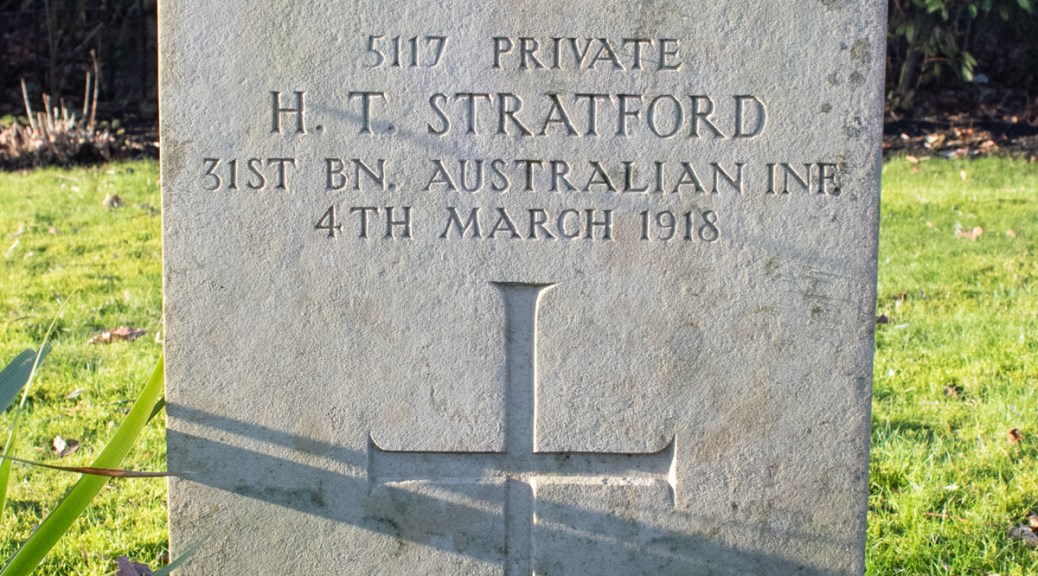
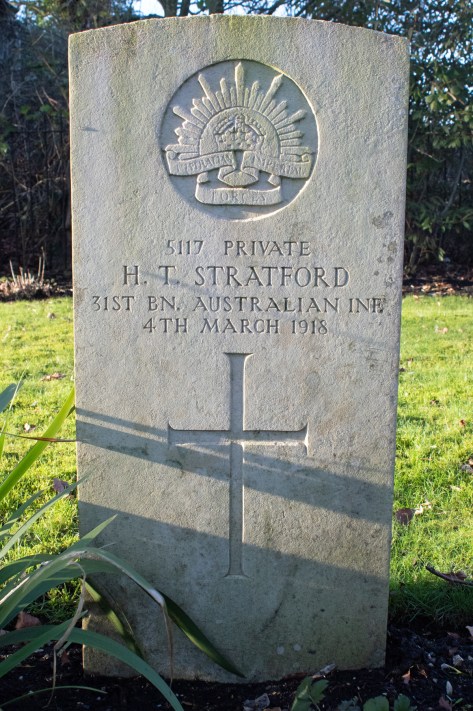
Henry Thomas Stratford was born in Southampton, Hampshire, in the autumn of 1870. The youngest of three children, his parents were John and Maria Stratford. When Henry’s father died in 1876, Maria re-married, and went on to have a further child with her new husband, James Simmons.
Maria’s husbands worked away, and likely served on ships: John was absent from the 1871 census, while James was missing from the 1881 return.
By the 1901 census, Maria had been widowed a second time. She was living at 29 Dock Street with her three youngest children – Henry, his older brother John, and his younger half-brother William. By this point, John was employed as a waterman on a barge, while Henry had also taken to the water, and was employed as a seaman.
Maria passed away in 1904, and there is little further information about Henry’s earlier life. His later army records suggest that he served in the Royal Navy for 14 years, although there are no records for his service at that time.
At some point, presumably after his time in the navy had expired, Henry emigrated to Australia. Again, details are scarce, but he was definitely there by the spring of 1917, having settled in Brisbane, and taken up work as a sailmaker.
When war broke out in Europe, Henry stepped up to serve his country, enlisting in the Australian Imperial Force on 3rd Mary 1917. His records confirm that he was 5ft 4ins (1.62m) tall, and weighed in a 152lbs (69kg). With light brown hair and blue eyes, he had a fair complexion and tattoos on both of his forearms.
Assigned to the 31st Battalion of the Australian Infantry, Private Stratford set sail from Sydney on 14th June 1917. After a ten week voyage, he was marched in to Hurdcott Camp near Fovant, Wiltshire, and would remain in the ANZAC base for his training.
On 23rd February, Henry was admitted to the No. 3 New Zealand General Hospital in Codford, Wiltshire, having fallen from a train. He remained in hospital for the next week, but his head injuries would ultimately prove fatal.
An inquest was held at the New Zealand Military Hospital on Wednesday concerning the death of Henry Thomas Stratford…
Mr FAP Sylvester (coroner) conducted the inquiry, and the evidence went to show that on the night of February 23rd last the deceased man met with an accident by trying to leave a train while it was in motion, before reaching Codford GWR Station. He was picked up in an unconscious state and conveyed to the Military Hospital where he died on Monday.
Corporal John Brooks, ASC Cyclist Section, of Codford, stated that he proceeded from Warminster on the 9:45pm train to Codford on February 23rd. He was in the company of Gunner E Ford, RFA, of Boyton, and they were in the came corridor carriage as the deceased man. After leaving Warminster deceased walked down the corridor, and some time later witness found that deceased had opened the carriage door and was sitting with his feet hanging outside, apparently trying to alight from the train. Just after passing Upton Lovel [sic] crossing, he suddenly disappeared, and witness just saw him fall off the footboard. Deceased never spoke or shouted, and when the train pulled up at Codford, witness reported the matter to the military police and stationmaster, and accompanied them to the spot where deceased was found lying face downwards, his head against the main line rail. First aid was rendered and he was moved to the military hospital.
Private Claude E Thompson, Australian military police, stated that deceased had a road pass, but he had no right to travel by train. He had probably endeavoured to leave the train before it reached Codford to evade the military police.
The jury returned a verdict that deceased came to his death by trying to alight from the train and that he accidentally fell and sustained a compound fracture of the skull.
[Warminster & Westbury Journal – Friday 08 March 1918]
Henry Thomas Stratford was 47 years of age when he passed away. His body was laid to rest in the ANZAC extension to St Mary’s Churchyard in Codford, Wiltshire, close to the hospital in which he had breathed his last.


 Death and Service