
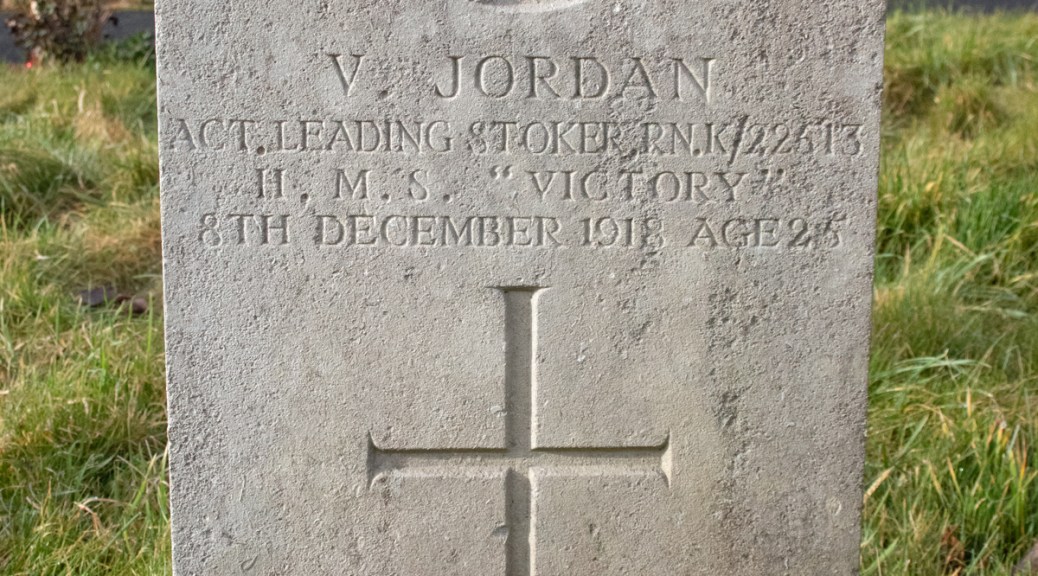

Victor Jordan was born on 20th November 1893 in Beeston Regis on the north Norfolk coast. The second of four children, his parents were school teachers Albert and Melletta Jordan.
By the time of the 1911 census, the family had moved from one coast to another, setting up home in Bognor Regis, Sussex. Albert had given up teaching, and had become an insurance agent for Prudential. Victor had left school and found work as a wheelwright, while his older sister, Emily, had taken up where her father had left off, teaching in an elementary school, The family of six was expanded by the inclusion of Albert’s mother, Emily, who had moved in with them.
By 1914, war was on the horizon, and Victor sought out a career beyond wheel work. On 21st May he enlisted in the Royal Navy as a Stoker 2nd Class. His service records show that he was 5ft 6ins (1.78m) tall, had light brown hair, blue eyes and a fair complexion.
Stoker Jordan was initially sent to HMS Victory, the Royal Naval Dockyard in Portsmouth, Hampshire, for training. After an initial six-month period, he was assigned to the battleship HMS Indomitable, on board which he was to serve for the next four years.
During his time on board, Victor proved to be a disciplined and determined worker. He was promoted to Stoker 1st Class in July 1915, and reached the rank of Leading Stoker in the summer of 1918. HMS Indomitable was involved in some of the key naval battles of the First World War – including Dogger Bank and Jutland – and Victor would have been on the forefront of maintaining the vessel’s power.
By October 1918, Leading Stoker Jordan was back on dry land, and was based once again in Portsmouth. As the war came to a close, however, he became unwell, and was admitted to Haslar Naval Hospital in nearby Gosport, suffering from acute tonsillitis.
Tragically, the condition was to get the better of him: Leading Stoker Jordan died of heart failure on 8th December 1918, having not long turned 25 years old.
Victor Jordan’s family were, by now, living in the Somerset hamlet of Brewham, and this is where his body was brought for burial: he was laid to rest in the peaceful graveyard of St John the Baptist’s Church.
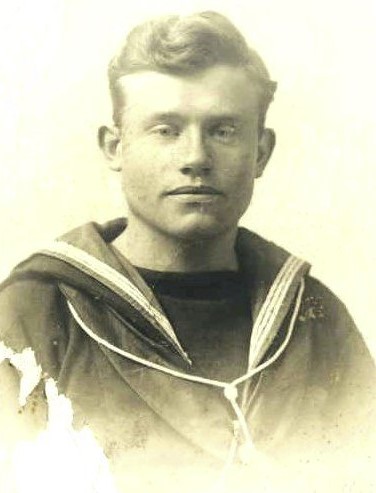
(from findagrave.com)
Scandal was set to rock the grieving family. Albert, who was now teaching again, was charged with indecently assaulting a nine-year-old girl three times over the winter of 1918/19. He denied the accusation and a jury found him not guilty after only a few minutes’ deliberation.
Albert and Melletta seem to have found it impossible to remain in the quiet corner of Somerset, and moved to Essex. The couple took up new teaching posts, Albert eventually becoming the headmaster of Doddinghurst Church of England School, near Brentwood, while his wife worked as a school mistress for one of the classes.
Melletta died in February 1931, and at this point, Albert came back to Somerset to live with his daughter and her family in Cheddar. He was 75 years old when he passed away at Emily’s family home – called Melletta after her mother – and was laid to rest in St Andrew’s Churchyard, Cheddar.
 Death and Service