Tag Archives: Norfolk

Engineman John Raven

Engineman John Raven

The loss of another Gorleston man in the service of King and Country is recorded this week in the death of Chief-Engineer John Edmund Raven, RNR, of 46, John-road, Gorleston, who was among the victims of the air raid at Chatham on September 3rd. Chief-Engineer Raven, who was 43 years of age, had been in the Service nearly three years, and was sailing from this port. Some seven weeks ago he was taken ill and went to Chatham to undergo an operation, following which he was allowed home for a few days and returned to Chatham Naval Barracks on the sick list, where he was on the night of the raid. He was very popular with his comrades at the Naval Base at Gorleston, and his loss is much regretted by the crew of his ship. To his widow and two children every sympathy has been extended in this heavy blow which follows hard on the loss a few weeks ago of her daughter after a brief illness.

[Yarmouth Mercury: Saturday 15th September 1917]

John Edmund Raven was born on 28th December 1872 in Caister, Norfolk. The middle of six children, he was the youngest of three sons to Robert and Ann Raven. Robert was a farm labourer-turned-fisherman, and, after his untimely death in 1883, it was the sea to which his son turned to support his widowed mother.

In the autumn of 1902, John married Eliza Casey. A milkman’s daughter from Gorleston, Norfolk, she was employed as a domestic servant when the couple exchanged vows. They set up home at 46 John Road, Gorleston, and went on to have three children: Elsie (who would pass shortly before her father), Gladys and Jack.

Little further information is available about John’s life. As the newspaper report suggests, he joined the Royal Naval Reserve as an Engineman towards the end of 1914, and was based out of HMS Pembroke, the Royal Naval Dockyard in Chatham, Kent.

On the night of the 3rd September 1917, Engineman Raven was billeted in temporary accommodation set up in the dockyard’s Drill Hall. That night, an audacious raid by German bombers landed two explosives directly on the building, shattering its glass roof, and killing dozens of the men sleeping within. John was one of those to be killed. Contrary to his obituary suggested, he was actually 45 years of age.

The body of John Edmund Raven was taken back to Norfolk for burial. He was laid in the family plot, reunited with his daughter, Elsie, far too soon.


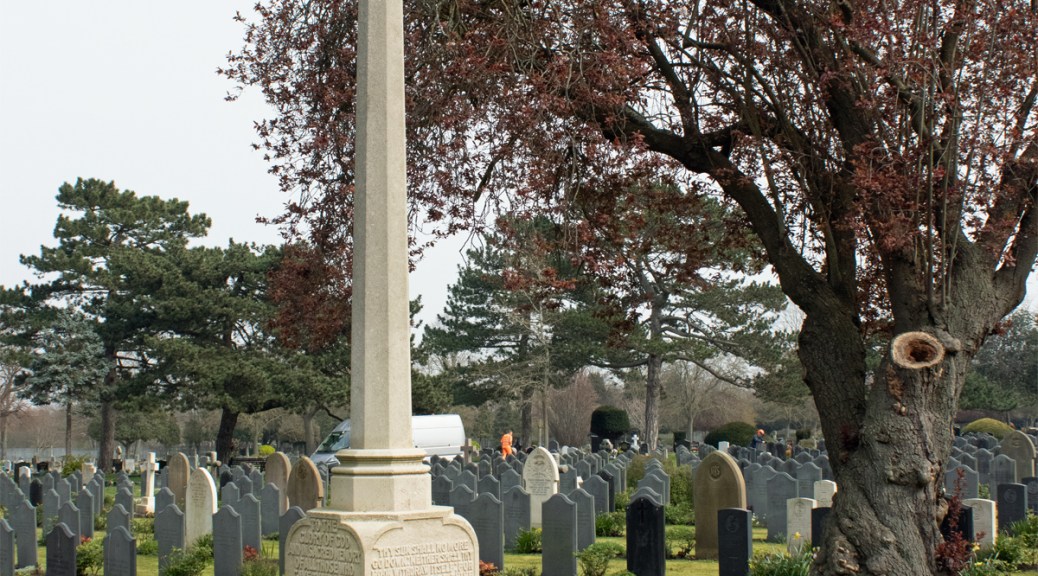
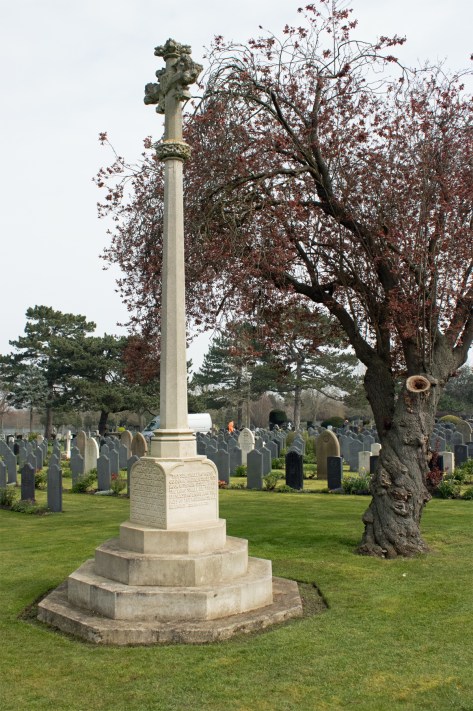
[Note: the photo above is of the memorial to the Chatham Air Raid victims, close to the mass grave for those whose bodies were not identified, in Woodlands Cemetery, Gillingham, Kent.]


Private Alexander Shurie

Private Alexander Shurie

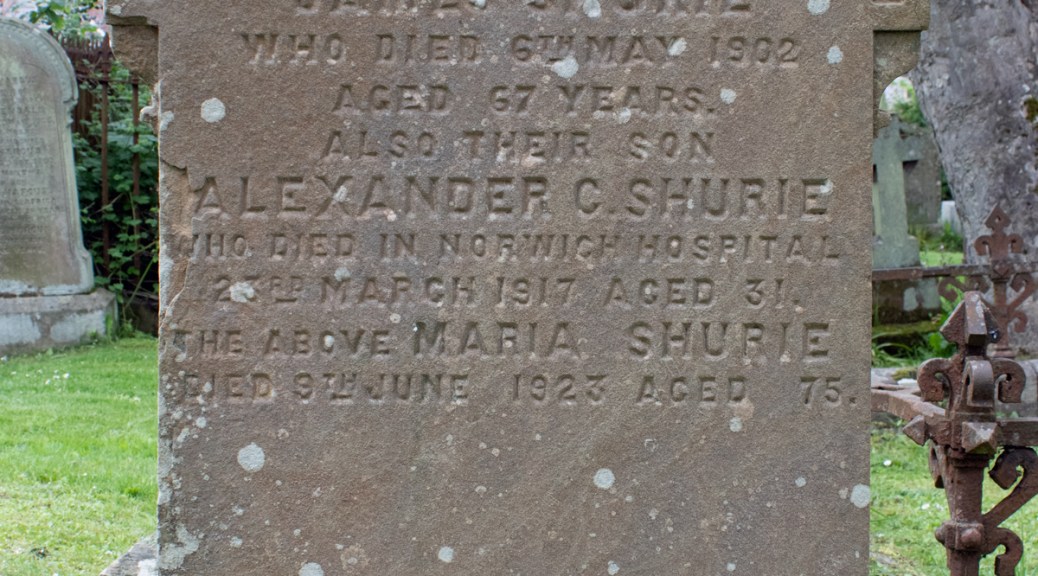
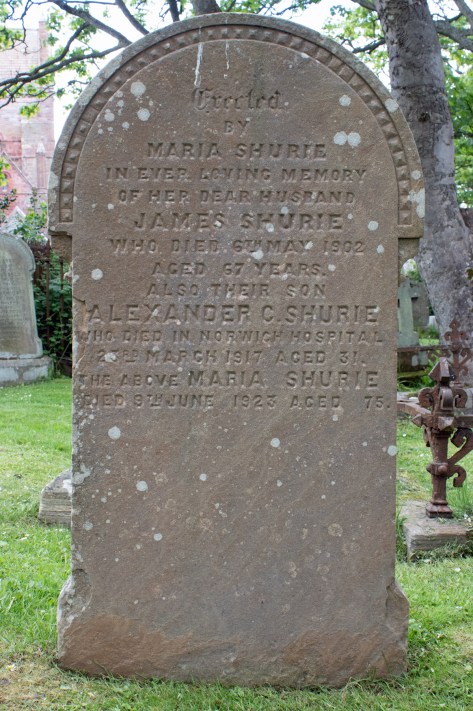
Alexander Cursiter Shurie was born in Orkney, in 1886. The youngest of seven children, his parents were farmers James and Maria Shurie. The family were born and raised in West Grenigoe, a small hamlet between Orphir and Scapa, on the Orkney mainland.

There is little information about Alexander’s young life. James died in 1902, and it is likely that his son helped with the running of the farm. When war broke out, he did not enlist immediate and, while his service records have been lost to time, it seems likely that he did not join up until the autumn of 1916.

Private Shurie’s unit – the 6th Battalion or the Seaforth HIghlanders – served on the Western Front during the conflict, but there is nothing to show that Alexander spent any time overseas himself. By March 1917, he had fallen ill, and was admitted to the Norwich War Hospital in Norfolk. His condition is unclear, but it would prove fatal: he passed away on 18th March 1917, at the age of 31.

The body of Alexander Cursiter Shurie was taken back to Orkney for burial. He was laid to rest in the family plot in the graveyard of St Magnus’ Cathedral, Kirkwall.


Stoker 1st Class Frederick Diver

Stoker 1st Class Frederick Diver

Frederick Isaac Diver was born in Hopton, Suffolk, on 4th July 1888, the third of nine children to Matthew and Louisa Diver. Matthew was a tinsmith from Thetford, Norfolk, and was twenty years older than his wife. He had been married before, but was widowed in 1880, leaving him with six children to raise (tragically he and his first wife, Emily, had lost two children in the year before she died).

Matthew married Louisa in the autumn of 1881 and the couple raised their family at 17 Old Market Street, close to Thetford town centre. Matthew himself died late in 1909, and the census return that was taken two years later found his widow and four of her children still living in the family home. Frederick was the only one bringing in a wage, and was employed as a general labourer.

In the autumn of 1911, Frederick married Ethel Talbot. The daughter of a postman from Brandon, Suffolk, she was a couple of years younger than her new husband. The couple set up home on Castle Street, Thetford, and had three children – Sybil, Arthur and Frederick Jr.

Frederick worked at the docks on the town’s river and, when war came to Europe, he would be called upon to play his part. He was conscripted into the Royal Navy and, as a Stoker 2nd Class, was sent to HMS Pembroke, the dockyard in Chatham, Kent, for his training. His service records show that he was just under 5ft 9ins (1.75m) tall, with brown hair, blue eyes and a fresh complexion.

After a couple of months, Stoker Diver was given his first posting, on board the battleship HMS Vanguard. She would remain his home for just under a year, during which time he was promoted to Stoker 1st Class. At the start of July 1917, he was home on leave, Frederick Jr having been born a few months before.

HMS Vanguard was stationed in Scapa Flow, in the Orkneys, when, on 9th July 1917, a series of magazine explosions tore the ship apart. She sank almost at once, and 843 of the 845 crew were killed. Stoker Diver had had a lucky escape.

At the end of his leave, Frederick returned to HMS Pembroke, to await a new assignment. The loss of Vanguard resulted in the dockyard being a busy place – its replacement crew were based there, and were now stuck there as they waited to be re-assigned. Stoker 1st Class Diver was billeted in temporary accommodation in Chatham Drill Hall.

On the 3rd September 1917, the first night air raid carried out by the German Air Force bombarded the town, and scored a direct hit on the Drill Hall; Stoker Diver was not so lucky this time, and was among those killed. He was just 29 years of age.

The body of Frederick Isaac Diver was taken back to Norfolk for burial. He was laid to rest in Thetford Cemetery, not far from where his widow was still living.


[Note: the photo above is of the memorial to the Chatham Air Raid victims, close to the mass grave for those whose bodies were not identified, in Woodlands Cemetery, Gillingham, Kent.]


Stoker 2nd Class William Berwick

Stoker 2nd Class William Berwick

William George Berwick was born in Norwich, Norfolk, on 12th July 1896. He was the oldest of two children – his younger sibling, sister Agnes, was born thirteen years after him – to William and Lucy Berwick.

The family lived at 29 Fishergate, close to the River Wensum. The 1901 census recorded William Sr working as a brush maker, while Lucy was a silk weaver. Fast forward a decade, and while they were living in the same house, William Sr was a licenced victualler, with his son assisting him in the business.

War broke out in 1914, and William Jr would eventually be called upon to serve his country. He enlisted in the Royal Navy on 11th January 1917, giving up his then job as a boot and shoe operator to work as a Stoker 2nd Class. His service papers show that he was 5ft 5ins (1.65m) tall, with brown hair, blue eyes and a fresh complexion. His was recorded as having an appendix scar.

Stoker Berwick was sent to HMS Pembroke, the Royal Naval Dockyard in Chatham, Kent, for his training. After six months he was giving his first posting, HMS Wallington, the shore base on the Humber estuary. Just a few weeks later, he was sent back to Pembroke, in anticipation of his first sea-going assignment.

The dockyard was a particularly busy place in the summer of 1917, and temporary accommodation was set up. William found himself billeted at Chatham Drill Hall, away from the main barracks.

On the night of 3rd September 1917, Chatham suddenly found itself in the firing line, as the German Air Force launched a bombing raid. One of the bombs landed squarely on the Drill Hall, and Stoker 2nd Class Berwick was killed. He was just 21 years old.

The body of William George Berwick was taken back to Norfolk for burial. He was laid to rest in Norwich Cemetery, not far from where his parents and sister still lived.


[Note: the photo above is of the memorial to the Chatham Air Raid victims, close to the mass grave for those whose bodies were not identified, in Woodlands Cemetery, Gillingham, Kent.]


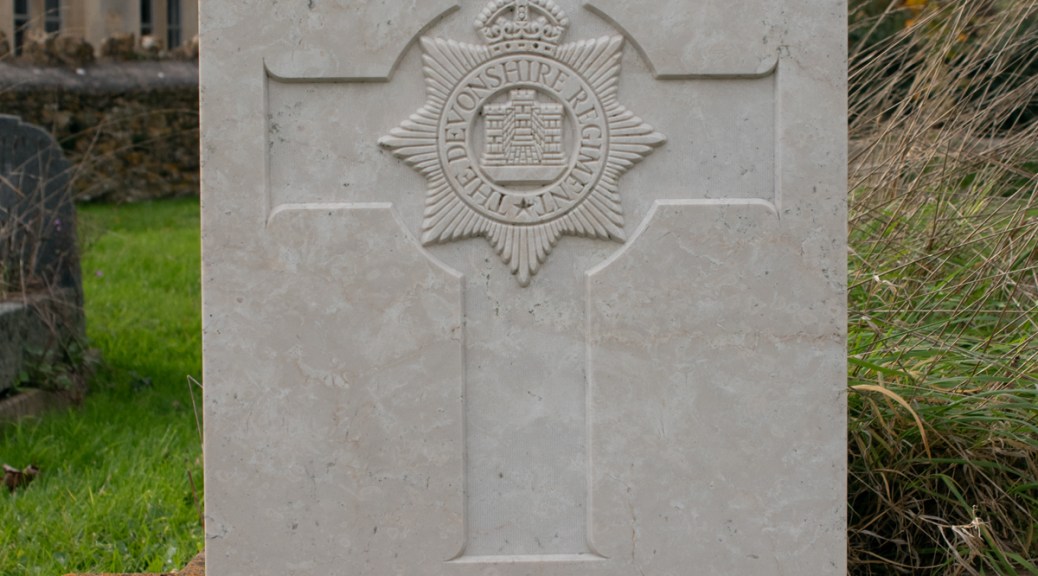
Private Henry Davis

Private Henry Davis

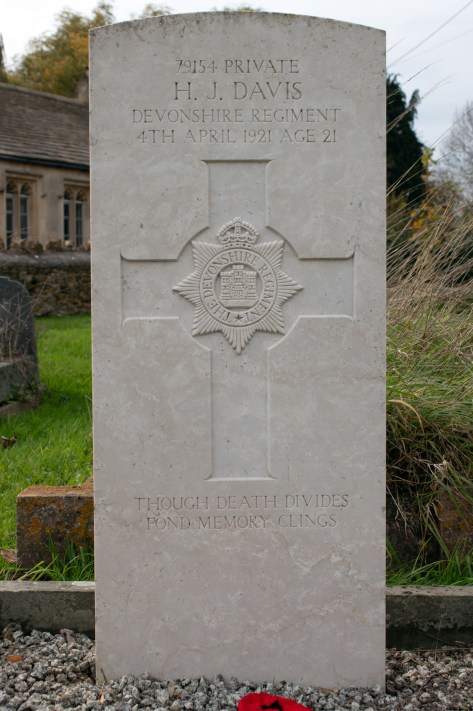
Henry John Davis was born in the village of Broughton Gifford, Wiltshire, in December 1899. The middle of nine children, his parents were John and Annie Davis. John was a cowman, and he worked for the Chalfield estate, not far from the village.

After the 1911 census, Henry’s life is a challenge to piece together. When war broke out, he was too young to serve his country, but it is clear that he enlisted in the Devonshire Regiment at some point. As a Private, he was assigned to the 52nd (Graduated) Battalion, and was based in Norfolk during the second half of the conflict.

By the spring of 1918 Private Davis’ unit was in France, although there is no evidence that Henry was there himself. All that can be confirmed is that he was medically discharged from the army on 26th March 1920, as he was suffering from adenitis, a swelling of the lymph nodes in the abdomen.

Henry John Davis passed away on 4th April 1921, at the age of 21 years old. He seems to have died at home, although the exact cause of his passing is not known. He was laid to rest in Holt Old Cemetery, not far from where his family were living.


Serjeant William Low

Serjeant William Low

In the graveyard of St John the Baptist Church in Marldon, Devon, is a headstone commemorating Sergeant William Low of the Royal Garrison Artillery. The marker notes his parents as being Thomas and Mary Low, and that he was their eldest son.

Details of William’s early life are a challenge to piece together. Born early in 1872, he was the oldest of eight children. The 1881 census found the Low family living in the village of Compton, just to the north of Marldon. Thomas was working as a farm labourer and his children were still at school.

At this point, William falls off the radar. Thomas and Mary continued to live in Compton until their deaths in 1906 and 1907 respectively, but their eldest son is nowhere to be seen. It is possible that he had sought a better life for himself and enlisted in the army when he came of age, but there are no military records to back this up.

The only other available document relating to him is his entry on the British Army Register of Soldiers’ Effects. This confirms that Sergeant Low had passed away in Lakenham Military Hospital, Norfolk, on 21st February 1916. His next of kin was recorded as being his executor, Edward A Harper, and his effects were recorded as being £24 6s 9d (around £2700 today), with a war gratuity of £8 10s (approx. £950).

The body of William Low, who was 44 years old when he passed away, was taken back to Devon for burial. He was laid to rest in the graveyard of his childhood parish church.


Stoker 1st Class Richard Jenkins

Stoker 1st Class Richard Jenkins

Richard Henry Jenkins was born on 7th April 1878 in Soho, Middlesex. The youngest of seven children, his parents were glazier George Jenkins and his wife, Emma. The 1881 census found the family living in rooms at 2 Church Street, but they disappear from both of the next two census returns.

The next document for Richard is his service record. He gave up his job as a labourer to join the Royal Navy as a Stoker 2nd Class, on 27th November 1905. His papers note that he was 5ft 5.5ins (1.66m) tall, with dark brown hair, grey eyes and a fresh complexion.

Stoker Jenkins was sent to HMS Acheron, a torpedo boat, for his training. Over the term of his five-year contract, he would spend time on three further vessels, but it was HMS Pembroke, the Royal Naval Dockyard in Chatham, Kent, that would become his on-shore home. Promoted to Stoker 1st Class in Mary 1907, he was stood down to reserve status then his contract ended in 1910.

By this point, Richard was married. He exchanged vows with widow Mary Ann Bunyon, on 11th April 1909. The same age as her husband, she had a son, Edward, from her previous marriage, and the couple set up home in Clerkenwell. The 1911 census found them living in rooms at 3 Roberts Place. They shared their home with their first child and Mary’s mother and sister.

When war broke out, Richard was called upon to play his part once more. Sent back to HMS Pembroke on 2nd August 1914, he seems to have spent the next couple of years on shore. His papers note that he was wounded on 26th June 1915, but no further information is available.

On 15th May 1917, Stoker 1st Class Jenkins was assigned to the monitor ship HMS Roberts. She has spent time in the Mediterranean, but by the time Richard joined her crew, she was put to use as a guard ship off the Norfolk coast.

A case of very determined suicide was inquired into at the Royal Naval Hospital, Gillingham, on Saturday last, by Mr CB Harris (County Coroner) and a jury. It appeared from the evidence that Richard Henry Jenkins, a stoker petty officer [sic], of the Royal Fleet Reserve, had been depressed and in a morose state of mind for some days, reference being made in a letter to an alleged unpleasantness at his home. On October 4th, when the vessel was at sea, Jenkins cut his throat with a savage slash of his own razor, and them jumped through a port-hole. The Coroner remarked that it was extraordinary that the man should have had sufficient strength to get through the port-hole after inflicting such a severe wound upon himself. A verdict of suicide during temporary insanity was returned.

[Sheerness Guardian and East Kent Advertiser: Saturday 13th October 1917]

Richard Henry Jenkins was 39 years of age when he took his life. His body was laid to rest in Woodlands Cemetery, Gillingham, Kent, not far from HMS Pembroke.


There is no further information about the alleged unpleasantness at home. The 1921 census recorded Mary living in Clerkenwell with their two children and her mother.


Stoker 1st Class Richard Jenkins
(from ancestry.co.uk)

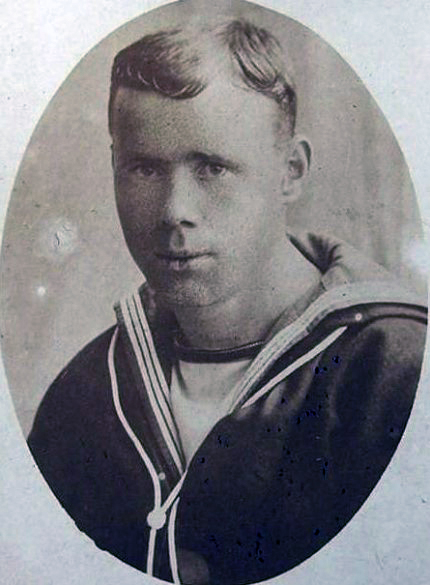
Able Seaman Arthur Crisp

Able Seaman Arthur Crisp

Arthur Edward Crisp was born in 16th March 1899 in the Norfolk village of South Creake. The youngest of six children, his parents were blacksmith Henry Crisp and his wife, Sarah.

When war broke out across Europe, young Arthur had already had some experience of seamanship, and was keen to play his part. He joined the Royal Navy on 7th April 1915 and, given his age, he was assigned the rank of Boy 2nd Class. Initially sent to HMS Powerful, he was trained there for three months, rising to the rank of Boy 1st Class.

On 26th July 1915, Arthur was assigned to the battlecruiser HMS New Zealand, and would remain on board for the next two years. During this time, he came of age, and was formally inducted into the Royal Navy as an Ordinary Seaman. His service records show that he was 5ft 5ins (1.65m) tall, with brown hair, grey eyes and a fresh complexion.

His stint on New Zealand also exposed him to naval warfare, as she was heavily involved in the Battle of Jutland in May 1916. Ordinary Seaman Crisp came through, however, and remained part of the battlecruiser’s crew for a further year.

After a short time on shore, where he was based at HMS Victory, the Royal Naval Dockyard in Portsmouth, Hampshire, Arthur’s next posting was on board HMS Wallington. A former trawler, she had been converted to a boom defence vessel, she protected the dockyard in Grimsby. In November 1917, while based in the Lincolnshire town, Arthur was promoted again, rising to Able Seaman.

The following March, Arthur moved again, and was assigned to HMS Attentive, the shore base for the Dover Patrol. He would not remain there for long, however, and was admitted to the Royal Naval Hospital in Chatham, Kent. He passed away on 17th March 1918, from an intriguing combination of gunshot wounds to his chest and pneumonia. He had turned 19 years old the day before.

The body of Arthur Edward Crisp was taken to nearby Gillingham for burial. He was laid to rest in the military section of the town’s Woodlands Cemetery.


Able Seaman Arthur Crisp
(from findagrave.com)

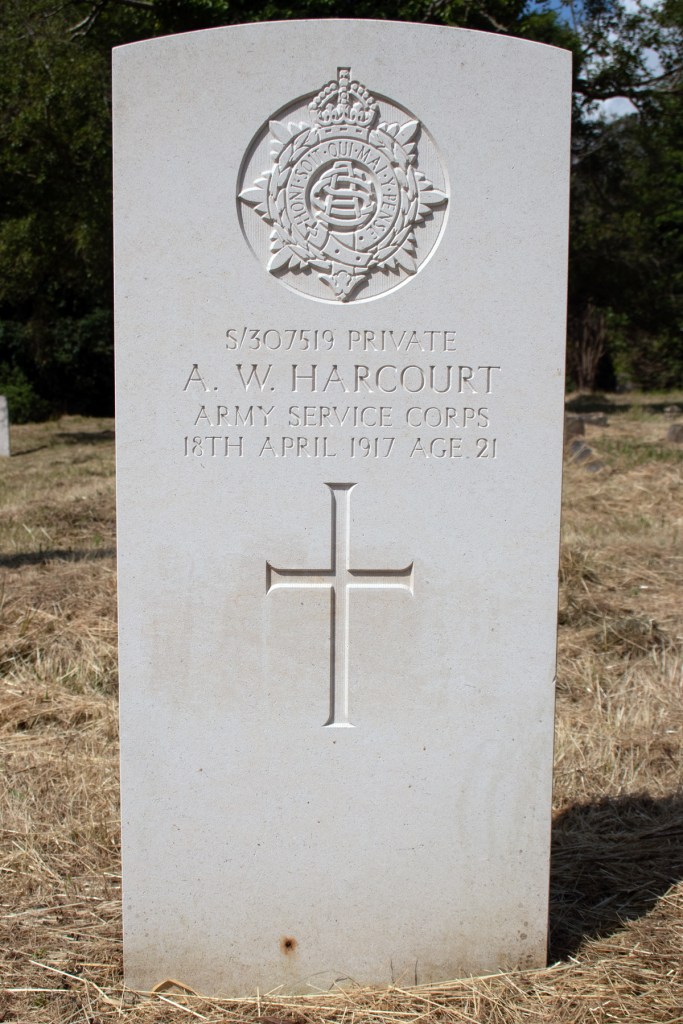
Private Arthur Harcourt

Private Arthur Harcourt

Arthur Wellesley Harcourt was born on 18th June 1895 in Brentford, Middlesex. He was the youngest of five children to Charles and Eliza Harcourt.

The son of a Baptist minister, Charles was a banker’s clerk, but “practically the whole of [his] leisure in a busy life [was] spent in mission work, mainly in Middlesex…” [Middlesex & Surrey Express – Saturday 13 October 1900] When he died in 1900, at the age of 57, Eliza was left to raise her younger children alone.

Arthur’s young life was to be one of travel. The 1901 census, taken just six months after his father’s death, found him living in Walton le Soken (now Walton-on-the-Naze), Essex. Eliza had taken rooms for the family in a lodging house at 9 New Pier Street, yards from the town’s stony beach.

The next record for Arthur is from 1908. Surprisingly, for the grandson of a Baptist minister and the son of a missionary, he seems not to have been baptised when he was born. The document shows that he was christened on 26th April, at St Mary’s Church in the village of Sporle with Palgrave in Norfolk. There is nothing to confirm why he was in Norfolk, or why he chose to be baptised there: the 1911 census found Eliza and his siblings living back in Middlesex.

By this point, Arthur was on the move again. Now fifteen years of age, the same census found him visiting George and Amelia Kerswill at their home in Exeter, Devon. George was a retired nurseryman and florist from Hendon, and it seems likely that the couple were friends of the family.

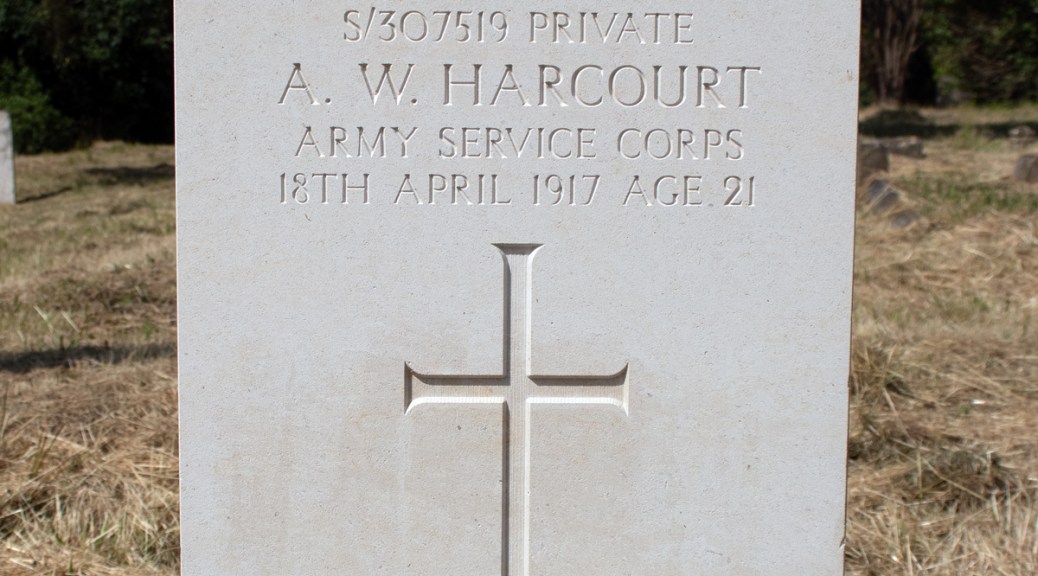
By the time war broke out, the Harcourts had moved once again, this time setting up home in Reculver, Kent. Arthur was working as a surveyor’s assistant, but felt drawn to play his part. On 8th March 1917, he enlisted, joining the Army Service Corps as a Private. His records show that he was 5ft 4.5ins (1.61m) tall, and weighed 96lbs (43.5kg). He was of fair physical development, but it was noted that he had an understandard chest, but was deemed fit for military service.

Private Harcourt was sent to Somerset for training. Tragically, however, his health was to take a dramatic downturn. Admitted to the Bath War Hospital on 1st April with influenza, this quickly developed into double pneumonia and pleurisy. The strain was to be too much for his young body to bear: Arthur passed away on 18th April 1917, at the age of just 21 years old.

Surprisingly, Eliza, whilst able to live on her own means, did not chose to lay her son to rest close to home. Instead, Arthur Wellesley Harcourt was buried in Locksbrook Cemetery, Bath, not far from the hospital in which he had breathed his last.


Petty Officer 1st Class Albert Hodder

Petty Officer 1st Class Albert Hodder

Albert George Hodder was born on 27th December 1878 in Lyme Regis, Dorset. The oldest of three children, his parents were Samuel and Ellen Hodder. Samuel was a general labourer who died in 1886, when he was 35 years of age. By the time of the 1891 census, Albert had given up school, and was working as a live-in cowboy in the nearby Devon village of Uplyme, bringing in what would be the only wage for him, his mother and his two younger brothers.

Working on a dairy farm would not bring in the money his family would need. So, on 7th August 1894, Albert sought out more of a career and enlisted in the Royal Navy. His service records confirm that he was 5ft 4ins (1.62m) tall with brown hair, grey eyes and a ruddy complexion.

Albert was under the age to formally enlist, and so was given the rank of Boy 2nd Class. He was sent to the training ship HMS Boscawen, and, over the next eighteen months he received a basic education and naval induction. By the end of July 1895, he had been promoted to the rank of Boy 1st Class.

On 12th November 1895, Boy Hodder was assigned to the ironclad ship HMS Alexandra, and his naval career began. Over the next nearly two decades, he would serve on twelve separate ships, rising through the ranks as he did so.

When Albert came of age, on 27th December 1896, he was serving on board HMS Gibraltar. Formally inducted into naval service, he was given the rank of Ordinary Seaman. He spent more than three years on board Gibraltar, and rose to Able Seaman on 1st January 1899.

From here his career continued: He was promoted to Leading Seaman on 18th May 1903, Petty Officer 2nd Class on 1st April 1905 and Petty Officer 1st Class just two years later.

In the autumn of 1912, Albert’s career changed course. He was assigned to HMS Maidstone, a submarine depot ship, and a life under the ocean waves started to appeal. On 28th March 1914, Petty Officer Hodder was sent to HMS Dolphin, home of the Royal Navy Submarine Service, where he was trained up for new duties. By October that year he was to be found serving on board the newly-commissioned submarine E11.

Over the next few months, he served in the North Sea, Baltic Sea, and the E11 was involved in a minor way in the defence of Scarborough in December 1914 and the Cuxhaven Raid ending on Christmas Day that year.

At this point, Petty Officer Hodder’s trail goes cold. He remained on the E11 until early February, by this time she was based off the Norfolk coast.

An inquest was held on Friday on the body of Albert George Hodder… of Lyme Regis, Dorset, a member of the crew of one of HM vessels, who died from the effect of immersion.

Evidence showed that at 9.20 on the previous Thursday night a petty officer heart the shout of “Man overboard.” He got on to a collier moored in the river and saw a black object float past. Unable to reach it, he jumped ashore and got into the ferry boat. He was then able to reach the object, which he found was the deceased. He held his head above the water while the ferryman pulled the boat to the quay. The deceased was got out in an insensible condition, a doctor sent for, and artificial respiration tired. Efforts were persisted till breathing was established, and he was then wrapped in blankets, with hot water bottle; but he succumbed to the effects of immersion and shock shortly after eleven. No one saw how the deceased fell overboard.

A verdict of “Accidental death” was returned.

[Diss Express: Friday 12th February 1915]

Petty Officer 1st Class Albert George Hodder was just 35 years of age when he died on 4th February 1915. His body was taken back to Dorset for burial, and he was laid in Lyme Regis Cemetery.