
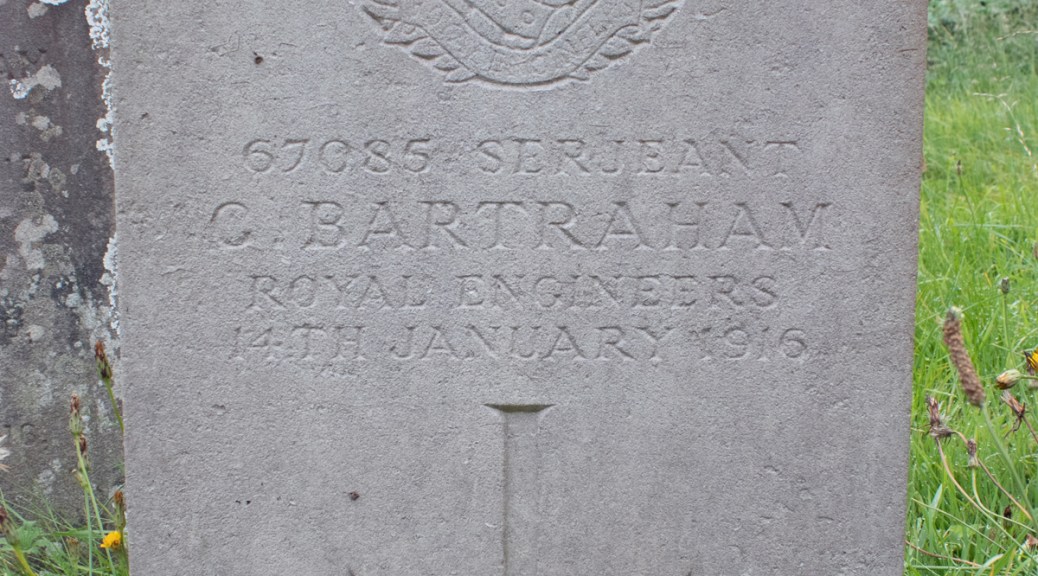
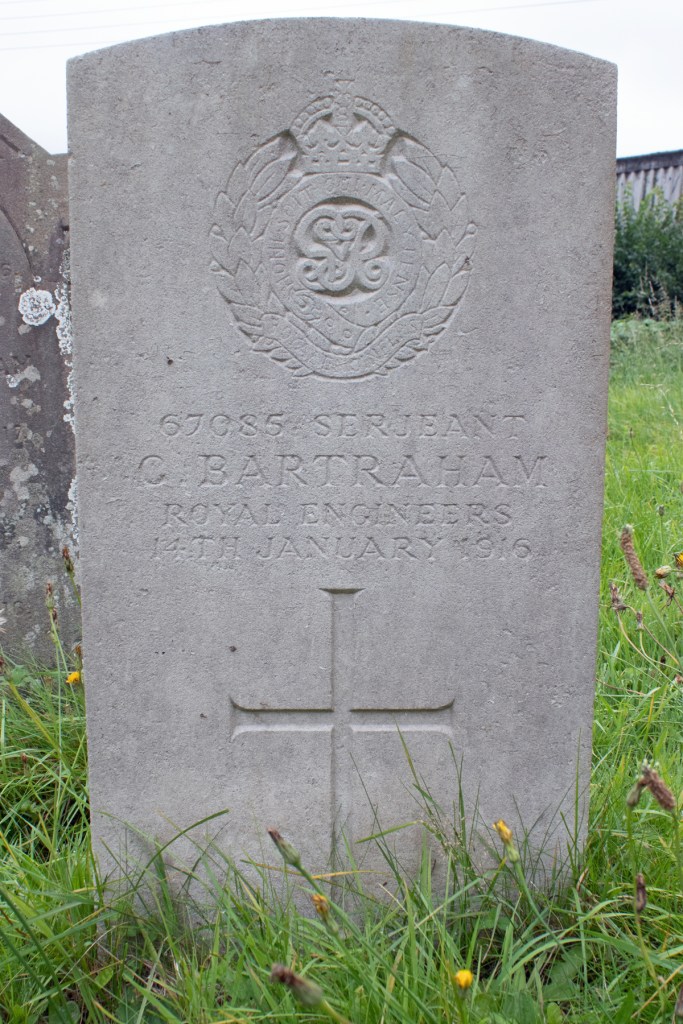
George Bartraham was born in the autumn of 1868 in the Somerset village of Sampford Brett. One of seven children, his parents were George and Sarah Bartraham. George Sr was a farm labourer and, while his son initially followed suit, he sought a life of adventure in the wilder world.
George Jr had found work as a tailor, and was apprenticed to a Charles Taylor, who lived in the village. That bigger and better life was niggling away, however, and, on 11th June 1888, he enlisted in the Royal Engineers. His service records show that he was 5ft 5.5ins (1.66m) tall, with black hair, dark eyes and a fair complexion. Sapper Bartraham was also noted as having a scar on his left foot.
George initially signed up for seven years’ service, with an additional 5 years on reserve status once that was completed. The 1891 census recorded him as being based at Fort Blockhorse in Alverstoke, Hampshire. Early in 1894, he married Mary Bowden, in Portsmouth: the couple would go on to have two children, George and Albert. The following year, Sapper Bartraham opted to remain on full service with the Royal Engineers, partially, it is fair to assume, as the pay would be better to support his family than on reserve.
By 1901, George had been moved to barracks in Pembroke Docks, Wales. Mary and the children remained in Hampshire, living with her parents in Unicorn Street, close to the town’s naval base. Wales was not to be the last stop for George, however, and in October 1902, he was sent to Ceylon, where he remained for the next three years.
During his time in the army, George did not sit on his laurels. He received a certificate as a master tailor, became skilled in submarine mining, and also received a qualification in signalling. He was promoted to Lance Corporal in 1899, and full Corporal four years later.
George returned to Britain in January 1906, and seems to have returned to a base in Hampshire. It was here, on 28th December 1908, that an altercation led to him being convicted of assault. He was charged with ‘unlawfully and maliciously wounding one Albert Edward Bartraham, by stabbing him with a pair of scissors, at Aldershot… and counts for assault occasioning actual bodily harm and common assault’ [Calendar of Prisoners, 1868-1929]
Albert was George’s older brother, and he was convicted to six months’ hard labour for the assault. Corporal Bartraham returned to base on 6th June 1909, and was discharged a few days later, having completed 21 years’ service in the Royal Engineers.
The next census record, taken in 1911, found a family divided by work or circumstance. Mary and the children remained firmly ensconced in Portsmouth with her parents, while George was living in Aldershot, where he was employed as a tailor. His employer is noted as being the Government, so it seems likely that he was still connected to the army camp there.
When war came to Europe, George was called upon to play his part once more. Promoted to the rank of Serjeant, he was attached to the 136th Fortress Company of the Royal Engineers. He arrived in Egypt in June 1915, although it is unclear how long he remained overseas.
By the start of 1916, Serjeant Bartraham was back in Britain, primarily because of ill health. He had come down with nephritis, or inflamed kidneys. Admitted to hospital in South London, he died from the condition on 14th January 1916, at the age of 47 years old.
Brought back to Somerset, George Bartraham was laid to rest in the peaceful graveyard of St George’s Church in the village of his birth, Sampford Brett.
This was a time of tragedy for the Bartraham family.
George’s father, George, had died around the same time as his son, and was buried near him.
George and Mary’s son, George, had enlisted in the Hampshire Regiment when war was declared and, by the summer of 1916, was based in Iraq. He died on 23rd September 1916, through causes unclear, and was laid to rest in Baghdad War Cemetery.
Three generations of Bartrahams, all called George, had passed away within nine months.
In the summer of 1917, Sarah Bartraham also passed away. She was laid to rest with her husband and son in St George’s Churchyard.
 Death and Service